Intro to psychology - basic processes: Chapter 6 - Learning
 Call Kai
 Learn
Learn Practice Test
 Spaced Repetition
 Match
Match Flashcards
 Knowt Play
1/137

There's no tags or description
Looks like no tags are added yet.
Name | Mastery | Learn | Test | Matching | Spaced | Call with Kai | Chat |
|---|
No analytics yet
Send a link to your students to track their progress
138 Terms
Learning (Environmental/Social Perspective)
The learning of connections or associations between events that occur in the environment, rather than a purely biological approach.
Phobias
Irrational fears of specific objects or situations
Why are phobias hard to get rid of?
Responses that allow you to avoid a phobic stimulus earn negative reinforcement each time they are made so the avoidance behaviour is strengthened and continues
Why are phobias hard to get rid of? (con’t)
Avoidance responses prevent any opportunity to extinguish the phobically conditioned response because you’re never exposed to the conditioned stimulus
e.g. Riding an elevator
Classical Conditioning (Pavlovian conditioning)
A type of learning when a stimulus that naturally elicits a response is paired with another stimulus that initially doesn’t elicit a response on its own
Ivan Pavlov
A Russian researcher who in 1903 initially observed and demonstrated the principles of classical conditioning while studying salivation in dogs.
Unconditioned Stimulus (UCS)
A stimulus that triggers a naturally occurring, unlearned, and biologically determined response, without previous conditioning
e.g. Meat powder
Unconditioned Response (UCR)
An unlearned reaction that occurs naturally in response to an unconditioned stimulus without previous conditioning
E.g. salivation
Neutral Stimulus (NS)
A stimulus that initially produces no response before any conditioning or pairing occurs.
E.g. A tone or bell,
Conditioned Stimulus (CS)
A previously neutral stimulus that has acquired the capacity to evoke a learned response via conditioning
e.g. A tone
Conditioned Response (CR)
A learned reaction to a conditioned stimulus that occurs because of previous conditioning.
Differences between conditioned and unconditioned responses
Conditioned responses are often weaker or less intense
e.g. If an animal is given a brief shock as a UCS, the unconditioned response is scrambling about and leaping, whereas the conditioned response when an animal is expecting shock tends to be immobility
Acquisition
The initial learning stage where associations or conditioning are formed over time.
Stimulus contiguity
Stimuli are contiguous if they occur together in time and space
Elicited
When a conditioned response is drawn fourth
Trial
Consists of any presentation of a stimulus or pair of stimuli
Stimulus Contiguity
The co-occurring in time or close association in time between the neutral stimulus and the unconditioned stimulus.
Extinction
The gradual weakening and disappearance of a conditioned response tendency when the conditioned stimulus is no longer paired with the unconditioned stimulus.
Cause of extinction
The consistent presentation of the conditioned stimulus alone, without the unconditioned stimulus
e.g. Pavlov consistently presented only the tone to a previously conditioned dog, the tone gradually lost its capacity to elicit the response of salivation
Spontaneous Recovery
The reappearance of an extinguished response after a period of non-exposure to the conditioned stimulus.
Classical conditioning and phobias
Case studies of patients suffering from phobias suggest that many irrational fears can be traced back to experiences that involve classical conditioning
e.g. Childhood experiences
Evaluative conditioning
Changes in the liking of a stimulus that result from pairing that stimulus with other positive or negative stimuli
Evaluative conditioning (con’t)
Involves the acquisition of likes and dislikes, or preferences, through classical conditioning
e.g. Funny cartoons paired with two types of energy drinks increased participants’ liking of the drinks
Renewal effect
If a response is extinguished in a different environment than it was acquired, the extinguished response will reappear if the subject is returned to the original environment where acquisition took place
Renewal effect (con’t)
Suggests that extinction somehow suppresses a conditioned response rather than erasing a learned association
e.g. If one manages to rid themselves of an unwanted conditioned response (such as cringing when you hear a dental drill), there is an excellent chance that it may make a surprise reappearance later.
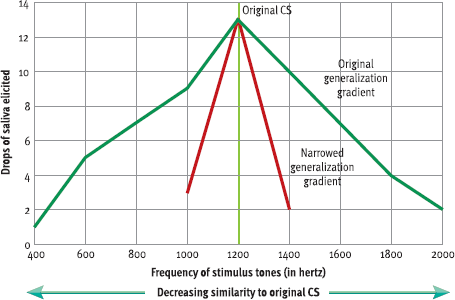
Stimulus Generalization
An adaptive phenomenon where an organism that has learned a response to a specific stimulus responds in the same way to a new stimulus that is similar to the original stimulus.
e.g. Conditioned fear of a stimulus environment where panic occurs (e.g. a specific shopping mall) readily generalizes to similar stimulus situations (all shopping malls)
Generalization Gradient (Stimulus Generalization law)
The principle states that the more similar a new stimulus is to the original, the more generalizability occurs,
The less similar they are, the less generalizability occurs.
John Watson
The researcher who conducted experiments on Little Albert to demonstrate how a fear response could be generalized to various white objects.
Stimulus discrimination
Occurs when an organism that has learned a response to a specific stimulus does not respond in the same way to new stimuli that are similar to the original stimulus
e.g. If there’s anything distinctive about the sound of your car, your dog may gradually respond with excitement to only your car and not to other cars
Stimulus discrimination (con’t)
A process where organisms or animals can distinguish between one stimulus and another, occurring with greater likelihood when the neutral stimulus is less similar to the conditioned stimulus.
e.g. Being able to distinguish friend from foe, or edible from poisonous food
Higher order conditioning
A process that occurs when a learned conditioned stimulus is paired with a new neutral stimulus until that neutral stimulus also produces the conditioned response.
Higher order conditioning (con’t)
When a conditioned stimulus functions as if it were an unconditioned stimulus
e.g. When a dog salivates at the sight of a red light instead of a previously established bell ringing
Higher order conditioning (III)
Shows that classical conditioning doesn’t depend on the presence of a genuine, natural UCS; an already established CS will do just fine.
Conditioned taste aversions
Rapid learning and slow extinction of food or drink avoidance after a single pairing or trial, often suspected to have biological or evolutionary underpinnings.
Evolved module for fear learning
An instinctual survival mechanism that allows for the rapid acquisition and difficult extinction of phobias related to elements like spiders, snakes, heights, and darkness.
Amygdala
The part of the underlying neural circuitry associated with the fear module in classical conditioning.
John Watson (con’t)
The psychologist who produced the study with little Albert to demonstrate a learned fearful response to white objects.
Stimulus generalization (II)
The transfer of learning from a conditioned stimulus to another similar object
Classical Conditioning (con’t)
A learning process controlled by stimuli that precede a response, regulated by reflexive and involuntary responses and built upon biologically based associations.
Environmental stimuli and conditioning
Environmental stimuli serve as signals and that some stimuli are better, or more dependable, signals than others
Signal relations in classical conditioning
CS–UCS relations that influence whether a CS is a good signal
Signal relations in classical conditioning (con’t)
A “good” signal is one that allows accurate prediction of the UCS
Conditioned taste aversion (con’t)
When the act of thinking about a food that made a person sick causes that person to feel sick
e.g. Nausea, vomiting
Conditioned taste aversion (III)
May be a by-product of the evolutionary history of mammals as natural selection will favour organisms that quickly learn what not to eat
Preparedness
Involves a species-specific predisposition to be conditioned in certain ways and not others
Preparedness (con’t)
Can explain why certain phobias are vastly more common than others, as evolutionary forces gradually programmed humans to acquire conditioned fears of them
Evolved module for fear learning
Preferentially activated by stimuli related to survival threats in evolutionary history,
Automatically activated by these stimuli,
Relatively resistant to conscious efforts to suppress the resulting fears,
Dependent on neural circuitry running through the amygdala.
Operant Conditioning (instrumental learning)
A form of learning in which voluntary responses come to be controlled by their consequences.
Thorndike's Law of Effect
The observation that if a response in the presence of a stimulus leads to a satisfying effect, the association between the stimulus and response is likely to be strengthened.
Skinner's Principle of Reinforcement
The concept that organisms tend to repeat responses that are followed by favorable consequences.
Reinforcement
Occurs when an event following a response increases an organism's tendency to make that response.
Primary Reinforcers
A limited number of events that are inherently reinforcing because they satisfy biological needs
e.g. Food or certain drugs.
Secondary (Conditioned) Reinforcers
Events that acquire reinforcing qualities by being associated with primary reinforcers
e.g. Money, attention, flattery, praise, etc
Reinforcement contingencies
Circumstances or rules that determine whether responses lead to the presentation of reinforcers
Operant chamber/Skinner box
A small enclosure in which an animal can make a specific response that is recorded while the consequences of the response are systematically controlled
Operant chamber/Skinner box (con’t)
Permits the experimenter to control the reinforcement contingencies that are in effect for the animal, where the experimenter manipulates whether positive consequences occur when the animal makes the designated response
Cumulative recorder
Creates a graphic record of responding and reinforcement in a Skinner box as a function of time by means of a roll of paper that moves at a steady rate underneath a movable pen
Slope
The representation of the key consideration
Slope (con’t)
A rapid response rate produces a steep slope
A slow response rate produces a shallow slope.
Acquisition (con’t)
Associations are built between a reinforcer and a response.
Acquisition (III)
The procedures used to establish a tendency to emit an operant response are different from those used to create the typical conditioned response
Shaping
The reinforcement of closer and closer approximations of a desired response, often used to train complex behaviors.
Shaping (con’t)
Is necessary when an organism doesn’t emit the desired response on its own
e.g. When a rat’s first placed in a Skinner box, it may not press the lever at all until an experimenter begins shaping by releasing food pellets whenever the rat moves toward the lever.
Extinction
The gradual weakening and disappearance of a response tendency because the response is no longer followed by a reinforcer and previously available reinforcement is stopped
Resistance to Extinction
When a learned response continues even after the reinforcer is no longer presented.
Resistance to Extinction (con’t)
The greater the resistance to extinction, the longer the response will continue
e.g. If a researcher stops giving reinforcement for lever pressing and the response tapers off slowly, the response shows high resistance to extinction, and vice versa
Stimulus Generalization (III)
A process where similar cues produce the same learned response.
Stimulus Discrimination
The ability to distinguish between different cues so that a specific learned response is not produced by a different stimulus.
e.g. When pigeons quickly learn to peck a disk only when it is lit because doing so will lead to a reward
Continuous Reinforcement
A schedule where reinforcement occurs every time the designated response takes place.
Intermittent (Partial) Reinforcement
A schedule where a response is reinforced only some of the time, typically resulting in greater resistance to extinction.
Reinforcement and superstitious behaviour
Reinforcement is most likely accidental, but has no real impact on the probability of receiving a reward
e.g. Wearing a special pair of socks, eating the same lunch, going through special rituals, and so on, to enhance their chances of success
Reinforcement and superstitious behaviour (con’t)
Is relied on more when the challenge level increases
Fixed Ratio (FR) Schedule
A schedule where reinforcement is given after a set number of non-reinforced responses,
e.g. Being paid for every 100 items produced.
Variable Ratio (VR) Schedule
A schedule where reinforcement is given after a random or unknown number of responses, such as with a slot machine.
e.g. A rat is reinforced for every tenth lever press on the average.
Interval Schedule
Requires a time period to pass between the presentation of reinforcers
Fixed Interval Schedule
A schedule where reinforcement is given for the first response that occurs after a specific, set amount of time has elapsed.
e.g. A rat is reinforced for the first lever press after a two-minute interval has elapsed and then must wait two minutes before being able to earn the next reinforcement
Variable Interval Schedule
A schedule where reinforcement is given for the first response after an unpredictable amount of time has passed.
e.g.A person repeatedly dials a busy phone number (getting through is the reinforcer).
Schedule of reinforcement
Determines which occurrences of a specific response result in the presentation of a reinforcer
Continuous reinforcement
Occurs when every instance of a designated response is reinforced
Intermittent, or partial, reinforcement
Occurs when a designated response is reinforced only some of the time
Intermittent, or partial, reinforcement (con’t)
Makes a response more resistant to extinction
Positive Reinforcement
Strengthening a response by increasing the tendency to perform a behavior through the presentation of a rewarding stimulus.
e.g .Getting a cookie after doing chores
Negative Reinforcement
Strengthening a response by increasing the tendency to perform a behaviour through the removal of an aversive or unpleasant stimulus
e.g. Showering daily to avoid smelling bad
Punishment
When an event following a response weakens the tendency to make that response
Positive Punishment
Weakening a response by presenting an aversive stimulus to decrease a behaviour.
e.g. Spanking
Negative Punishment
Weakening a response by removing a rewarding stimulus to decrease a behaviour.
e.g. taking away a video game,
Side effects of physical punishment
Slowed cognitive development, increases in criminal behaviour, and a wide range of mental health problems
Learning
In psychology, a long-term change in behavior that's based on experience.
Escape learning
An organism acquires a response that decreases or ends some aversive stimulation
e.g. An animal learns to escape the shock by running to a compartment that has no electrical shocks
Avoidance learning
An organism acquires a response that prevents some aversive stimulation from occurring
e.g. An experimenter gives an animal a light signal that a shock is forthcoming a few seconds before the shock, and the animal learns to run as soon as the light comes on
Avoidance learning and phobias
Phobias are acquired through classical conditioning.
e.g. If someone developed an elevator phobia due to being paired with a frightening event, they’ll take the stairs as an avoidance response
Latent learning
Learning that is not apparent from behaviour when it first occurs.
i.e. Learning can take place in the absence of reinforcement
Classical Conditioning (III)
Was discovered by Ivan Pavlov, where a previously neutral stimulus is paired with an unconditioned stimulus to elicit a learned response.
Instinctive drift
When an animal’s innate response tendencies interfere with conditioning processes.
e.g. Bringing out raccoons’ innate food-washing behaviour by associating coins with food
The laws of learning across various species
Basic mechanisms of learning are similar across species but they’ve sometimes been modified in the course of evolution as species have adapted to the specialized demands of their environments
Response–outcome relations and reinforcement
Reinforcement is not automatic when favourable consequences follow a response
Response–outcome relations and reinforcement (con’t)
When a response is followed by a desirable outcome, the response is more likely to be strengthened if one thinks that the response caused the outcome.
Operant Conditioning (con’t)
Explains how consequences lead to changes in voluntary behavior.
Reinforcers
Components in operant conditioning that make it more likely that a behavior will be repeated.
Punishers
Components in operant conditioning that make it less likely that a behavior will be repeated.