Respiratory Acid-Base Balance (Week 3, Mod 9)
 Call Kai
 Learn
Learn Practice Test
 Spaced Repetition
 Match
Match Flashcards
 Knowt Play
1/21

There's no tags or description
Looks like no tags are added yet.
Name | Mastery | Learn | Test | Matching | Spaced | Call with Kai | Chat |
|---|
No analytics yet
Send a link to your students to track their progress
22 Terms
Why is pH so important in the body? Think of 2 main reasons.
Enzyme reactions are pH sensitive and have and optimum pH range
Optimum function requires strict regulation of ionic composition of body fluids
Serious deviations outside the normal range can disrupt cell metabolism and body function.
What is the normal range for the pH of arterial blood? What is it called when the pH goes higher or lower than this normal range?
Normal range:
7.35 - 7.45
Below range = ACIDOSIS
Above range = ALKALOSIS
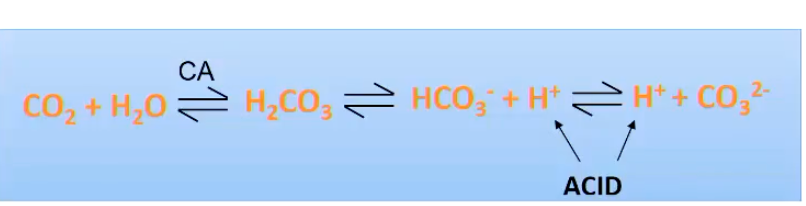
How does CO2 contribute to / change the pH of arterial blood?
Increase CO2 = DECREASE in pH
makes it more acidic
Remember, the dissolving of CO2 on an aqueous solution results in more free H+ ions in the body (see image)
How does the body maintain a relatively stable pH as CO2 is produced in the body?
BUFFERS
Substances that reversibly bind H+ ions
Prevents them from changing the pH of blood
What is the MOST important buffer system, and how does it work?
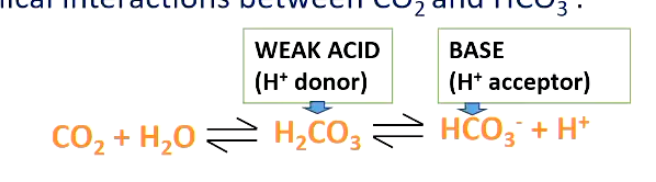
The CO2/HCO3- buffer system
Bicarbonate acts as a H+ acceptor (see image) for the weak acid, carbonic acid
Large amount of HCO3-, in the blood (24mM/L)
so can buffer a lot
Reactions are reversible so dependent on what's on each
side of the equation
for example, if you were to add more H+ ions using a stronger acid (ie. HCl), the equation would then move right to left, as bicarbonate buffers what it can while producing more CO2 and H2O
What is another buffer that assists in taking up H+ ions? (think about the different ways that CO2 is moved around the body…)
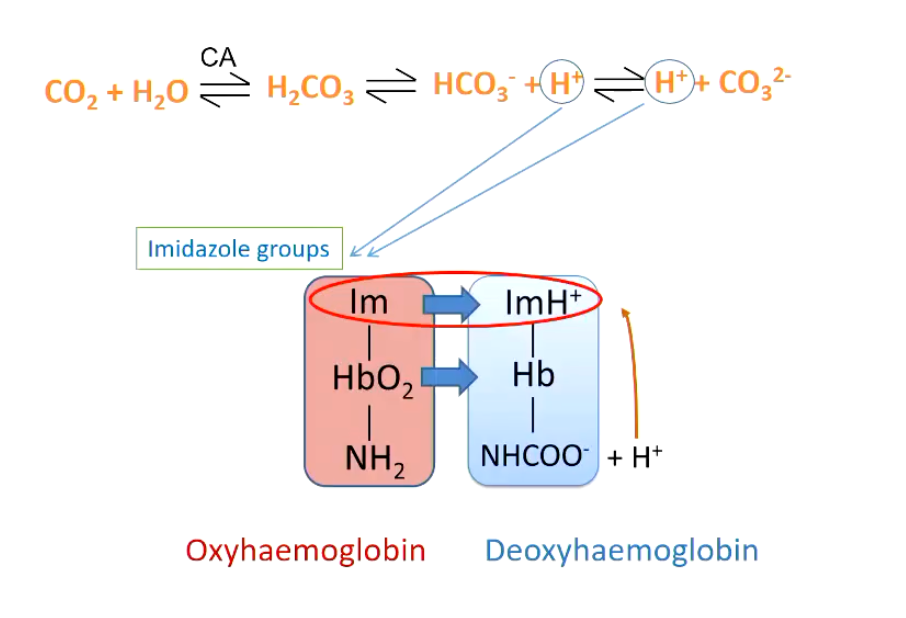
Hemoglobin
Can carry an H+ ion on the Imidazole group of the protein unit (see image)
How do cells also act as H+ buffers?
Cell metabolism continuously produces H+ (acid load)
Intracellular pH (pHi) must then be tightly regulated
Has to balance between a system of acid loaders ( DECREASE pHi) and acid extruders (INCREASE pHi)
Main buffering system involves bicarbonate (HCO3-)
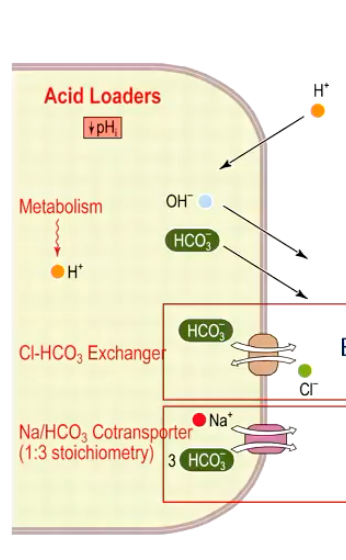
What are the 2 different mechanisms for “acid loading” in a cell? What is the overall net effect?
Net effect: increased intracellular H+ and decreased pHi
Mechanisms:
Cl - HCO3 exchanger
Na/HCO3 cotransporter (see image); favors bicarbonate eflux
Essentially: EXPORTING BICARBONATE → loss of base in the cell
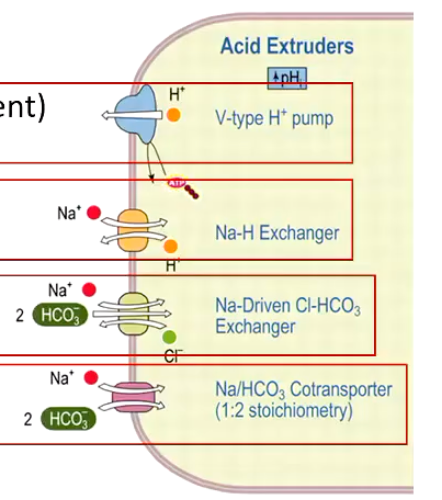
What are the 2 different mechanisms for “acid extruding” in a cell? What is the overall net effect?
Net effect: DECREASING intracellular pH and INCREASING pHi
Mechanisms:
V-type H+ pump → actively pumps out H+ (ATP dependent)
Na-H exchanger → removes H+ in exchange for Na
Na-driven Cl-HCO3 exchanger → IMPORTS bicarbonate
Na/HCO3 Cotransporter → promotes HCO3 influx
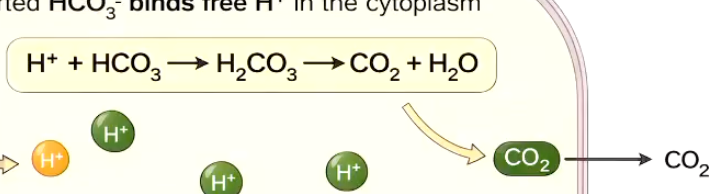
What is happening WITHIN the cell when there is excess H+ ions in the body?
INTRACELLULAR BICARBONATE ACTS AS A BUFFER
H+ ions go in, and are buffered by bicarbonate
Produces CO2, which then diffuses out of the cell and into the blood to be brought to the lungs and exhaled
Links cellular buffering to ventilation and gas exchange
Though blood buffers are the first line of defense for maintaining blood pH, what are the 2 main regulators of pH in the body?
Lungs
Kidneys
How do changes in ventilation alter pH?
Hypoventilation: not breathing enough…
PACO2 increases
Leads to hypercapnia
Acidosis (DECREASED pH)
Hyperventilation: breathing too much…
PACO2 decreases
Leads to hypocapnia
Alkalosis (INCREASED pH)
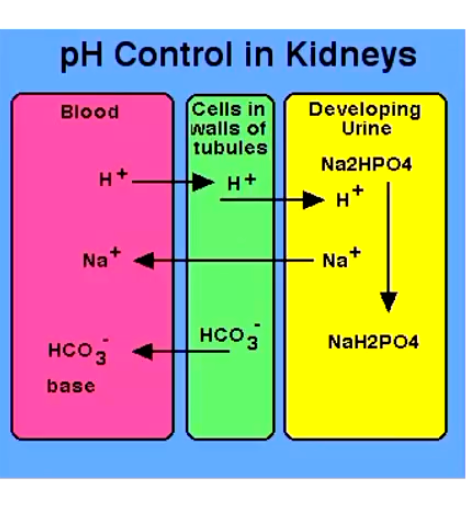
How do the kidneys function in acid/base balance?
The kidneys are the ONLY route through which H+ ions can be ELIMINATED from the body
H+ excretion occurs in the PCT and is coupled to reabsorption of HCO3
H+ ions are secreted into the tubular lumen in exchange for Na+
Na+ and HCO3 are reabsorbed
Describe the Henderson-Hasselbach equation…
Changing the [HCO3] without changing the partial pressure of CO2 will show a change in pH… and vis versa
These values are determined by the kidney’s level of reabsorption of HCO3 and by the ventilation of the lungs (PCO2)
** solubility coefficient and pK are constant
For pH to remain normal (7.4) the ratio between bicarbonate and PCO2 needs to be 20:1
![<p>Changing the [HCO<sub>3</sub>] without changing the partial pressure of CO2 will show a change in pH… and vis versa</p><ul><li><p>These values are determined by the kidney’s level of reabsorption of HCO<sub>3</sub> and by the ventilation of the lungs (PCO2)</p></li></ul><p></p><p>** solubility coefficient and pK are constant </p><p></p><p>For pH to remain normal (7.4) the ratio between bicarbonate and PCO2 needs to be <strong>20:1</strong></p><p></p>](https://knowt-user-attachments.s3.amazonaws.com/edd53e4e-ef28-4a1b-9a80-3d96fc80fb29.png)
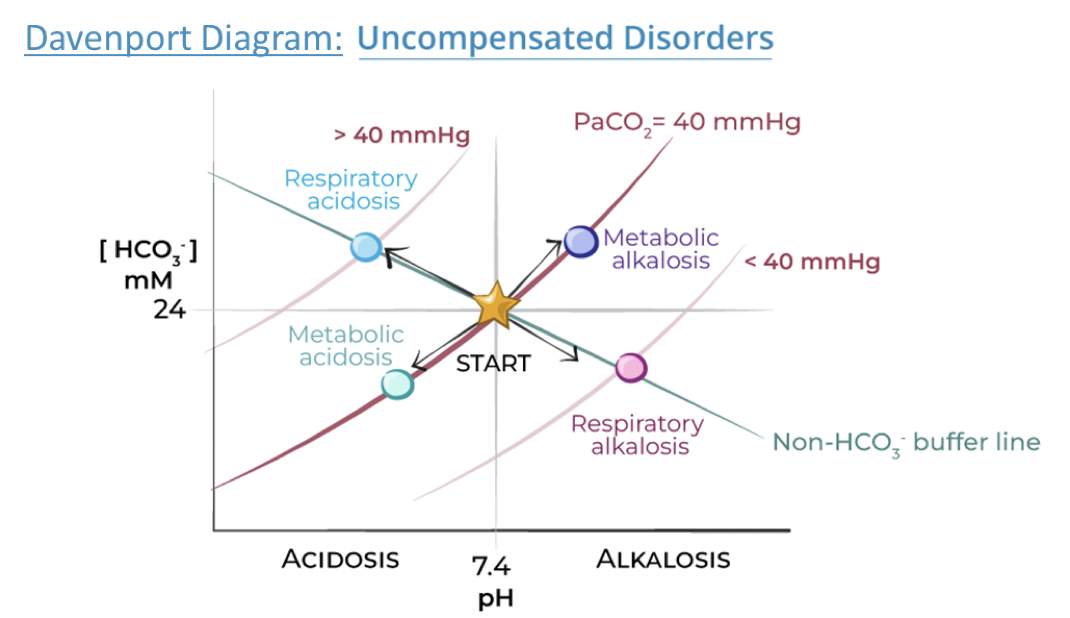
Attempt to interpret this Davenport Diagram… how does this illustrate the link between respiratory partial pressure of CO2 and the metabolic (kidney) bicarbonate components in acid-base balance?
Can see the PaCO2 representation at those three curved lines… middle one represents normal PaCO2 at 40 mmHg
Green line represents the HCO3 concentration essentially
STAR = equilibrium between lungs and kidneys (normal pH 7.4, HCO3 24mmol/L, PaCO2 40mmg)
BLUE CIRCLE = Uncompensated respiratory acidosis (hypoventilation) immediate buffering causes small rise in HCO3 (renal compensation will pH back to normal, PCO2 remains elevated)
PINK CIRCLE = Uncompensated respiratory alkalosis (hyperventilation) immediate buffering causes small fall in PHCO3 (reduced renal H+ secretion, pH back to normal, PCO2 remains low)
GREEN CIRCLE = Metabolic acidosis reduction in HCO3- concentration (kidneys conserve HCO3, eliminate H+ in urine), pH back to normal, PCO2 unaffected- compensation hyperventilation)
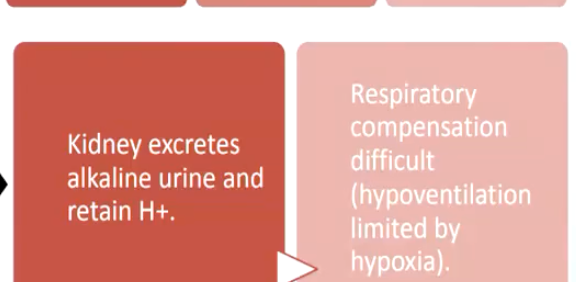
PURPLE CIRCLE = Metabolic alkalosis increase in HCO3- concentration due to loss of Cl- ions/excess sodium bicarbonate ingestion (kidneys conserve H+, eliminate HCO3 in alkaline urine), pH back to normal, PCO2 unaffected- compensation hypoventilation-difficult...WHY?
In most diseases, the lungs and the kidney are able to keep pH normal… what are two instances in which the pH of an individual would then be affected?
1. Excessive accumulation or elimination of CO2 (RESPIRATORY ABNORMALITIES)
2. Excessive accumulation or elimination of fixed acids or buffer bases
(METABOLIC ABNORMALITIES)
What process do acid-base disturbances affect in particular? Why is this? hint: Think about how CELLS help to buffer acid levels… how do they maintain their balance?
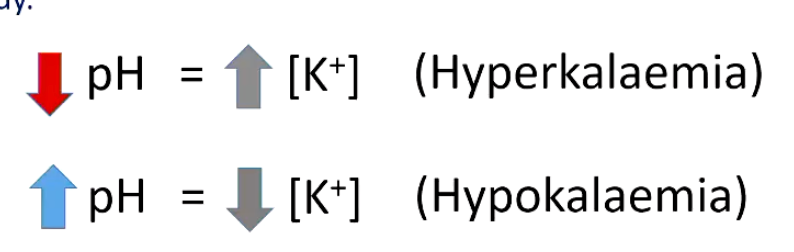
Acid base disturbances affect distribution of K+ within the body
Acidosis causes K* to move from cells to extracellular fluid (plasma) in exchange for hydrogen ions, and alkalosis causes the reverse movement of K+ and H+ ions
Cl- depletion can also maintain a metabolic alkalosis (eg after vomiting has stopped)
because in absence of Cl- , kidney must reabsorb HCO3 with Na+ to maintain electroneutrality
BAD; with alkalosis, you don’t want to REABSORB bases, you’d want to excrete them… but because of the change in electricity from the loss of Cl-, your body has no other choice
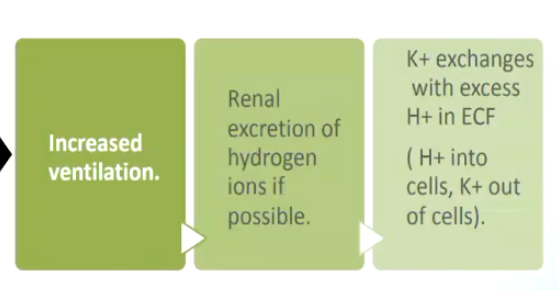
What are 4 possible respiratory causes of acidosis? How does the body compensate?
CNS depression (anaesthesia).
Resp. muscle paralysis/ diaphragm paralysis, rib fractures, etc..
Obstructive lung diseases e.g. Emphysema.
Pulmonary edema
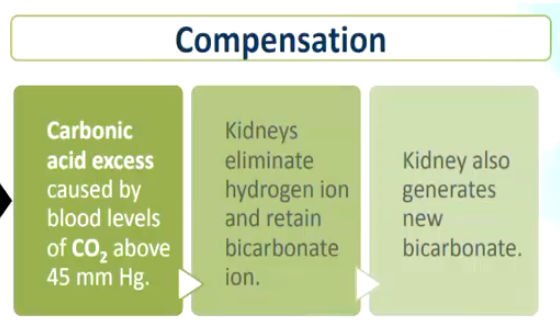
What are 5 possible metabolic causes of acidosis? How does the body compensate?
Bicarbonate deficit: blood conc. of HCO3- drops below 22mEq/L
• Diabetic ketoacidosis.
• Severe diarrhea. (loss of HCO3).
• Hypoaldosteronism.
• Acute renal failure (fail to excrete H+).
Accumulation of acids.
What are 5 possible respiratory causes of alkalosis? How does the body compensate?
Carbonic acid deficit: pCO, is < 35mmHg (hypocapnea).
Most common acid base imbalance.
• Hyperventilation
• High altitude (Oxygen deficiency).
• Hysterical.
• Anorexia nervosa.
• Early salicylate intoxication.
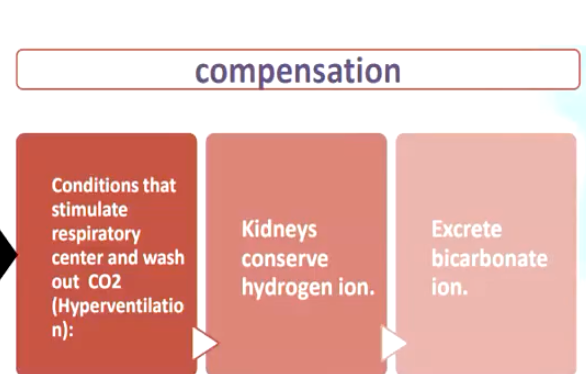
What are 4 possible metabolic causes of alkalosis? How does the body compensate?
Blood conc. Of HCO3 is > 26mEq/L.
• Severe vomiting = loss of stomach acid or heavy ingestion of antacids.
• Severe dehydration.
• Excess antacids & alkaline drugs.
• Hyperaldosteronism (endocrine disorders).