9 - Investigating pH changes
 Call Kai
 Learn
Learn Practice Test
 Spaced Repetition
 Match
Match Flashcards
 Knowt Play
1/6

There's no tags or description
Looks like no tags are added yet.
Name | Mastery | Learn | Test | Matching | Spaced | Call with Kai | Chat |
|---|
No analytics yet
Send a link to your students to track their progress
7 Terms
What is an acid & what is a base?
Acid: proton donor
Base: proton acceptor
What is an alkali?
A base that dissolves in water
Why are acid-base indicators used?
To detect when a reaction reaches completion/becomes neutral, usually by the presence of a colour change
Why does a pH probe need to be calibrated?
So that the pH values for each pH reading are accurate
What is the method to calibrating a pH probe?
Rinse the pH probe thoroughly with distilled water & shake gently to remove excess water
Place the probe in standard pH 7.00 buffer solution & record the pH reading
Repeat this process using standard pH 4.00 & pH 9.00 buffer solutions & record the pH readings
Plot a graph of the recorded pH readings (x-axis) against the pH of the buffer solution (y-axis) → should be a curve
What is the method to measuring pH using an acid-alkali mixture?
Rinse a burette with 0.100moldm-3 ethanoic acid solution & then fill the burette with this solution (label this burette)
Use the burette to transfer 20cm3 of ethanoic acid to a clean 100cm3 beaker
Rinse a second burette with 0.1moldm-3 NaOH solution & then fill this second burette with this solution (label this burette)
Rinse the pH probe with distilled water & clamp it so that its bulb is immersed in the ethanoic acid solution in the beaker
Use a rod to stir the solution & record the pH reading in a table
Add 2cm3 of NaOH solution from the burette at a time. Stir the solution & record the pH alongside the volume of NaOH added
When the end-point is nearly reached, add 0.2cm3 of NaOH each time. Stir the solution & record the pH alongside the volume of NaOH added
After this, continue adding 2cm3 NaOH until it’s in excess. Stir the solution & record the pH alongside the volume of NaOH added
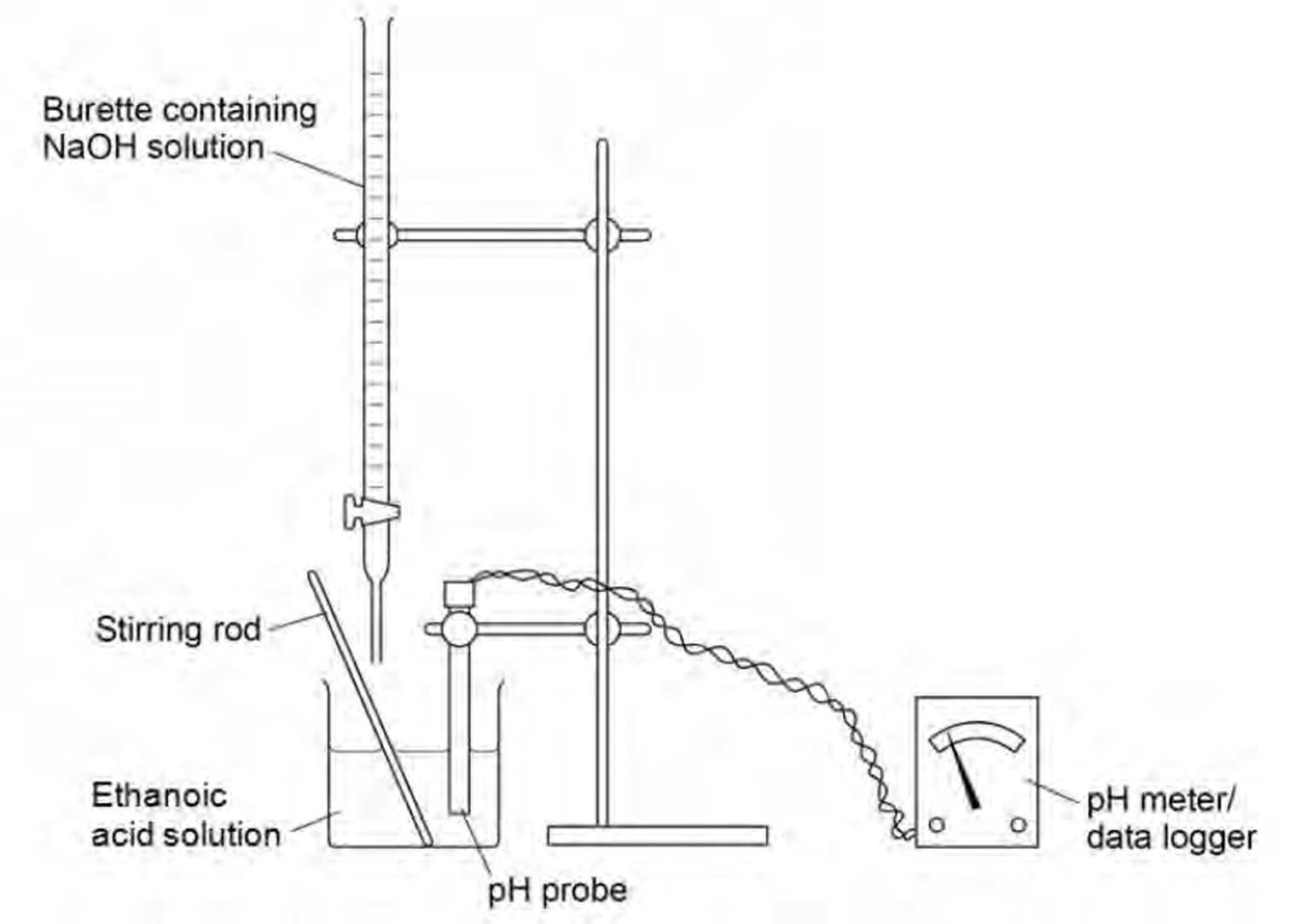
Why is it important to stir the resulting solution?
Ensures that all of the acid & base is thoroughly mixed, so the pH doesn’t significantly vary throughout the solution, as this would give an inaccurate reading