Sports Science topic C
 Call Kai
 Learn
Learn Practice Test
 Spaced Repetition
 Match
Match Flashcards
 Knowt Play
1/30

Earn XP
Description and Tags
31 Terms
Define personality
Enduring patterns of thinking, feeling and behaving shaped by genetic and environmental factors
Difference between a trait and a state
Trait refers to consistent characteristics across situations whereas state is temporary and a pattern influenced by context
Self efficacy
Belief in ones ability to succeed in a specific task
Mental toughness
A psychological disposition that helps athletes cope with challenging and pressurized situations through self belief, determination and resilience.
Skill vs ability
A skill is a learnt action directed at achieving a predetermined goal with maximum certainty and minimal effort whereas ability refers to the innate trait (born with it) that enables skill performance
Motivation
The direction and intensity of an effort
Intrinsic motivation
Performing an activity for internal satisfaction, fun, or improvement
What is a stressor
A trigger that causes psychological strain, can be positive or negative
Arousal
A state of physical and psychological activation
Imagery
A mental experience that mimics real experience using multiple senses without actual perception
Mastery climate
A motivational environment focused on personal growth, effort and improvement
Open loop vs closed loop learning
Open loop is fast with NO feedback during action where as closed loop is slower and feedback dependent. Step by step
Is external or internal focus of attention better for skill learning and performance
External is better
Difference between internal and external focus
Internal- Attention directed to how body is moving “Swing your arm faster” Can lead to overthinking and muscular strain
External- Attention directed to effect of movement on outcome “Snap the racket through the ball” Makes a smooth movement and more automatic
Self determination theory key idea and continuum
There are 3 core needs that support well being:
Autonomy
Competence
Relatedness
people are more motivated and healthier psychologically when they feel choice and control (autonomy), feel capable (competence), and feel connected to others (relatedness).
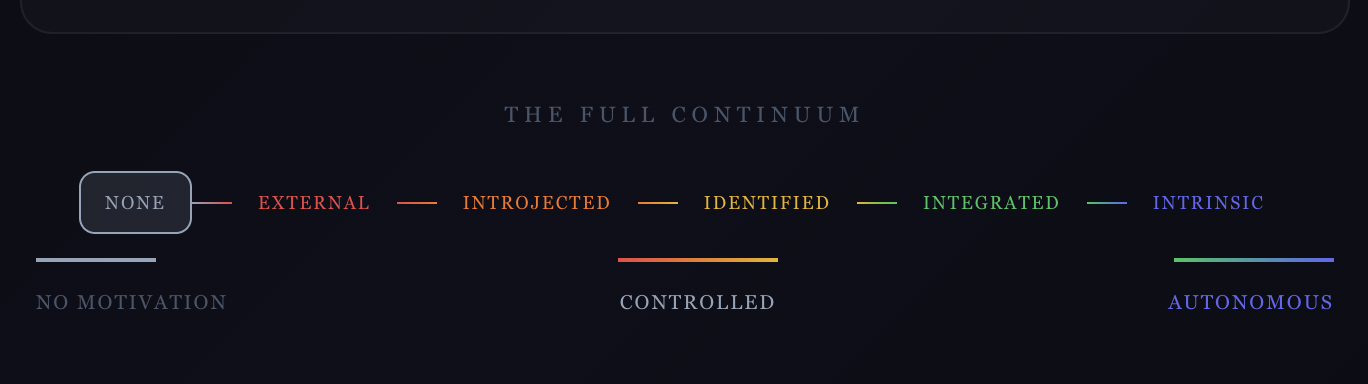
It presents a SDT continuum with 6 types of motivation:
Amotivation- no intention or motivation
External- driven by rewards or punishment “I do it for reward/ punishment”
Introjected- Driven by shame or ego,“I do it because of guilt”
Identified- Done because person sees value it “I do it because I value it”
Integrated- Behaviour is fully accepted as a part of persons identity“I do it because it is a part of who I am”
Intrinsic- Done for enjoyment “I do it because I enjoy it”
According to inverted U theory and catastrophe theory what is optimal arousal and when can it collapse
Moderate arousal is optimal and may suddenly collapse is cognitive and somatic anxiety are both high
Coping types, features
Problem focused coping- Deals with source of stress, used in controllable situations like practicing to fix a weakness
Emotion focused coping- Aims to change feelings caused by stress, helps reduce anxiety and includes things like breathing exercises and imagery
Avoidance focused coping- Aims to ignore stressor, can include distractions and denial, can help short term but doesnt solve problem
Types of goal
Outcome (norm-reference)- focus on results compared with other people
Performance (self reference)- focus on own self standard
Process (technique/strategy)- Focus on how they perform themselves (skills or tactics used)
Self efficacy vs self esteem
Self efficacy is task specific where as self esteem is the global sense of self
What does PETTLEP stand for and what does it do
PETTLEP = how to do imagery (structure/realism)
Physical (include body position/kit),
Environment (imagine the real setting),
Task (match the exact skill),
Timing (real speed),
Learning (adapt imagery to skill level/stage of learning),
Emotion (include the feelings/arousal),
Perspective (internal or external view).
Types and subtypes of imagery
There is cognitive imagery and motivational imagery.
Cognitive:
Cognitive specific- rehearsing skill or movement
Cognitive general- Rehearsing plans or tactics
Motivational:
Motivational specific- goal achievement
Motivational general- confidence and focus
Mental toughness vs resilience
MT= proactive psychological disposition
Resilience = positive adaptation AFTER adversity. MT enhances resilience
task vs ego orientation
Task orientation focuses on personal improvement and skill mastery, while ego orientation emphasizes winning and outperforming others. Task-oriented individuals are motivated by self-referenced standards, whereas ego-oriented individuals gauge success by comparing themselves with others.
Nicholls task(self ref) vs ego orientation (norm ref)
High ego + low ability = dropout/anxiety risk
Relaxation and how to cope
It is an active composure skill and NOT just turning off, in order to cope effectively it has to be matched to the controllability of stressor
Skil to skill vs ability to skill
Skill to skill- Most common type, a skill developed in one sport context influences a skill in another context (ie a tennis player using overarm serve for volleyball serve
Ability to skill- When an innate trait, is applied to a specific motor task (ie having high natural coordination helping a gymnast learn a routine)
State to stage vs principle to skill
Stage to stage- Process of going through 3 stages of learning (cognitive, associative, autonomous)
Principle to skill- Understanding of a certain concept applied to execution of skill
Ecological systems theory
Suggests that learning isn't just about a coach telling you what to do; it’s about how you, as an "organism," interact with your environment to find solutions.
Learning is driven by the interaction of 3 main constraints:
Task- Rules of activity ie size of team or ball
Environment- World around athlete, ie light, crowd
Individual- Internal to athlete ie height, weight, motivation
Perception coupling theory
Explains the relationship between what you see and what you do. In this theory, you cannot separate the two.
The Concept: Perception (seeing the ball's flight) and Action (moving your hand to catch it) are "coupled" or looped together. You don't process the data, stop, and then move; you move as you perceive.
Example: A goalkeeper doesn't calculate the math of a ball's trajectory. They constantly adjust their body position based on the "information" they are picking up from the ball's movement in real-time.
Affordance in motor learning
These are the opportunities for action provided by the environment.
The Concept: Everything in your environment "invites" you to do something. An affordance is what a surface, object, or person offers the athlete.
Example: For a professional basketball player, a 10-foot hoop "affords" a dunk. For a toddler, that same hoop does not. A gap between two defenders "affords" a pass.
Whats the purpose of goal setting
Directs attention to specific tasks
Increases persistence
Enhances motivation