immuno VDJ Recombination and Ig/TCR Diversity
 Call Kai
 Learn
Learn Practice Test
 Spaced Repetition
 Match
Match Flashcards
 Knowt Play
 Podcast
1/43

Earn XP
Description and Tags
Vocabulary practice covering the molecular mechanisms of VDJ recombination, genetic loci for immunoglobulins and T-cell receptors, and class switch recombination.
Name | Mastery | Learn | Test | Matching | Spaced | Call with Kai | Chat |
|---|
No analytics yet
Send a link to your students to track their progress
44 Terms
Innate Immunity
A genetic program characterized by germline-coded genes and Pattern Recognition Receptors (PRRs) found on all nucleated cells.
Adaptive Immunity
A genetic program utilizing recombined genes to produce antigen (Ag) receptors on B cells and T cells.
PAMP
Pathogen-Associated Molecular Pattern; recognized by the innate immune system.
Somatic Recombination
The process by which gene segments in germline DNA are rearranged to generate unique antigen receptor genes.
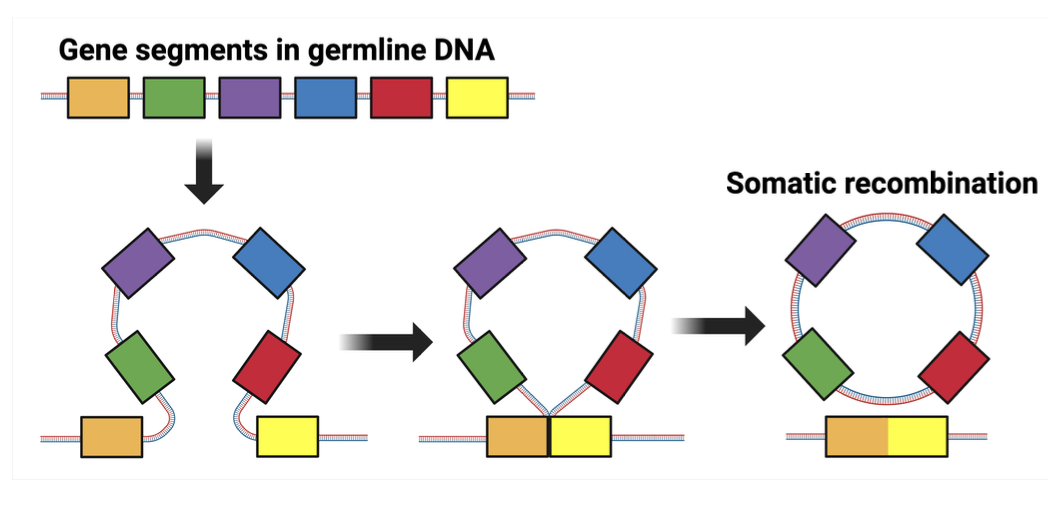
Are there more Ag receptors or genes in the human body
Ag receptors
λ light-chain locus
Located on Chromosome 22, encoding Vλ, Jλ, and Cλ segments.
What is the purpose of rearrangment of gene segments
To produce combinatoial diversity downstream
κ light-chain locus
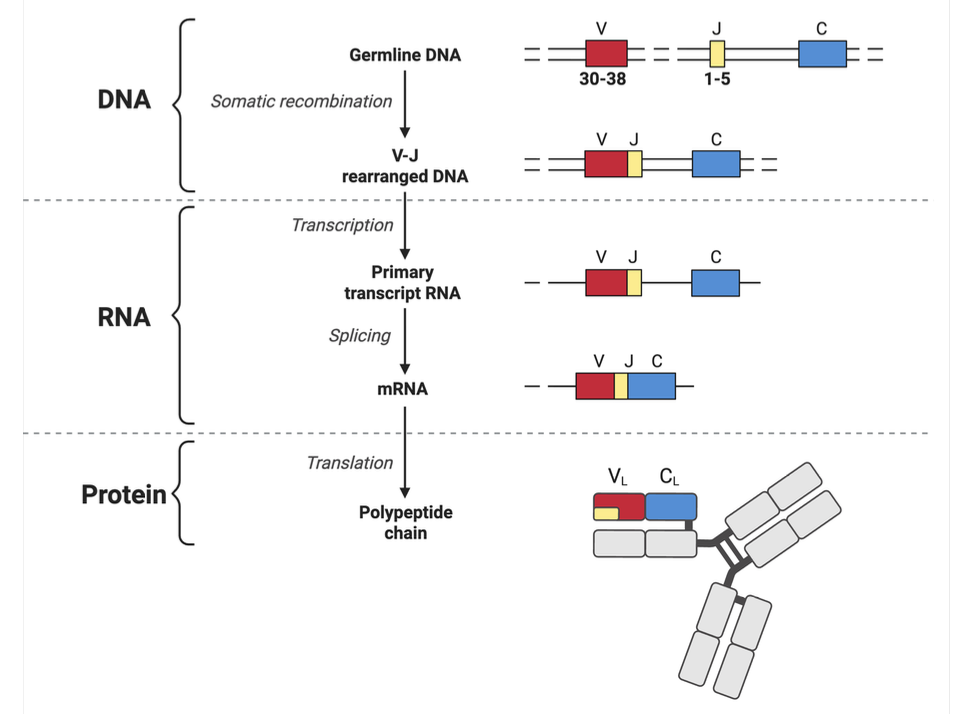
Located on Chromosome 2, encoding Vκ, Jκ, and Cκ segments.
Where are the Ig light chains V and J segments encoded
in the κ and λ light-chain loci
What does the V/J combination encode for
Variable Light region of the immunoglobulin light chain.
recombination of Ig light chains
involves the permanent somatic recombination of V, J segments to produce diverse antibodies.
Heavy-chain locus
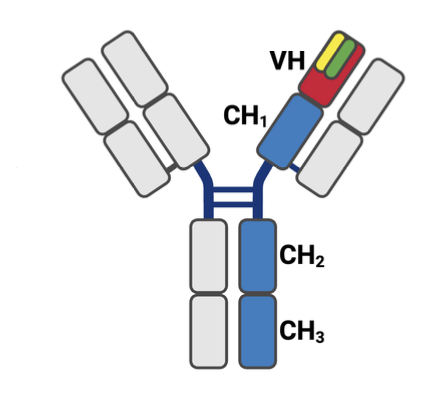
Located on Chromosome 14, containing VH, DH, and JH gene segments.
Recombination of Ig heavy chains
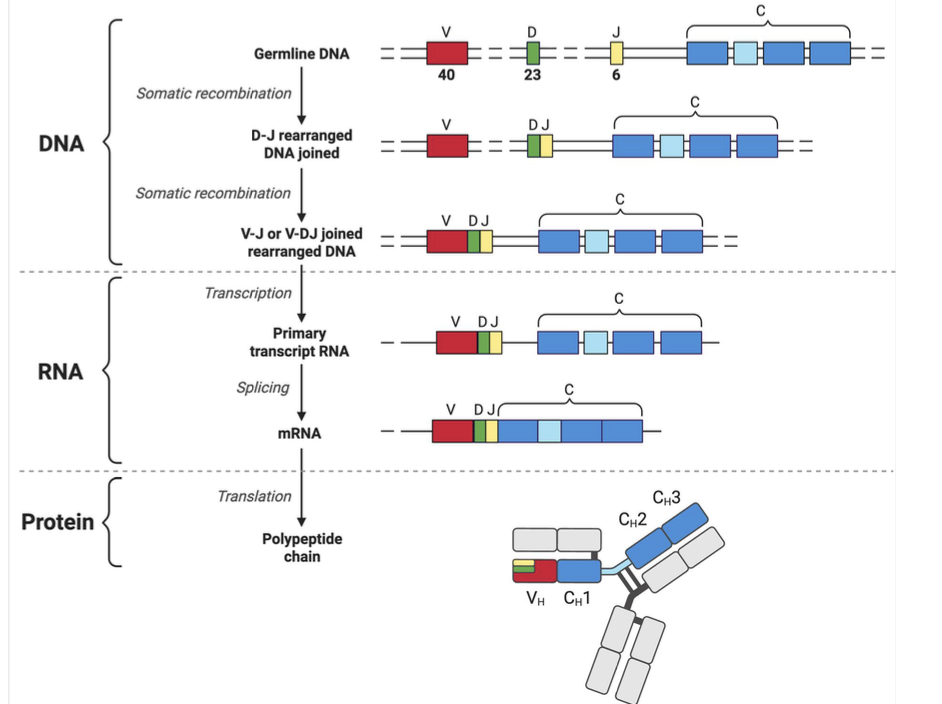
involves the somatic recombination of VH, DH, and JH segments to create diverse immunoglobulin heavy chains, with D/J rearranged first
Calculating Ig combinatorial diversity
multiply the number of available V, D, and J segments to determine the total combinations of antibodies formed.
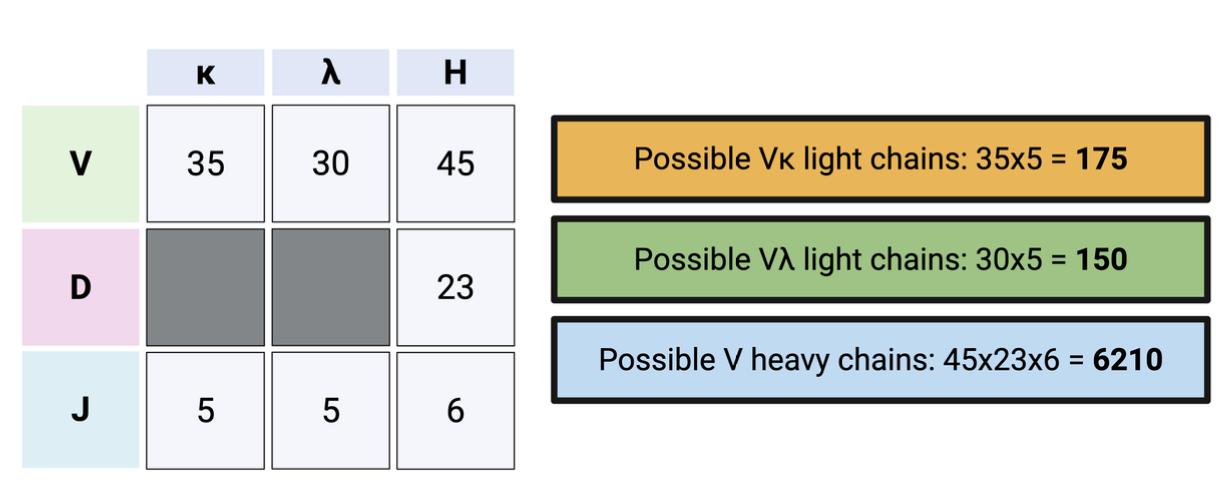
Combinatorial Diversity
Diversity generated by the random joining of different V, D, and J segments; for immunoglobulins, this results in approximately 2,018,250 (2×10^6) possible combinations from 150 total gene segments.
RAG (Recombination Activating Gene)
An enzyme complex (RAG-1 and RAG-2) that facilitates somatic recombination by binding to RSSs and cleaving DNA to generate coding and signal joints.
Recombination Signal Sequence (RSS)
Conserved DNA sequences consisting of a heptamer (CACAGTG), a nonamer (ACAAAAACC), and either a 12-base-pair or 23-base-pair non-conserved spacer.
12/23 Rule
The requirement that a gene segment flanked by an RSS with a 12-bp spacer can only be joined to a segment flanked by an RSS with a 23-bp spacer.
Coding Joint
The functional joint formed between recombined V, D, or J segments during somatic recombination.
Signal Joint
The DNA byproduct formed by the joining of RSS ends during recombination, which is typically circularized and discarded.
Ku70:Ku80
A heterodimeric complex that binds to DNA ends following RAG cleavage to initiate the repair process for both coding and signal joints.
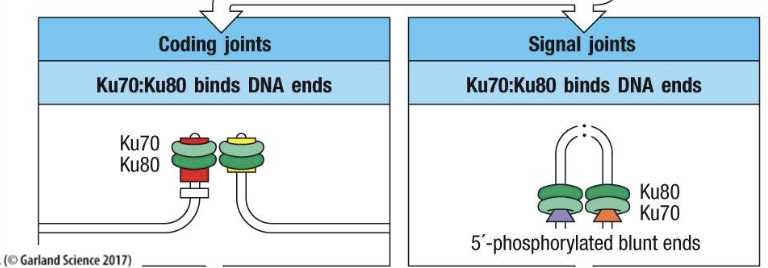
Artemis
An endonuclease that, when complexed with DNA-PK, opens the DNA hairpins at coding ends to allow for nucleotide addition.
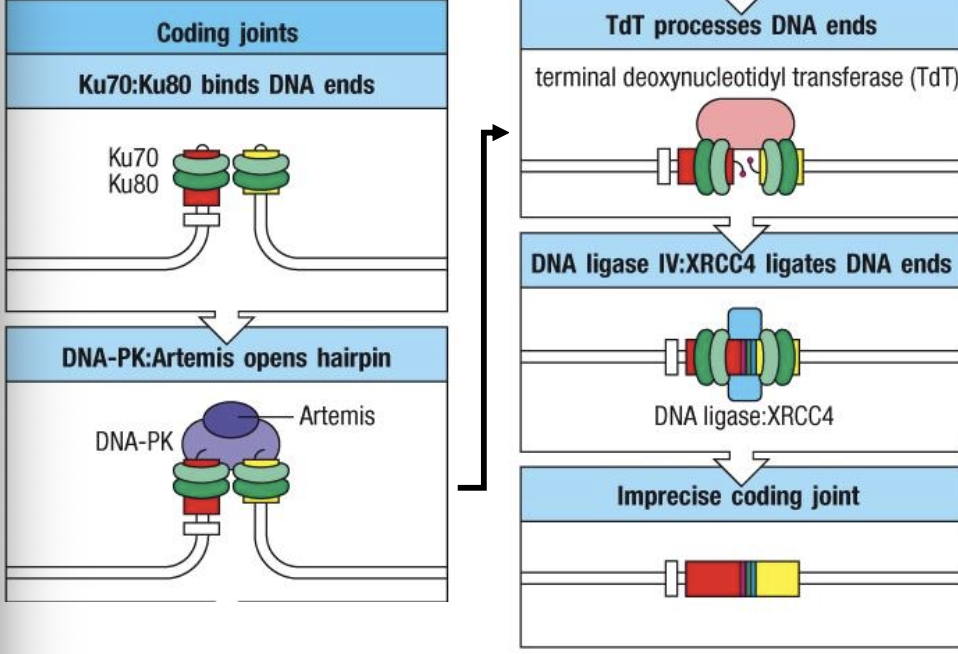
What happens to signal joints after cleavage
are typically closed off and discarded to create a precise signal joint
Terminal deoxynucleotidyl transferase (TdT)
An enzyme that adds random N-nucleotides to the ends of DNA during the repair of coding joints, increasing junctional diversity.
P-nucleotides
Palindromic sequences generated when Artemis opens the DNA hairpin at coding ends and the nucleotides flips up.
N-nucleotides
Non-templated random nucleotides added by TdT between V, D, and J segments.
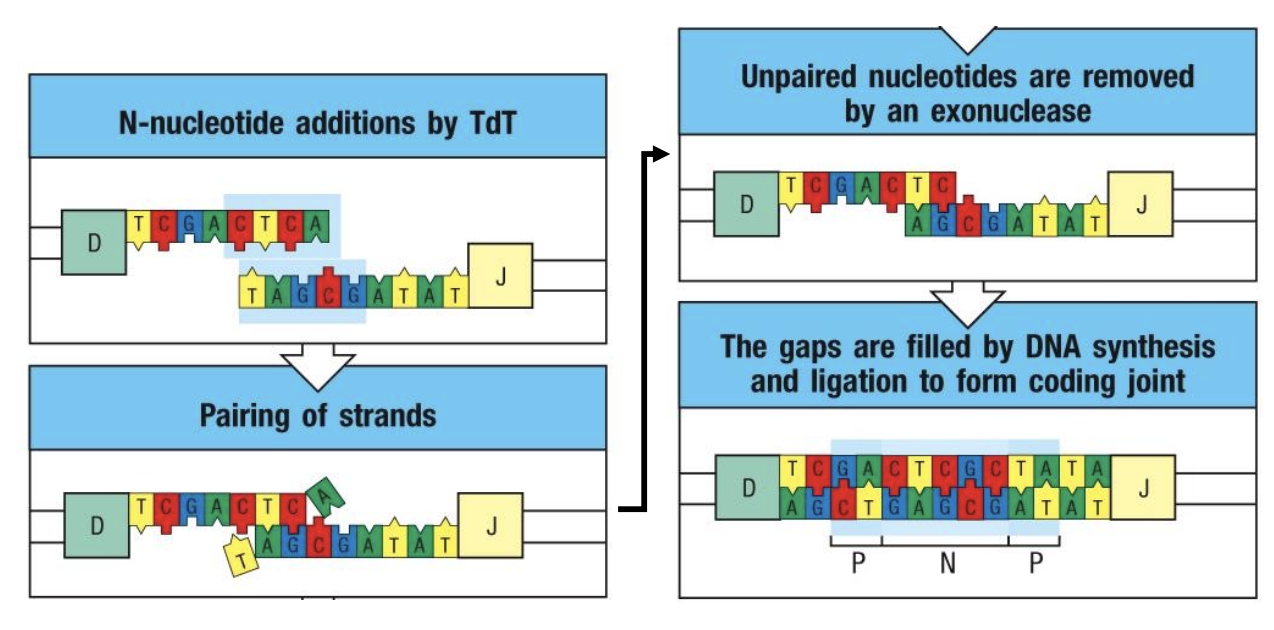
Junctional Diversity
Imprecise DNA repair at coding joints that introduces random P and N nucleotides, significantly increasing the total Ig and TCR repertoire. 33% of recombination events are successful
TCRα locus
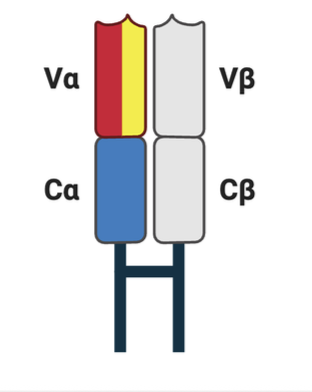
encoded on Chromosome 14, consisting of Vα and Jα segments.
TCRβ locus
Located on Chromosome 7, consisting of Vβ, Dβ, and Jβ segments. Analogous to H chain in Ig
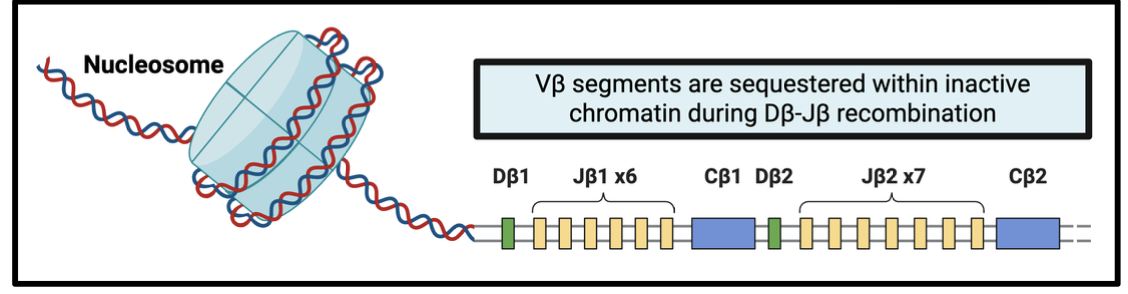
Why do D/J recombination happens first and not with V segment
Vbeta segments are sequestered within inactive chromatin during Dbeta-jbeta recombination
Allelic Exclusion
The process ensuring that B cells and T cells express only one antigen receptor specificity by silencing the second allele once a successful rearrangement occurs.
Allelic Exclusion for B cells
Always recombine hevay chain first, then light chain with kappa loci first then lamba.
Allelic Exclusion for T cells
Recombination first at TCRbeta. Then TCRalpha is rearranged stimulantenously with a possibility of both alleles being expressed.
TCRs exhibit a higher degree of junctional diversity
due to the presence of additional nucleotides added during V(D)J recombination, which enhances the variability of the T cell receptors.
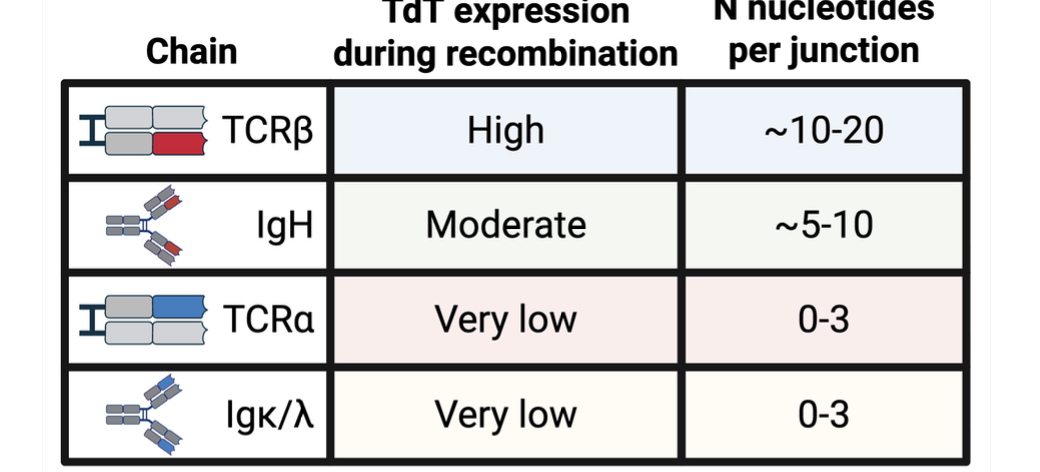
Junctional diversity is restricted to …
CDR3 in both Ig and TCR chains. CDRbeta 1 and 2 interact with MHC
Class Switch Recombination (CSR)
A process in activated B cells where the constant heavy (CH) region is changed to switch the antibody isotype (e.g., from IgM to IgG, IgA, or IgE) without changing antigen specificity.
Activation-induced cytidine deaminase (AID)
The enzyme responsible for initiating Class Switch Recombination and somatic hypermutation by converting cytidine to uracil in DNA.
Ig constant heavy regions are encoded …
downstream of VDJ segments
Switch (S) Regions
DNA sequences located upstream of each constant heavy region (except Cδ) where double-stranded breaks occur during isotype switching.
How to mismatch repair
UNG and APE excise uracile and cause breaks in both switch regions
Double stranded break repair (DSBR)
Facilitate recombination of CH genes via synapsis and cleavage
IFN-γ
A Type 1 (viral/bacterial) cytokine that promotes B cell class switching to the IgG isotype.
IL-4
A Type 2 (parasitic) cytokine that promotes B cell class switching to the IgE isotype.
IL- 21 TGF-β
A mucosal cytokine that, along with IL-21, promotes B cell class switching to the IgA isotype.