ch4- Dynamics of Microbial Growth
 Call Kai
 Learn
Learn Practice Test
 Spaced Repetition
 Match
Match Flashcards
 Knowt Play
1/21

There's no tags or description
Looks like no tags are added yet.
Name | Mastery | Learn | Test | Matching | Spaced | Call with Kai | Chat |
|---|
No analytics yet
Send a link to your students to track their progress
22 Terms
bacterial growth
it is an increase in number
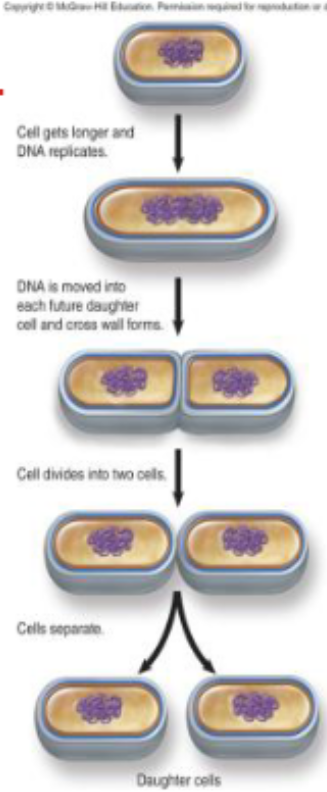
bacteria divide by binary fission
1 cell → 2 cells, 2 → 4, 4 → 8, 8 → 16, etc…
growth is exponential: population doubles with each division
generation time
time it takes for a cell to divide or population to double
varies among species and with growth conditions
environmental conditions
different media, temperature

pure culture and how to obtain it
bacteria are study in pure culture
pure culture: population of cells derived from a single cell (clones, genetically known)
pure culture maintained using aseptic technique
minimizes potential contamination
bacteria are grown in/on culture medium
contains nutrients dissolved in water
can be broth (liquid) or solid gel
growing microorganisms on solid medium - solid media/bacteria
solid media - broth media with the addition of agar
agar - marine algae extract
liquefies at >95 *C
solidifies at 45 *C
remains solid at RT and body temperature
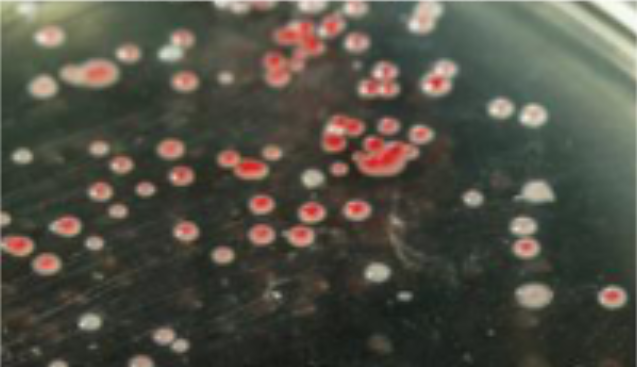
Bacteria grow in colonies on solid media surface
all cells in colony descend from single cell
approx. 1 mil cells per visible colony
growing microorganisms on solid medium - streak plate method
simplest and most commonly used for isolation
spreads out cells to separate
obtain single cells → individual colonies

bacterial growth under laboratory conditions
bacteria grown on agar plates or in tubes or flasks of broth are closed systems
nutrients not renewed; wastes not removed
termed batch cultures
yield characteristic growth curve
The Growth Curve
characterized by 5 distinct stages:
Lag phase:
number of cells does not increase
cells prepare for growth
Log/exponential phase:
exponential growth
cell most sensitive to antibiotics
Stationary phase:
overall population stabilizes
cells exhausted nutrients, waste build-up
Death phase:
total number of viable cells decrease
death is exponential
Phase of prolonged decline:
99% of cells died
very gradual decrease in viable cell population
most adapted cells survive

environments & microbial growth
prokaryotes inhabit nearly all environments
some live in comfortable habitats favored by humans
some live in harsh environments
termed extremophiles: most are archaea
environmental factors that influence growth
temp, oxygen, pH, water availability
temperature requirements
each species has a well-defined temperature range
optimum growth temperature
prokaryotes divided into 5 categories
psychrophiles (-5C to 15C)
found in arctic and Antarctic regions
psychrotrophs (20C to 30C)
important in food spoilage
mesophiles (25C to 40C)
more common
disease causing
human pathogens
thermophiles (45C to 70C)
common in hot springs
hyperthermophiles (70C to 110C)
usually members of archaea
found in hydrothermal vents

oxygen requirements
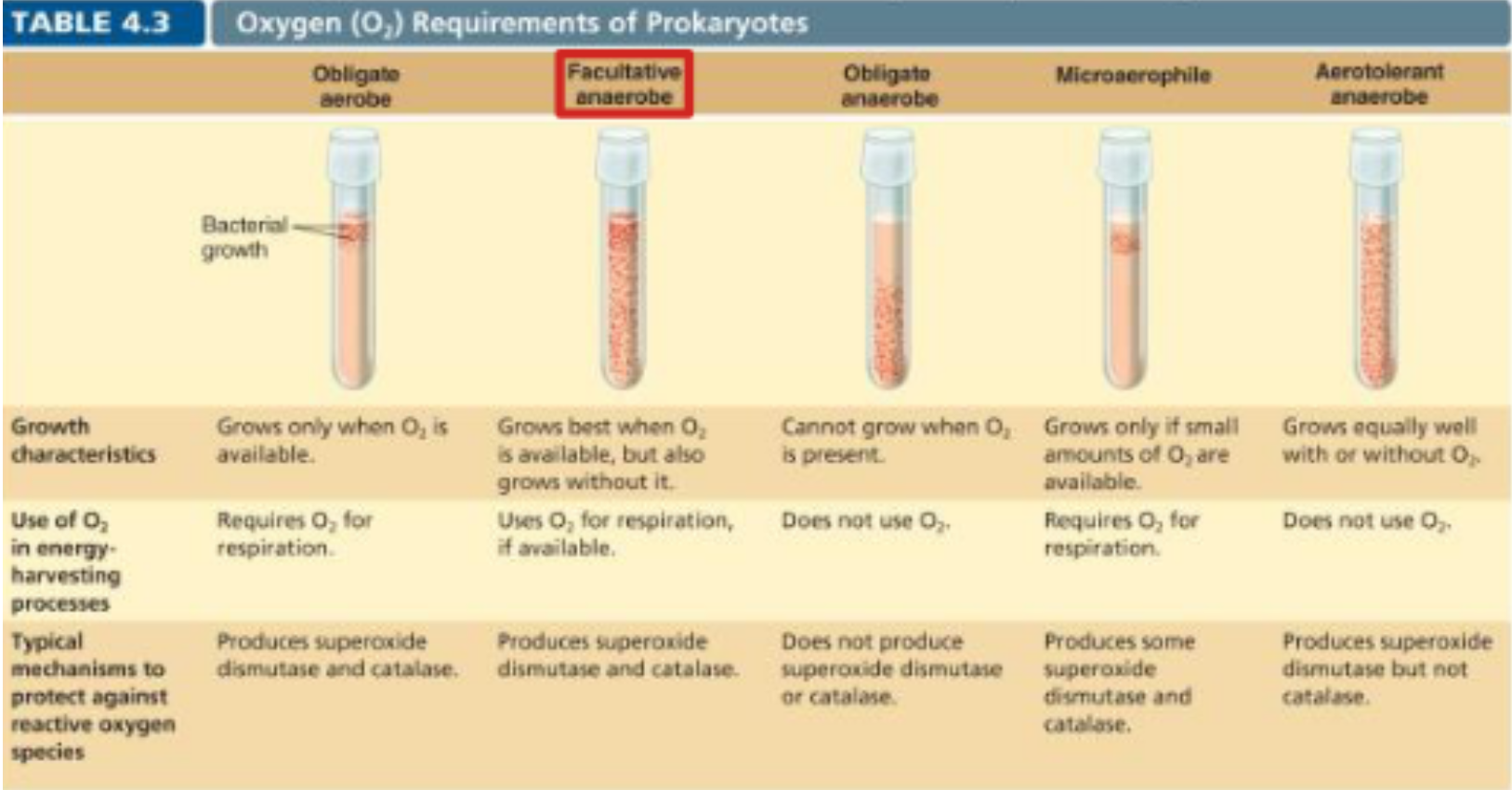
prokaryotes divided based on oxygen requirements
pH requirements
bacteria survive within a narrow pH range
have an optimum pH
maintain constant internal pH (near neutral)
neutrophiles
multiply between pH of 5-8, optimum near neutral
acidophiles
thrive at pH below 5.5
picrophilus oshimae has optimum pH of <11
alkaliphiles
grow at pH above 8.5
water availability
all microorganisms require water for growth
water not available in all environments
In high salt environments, a cell may undergo plasmolysis
some microbes can withstand or even require high salt
halotolerant: withstand up to 10% (ex. Staphylococcus )
halophiles: require high salt concentrations
marine bacteria ~3%
extreme halophiles >= 9%
dead sea, utah’s salt flats

nutritional facts that influence microbial growth
growth of prokaryotes depends on nutritional factors as well as physical environment
required elements - essential components for macromolecules
organisms classified based on
carbon sources
heterotrophs
use organic compounds as nutrient source
autotrophs
use inorganic carbon CO2 as carbon source
energy sources
phototrophs
derive energy from sunlight
chemotrophs
derive energy from chemical compounds
trace elements (minerals)
required in minute amounts
cobalt, zinc, copper, molybdenum and manganese
growth factors
must be added to growth media
bacteria can’t synthesize
certain amino acids, vitamins, purines, pyrimidines
organisms with many requirements → fastidious
cultivating microorganisms in the laboratory
microorganisms grown on culture media
general categories of culture media
complex media contain a variety of ingredients
exact composition highly variable
often a digest of proteins
NA, blood agar, chocolate agar
chemically defined media
contain precise amounts of pure chemicals
not practical for routine laboratory use
invaluable in research
each batch is chemically identical
does not introduce experimental variable
cultivating prokaryotes in the laboratory
special types of culture media
useful for isolating and identifying a specific species
selective media
differential media
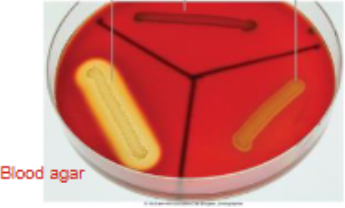
selective media
inhibit growth of unwanted organisms
allow only sought after organisms to grow
ex.
Thayer-Martin agar
for isolation of Neisseria gonorrhoeae
MacConkey agar
for isolation of Gram-negative bacteria
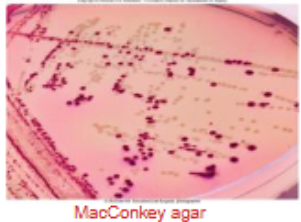
differential media
contain substances that are changed by bacteria in recognizable ways
example:
blood agar
identifies bacteria that produce hemolysin (break down RBCs)
hemolysis
MacConkey agar
contains lactose and pH indicator → identify bacteria that produce acid from lactose
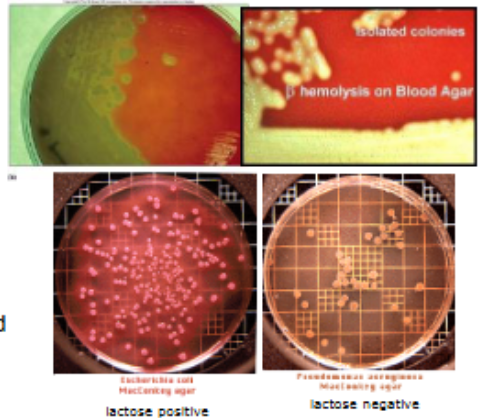
providing appropriate atmospheric conditions
anaerobes
die in the presence of oxygen
growing anaerobic bacteria using
anaerobic jar
reducing agents (ex. sodium thioglycolate)
anaerobic chamber
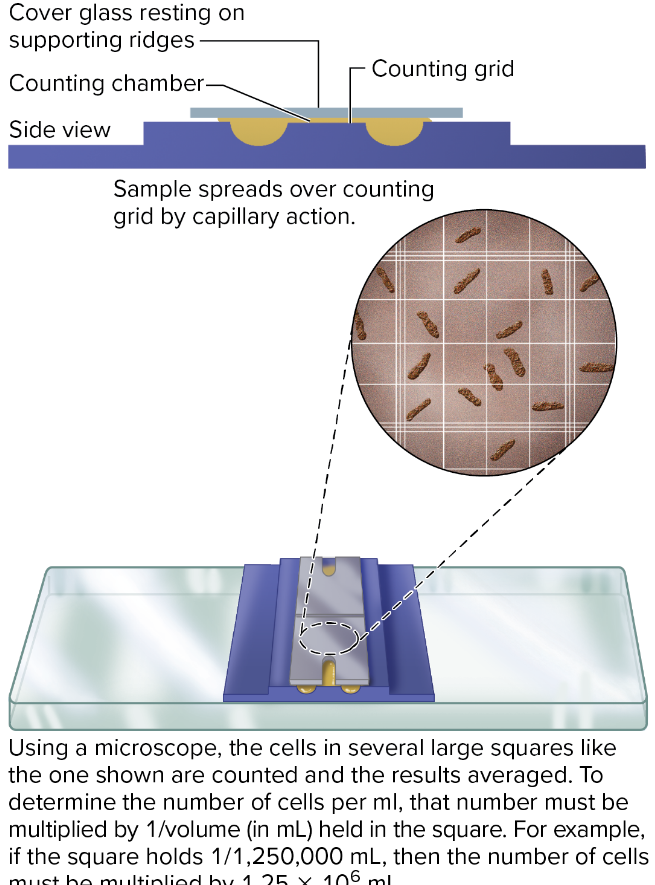
methods to detect and measure microbial growth - direct microscopic count
liquid dispensed in specialized slide
viewed under microscope
cells counted
does not distinguish between living and dead cells
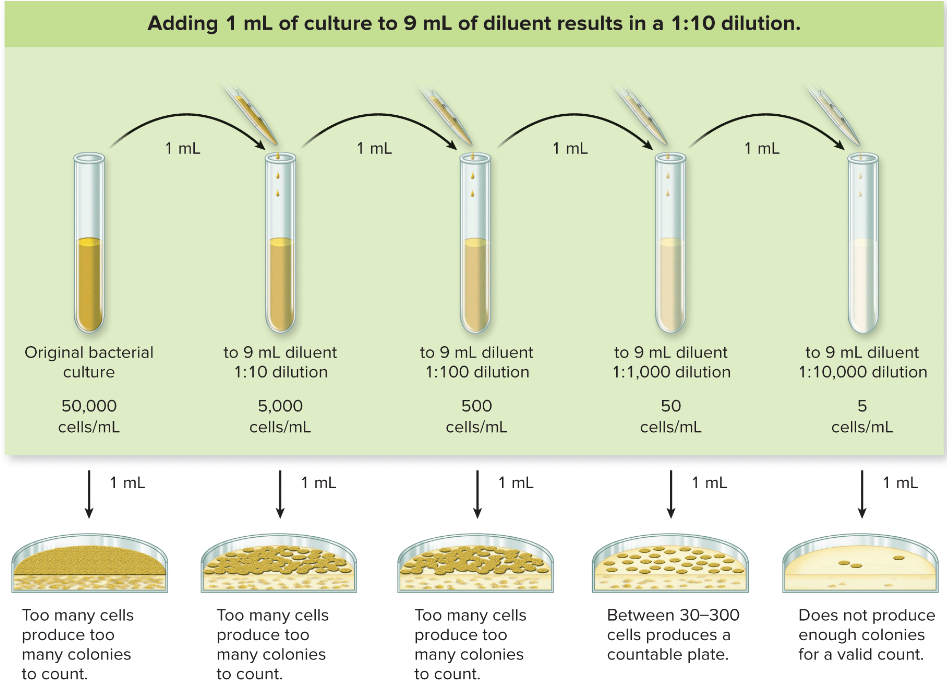
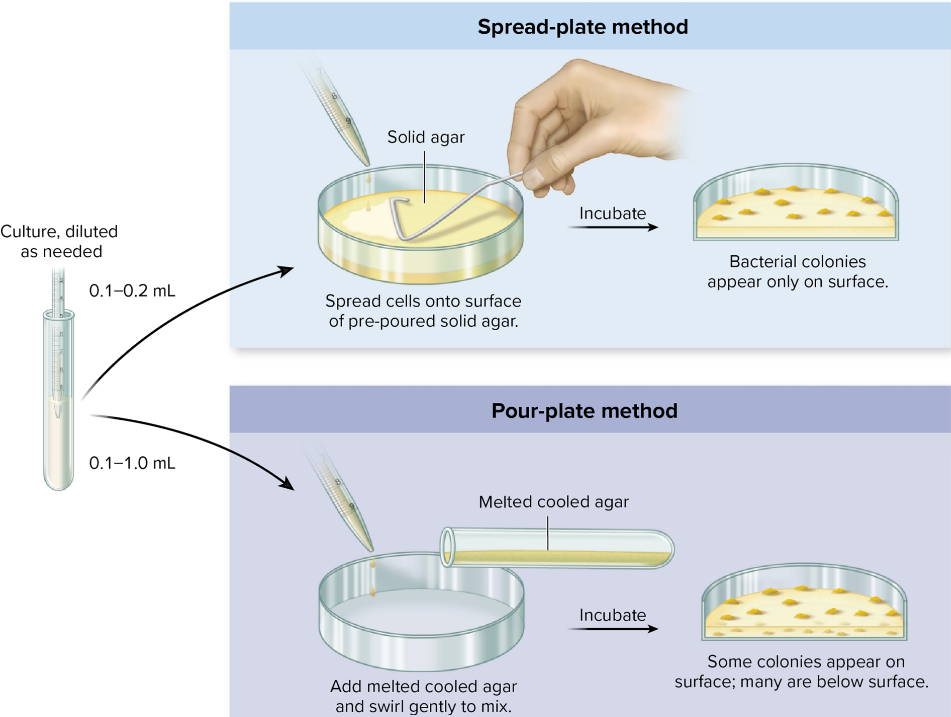
methods to detect and measure microbial growth - viable cell count
quantify living cells on solid culture media
assumption: single cell gives rise to colony
plate out dilution series: 30-300 colonies ideal
count colony forming units (CFU)
methods to detect and measure microbial growth - membrane filtration
concentrates microbes by filtration - trapped on surface
filter is incubated on appropriate agar medium → colonies counted

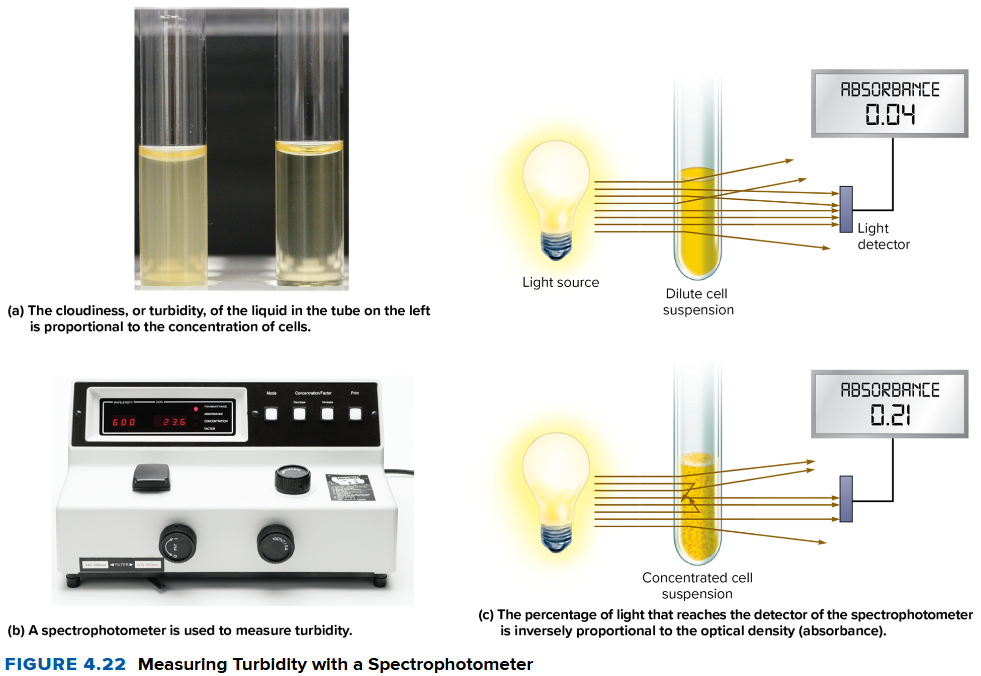
membrane filtration - turbidometric method
measures biomass
turbidity (cloudiness)
measured with spectrophotometer (absorbance)
proportional to concentration of cells