Bio 144
 Call Kai
 Learn
Learn Practice Test
 Spaced Repetition
 Match
Match Flashcards
 Knowt Play
1/19

Earn XP
Description and Tags
Microbial Diversity
Name | Mastery | Learn | Test | Matching | Spaced | Call with Kai | Chat |
|---|
No analytics yet
Send a link to your students to track their progress
20 Terms
Types of Microscopes
Light & Electron microscope
Transmission electron microscope
Used to view internal structures of cells at very high magnification by transmitting electrons through a thin specimen.
Scanning electron microscope
Used to study the surface of objects by scanning them with a focused beam of electrons, producing high-resolution three-dimensional images.
Characteristics of microbes
1) Found all over (ubiquitous)
2) Aerobic/anaerobic
3) Nutrient cycling
4) Less complex
5) Horizontal gene transfer
6) Diverse metabolic pathways - rapid growth rate
7) Co-evolved
Importance of microbes
1) Created prehistoric atmosphere
2) Nitrogen fixing
3) Decomposition
3 Domains
Bacteria, Archaea, Eukarya
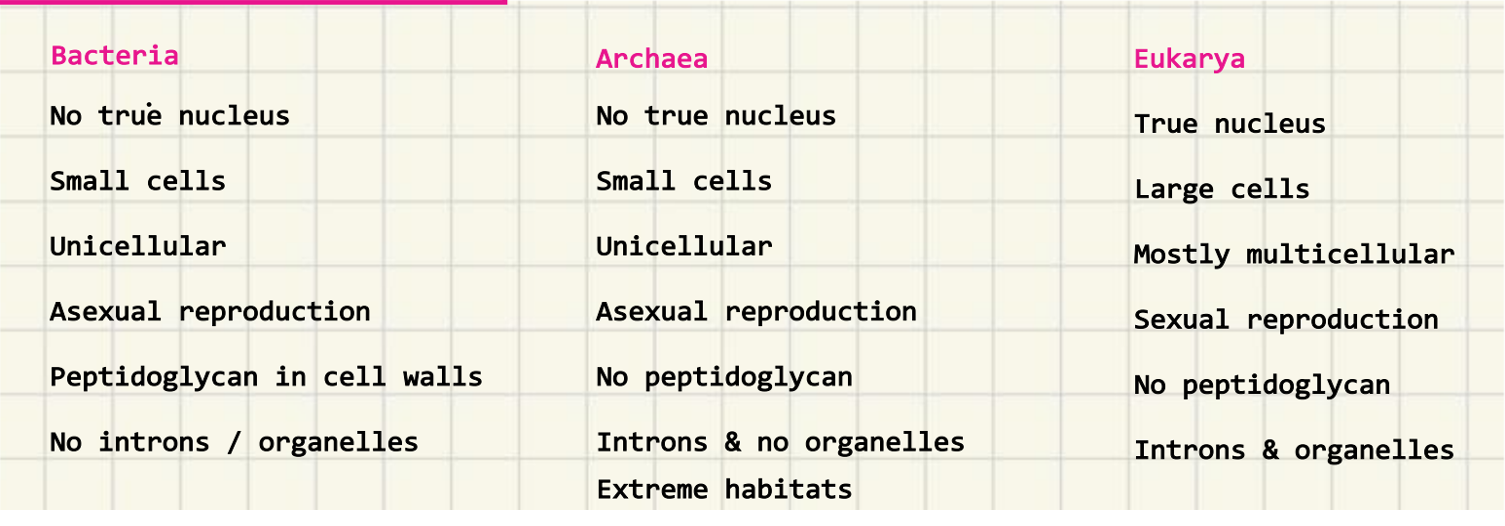
Differences between 3 Domains
First person to observe microorganisms
Antonie van Leeuwenhoek
Protists
Uni/multicellular
Asexual/sexual reproduction
Fungi
Chemoheterotrophic, multicellular decomposers
Plantae
Multicellular photoautotrophs
Rigid cell walls
Anamalia
Multicellular chemoheterotrophic
Cell walls
Bacteria characteristics
No membrane-bound organelles
Prokaryotes
Small
Rapid production
Archaea characteristics
Extreme habitats
Gene translation machinery → Eukarya
Prokaryotes vs Eukaryotes

Taxonomic domain associated with methanogenesis
Archaea
Basic taxon of classification systems
Species
Kingdom that Saccharomyces cerevisiae belongs to
Fungi
DNA-associated feature that only occurs in Eukarya
Nucleus
Differences between Bacteria & Eukarya that make it possible to target drugs against bacteria alone
Cell Wall Composition: Bacteria have a rigid cell wall made of peptidoglycan, while eukaryotic cells lack such a structure
Nucleus: Eukaryotic cells have a membrane-bound nucleus, whereas bacteria have a nucleoid region with circular DNA
Ribosomes: Bacterial ribosomes are smaller compared to eukaryotic ribosomes
Metabolic Pathways: Bacteria have unique metabolic pathways that eukaryotic cells do not