Ch 6, 7, 8 -Packet
 Call Kai
 Learn
Learn Practice Test
 Spaced Repetition
 Match
Match Flashcards
 Knowt Play
1/20

There's no tags or description
Looks like no tags are added yet.
Name | Mastery | Learn | Test | Matching | Spaced | Call with Kai | Chat |
|---|
No analytics yet
Send a link to your students to track their progress
21 Terms
b
Ch 6
A binding price ceiling
a. is efficient since all buyers that were willing to pay a higher price now pay a lower price
b. will make it necessary to develop a way of rationing the product because there will be a shortage
c. is set above the equilibrium price and causes a surplus
d. is set below the equilibrium price and causes a surplus
e. a and b
a
Ch 6
If a minimum wage is set above the equilibrium wage in the labor market for unskilled workers
a. there will be a surplus of labor
b. there will be a shortage of labor
c. all unskilled workers will find jobs
d. unemployment will decrease
d
Ch 6Rent control
a. increases the quantity supplied of apartments
b. decreases discrimination by landlords
c. results in better housing
d. causes a rationing of rent-controlled housing
b
Ch 6
4. A binding price floor
a. causes quantity demanded to be greater than quantity supplied
b. causes quantity supplied to be greater than quantity demanded
c. causes quantity demanded to be equal to quantity supplied
d. is set below the equilibrium price
c
Ch 6
5. If a tax is imposed on a market with inelastic demand and elastic supply,
a. the burden of the tax will be shared equally between buyers and sellers
b. sellers will bear most of the burden of the tax
c. buyers will bear most of the burden of the tax
d. the government tax revenue will be equal to the burden of the tax on sellers
c
Ch 6
6. In the graph shown below, the total burden of the tax on buyers is __________________________
and the government revenue is ________________________ .
a. (P2 minus P0) ( Q0) -------- (P1) (Q1)
b. (P2 minus P1) ( Q1) -------- (P2 minus P0) (Q0)
c. (P2 minus P1) ( Q0) -------- (P2 minus P0) (Q0)
d. (P1 minus P0) ( Q0) -------- (P1 minus P0) (Q0)

d
Ch 6.
If a tax is imposed in both markets (a) and (b),
a. buyers bear the entire burden of the tax in market (a)
b. sellers bear the entire burden of the tax in market (b)
c. in market (a) the government would collect no tax revenue
d. sellers bear the entire burden of the tax in market (a)

b
ch 7
1. Suppose there is an early freeze in California that ruins the lemon crop. What happens to consumer surplus in the
market for lemons?
a. it increases
b. it decreases
c. it is not affected by this change in market forces
d. it increases very briefly then decreases
a
ch 7
2. Suppose that the demand for French bread increases. What will happen to producer surplus in the market for
French bread?
a. it increases
b. it decreases
c. it is unaffected by this change in market forces
d. it decreases briefly, then increases
c
ch 7
3. Which of the following statements is FALSE?
a. welfare economics is the study of how the allocation of resources affects economic well being
b. when there is no government intervention, the total surplus is equal to the sum of consumer and producer
surplus
c. when there is no government intervention, the total surplus is equal to the sum of the willingness to pay
by buyers and the cost to sellers
d. if a market produces a quantity greater than the equilibrium quantity, total surplus would decrease
d
ch 8
Use the graph below to answer question 1. The distance (P2 - P1 ) represents a per unit tax.
According to the picture above, after the tax is imposed, the producer surplus (PS) is represented by area(s)
a. C, D, B
b. G
c. A
d. B
e. F, C

b
ch 8
Assume that the demand for salt is relatively inelastic and that the demand for orange juice is relatively elastic.
Compared to the deadweight loss from the same tax on orange juice, the deadweight loss from imposing a tax on
salt would be
a. neither greater nor less
b. less
c. greater
d. either greater or less
ch 6
a. If the government imposes a price control of P2 and the market is then unable to reach the market equilibrium, would this be an example of a binding price floor or a binding price ceiling?
b. What is the quantity that would be bought and supplied in the market if the price is P2?
c. Is there a shortage or a surplus at P2?

ch 6
2. The market equilibrium rent per room in a small city is $250 a month. A rent control law is passed that establishes a price ceiling of exactly $250 a month. Shortly after this law is passed, a major corporation announces that it will build a new factory employing 10,000 workers and that most of the workers will likely move into the city. How will the housing market in this city be affected?
ch 6
3. True/False statements. If true, no need to explain. If false, explain why a. If the equilibrium wage rate in Raleigh is $9.00 and the minimum wage is $13.25, there will be a shortage of labor in the Raleigh labor market.
b. Suppose that the market for chocolate candy bars is in equilibrium at a price of $1 per bar. If the government imposes a tax of $0.15 per candy bar on buyers, then the new price paid by buyers will be $1.15.
c. Suppose that the market for chocolate candy bars is in equilibrium at a price of $1 per bar and that the demand for chocolate candy bars is perfectly inelastic. If the government imposes a tax of $0.15 per candy bar on sellers, then the new price paid by buyers will be $1.
d. Rent control may lead to lower rents for those who find housing, but the quality of housing may also be lower.
ch 6
4. A tax of $4 is imposed by the government.
a. What the equilibrium price and quantity before the tax is imposed?
b. what is the quantity after the tax is imposed?
c. what is the price paid by consumers after the tax is imposed?
d. what is the price received by sellers after the tax is imposed?

ch 7
1. Suppose a technological advancement reduces the cost of making computers. a. Use a supply and demand graph to show what happens to price, quantity, and the consumer surplus in the market for computers.
b. Assume computers and adding machines are substitutes. Use a supply and demand graph to show what happens to price, quantity, and the producer surplus in the market for adding machines.
c. Computers and software are complements. Use a supply and demand graph to show what happens to price, quantity, and the producer surplus in the market for software.
ch 7
2. True/False statement. If true, no need to explain. If false, explain why.
With no government intervention, the market equilibrium maximizes total surplus.
ch 8
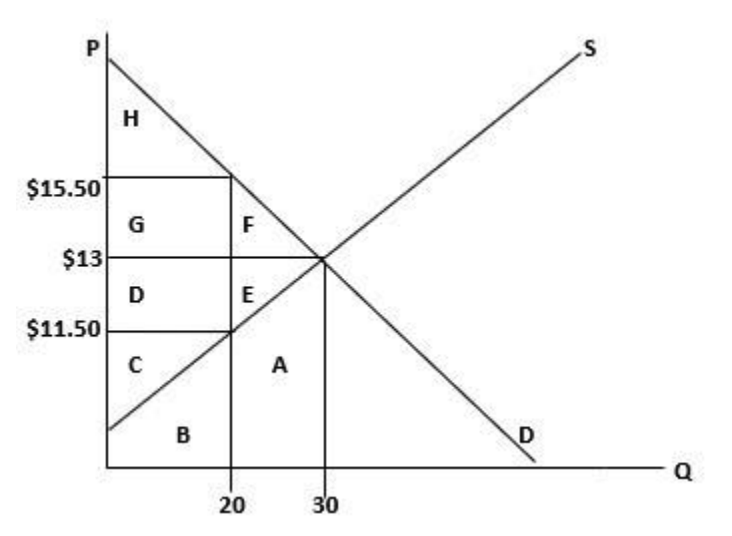
1. In the graph below, areas are determined by solid lines. A tax of $4 is imposed by the government.
In terms of area(s),
a. what is the consumer surplus before the tax is imposed?
b. what is the producer surplus before the tax is imposed?
c. what is the total surplus before the tax is imposed?
d. what is the consumer surplus after the tax is imposed?
e. what is the producer surplus after the tax is imposed?
f. what is the government revenue from the tax?
g. what is the total surplus after the tax is imposed?
h. what is the deadweight loss from the tax?
i. In terms of dollars, what is the government tax revenue?
ch 8
2. Can you think of a case (or two) where the dead weight loss (DWL) of a tax would be 0. 3.
ch 8
True/False statements. If true, no need to explain. If false, explain why.
a. The more elastic is the demand, the smaller is the dead weight loss (DWL), Ceteris Paribus.
b. As the tax on a good decreases, Ceteris Paribus, so does the dead weight loss (DWL), assuming that neither the D nor the S curve is perfectly inelastic.
c. The more inelastic is the supply, the smaller is the dead weight loss (DWL), Ceteris Paribus.