Graphs/ Open-Ended/ Exam Style
 Call Kai
 Learn
Learn Practice Test
 Spaced Repetition
 Match
Match Flashcards
 Knowt Play
1/30

There's no tags or description
Looks like no tags are added yet.
Name | Mastery | Learn | Test | Matching | Spaced | Call with Kai | Chat |
|---|
No analytics yet
Send a link to your students to track their progress
31 Terms
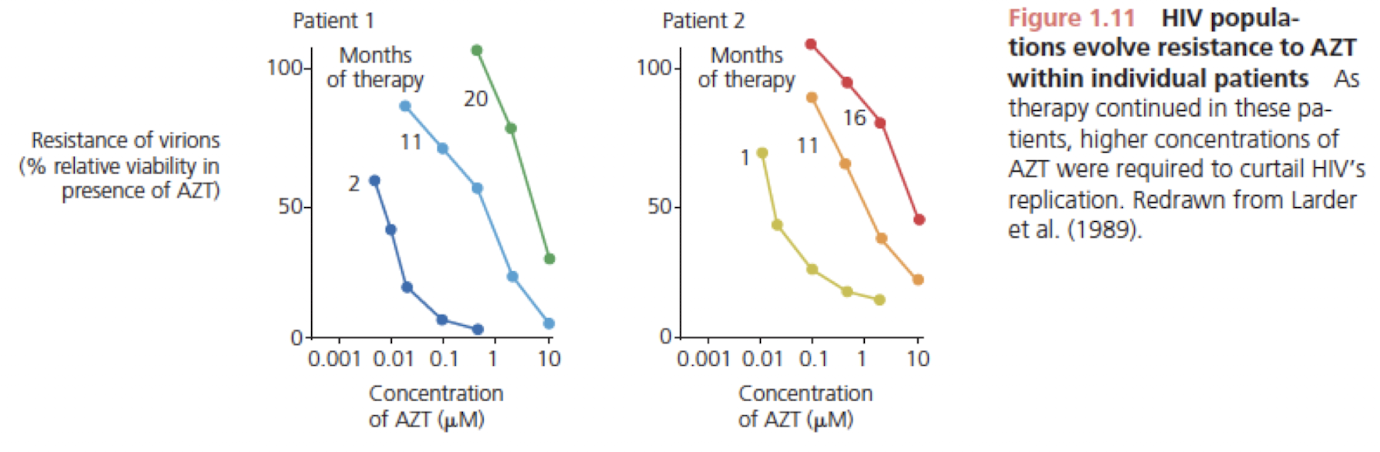
What evidence in the graph supports the conclusion that HIV evolved resistance?
The frequency/proportion of resistant HIV changes over time, particularly increasing during AZT treatment. This indicates that resistant variants became more common in the population.
What would you predict would happen to the proportion of AZT-resistant HIV if AZT treatment were stopped?
The proportion of resistant HIV could decrease toward its previous level because the selective pressure favoring resistance has been removed
Two patients receive AZT. Patient A's HIV population becomes highly resistant, while Patient B's changes very little. Give possible evolutionary reasons for the difference.
Their HIV populations may experience different selective pressures, including differences in immune response and drug effects.
Explain how HIV can evolve resistance to AZT without AZT intentionally “creating” resistance.
Replication errors generate variation. Some variants happen to carry mutations that make reverse transcriptase resistant to AZT. AZT kills or inhibits susceptible variants more effectively, allowing resistant variants to survive and reproduce. Over generations, resistant variants become more common.
Why is HIV particularly capable of evolving rapidly?
Its replication produces errors that generate mutations, and those mutations can create variation in traits such as drug resistance. Variants reproduce and pass their genes to offspring.
Why should HIV treatment use multiple drugs that target different stages of the viral life cycle?
Using multiple drugs makes it less likely that one virus will simultaneously acquire all the mutations needed to resist the drugs. Consistent treatment also helps prevent breaks in selective pressure.
What happens evolutionarily when AZT treatment is stopped?
The resistant trait may become less common because the selective pressure favoring resistance is removed. This does not mean evolution itself simply “reverses”; rather, the population's genetic composition can change in another direction under new conditions.
Does HIV evolve in order to become better at surviving inside a person? Explain.
No. Evolution has no predetermined goal. Random variation exists first, and environmental conditions determine which variants survive and reproduce more successfully.
Explain the statement “evolution is short-sighted” using HIV as an example.
HIV is selected to survive and reproduce under its current conditions. A trait that improves immediate reproduction can be favored even if it ultimately contributes to harm or death of the host.
How can a person's immune response act as a selective pressure on their HIV population?
Different HIV variants may be affected differently by the person's immune response. Variants that survive and reproduce better under that immune pressure can become more common.
Why might differences in the number/activity of activated T-cells affect HIV evolution?
HIV replicates most efficiently in activated T-cells. Differences in the host environment can therefore affect HIV reproduction, generation time, and the accumulation of mutations.
Could a human population evolve resistance to HIV? What would have to happen?
Heritable genetic variation affecting HIV susceptibility would need to exist, resistant individuals would need to survive/reproduce at higher rates, and selection would need to change the frequency of those variants over generations.
Explain, step-by-step, how a population of HIV evolves resistance to an antiviral drug.
Variation → mutation → heritability → selection → differential reproduction → change in population frequency.
Replication errors create genetically different HIV variants. Some variants have mutations that provide drug resistance. Those mutations are inherited. When the drug is present, resistant viruses survive and reproduce more successfully than susceptible viruses. Over generations, the resistant variants become a larger proportion of the population.

Look at the field mustard flowering-period graph.
What changed between 1997 and 2004?
What evolutionary process could explain the change?
What must be true for this to represent evolution?
The population's average flowering period changed.
Selection could favor individuals with certain flowering periods under drought conditions.
The trait must have a heritable genetic component so that the change can be passed across generations.
You are given a graph showing B₁ increasing from 20% → 80% over several generations.
What does the graph demonstrate?
The allele frequency of B₁ increased over generations, demonstrating microevolution if the change represents a change in the population's genetic composition.

Two allele-frequency graphs show B₁ increasing:
Graph A: gradual increase
Graph B: rapid increase
Which experienced stronger selection for B₁? Why?
Graph B. Stronger selection produces a faster rate of allele-frequency change.

Would you expect allele-frequency change to necessarily look the same if B₁ were dominant versus recessive?
Not necessarily. Dominance affects how the phenotype associated with an allele is expressed, particularly in heterozygotes, which can affect how selection acts on the allele.
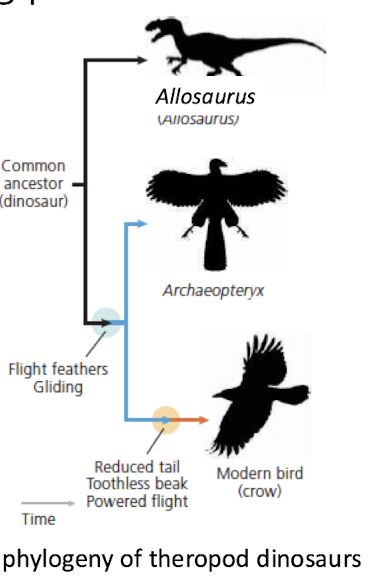
Look at the theropod dinosaur phylogeny.
What is the tree actually showing?
It is a hypothesis about evolutionary relationships among the lineages and their branching history.
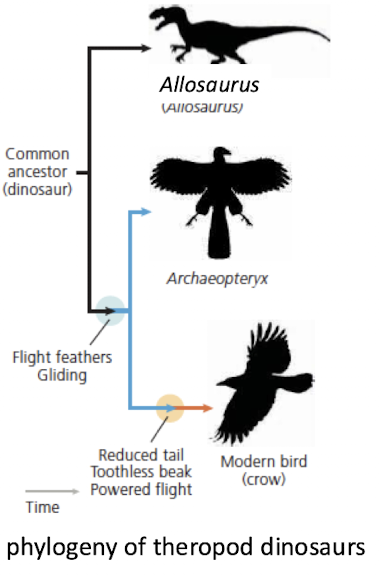
A new fossil species is discovered.
How could this fossil test the existing phylogenetic hypothesis?
Compare its characteristics with those of existing taxa. Its traits could support the proposed relationships or provide evidence that the phylogeny should be revised.
Given a character matrix:
Rows = ?
Columns = ?
Cells = ?
Then explain how the matrix helps create a phylogeny.
Rows = characters
Columns = taxa
Cells = character states
Scientists compare the character states to identify patterns of shared characteristics/mutations and infer evolutionary relationships.

Look at a functional gene and its pseudogene sequence.
How can you identify mutations that accumulated in the pseudogene?
Compare the pseudogene sequence with a functional homolog or paralog. Differences can reveal mutations that accumulated after the gene became nonfunctional.
Explain how natural selection can cause a population to evolve.
Heritable variation exists among individuals. If certain traits increase survival or reproduction, individuals with those traits contribute more offspring. The associated alleles therefore become more or less common over generations.
What types of events could lead to the separation of two populations and eventually result in speciation?
Events that reduce gene flow, such as geographic isolation, can cause populations to evolve independently. Differences can accumulate and eventually produce reproductive isolation.
Why might it be difficult to identify the exact moment when two populations become separate species?
Speciation can occur gradually. Reproductive isolation can increase over time, creating intermediate stages rather than one obvious moment when the populations suddenly become separate species.
A fossil has characteristics intermediate between two groups.
Does this prove that it is the direct ancestor of one of those groups? Explain.
No. It can provide evidence of an evolutionary transition or relationship, but it does not necessarily represent the direct ancestral lineage.
How could an incomplete fossil record make evolutionary change appear different from how it actually occurred?
Missing intermediate fossils can make gradual evolutionary change appear more abrupt because the intermediate stages aren't preserved or discovered.
Explain why homologous structures provide evidence for common ancestry even when they perform different functions.
The similarity is due to inheritance from a common ancestor. Descendant lineages can modify the inherited structure for different functions while retaining evidence of their shared ancestry.
Why can comparing pseudogenes between species provide evidence about their evolutionary history?
Pseudogenes are typically not expressed and therefore not strongly affected by selection. Mutations can accumulate through neutral evolution, allowing scientists to compare accumulated mutations and infer relationships.
Scientists discover that Species A and B share several DNA mutations that Species C does not have.
How could this information be used to infer evolutionary relationships?
The shared mutations may have been inherited from a common ancestor. If A and B share more informative derived mutations, this can provide evidence that they share a more recent common ancestor than either does with C.
Explain how microevolution can eventually contribute to macroevolution.
Populations undergo changes in allele frequencies over generations. If populations become isolated, they can accumulate differences independently. Increasing divergence can lead to reproductive isolation and speciation. Repeated lineage splitting and evolutionary change over long periods contribute to macroevolution.