Lecture 1.1: The Composition of Cells
 Call Kai
 Learn
Learn Practice Test
 Spaced Repetition
 Match
Match Flashcards
 Knowt Play
1/55

There's no tags or description
Looks like no tags are added yet.
Name | Mastery | Learn | Test | Matching | Spaced | Call with Kai | Chat |
|---|
No analytics yet
Send a link to your students to track their progress
56 Terms
What is the Gibb's Free Energy Equation
∆G = ∆H - T∆S
What does a negative Δ G represent?
Process is favorable in the forward direction (exergonic)
What does a positive Δ G represent?
Process is favorable in reverse (endogonic)
What does a Δ G = 0 represent?
Equation is at equilibrium, favorable in both directions
What does ΔG°′ represent?
Biochemical standard free energy change at a pH is fixed at 7. This is more representative of human biological conditions
What is the equation to find ΔG°′ ?
ΔG°′ = -RT ln Keq
What does Keq consist of?
Keq = [Products] / [ Reactant]
What is 25 Fahrenheit in Kelvin
298K
What is 37 Fahrenheit in Kelvin
310K
A covalent chemical bond is one in which _________
outer-shell electrons of one atom are shared with the inner electron shell of another atom.
A covalent bond is likely to be polar when _________
one of the atoms sharing electrons is more electronegative than the other atom
Explain the interactions that occur between the atoms of water molecules and the ions that form when sodium chloride dissolves in water?
Hydrogens interact with the chloride ion; oxygens interact with the sodium ion.
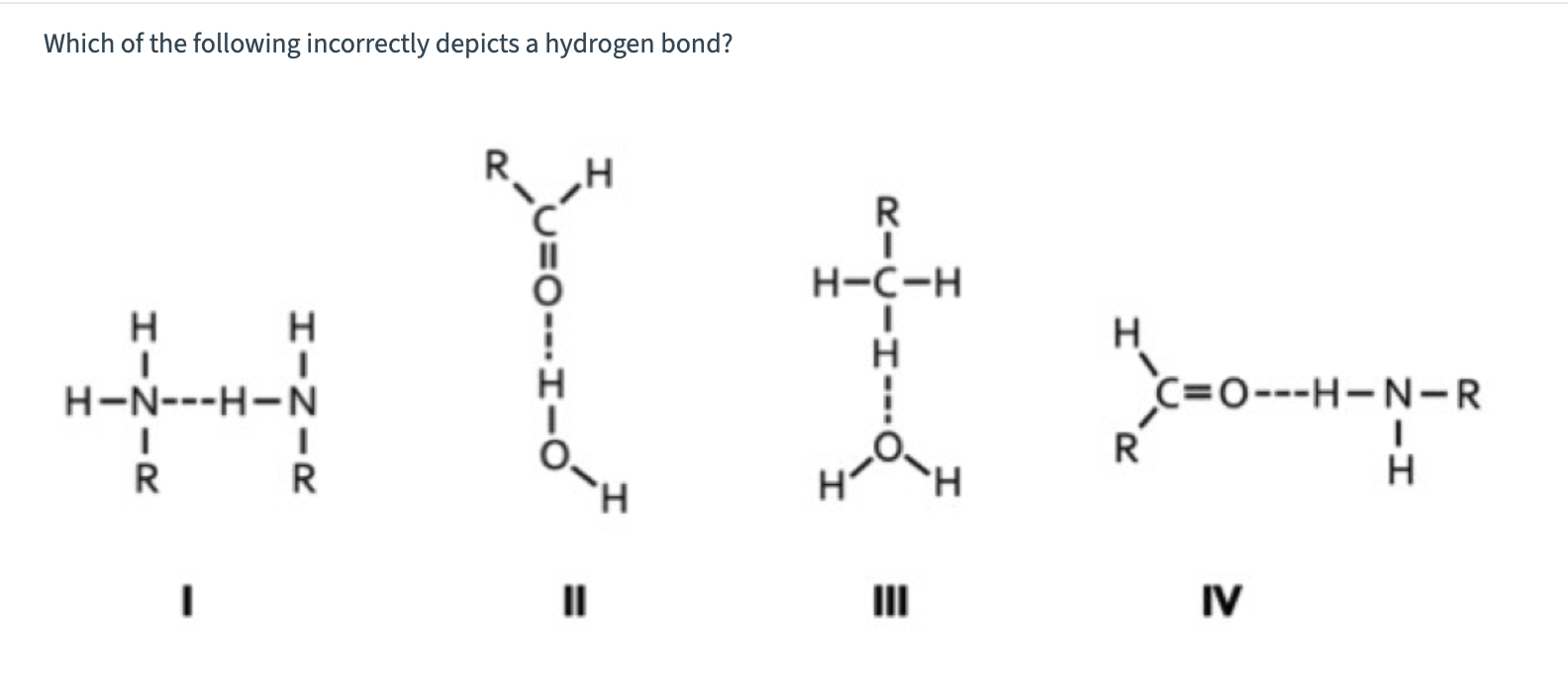
Answer and explain why
ANSWER: III — carbons are not good hydrogen bond donators
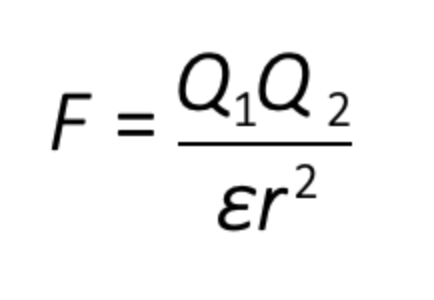
What does this equation represent and explain its meaning?
The dielectric constant — This equation represents the ability of a solvent to reduce the electric field between charged particles, reflecting how the solvent influences the strength of ionic interactions.
Higher dielectric constant = more screening = weaker ionic bond
Lower dielectric constant = less screening = weaker ionic bond
Hydrophobic interactions between nonpolar molecules result from the water ______
becoming more ordered around the nonpolar molecule.
Which of the following bonds has the lowest potential energy and why?
1) C-C
2) C-H
3) N-N
4) O-H
5) H-H
O-H — Oxygen's high electronegativity creates a strong, tightly held bond with hydrogen. Since O–H requires the most energy to break, it means the O–H bond starts from the lowest (most stable) potential energy
What is the first law of thermodynamics?
Energy cannot be create nor destroyed only transformed
What is the second law of thermodynamics?
Natural, spontaneous processes always result in an increase of the universe's total entropy
During photosynthesis, plants use light energy to synthesize sugars. They do not make new energy in this process; they merely convert it from light energy to chemical energy. This is an illustration of the __________ law of thermodynamics. The energy in the sugars made by photosynthesis can then be transformed to the energy of ATP. In this process, some of the energy is lost as heat, which increases the entropy of the universe. This is an illustration of the __________ law of thermodynamics.
First ; Second
At 25°C (298K), what is the change in Gibb's free energy (ΔG) in kJ/mol if the change in enthalpy is 500 kJ/mol, and the change in entropy is 10 kJ/mol K? Give your answer as a numeral only. Note: the temperature term in the Gibb's free energy equation is always given in Kelvin (K).
-2480.0
When a reaction is at equilibrium, ...... select all that apply
a) the concentration of products is equal to the concentration of reactants.
b) the rates of the forward and reverse reactions are equal.
c) no more products are formed.
d the equilibrium constant is equal to 1.
e) the forward reaction continues to occur.
f )there is no net change in the concentrations of products or reactants.
g) the ΔG = 0
b) the rates of the forward and reverse reactions are equal.
e) the forward reaction continues to occur.
f )there is no net change in the concentrations of products or reactants.
g) the ΔG = 0
Atoms can rotate around double bonds (T/F)
False
Atoms can rotate around single bonds (T/F)
True
What atoms are good hydrogen bond donors?
Hydrogen (bonded to Oxygen and Nitrogen)
What atoms are good hydrogen bond acceptors?
Oxygen and Nitrogen
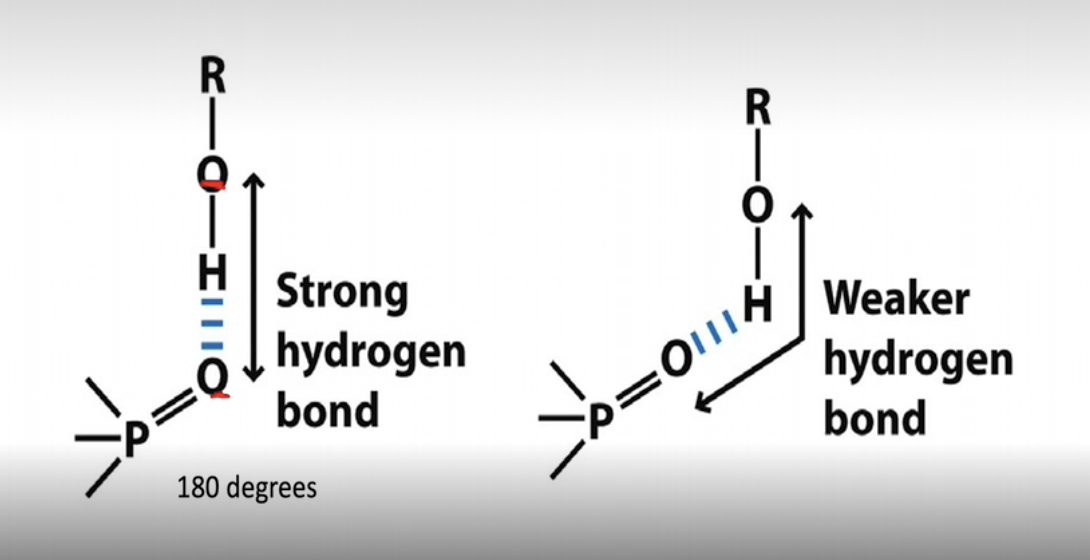
Which hydrogen bond is stronger 180 degrees or 120 degrees and why?
180 degree because the bond in straight and linear
What is the hydrophobic effect?
When a hydrophobic molecule is dropped into an aqueous solution. The hydrophobic molecules will pack together in order to allow the water to hydrogen bond/move more freely. This decreases the entropy of the solution. (Lecture 1.1 part 3 20:00)
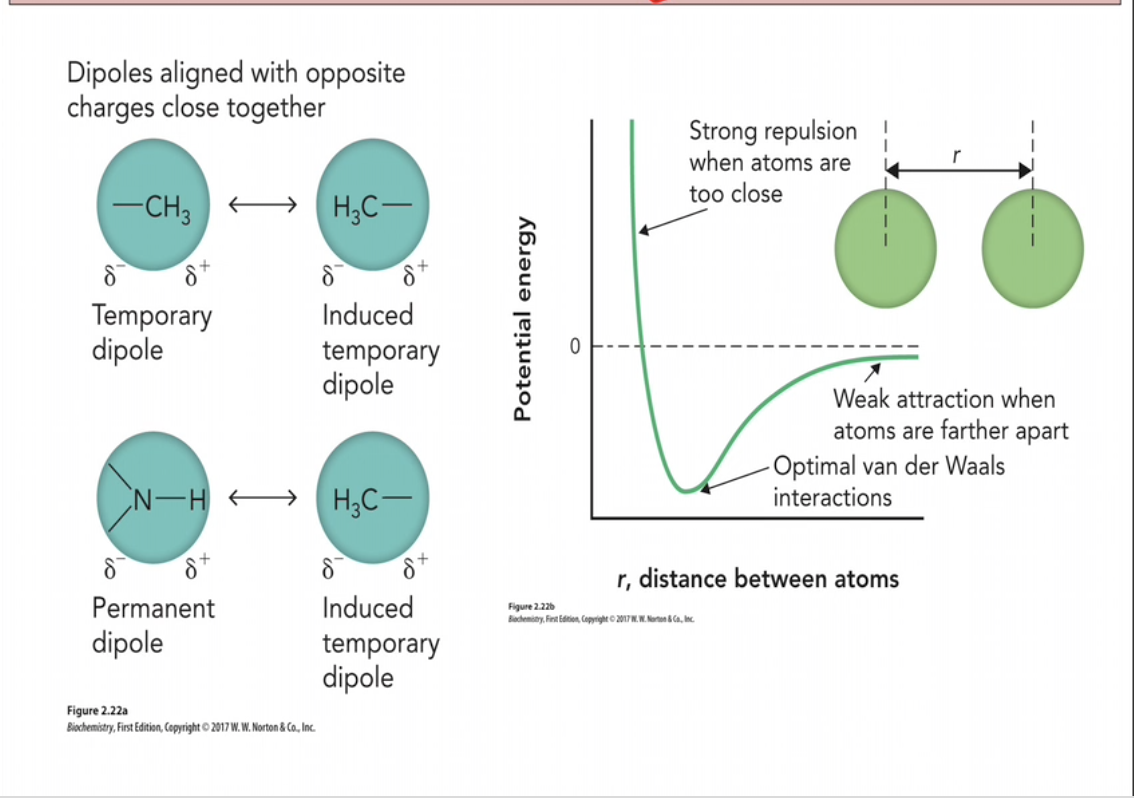
What are van der waals effects?
The electrons moving around an atom create small, temporary dipole moments which can interact with surrounding atoms. (Lecture 1.1 part 3 24:00)
All living organisms are _______ system with the environment?
Open — living organisms must give and receive energy/matter from our surroundings in order to survive
What is potential energy and give an example?
Potential energy is the likelihood that an object will perform an action
Ex: someone holding a brick above the ground
What is kinetic energy and give an example?
The energy from the movement of an object causing change
Ex: brick falling after being dropped from a persons hand
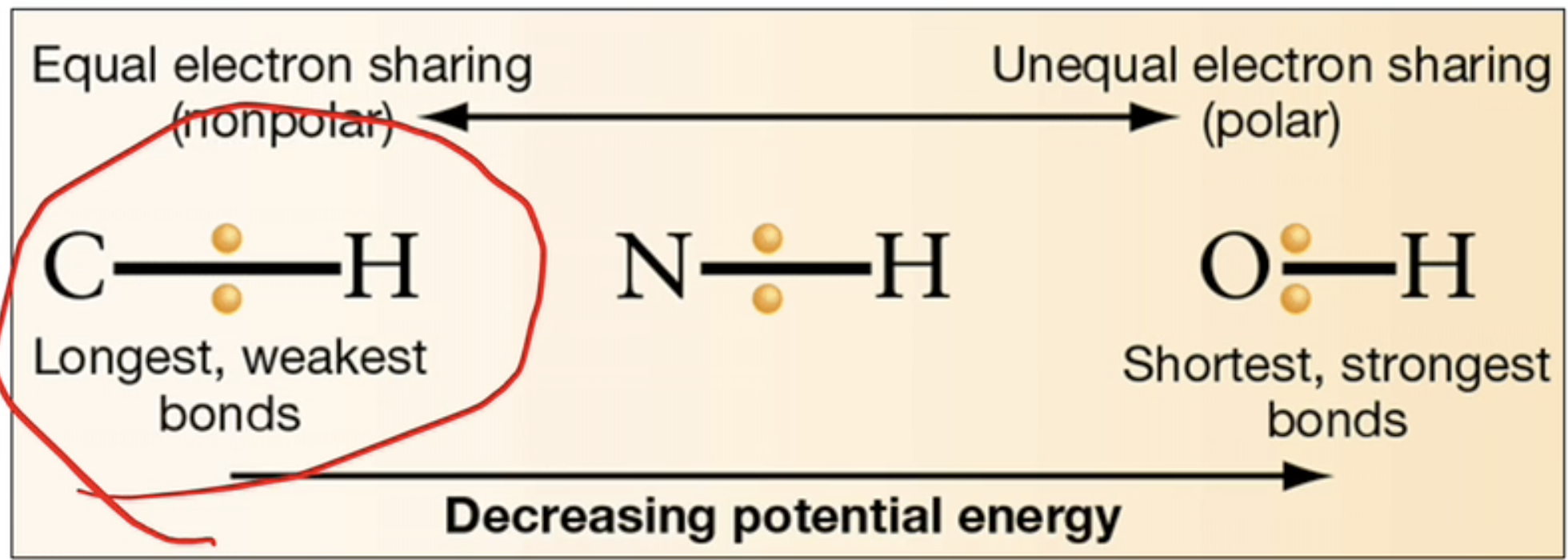
Label these bonds from longest to shortest and why?
O-H, N-H, C-H
C-H, N-H, O-H — oxygen is the most electronegative out of C and N making it pull electrons stronger to its core. This decrease the size of the bond with H
Label these bonds from highest to lowest potential energy and why?
O-H, N-H, C-H
C-H, N-H, O-H — oxygen is much less likely to give up electrons than carbon (Lecture 1.1, part 4, 6:00)
At equilibrium what is the Keq?
It depends on the reaction. Each reaction has a different Keq point based on the concentration of products and reactants.
How can a reaction be changed in order to reach equilibrium?
Change the [product] and [reactants]
What does a negative Δ S mean?
Decreased entropy (thermodynamically unfavorable)
What does a positive Δ S mean?
Increased entropy; more disorder (thermodynamically favorable)
What does a positive Δ H mean?
Increase in enthalpy (endothermic) (thermodynamically unfavorable)
What does a positive Δ H mean?
Decrease in enthalpy (exothermic) (thermodynamically favorable)
If Δ H is negative and Δ S is positive than Δ G is ____?
Always spontaneous (-ΔG)
If Δ H is negative and Δ S is negative than Δ G is ____?
Spontaneous at low temperature only
If Δ H is positive and Δ S is negative than Δ G is ____?
Always non-spontaneous
If Δ H is positive and Δ S is positive than Δ G is ____?
Only spontaneous at high temperatures
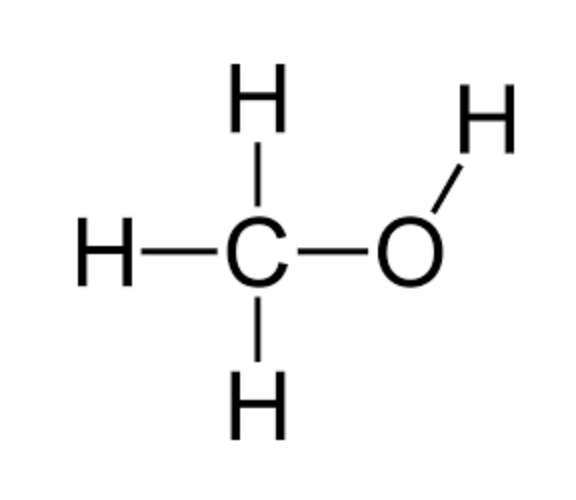
How many potential hydrogen bonds can this molecule have?
3
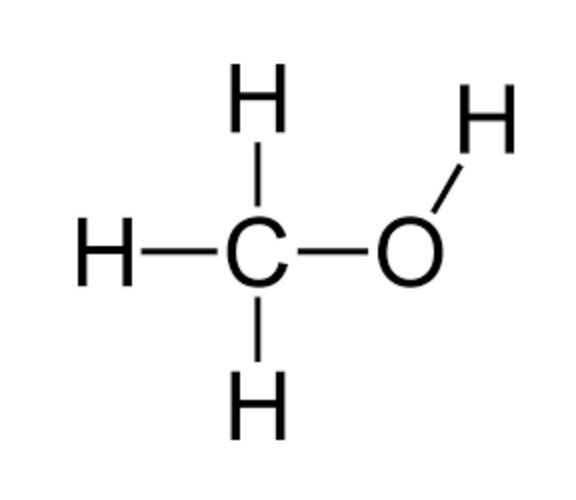
Which atom can act as a H-bond donor?
"H" attached to O
Which of the following statements about water are true? Select all that apply.
a) Liquid water is less hydrogen bonded than ice.
b) Water is a nonpolar molecule
c) Water is a key player in the energetics of hydrophobic interactions.
d) It has a low dielectric constant.
e) It dissolves salts and polar substances.
f) It can form a maximum of three hydrogen bonds per water molecule.
g) The electron-rich oxygen atom of one water molecule can interact with an electron-poor hydrogen on another water molecule to form a hydrogen bond.
a) Liquid water is less hydrogen bonded than ice.
c) Water is a key player in the energetics of hydrophobic interactions.
e) It dissolves salts and polar substances.
g) The electron-rich oxygen atom of one water molecule can interact with an electron-poor hydrogen on another water molecule to form a hydrogen bond.
Why are polar molecules more soluble
The dipolar moment can hydrogen bond with water, increasing solubility
Select all of the statements that are FALSE. (You should be able to explain why they are false.)
a) When a reaction is at equilibrium the concentration of products is equal to the concentration of reactants.
b) When a reaction is at equilibrium the rates of the forward and reverse reactions are equal.
c) When a reaction is at equilibrium no more products are formed.
d) When a reaction is at equilibrium the equilibrium constant is equal to 1.
e) When a reaction is at equilibrium the forward reaction continues to occur.
f) When a reaction is at equilibrium there is no net change in the concentrations of products or reactants.
a) When a reaction is at equilibrium the concentration of products is equal to the concentration of reactants.
c) When a reaction is at equilibrium no more products are formed.
d) When a reaction is at equilibrium the equilibrium constant is equal to 1

Assess the entropy changes that occur during photosynthesis. Which of the following would you expect to be true? Select all that apply.
a) the entropy change is favorable.
b) the entropy change is unfavorable.
c) the reaction creates more order.
d) the reaction creates more disorder.
e) ΔS is a positive number.
f) ΔS is a negative number.
b) the entropy change is unfavorable
c) the reaction creates more order
f) ΔS is a negative number

Assess the enthalpy changes that occur during photosynthesis. Which of the following would you expect to be true? Select all that apply.
a) the enthalpy change is favorable.
b) the enthalpy change is unfavorable.
c) the reaction produces products that are less stable (higher potential energy) than the reactants.
d) the reaction produces products that are more stable (lower potential energy) than the reactants.
e) ΔH is a positive number.
f) ΔH is a negative number.
b) the enthalpy change is unfavorable
c) the reaction produces products that are less stable (higher potential energy) than the reactants
e) ΔH is a positive number
Assess the entropy changes that occur as ice melts to water. Which of the following would you expect to be true? Select all that apply.
a) the entropy change is favorable.
b) the entropy change is unfavorable.
c) the reaction creates more order.
d) the reaction creates more disorder.
e) ΔS is a positive number.
f) ΔS is a negative number.
a) the entropy change is favorable.
d) the reaction creates more disorder.
e) ΔS is a positive number.
Assess the enthalpy changes that occur as ice melts to water. Which of the following would you expect to be true? Select all that apply.
a) the enthalpy change is favorable.
b) the enthalpy change is unfavorable.
c) the reaction produces products that are less stable (higher potential energy) than the reactants.
d) the reaction produces products that are more stable (lower potential energy) than the reactants.
e) ΔH is a positive number.
f) ΔH is a negative number.
b) the enthalpy change is unfavorable (absorbs heat)
c) the reaction produces products that are less stable (higher potential energy) than the reactants
e) ΔH is a positive number.
In the reaction of Hydrolysis of ATP from ADP and Pi at 25°C. If the ΔG°' = -30.5 and ΔG = -52.0 that means that…
In the cell, the [ATP] is _____ than at equilibrium, thus ____ energy is released when ATP is hydrolyzed in a cell than when hydrolyzed at standard conditions.
Higher ; more. A more negative ΔG means the reaction is being pushed farther away from equilibrium than at standard conditions.
What is the Ideal gas constant (R)
8.315 × 10⁻³ kJ/molK
How do you convert from kJ/mol to J/mol
multiply by 1000
How do you convert from J/mol to kJ/mol
divide by 1000