Cardio: Exam 4 (Tsu)
 Call Kai
 Learn
Learn Practice Test
 Spaced Repetition
 Match
Match Flashcards
 Knowt Play
1/87

There's no tags or description
Looks like no tags are added yet.
Name | Mastery | Learn | Test | Matching | Spaced | Call with Kai | Chat |
|---|
No analytics yet
Send a link to your students to track their progress
88 Terms
ACS patients should be asssesed for _ therapy in the emergency department. Explain all the indications.
MONA
Morphine:
If chest pain not relieved by NTG
Caution: can slow absorption of oral antiplatelet activity
Oxygen: if O2 sat < 90%
Can increase coronary vascular resistance and reduce coronary blood flow so only use if needed
Nitroglycerin: if chest pain ongoing, 0.4 mg SL x 3 doses, then IV infusion
Aspirin for everyone: Chew 162 – 325 mg tablet
Optional in ED
Beta-blocker (oral) within 24 hours if no contraindications
Moprhine dosing
2-4mg IV PRN q 5-15 minutes
What are the two main treatments for ACS (Stem I)?
PCI
Fibrinolytics
Alteplase
Reteplase
Tenecteplase
When would fibrinolytics be used for STEM I instead of PCI?
If transfer to PCI-capable hospital means that first medical contact (FMC)-to-PCI would be >120 minutes
Fibrinolytics for STEMI has the most benefit when administered within _ hours.
Can still give if between 12 – _ hours if ongoing ischemia.
12
12-24
What is the door-to-needle time for fibrinolytics for STEMI?
<30 minutes
What are the absolute contraindications to fibrinolytics for ACS?
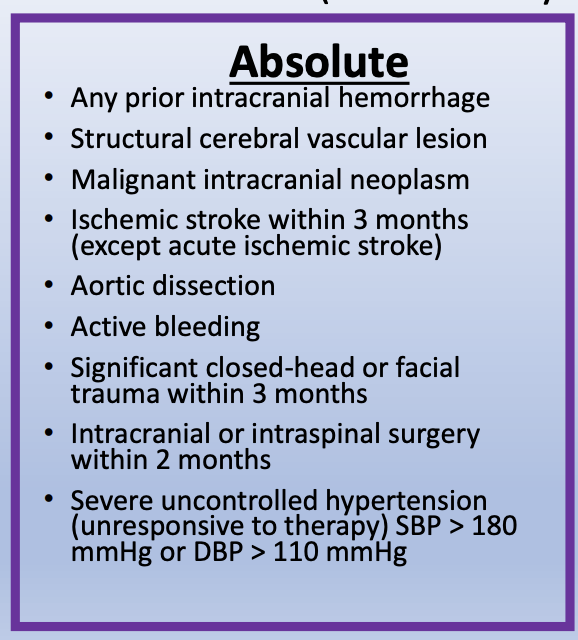
UFH ACS Dosing
60 units/kg IV, then 12 units/kg/hour
UFH VTE Dosing
80 units/kg, then 18 units/kg/hour
Enoxaparin (Lovenox) Dosing ACS & VTE
1mg/kg SC q12h
For patients with ACS, how long is aspirin prescribed for?
Lifelong
RT is an 80 year-old, 80kg female who is admitted to your hospital, and is diagnosed with STEMI. She states her chest pain started 1 hour ago.
PMH: HTN, DM Vitals: BP 200/102, HR 92.
The nearest hospital with a cardiac catheterization lab is 2.5 hours away. You receive an order for alteplase.
Does this pt meet have any absolute contraindications to fibrinolytics?
Should this patient be transferred to hospital with cardiac catheterization laboratory?
How soon must the Alteplase be prepared and administered to the pt?
What other medications should be given in conjunction with Alteplase?
“Maybe.” SBP > 180 mmHg → Start IV antihypertensives to decrease her BP so that we can still give fibrinolytic
No, only transfer if first medical contact to PCI-facility would be <120 minutes. Just give fibrinolytic instead of PCI
Within 30 minutes (door-to-needle time)
UFH/Enoxaparin or Fondaparinux PLUS
Aspirin PLUS
Clopidogrel
What is FMC-to-device (balloon) time?
<90 minutes
What anti-coagulation therapy can be given with fibrinolytics?
At least 48 hours, up to 8 days
UFH 60 units/kg IV then 12 units/kg/hour
Enoxaparin 1mg/kg SC q12h
Fondaparinux
What anti-platelet therapy can be given with fibrinolytics?
Aspirin 81-325 mg daily indefinitely AND
Clopidogrel for 14 days – 1 year
Which of the following statements regarding PCI in STEMI patients is most accurate?
A. Patients should be transferred to PCI-capable hospital if FMC-to-PCI is <180 minutes
B. PCI is more effective than fibrinolytics at opening arteries, but there is no difference in bleeding rates
C. Patients do not need MONA(B) therapy if a PCI is planned
D. The door-to-device (balloon) time is < 90 minutes
A. Patients should be transferred to PCI-capable hospital if FMC-to-PCI is <180 minutes
>120 minutes
B. PCI is more effective than fibrinolytics at opening arteries, but there is no difference in bleeding rates
Fibrinolytics has a higher bleeding risk
C. Patients do not need MONA(B) therapy if a PCI is planned
Still do, everybody should geta MONA (B) therapy for s/x management
D. The door-to-device (balloon) time is < 90 minutes
What do the differing TMI scores indicate?
Invasive vs Conservative Therapy in NSTEMI/UA
0-2: Low isk → Conservative
3-4: Medium Risk → Conservative or Invasive
5-7: Medium Risk → Invasive
BV is a 54 year old female how presents to the hospital with an NSTEMI. Her calculated TIMI score is 4, which is an intermediate risk score. Which statement is most accurate regarding management for BV?
A. She should get conservative therapy, which includes CABG surgery
B. She should get invasive therapy, which includes medical management with pharmacotherapy only
C. She could get either invasive or conservative therapy
D. Further testing is needed to determine type of therapy needed
A. She should get conservative therapy, which includes CABG surgery
CABG surgery = Very invasive
B. She should get invasive therapy, which includes medical management with pharmacotherapy only
Conservative is inpatient ASA (indefinitely), P2Y-12 (1 year) + Anticoag (UFH x 48 hours, LMWH, or Fondaparinux x hospital duration)
C. She could get either invasive or conservative therapy
D. Further testing is needed to determine type of therapy needed
Eptifibatide and Tirofiban Indication
STEM or NSTEMI with or without PCI
T/F: Fibriniolytics are used for NSTEMI/UA
F → No fibrinolytics
Reduce Eptifibatide (Integrillin) when CrCl < [] for [] hours.
Reduce Tirofiban (Aggrastat) when CrCl < [] for [] hours.
Eptifitabide (Integrillin): 50, 18
Tirofiban (Aggrastat): 30, 12
You are the hospital pharmacist verifying orders for the CCU. The medical intern asks you for recommendations for a GP2b/3a inhibitor for an 80- year old pt who was admitted for a STEMI and is going to the cath lab. His Scr is elevated, with a CrCl of 40 mL/min. Other pertinent labs are WNL.
Which of the following is the BEST option for this pt?
A. Tirofiban at standard dose for 48 hours
B. Tirofiban at reduced dose for 12 hours
C. Eptifibatide at standard dose for 48 hours
D. Eptifibatide at reduced dose for 18 hours
A. Tirofiban at standard dose for 48 hours
B. Tirofiban at reduced dose for 12 hours
When CrCl <30
C. Eptifibatide at standard dose for 48 hours
D. Eptifibatide at reduced dose for 18 hours
Which P2Y-12 inhibitors are preferred for PCI? For non-invasive approach?
Prasugrel and Ticagrelor
Non-invasive: Ticagrelor
Clopidogrel (Plavix) dosing
300-600 mg x1, then 75mg daily
Prasugrel (Effient) dosing
60 mg x1, then 10 mg PO daily
Ticagrelor (Brillinta) dosing
180 mg x1, then 90mg PO BID
What are Ticagrelor (Brilinta) C/I?
H/O ICH
Use with aspirin doses > 100 mg decreases effectiveness (only give ASA doses 75-100mg)
Prasugrel C/I
History of TIA or stroke,
Age > 75, Weight <60 kg
Clopidogrel C/I
2C19 Inhibitors
Our 80-year old pt with a STEMI also requires an oral P2Y12 inhibitor in addition. PMH: uncontrolled HTN, hyperlipidemia, TIA 2006. He only wants to take a medication dosed once a day.
Which of the following would be the best recommendation for this pt?
A. Clopidogrel B. Prasugrel C. Ticagrelor D. Cangrelor
A. Clopidogrel
300-600 mg x1, then 75 mg daily
B. Prasugrel
C/I w TIA
C. Ticagrelor
180 mg x 1 then 90 mg BID → Wants dose once a day
D. Cangrelor
IV → Wants oral
Ticagrelor should be avoided in strong CYP _ inhibitors and inducers
3A4
How long must a patient hold on Clopidogrel, Prasugrel, Ticagrelor, Cangrelor prior to CABG?
Clopidogrel: 5
Prasugrel: 7
Ticagrelor: 3-5
Our same patient is re-admitted to the hospital for recurrent chest pain, and is diagnosed with acute stent thrombosis. He states that he has been compliant with all of his medications. He is then switched to ticagrelor therapy. Which of the following statements is most accurate regarding ticagrelor?
A. Patient must be on aspirin 325 mg
B. Review the patient’s chart for any CYP 2C19 inhibitors
C. Counsel the patient on initial adverse effect of trouble breathing
D. If planning for CABG, must hold for 7 days
A. Patient must be on aspirin 325 mg
C/I w/ Aspirin >100 mg
B. Review the patient’s chart for any CYP 2C19 inhibitors
More related to Clopidogrel
C. Counsel the patient on initial adverse effect of trouble breathing
D. If planning for CABG, must hold for 7 days
Hold 3-5 days
Which anticoagulant in PCI requires renal adjustment?
LMWH
Which anticoagulant in PCI is usually discontinued immediately after PCI?
UFH
Which anticoagulant in PCI is not recommended during PCI due to catheter thrombosis?
Fondaparinux
Which statement regarding anticoagulants in PCI is most accurate?
A. UFH requires renal adjustment
B. Enoxaparin is monitored in cath lab with aPTT
C. It should be continued for 12 hours after PCI
D. Bivalirudin should be used if there is concern for HIT
A. UFH requires renal adjustment
Usually discontinued immediately after PCI
LMWH requires renal adjustment
B. Enoxaparin is monitored in cath lab with aPTT
Cannot be monitored at bedside
C. It should be continued for 12 hours after PCI
All anticoags are only for DURING PCI
D. Bivalirudin should be used if there is concern for HIT
Reduce _ if CrCl <30
Enoxaparin
What is the monitoring for UFH, Enoxaparin, Fondaparinux, and Bivalirudin?
UFH: aPTT/ACT, HIT, bleeding
Enoxaparin: Scr, HIT, bleeding
Fondaparinux: Scr, bleeding
Bivalirudin: Scr, bleeding (use if h/o HIT)
What are the discharge medications for post-MI for secondary prevention?
Aspirin 81 mg (indefinitely)
Clopidogrel/Prasugrel/Ticagrelor (x12 months)
B-Blocker
ACEI/ARB if EF <40%, anterior MI, diabetes, or hypertension
Statin (high-intensity)
MRA if EF <40%
Nitroglycerin SL (PRN)
Duration of Aspirin and P2Y12 inhibitor in ACS
Aspirin: Lifelong
P2Y12 Inhibitor: 1 year
In triple therapy for ACS, what P2Y12-Inhibitor is preferred?
Clopidogrel
In DAPT (Aspirin + Ticagrelor), you discontinue aspirin [] - [] months post PCI and then [] monotherapy
1-3 months
Ticagrelor
For triple therapy, discontinue aspirin []-[] week post PCI and then start [] monotherapy and []
1-4 week
Clopidogrel, OAC
HY is a 67-year-old male who undergoes PCI for a STEMI and receives 2 drug-eluting stents. Which antiplatelet regimen and duration is most appropriate for HY?
A. Aspirin and clopidogrel lifelong
B. Aspirin and ticagrelor for one year, then aspirin lifelong
C. Ticagrelor and aspirin for one year, then ticagrelor lifelong
D. Aspirin and clopidogrel for one year
E. Aspirin and clopidogrel for 6 months, then aspirin lifelong
A. Aspirin and clopidogrel lifelong
Must stop Clopidogrel
B. Aspirin and ticagrelor for one year, then aspirin lifelong
C. Ticagrelor and aspirin for one year, then ticagrelor lifelong
Aspirin must be lifelong
D. Aspirin and clopidogrel for one year
E. Aspirin and clopidogrel for 6 months, then aspirin lifelong
RE is an 81-year-old female who receives a drug-eluting stent after a PCI for her NSTEMI. She is also taking apixaban for her AF. Which antiplatelet regimen is most appropriate for RE?
A. Aspirin, clopidogrel, and apixaban for one year, then continue apixaban lifelong
B. Aspirin and prasugrel for one year, then switch to apixaban lifelong
C. Ticagrelor and apixaban lifelong
D. Aspirin, clopidogrel, and apixaban for one month, then clopidogrel and apixaban for 11 months, then apixaban lifelong
E. Aspirin and ticagrelor for one year, then aspirin lifelong
A. Aspirin, clopidogrel, and apixaban for one year, then continue apixaban lifelong
B. Aspirin and prasugrel for one year, then switch to apixaban lifelong
C. Ticagrelor and apixaban lifelong
D. Aspirin, clopidogrel, and apixaban for one month, then clopidogrel and apixaban for 11 months, then apixaban lifelong
E. Aspirin and ticagrelor for one year, then aspirin lifelong
Which statement is most accurate regarding CABG therapy?
A. Prasugrel should be held 5 days prior to surgery
B. It is preferred over PCI if patients are diabetic or have multi-vessel CAD
C. It is less invasive than PCI
D. Non-DHP CCBs are preferred over BBs for rate control
A. Prasugrel should be held 5 days prior to surgery
Clopidogrel
Prasurgel → 7
B. It is preferred over PCI if patients are diabetic or have multi-vessel CAD
C. It is less invasive than PCI
D. Non-DHP CCBs are preferred over BBs for rate control
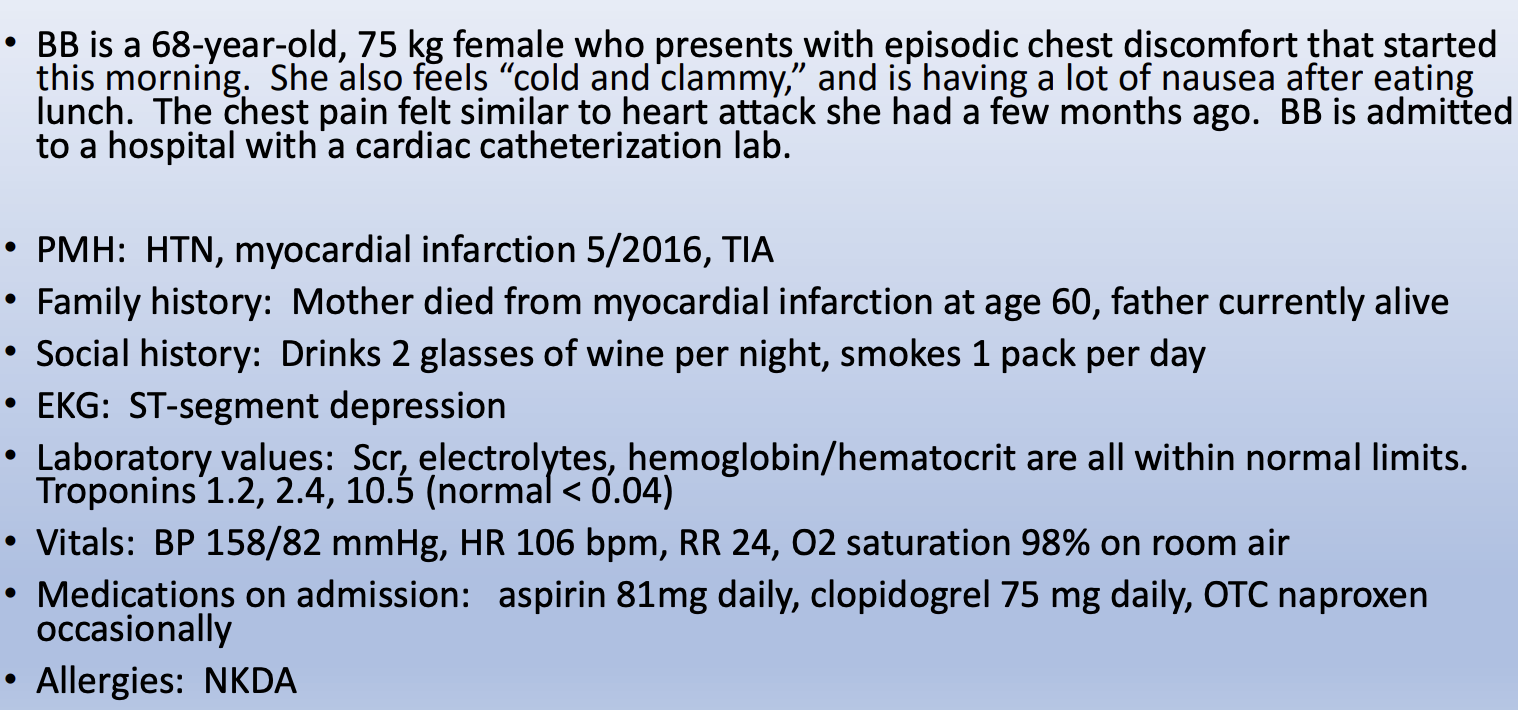
Initial management
What type of ACS does BB have?
What medications should we give in the ED?
How should we determine how to treat BB for her ACS?
BB goes to cath lab for PCI
What anti-platelet medications should she receive?
What anticoagulant medications should she receive?
Initial management
NTSEMI
If still having chest pain, continue SL nitroglycerin and consider morphine. Aspirin 325 mg. Metoprolol2 5 mg PO.
Calculate TIMI score.
BB goes to cath lab for PCI
Alr got aspirin in ED → needs P2Y12 inhibitor and maybe a GBPII/III Inhibitor, SCR is WNL, so can use standard dose of tirofiban/eptifibatide, Was already on clopidogrel at home. History of TIA → cannot use prasurgel. Either clopidogrel or ticagrelor is fine
SCR is WNL, so
BB goes to CABG
How long must BB wait before getting CABG, and why?
5 days since pt was taking clopidogrel at home
What anticoagulant is preferred in CABG?
UFH
What if BB has a concern for HIT?
Use bivalirudin
Should a GP 2b/3a inhibitor be used in CABG?
No, only anticoagulations are used in CABG
BB gets medical management only
Why would BB get medical management only?
If she had a low TMI score, or was too higih-risk for invasive procedures (PCI or CABG)
What types of medications should BB get?
ASA and portentially a P2Y12-, anticoaguant only during hospitalization, and then all
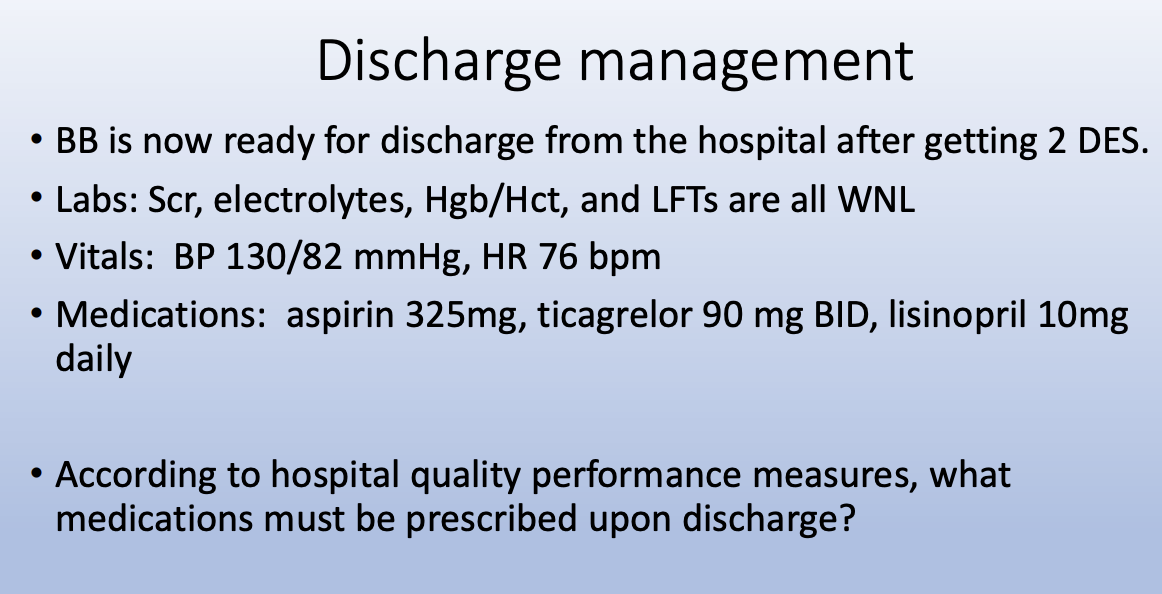
According to hospital quality performance measures, what medications must be prescribed upon discharge? Discharge management • What recommendations would you make regarding BB’s: • Anti-platelet therapy? • Antihypertensive therapy? • Anti-hyperlipidemia therapy? • How long should BB continue on her secondary prevention medications?
Aspirin at discharge (as well as upon arrival to hospital)
P2Y12-I
B-blocker
Statin
ACE/ARB if left ventricular dysfunction (EF <40%)
Which of the following statements regarding signs and symptoms (s/sx) is most accurate for pts with acute HF?
A. Most pts present with hypotension and renal impairment
B. Pulmonary congestion is a s/sx of hypoperfusion
C. Shortness of breath and peripheral edema are common s/sx of volume overload
D. Pts can have congestion or hypoperfusion but not both
A. Most pts present with hypotension and renal impairment
Congestion + fluid overload
Hypotension + renal impairment = hypoperfusion s/x
B. Pulmonary congestion is a s/sx of hypoperfusion
s/sx of Fluid overload
C. Shortness of breath and peripheral edema are common s/sx of volume overload
D. Pts can have congestion or hypoperfusion but not both
Can have both
T/F: BNP is usually elevated in HF.
T
What can be used to determine if heart failure is classified as HFrEF or HFpER?
HFrEF
Which of the following statements is most accurate regarding work-up of the acute HF pt? A. A high BNP level determines if the pt has HF
B. Use of NSAIDS and non-DHP CCBs can precipitate ADHF
C. Hypertension is a worse prognostic indicator than hypotension
D. BNP levels can determine if the pt has systolic (HFrEF) or diastolic HF (HFpEF)
A. A high BNP level determines if the pt has HF
BNP is usually increased in HF but does not determine it
High BNP = volume overload
B. Use of NSAIDS and non-DHP CCBs can precipitate ADHF
C. Hypertension is a worse prognostic indicator than hypotension
Hypotension is a worse prognostic indicator than hyperevention even though they’re both not good!
D. BNP levels can determine if the pt has systolic (HFrEF) or diastolic HF (HFpEF)
Echocardiogram
If Cl < 2.2 on cardiac index patient is _
Hypoperfused
If PCWP > 18 pt has _
Pulmonary congestion
Restrict sodium and fluids to _, inpatient for ADHF. Discuss how much to do if done together.
Na+: <2 grams daily
Fluids: <2 liters daily
What should be considered in hospitalized patients for diuretics?
Administer IV
Give dose greater than home dose
Goal is to titrate to relief of symptoms and adequate urine output without causing intravascular depletion
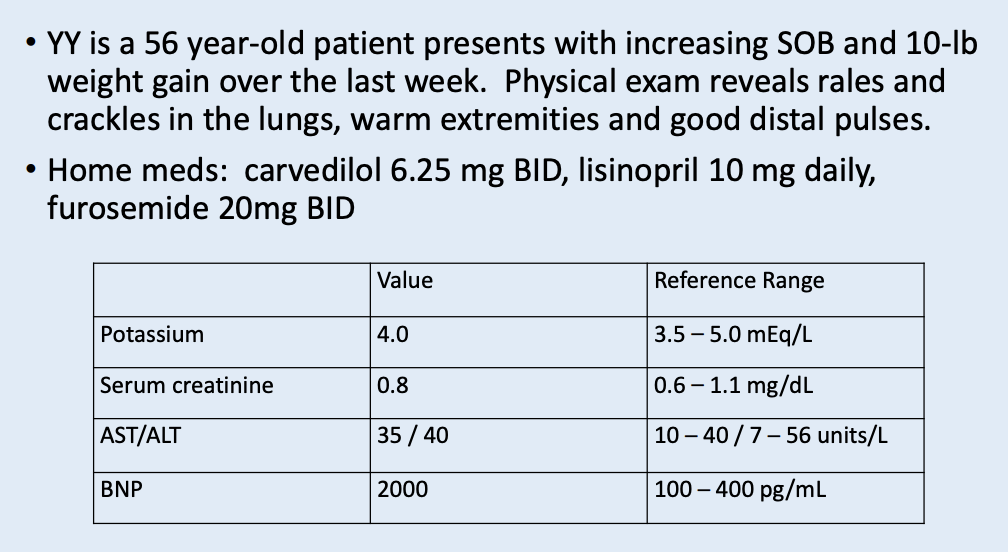
What Forrester classification would YY fit into?
What is your initial recommendation for diuretic dosing?
If YY doesn’t respond to your recommendation above, what alternative strategies can you recommend?
What Forrester classification would YY fit into?
2 → S/SX of congestion but no hypoperfusion
What is your initial recommendation for diuretic dosing?
Calculate total daily dose PO, then give 1-2.5x as IV route
If YY doesn’t respond to your recommendation above, what alternative strategies can you recommend?
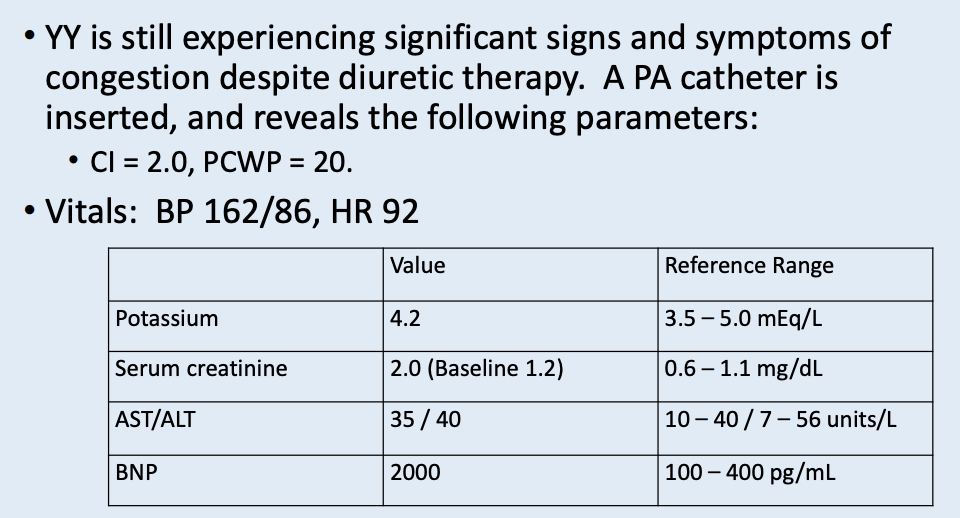
Does this pt meet criteria to use a vasodilator?
If yes, which vasodilator would you choose?
A. Nitroglycerin B. Nitroprusside C. Nesiritide D. Milrinone
Does this pt meet criteria to use a vasodilator?
Yes, refractory to diuretics, SBP > 90 mmHg
A. Nitroglycerin
B. Nitroprusside
S.E: Hepatic/renal dysfunction
C. Nesiritide
D. Milrinone
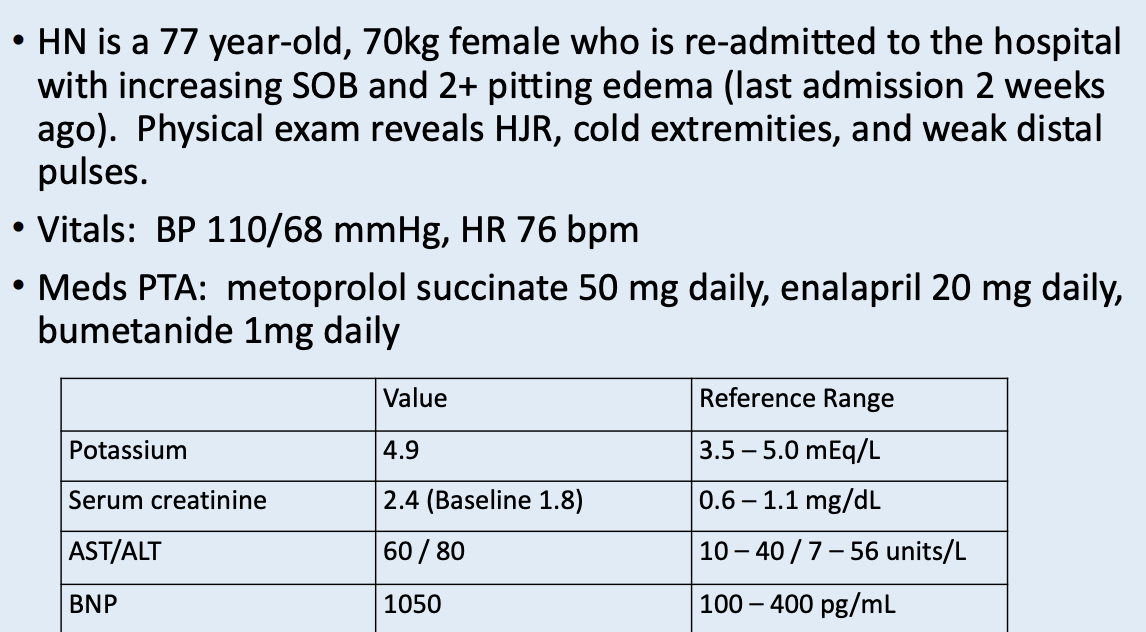
Which Forrester classification would HN best fit into?
What dosing of diuretic would you recommend for HN initially?
If HN is still symptomatic after diuretic therapy, which of the following medication therapy would be best in this pt? Why?
A. Milrinone B. Dobutamine C. Nitroprusside D. Nitroglycerin E. Dopamine
Which Forrester classification would HN best fit into?
Cold and wet (Congestion (edema, HJR, BNP) and hypoperfusion (cold extremities)) (Subset 4)
What dosing of diuretic would you recommend for HN initially?
Bumetadine 1mg-2.5 mg IV, monitor closely due to elecated Scr
Which med?
Should be a vasodilator → Nitroprusside or Nitroglycerin
(NG is best option, not impacted by hepatic/renal dysfunction)
Milrinone and Dobutamine → Inotropics (3rd line)
Pharm treatment for HFrEF (chronic H.F)
ACEI/ARB/ANRI (preferred)
B-Blocker
MRA
SGLT2-I
Select populations:
Digoxin
Hydralazine/Isosorbide dinitrate
Ivabradine
Vericiguat
Pharm treatment for HFpEF (chronic H.F)
SGLT2-I
ARNI
ARNI (Valsartan/Sacubutril → Entresto): Place in Therapy
Preferred over ACEI/ARB in HFrEF
ARNI can be substituted for ACEI or ARB in NYHA class [] or []
2 or 3
/// NYHA Classification
1: No limitation on physical activity
2: Slight limitation on physical activity, ordinary physical activity results in HF symptoms
3: Marked limitation on physical activity, less than ordinary activity causes HF s/x
4: Unable to carry on any pjysica lactivity without HF s/x, or s/x of HF at rest
What pharm treatment combination should be considered if patients are not tolerating ACE-Is or ARBs?
Hydralazine and an oral nitrate
Which statement regarding ACE inhibitors and ARBs is accurate?
A. ARBs are superior to ACE inhibitors in HF since they specifically block the AT1 receptors
B. ARBs can be substituted for ACE inhibitors if pt develops hyperkalemia
C. Both classes should be titrated to target doses in HF
D. Hydralazine/ISDN should be substituted for ACE inhibitor if pt develops a dry cough
A. ARBs are superior to ACE inhibitors in HF since they specifically block the AT1 receptors
ACE-I MOA
B. ARBs can be substituted for ACE inhibitors if pt develops hyperkalemia
Also an ARB S.E
Hydralazine/ISDN
C. Both classes should be titrated to target doses in HF
D. Hydralazine/ISDN should be substituted for ACE inhibitor if pt develops a dry cough
ARBs should be tried
ANRI should not be used in patients with history of _
Angioedema
When may B-blockers be recommended in particular for HF?
Prior MI, recurrent MI, and the development of HF.
T/F: Digoxin improves mortality in HF
F → Does not
ARNI should not be used concomitantly with ACEI or within _ hours of last dose of ACEI
36
ARNI can be substituted for ACEI or ARB in NYHA class _ or _
II or III
Digoxin target serum concentrations in HF
0.5-0.8 ng/mL in HF
Which medication is approved for use in African American patients in addition to standard therapy?
Hydralazine/Isosorbide dinitrate
Beta blockers should be titrated to target doses every _
2 week intervals
Which statement is most accurate regarding chronic therapy in HF patients?
A. Beta blockers should be titrated to target doses every 4-6 weeks
B. Target digoxin concentrations should be 1-2 ng/mL
C. MRAs have been proven to be most beneficial in African Americans
D. Only metoprolol succinate, not tartrate, is beneficial
A. Beta blockers should be titrated to target doses every 4-6 weeks
2 weeks
B. Target digoxin concentrations should be 1-2 ng/mL
0.5-0.8 ng/mL
C. MRAs have been proven to be most beneficial in African Americans
Hydralazine/Isosorbide Dinitrate
D. Only metoprolol succinate, not tartrate, is beneficial
T/F: Non-DHP CCBs can be usd in HFrEF but not in HFpEF
F → Can be used in HFpEF, NOT(!!) HFrEF
A MRA should be closely monitored for [] and []
Scr
K
Most common AE in Vericiguat
Hypotension
In what patient can Ivabradine help in? MOA?
Reduce HF hospitalizations in pts with symptomatic HFrEF NYHA Clas II-III, already receiving BB at max tolerated dose, resting HR > 70 bpm
MOA: Selectively inhibits If in SA Node
T/F: Digoxin improves mortality in HF
F → Does not improve mortality
Which statement is accurate regarding HF therapy?
A. Vasopressin antagonists should replace loop diuretics if pts develop hyponatremia
B. Ivabradine helps to reduce hospitalization in HF pts who are on maximum doses of BB C. Valsartan/sacubitril is similar in efficacy to ACEI/ARB
D. Valsartan/sacubitril should be used with combination of ACE inhibitor and BB
A. Vasopressin antagonists should replace loop diuretics if pts develop hyponatremia
Can help with hyponatremia but they do not replace loop diuretics to improve congestion
B. Ivabradine helps to reduce hospitalization in HF pts who are on maximum doses of BB C. Valsartan/sacubitril is similar in efficacy to ACEI/ARB
Preferred over ACEI/ARB in HFrEF
D. Valsartan/sacubitril should be used with combination of ACE inhibitor and BB
Should not be used in combination w/ ACE-I → Increased risk of edema
Can be used with B-blocker but not with an ACE-I at the same time
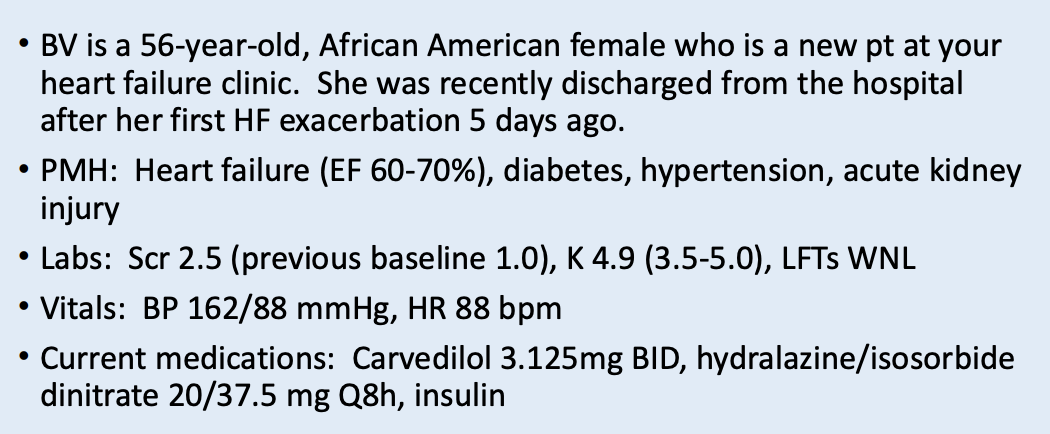
Evaluate the following potential changes in therapy for BV
Need for hydralazine/isosorbide
Addition of ACE inhibitor or ARB or ARNI
Increase of BB dose to target dose in HF
Since this is BV’s first visit to your HF clinic, what type of HF education should a pharmacist or pharmacy student provide?
What should the pt be self-monitoring at home?
What type of HF does BV have?
HFpEF (>50 levels)
Need for hydralazine/isosorbide
Unclear benefit in HFpEF.
Addition of ACE inhibitor or ARB or ARNI
Not currently d/t unstable renal function and risk of hyperkalemia
ARNI preferred over ACEI/ARB in HFpEF once renal function is back to baseline
Increase of BB dose to target dose in HF
Yes, but uptitrate in 2 week intervals
Since this is BV’s first visit to your HF clinic, what type of HF education should a pharmacist or pharmacy student provide?
Education regarding slow and cautious titration of HF meds
Education on long-term benefits of HF meds
Dietary counseling
What should the pt be self-monitoring at home?
Weight, fluid intake and output, BP
Shortness of breath
TB is a 68-year old Caucasian male who was recently discharged from the hospital 3 days ago for HF exacerbation. This is his second hospitalization for HF symptoms in the last 3 months.
Past medical history: Heart failure (EF 30-35%), myocardial infarction 2013, hypertension, hyperlipidemia, depression.
Current medications on discharge: aspirin 81 mg daily, furosemide 20 mg BID, sacubitril/vasartan 49/51 mg BID, atorvastatin 40mg daily, sertraline 20mg daily.
Labs: Scr 1.2 (baseline 1.2), LFTs and electrolytes WNL, Vitals: BP 138/76 mmHg, HR 72 bpm
What type of HF does TB have?
HFrEF (EF 30-35%)
The pt has a new Rx for sacubitril/valsartan, but hasn’t filled the prescription yet. He asks you for your advice on this medication.
Can take Entresto!
He was recently told to stop his lisinopril and start this new medication. What do you tell TB regarding: Wait 36 hours to take w/ Lisinopril
Benefits of Entresto?
Decreases hospitalizations and HF deaths compared to this precious ACEI
Monitoring of Entresto?
Angioedema, BP (hypotension)
Evaluate the following potential changes to TB’s medication regimen:
If TB is euvolemic (back to normal fluid status), discontinue furosemide.
Not at this time. Can only be done with selected pts who are stable. TB was recently hospitalized.
Addition of BB. If so, which one?
Yes→ Lowest dose of Metoprolol Succinate or Carvedilol or Bisoprolol
Addition of mineralocorticoid antagonist.
Yes → Spironolactone. Scr and K are OK today, need to monitor closely with combination fo Entresto (likely q2-4wks.)
Addition of dapagliflozin.
Yes! Can consider, or if you start MRA today, could wiat until next visit.
TB is a 56 year old, Hispanic male with HF with reduced EF (EF 30- 35%). His current list of medications include: • Aspirin 81mg PO daily • Clopidogrel 75mg PO daily • Metoprolol succinate 25mg PO daily • Simvastatin 40mg PO QHS • Bumetanide 1mg PO daily
Which of TB’s current medications improve clinical outcomes in HF?
Metoprolol Succinate, Bumtetanide (only for volume control, does not prevent HF from progressing)
Which medications could be added to TB’s regimen to improve clinical outcomes in HF?
ARNI (or ACEI/ARB)
Once added → MRA and SGLT2 Inhibitor
Digoxin could be added too _
How would this change if TB were African American?
Hydralazine/Isosorbide dinitrate
NM is a 56 year old, Caucasian female with HF with preserved EF (EF 60-70%). Her current list of medications include
Aspirin 81mg PO daily
Diltiazem ER 120mg PO daily
Pravastatin 80mg PO QHS
Which of NM’s current medications improve clinical outcomes in HF?
Which medications could be added to NM’s regimen to improve outcomes?
Which of NM’s current medications improve clinical outcomes in HF?
None
Which medications could be added to NM’s regimen to improve outcomes?
SGLT2-I
Then consider ARNI, MRA, ARB (if no ARNI)