Div I Exam 1
 Call Kai
 Learn
Learn Practice Test
 Spaced Repetition
 Match
Match Flashcards
 Knowt Play
1/86

There's no tags or description
Looks like no tags are added yet.
Name | Mastery | Learn | Test | Matching | Spaced | Call with Kai | Chat |
|---|
No analytics yet
Send a link to your students to track their progress
87 Terms
variation at all levels of biological organization
biodiversity
types of biodiversity
genetic, ecological, organismal
species-level biodiversity
organismal biodiversity
the largest scale of biodiversity, ecosystem-level
ecological biodiversity
the smallest scale of biodiversity
genetic diversity
diversity on a local scale; within a particular area/ecosystem
alpha diversity
turnover rate between ecosystems, involves the count of species that are unique to just one of the two ecosystems
beta diversity
overall regional diversity; large-scale
gamma diversity
hierarchical filing system that organizes all organisms
Linnaean hierarchy
how biodiversity is studied, mostly using evolutionary lines
systematics

simplified visualization of a taxon's evolutionary history, typically shows progression from ancestral to most evolutionarily derived
cladogram
newly derived character state shared by all members of a taxon, chosen by distinctive morphological traits
synapomorphy
a group all derived from a common ancestor
clade
includes most recent common ancestor and all its descendants (clade)
monophyletic group
includes a common ancestor and some, but not all, of that ancestor's descendants
paraphyletic group
grouping derived from more than one common ancestor (better to refine these into monophyletic groups)
paraphyletic group
a taxon that serves as a reference group for other taxa in a cladogram; relatively closely related, but not too closely
outgroup
applied, goal-oriented science that focuses on protecting and restoring Earth's biodiversity and natural ecosystem
conservation
____ for conservation are economic benefits from consuming or experiencing a resource; includes timber, medicinal plants, ecotourism
use values
____ for conservation are values associated with natural resources that does not concern human use or economic benefit
non-use values
conservation "in the wild," includes establishing protected areas and restoring ecosystems
in situ
conservation in captivity/controlled environment; includes seed banks, zoos, and culture collections
ex situ
when a species is only found in a single limited area
endemism
endemism ___ from poles to equator
increases
endemism peaks on ____
remote islands
alpha, beta, gamma are ____ of biodiversity
spatial patterns
number of species in a given area
species richness
abundance of each species in a given area
species evenness
percentage of described extant species that are vertebrate animals
2-3%
percentage of described extant species that are plants
18-20%
percentage of described extant species that are invertebrate animals
66%
percentage of described extant species that are fungi
8%
percentage of described extant species that are bacteria
<1%
total count of described extant species on Earth
1.5-2.5 million
singular reference specimen for a species
holotype
identical specimen collected at same time and place as holotype
isotype
identical specimen collected at different time or place than holotype
paratype
ecological principle stating that larger geographic areas contain a greater number of species
species-area relationship
method of measuring biodiversity that uses patterns of description to estimate cumulative unknown species
patterns of species description
one can use ____ where species number is well known to estimate biodiversity over larger areas
well studied areas
quantitative measures of diversity using richness, evenness, and dominance as core components
diversity indices
measures uncertainty or entropy in predicting the species identity of a randomly chosen individual, factoring in both richness and evenness
shannon-wiener index (H’)
the first person in Western science to create a formal system for grouping and organizing living things, introduced early versions of genus and species, divided organisms into plants vs. animal
aristotle
first to organize like organisms in genera
greeks and romans
period during which the polynomial system was invented, when people began using Latin to record names (AD 500-1500)
Middle Ages
descriptive terms added to genus name to refer to a particular organism, could become very long
polynomial system
modern system for describing a particular organism using two words (genus species)
binomial system
developed the binomial system
carolus linnaeus
holotype, isotype, and paratype are all types of ____, which are deposited when describing a new species
type specimens
first step to describe a new species, in order to document evidence
take photos and DNA samples
second step to describe a new species, in order to document analysis
observe morphology and record a description
third step to describe a new species, in order to ensure the species has not already been described
check field guides
fourth step to describe a new species, in order to consult others with your findings
send description, photos, and samples to experts
fifth step to describing a new species, after receiving confirmation that the species is not already described
deposit a type specimen
sixth and final step to describe a new species
publish name and description in a peer-reviewed journal

shows the evolutionary relationships and history among different species or groups of organisms
phylogenetic tree

lines connecting the nodes and tips of a phylogenetic tree that show the amount of genetic change or time passed
branches
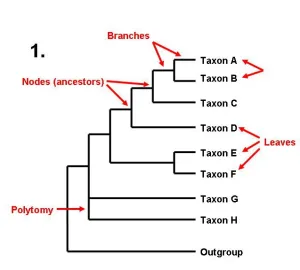
the endpoints of the branches on a phylogenetic tree that represent the specific species, organisms, or taxa being studied (leaves)
tips

the places where branches on a phylogenetic tree split, representing a common ancestor shared by the connected lineages (branch points)
nodes

the single ancestral lineage at the base of a phylogenetic tree that connects all organisms on the tree, representing their most recent common ancestor
root
largest division of geologic time, spanning hundreds of millions to billions of years
eon
four eons of Earth’s history
Hadean, Archean, Proterozoic, Phanerozoic
subdivision of an eon, lasting tens to hundreds of millions of years; typically separated by major changes in Earth's life forms, climate, and geology
era
subdivision of an era, lasting tens of millions of years.; characterized by specific rock systems and significant biological or regional events
period
subdivision of a period, lasting from several million down to tens of thousands of years; describe finer environmental and evolutionary shifts
epoch
age of Earth
4.5 billion years
Earth’s second eon: low oxygen environment, rock formations rich in iron, first life forms during this time, 4.5-2.5 billion years ago
precambrian archaean eon
Earth’s third eon: great oxygenation event and the evolution of the first eukaryotes occur during this time, 2.5 billion-570 million years ago
precambrian proterozoic eon
chemoautotrophic prokaryotes, the first life on Earth and the first photosynthesizers on the planet
cyanobacteria
Earth’s fourth eon: 542 million years ago-present, commenced with the Cambrian Explosion, a rapid diversification of multicellular life and shelled organisms
phanerozoic eon
most major animal phyla appear, Earth dominated by marine life
cambrian explosion
Earth’s current period, marked by repeated ice ages, climate fluctuations, and the eventual rise of human civilization
quaternary period
oppositions to maintaining biodiversity
economic growth, resource extraction, cost and resource allocation
reasons to maintain biodiversity
ecosystem services, medicine/health, ethics, aesthetics, balance
the five extinction level events
end ordovician, late devonian, permian, end triassic, cretaceous-tertiary
Earth’s first and second most severe extinction event; happened in two distinct phases that wiped out about 85% of marine species, global cooling and massive glaciers formed, followed by a rapid warming and sea-level thaw
end ordovician
Earth’s second mass extinction event; oceans lost oxygen on a global scale (anoxic events), turning large areas into toxic dead zones; roughly 75% of species vanished, heavily impacting reef-building organisms and tropical marine life
late devonian
Earth’s third and most deadly extinction event; massive volcanic eruptions in Siberia triggered extreme global warming and made oceans acidic, killed 96% of marine species and 70% of land vertebrate species
permian
Earth’s fourth extinction event, volcanic activity tied to the breakup of the supercontinent Pangaea caused intense global warming and carbon dioxide spikes, 76% to 80% of species went extinct which allowed dinosaurs to become dominant
end triassic
Earth’s fifth extinction event, massive asteroid struck the Chicxulub region in modern-day Mexico, triggering wildfires, earthquakes, and blocking out the sun with dust, killing all non-avian dinosaurs
cretaceous-tertiary
Earth’s potential sixth extinction event, the ongoing, human-driven loss of plant and animal species across the globe
Anthropocene/Holocene Extinction
period of fungal and plant colonization that occurred 470 million years ago
ordovician
three eras of the Phanerozoic eon
paleozoic, mesozoic, cenozoic
the hadean, archaean, and proterozoic eras are considered ____
precambrian
two major causes of extinction events
changes in atmospheric makeup, volcanic eruptions
caused by excess O2 in atmosphere
freezing
caused by excess CO2 in atmosphere
heating