PERS10130 Wk2 injury surveillance and epidemology
 Call Kai
 Learn
Learn Practice Test
 Spaced Repetition
 Match
Match Flashcards
 Knowt Play
1/13

Earn XP
Description and Tags
read Fuller and Horan papers, listen to files
Name | Mastery | Learn | Test | Matching | Spaced | Call with Kai | Chat |
|---|
No analytics yet
Send a link to your students to track their progress
14 Terms
recurrent injury
An injury of the same type and at the same site as an index injury (i.e., fist injury of a specific type sustained by a player in a particular season) and which occurs after a player’s return to full participation from the index injury.
injury severity
related to the no. of days lost due to injury
The number of days that have elapsed from the date of injury to the date of the player’s return to full participation in team training and availability for match selection
injury severity scale
Slight = 0 days of time-loss
Minimal = 1-3 days of time-loss
Mild = 4-7 days of time-loss
Moderate = 8-28 days of time-loss
Severe = >28 days of time-loss
match exposure
play between two teams from different clubs
training exposure
team-based and individual physical activities under the control or guidance of the team’s coaching or fitness staff that are aimed at maintaining or improving players’ football skills or physical condition.
match exposure worked example
In the context of football (i.e., soccer); for studies recording team match exposure, the total player-match exposure time in hours for a team is given by
(NM x PM x DM/60
where NM is the number of team-matches played, PM is the number of players in the team (normally 11 in a football (soccer team)), and DM is the duration of the match in minutes (normally 90 for a football (soccer match)).
The following is the calculation for a single match for 1 team.
NM = 1
PM = 11
DM = 90
Therefore (NM x PM x DM/60)
= (1 x 11 x 90(mins)/60(mins))
= 990(mins)]/60(mins)
= 16.5 hour
training exposure worked example
In the context of football (i.e., soccer); for studies recording team training exposure, the total training exposure time in hours is given by the sum of the values for (PT x DT/60) for every training session throughout the study, where PT is the number of players attending a training session and DT is the duration of the training session in minutes.
The following is the calculation for a single training session lasting 75 mins and attended by
25 players.
PT = 25
DT = 75 mins
Therefore (PT x DT/60)
= (25 x 75(mins)/60(mins))
= 31.5 hours
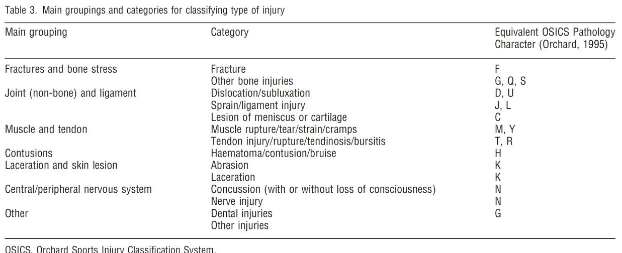
classification of injuries
Injuries should be classified by location, type, body side, and mechanism of injury (traumatic or overuse) and whether the injury was a recurrence.
injury location

injury type
injury surveillance in elite-level women’s football ireland (Horan 2022)
The FAI should prioritize the implementation of injury risk mitigation strategies focusing on injuries with a high injury burden such as ACL injuries, knee meniscus/cartilage injuries, lateral ankle sprains and hamstring strains.”
horan exp AIM
To investigate the pattern of injuries in elite-level women’s football in Ireland.
horan exp METHODS
The authors performed a two-season prospective injury surveillance study in the Women’s National League (WNL). Seven out of the eight clubs (271 players) in the WNL were followed prospectively during the 2018 and 2019 seasons
horan exp RESULTS
Players, on average, sustained 0.69 injuries per season (266 injuries/383 player seasons), which equates to 15 time-loss injuries per season for a squad of 22 players.
Most of the injuries sustained by players were lower extremity injuries (85%), of which, 46% had a non-contact injury mechanism. Muscle, ligament, and contusion injuries were the most common injury types, while the ankle, knee, and thigh were the most injured body sites.
The most common injuries sustained over the two seasons were lateral ankle sprains (13.9%), hamstring strains (12.4%), knee meniscus/cartilage injuries (7.5%), adductor strains (6%), quadriceps strains (4.5%), and ankle contusions (4.5%)