Chemistry Laboratory Manual and Safety Review
 Call Kai
 Learn
Learn Practice Test
 Spaced Repetition
 Match
Match Flashcards
 Knowt Play
1/32

Earn XP
Description and Tags
Vocabulary flashcards covering safety guidelines, procedures, waste disposal, safety data sheets, and equipment from the chemistry laboratory manual.
Name | Mastery | Learn | Test | Matching | Spaced | Call with Kai | Chat |
|---|
No analytics yet
Send a link to your students to track their progress
33 Terms
PREPARE (Lab Manual Step)
The manual usage step that involves reading the experiment before coming to lab, completing all assigned pre-laboratory work, and reviewing safety precautions.
PERFORM (Lab Manual Step)
The manual usage step that involves conducting the experiment safely, making thoughtful observations, and recording accurate data.
ANALYZE (Lab Manual Step)
The manual usage step that involves interpreting results, performing calculations, evaluating sources of error, and communicating findings.
CONNECT (Lab Manual Step)
The manual usage step that involves relating chemistry to lecture concepts, everyday life, and future academic or professional goals.
Chemical Splash Goggles
Approved eye protection required to be worn at all times in the laboratory.
Liquid Waste Disposal
The protocol requiring liquid waste to be disposed of only in designated waste containers, never poured down the sink unless instructed.
Solid Waste Disposal
The protocol requiring solid chemical waste to be placed in designated containers, never in regular trash.
Broken Glass Disposal
The practice of placing broken glass only in designated glass disposal containers.
Sharps Disposal
The practice of placing needles, blades, and other sharp objects in designated sharps containers.
Eye or Skin Contact Procedure
The emergency procedure requiring flushing the affected area with running water for at least 15minutes and notifying the instructor immediately.
Safety Data Sheet (SDS)
A document providing chemical safety details, including chemical name and concentration, hazard statements, hazard pictograms, precautionary statements, and required personal protective equipment (PPE).
Secondary Container Labeling
The requirement to clearly label all secondary chemical containers with your name, chemical identity, and date.
Analytical Balance
A laboratory measuring device that measures mass to 4 decimal places and is used for accurate measurements.
Centigram Balance
A laboratory measuring device that measures mass to 2 decimal places and is used for general measurements.
Graduated Cylinder
Laboratory equipment used to measure liquid volume by reading the bottom of the meniscus at eye level.
Volumetric Pipet
Glassware designed to accurately deliver one fixed volume of liquid using a pipet pump or bulb.
Buret
Glassware designed to accurately dispense variable volumes of liquid in a controlled manner.
Beaker
Common laboratory glassware used to hold, mix, and heat liquids, which is not intended for precise volume measurements.
Erlenmeyer Flask
Common laboratory glassware used for mixing by swirling and heating, which may be stoppered.
Watch Glass
Glassware used to cover beakers, weigh solids, or allow solvents to evaporate.
Stirring Rod
A laboratory tool used to stir solutions and guide liquid during pouring.
Test Tubes
Glassware used for small-scale reactions, heating, or observing chemical changes.
Wash Bottle
Equipment used to rinse glassware with distilled water or other approved solvents.
Bunsen Burner
Heating equipment providing a controllable flame, which should be adjusted to a blue nonluminous flame.

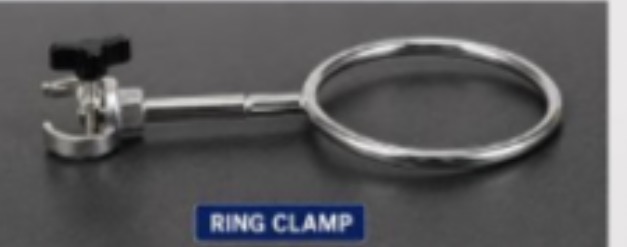
Ring stand & Ring Clamp
Supports clamps, rings, and other apparatus.

Wire Gauze
Placed on a ring support to distribute heat evenly
Clay Triangle
Supports a crucible during heating.
Evaporating Dish
Evaporating Dish is a shallow ceramic dish used to heat solutions and evaporate liquids, allowing the solvent to vaporize and leave the dissolved solid behind.
Crucible
A Crucible is small heat-resistant ceramic container with a lid used to strongly heat solids to very high temperatures during experiments such as drying, ignition, or ashing.
Manual
Used to measure the temperature of liquids and other substances. The temperature is read by observing the level of the colored liquid at eye level.
Digital thermometer
The digital is used to quickly and accurately measure the temperature of liquids or other samples. The metal probe is placed directly into the sample, and the temperature is displayed digitally.
Care of equipment
Treat all equipment with respect.
• Inspect equipment before use and report damage immediately.
• Keep equipment clean before and after use.
Handle glassware carefully to prevent breakage.
Use equipment only for its intended purpose.
Return all equipment to its proper location after use.
Laboratory Tip
When in doubt about how to use any piece of equipment, ask your instructor before proceeding.