3.9 PCR
 Note
Note Call Kai
 Learn
Learn Practice Test
 Spaced Repetition
 Match
Match Flashcards
 Knowt Play
1/6

Name | Mastery | Learn | Test | Matching | Spaced | Call with Kai | Chat |
|---|
No analytics yet
Send a link to your students to track their progress
7 Terms
What is Polymerase Chain Reaction (PCR)? Give me some background information about it!
technique that allows scientists to make millions of copies of desired gene fragment in hours
PCR allows scientists to perform genetic testing on incredibly tiny amounts of tissue - even a single cell
PCR can even be used on tissue that has been degraded by environment
Used in medicine, genetics, biotechnology and forensics
HIV research
Mummy of Pharaoh Ramses III
The Human Genome Project
Crime Scene Investigation
What is Step 1?
Denaturation
DNA sample is heated to 94°C - 96°C.
Heating breaks hydrogen bonds that hold double stranded DNA together - result is complimentary single strands

What is Step 2?
Annealing
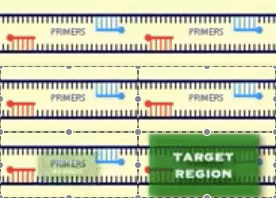
DNA primers added. Cooled to 50 ̊C - 65 ̊C
2 different primers (forward and reverse) - chosen to be complimentary to opposite ends of target region being copied
What is Step 3?
Elongation
Taq DNA Polymerase added. Heated to 72 ̊C
Taq DNA polymerase comes from bacterium Thermus aquaticus, which is found in hot springs - enzyme does not denature at 72 ̊ C
Taq DNA polymerase joins at primers and moves along strands adding complimentary base pairs as it goes - result is two incomplete copies of DNA, each containing target region
Cycle 1 Complete

What is Step 4?
Repeat steps 1 - 3
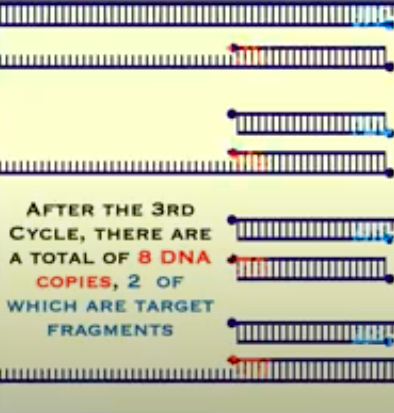
After cycle 2, the result is four incomplete copies of DNA, each containing target region
Taq DNA polymerase added; heat to 72 ̊C
Cycle 2

What is Step 5?
Repeat Steps 1-4
PCR vs. DNA Replication
Table 1: DNA Replication and PCR | DNA Replication | PCR |
|---|---|---|
Double-stranded DNA Separates | Topoisomerase DNA helicase | High Temperature (94 ̊C - 96 ̊C) |
Primers Added to Single Strands | RNA Primers | DNA Primers (forward and reverse) |
Complimentary Strand Synthesized | DNA polymerase III copies entire DNA strand | Taq DNA polymerase copies DNA fragments |
Result | Copy of entire DNA molecule | After 30 cycles, over a billion identical DNA fragments |