Presentation 9: Platform governance
 Call Kai
 Learn
Learn Practice Test
 Spaced Repetition
 Match
Match Flashcards
 Knowt Play
1/14

Earn XP
Description and Tags
Platform openness & governance
Name | Mastery | Learn | Test | Matching | Spaced | Call with Kai | Chat |
|---|
No analytics yet
Send a link to your students to track their progress
15 Terms
Define traditional and platform governance.
= who makes what decisions
Traditional governance:
Rigid hierarchy & command: Managers exert direct authority over employees
Uses a closed, internal innovation model
Directing labor: Primary goal is to direct specific actions and enforce compliance
Often relies on punitive penalties
Employment-based control: Authority is accepted as a standard condition of employment
Platform Governance:
Orchestration over control: Platform owners act as conductors, shaping an ecosystem of autonomous developers
Open & distributed innovation: Gives up some control
Uses incentives and rewards instead of punishment
Respect for autonomy: Developers freely choose to follow. Their varied contributions integrate
→ Platform governance differs across platform setups (e.g., ecosystem structure, maturity of the platform)
Explain the way from traditional governance to platform governance with the example of Microsoft.
Before 2014:
Closed ecosystem that fiercely protected Windows as its dominant server operating system
Dictated rigid rules to partners
Saw outside developers as secondary
Now:
Became open platform orchestrator centered on a more open server service (Azure)
Allowed developers to sell directly to users with lower revenue cuts (85/15 vs 70/30)
Embraced open-source, using incentives over control
→ Outcome: Market value rose from ~$300B (2014) to over $3T (2026), proving that giving up some control can create more value
→ Platform governance creates more value than traditional commandand-control by orchestration
What does it mean that private regulation can trump public regulation?
normally governments regulate markets (public regulation) through EU law, German law etc. but on digital platforms, the platform owner can make additional private rules that are often more stricter
Private regulation = platform governance → platform owner becomes regulator, police, judge inside the ecosystem
e.g. Apple exercises ”bouncer’s rights” to exclude apps of low quality, pornography, hate speech or viruses
e.g. Viddy lost API access after spamming friend links about its video service
Fake profiles immediately deleted
Facebook must balance needs of users, advertisers and developers
e.g. “Front Running” lets high speed traders arbitrage incoming purchase
IEX precisely times orders to eliminate advantages of Goldman Sachs
e.g. In contrast to standard practice, Airbnb embraces risk and insures travelers and hosts against loss
→ showes need for platform governance
How does platform governance orchestrates evolution?
Decision rights Partitioning (Aufteilung der Entscheidungsbefugnisse): Split (Aufteilung) of authority between owner and complementors
Control Portfolio: Formal and informal governance mechanism
Incentive (Anreiz) structure: Aligning (anpassen) individual interests with platform goals
→ all three are part of platform governance Toolbox + boundary resources
Explain decision rights partitioning.
Who decides?
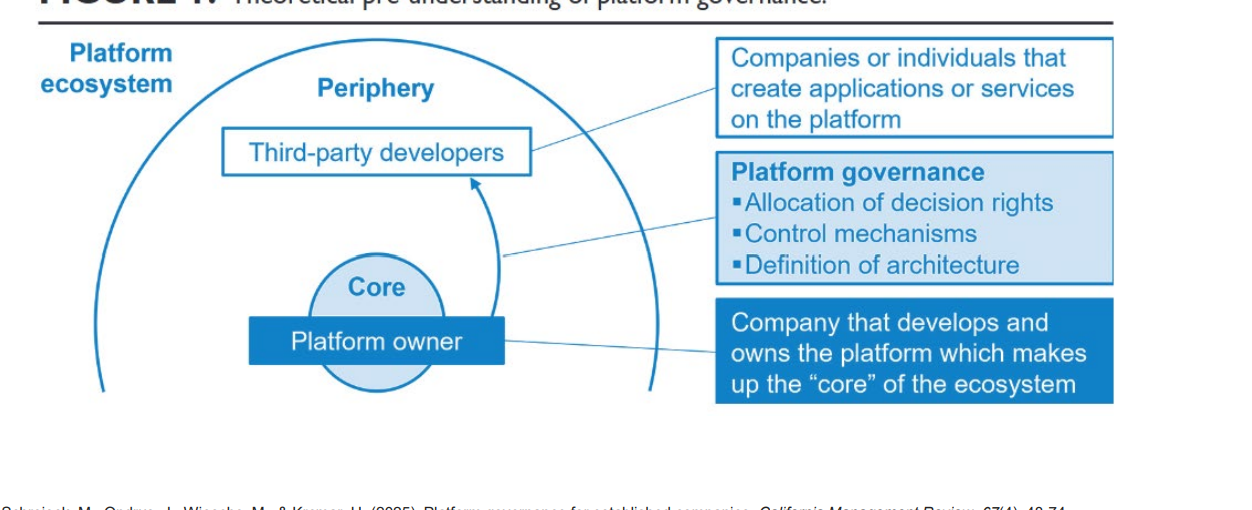
Core vs. Periphery: Owner controls the platform, developers control their apps
Autonomy: Decentralizes authority to suport innovation at the periphery
Balance: Trades off centralized power against developer freedom
= the structural division of authority between a platform owner controlling the core and developers controlling their apps
It defines how overall decision rights are allocated to balance platform stability with developer innovation
What are pros of centralization and pros of decentralization
Pros of centralization (Centralized with platform owner):
High Control: Ensures structural consistency
Low Risk: Minimizes security flaws, fragmentation, and compatibility bugs
Unified Strategy: Allows the owner to control the ecosystem's
Pros of decentralization (decentralized with app developer):
Rapid Innovation: Many developers to create a wide variety of apps
High Scalability: Removes corporate bottlenecks, allowing fast growth
Fast Adaptation: Empowers developers to respond to local user needs
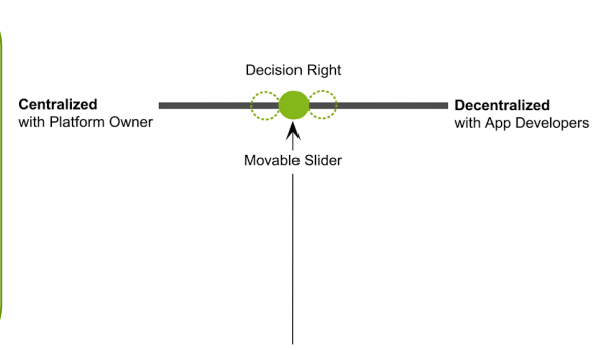
→ Rather than being strictly centralized or decentralized, it treats decision-making authority as a movalbe slider where control is shared in varying degrees
Explain control portfolio.
How does the platform enforce quality?
Four Elements: Combines gatekeeping, metrics, process rules, and relationships
No Hierarchy: Replaces employee management with ecosystem oversight
Quality Guardrails: Secures platform performance, safety, and standards
→ Portfolio is used by platform owners to manage and regulate the ecosystem in a structured way while balancing innovation and control
Explain Gatekeeping, process-control and metrics as part of the control portfolio.
Idea: A participant would have to go through three stages
Three main tools for the platform to enforcing quality
Gatekeeping: Allowing of developers and apps → ensure quality and security (Who may enter?)
Process-control: Rewards or punishment based on compliance with rules and standards → ensure interoperability
Metrics: Management based on objective targets and KPIs (e.g. sales figures, user ratings) → performance management
→ effective control system has to be simple, transparent, realistic, value-based and fair
Explain incentive structure.
Why should developers behave the way I want?:
Goal Alignment: Connects developer financial interests directly to platform growth
Asymmetric Pricing: Shifts costs to one side to trigger network effects
Carrots, Not Sticks: Drives high-quality contributions via economic rewards
→ instead of forcing behavior
Explain pricing policies for incentive structure.
Platforms are heterogeneous
There is no one-fits-all strategy for valuecapture!
Often, platform value capture is low in the beginning and higher with growing network effects / market dominance (often subsidize one side during early growth and increase value capture once strong network effects have been established)
Incentive structures and pricing shape complementor and user behavior
Also non-monetary incentives
Explain boundary resources as another tool of platform governance.
Interface between platform owner and complementors (developers)
On the one hand provide resources to developers (enable) and...
technical resources: Enable external developer to build apps easily
API: Acess to platform functions and data
SDKs: Tools, libraries, and documentation for development
Other Tools: Testing tools, and reference models
… on the other hand restrict the developers to given resources (control)
Social Resources: Define the legal and social framework of the ecosystem
Guidlines & Documentations: Transparency and quality standards
IP-Rights: Rules on ownership and use of innovations
Social infrastructure: Forums, blocks, conferences to built community norms
Provide a solution for direct communication problems with many developers
→ Balance innovation (developer freedom) and control (quality, security, consistency) on the platform
Explain how boundary resources help Resourcing and Securing for platforms.
Resourcing = provides developers with technical resources to create innovations.
Encourages complementors to create new innovations
Achieved, for example, through more powerful APIs or improved development tools
Incentive: Foster innovation and increase user value
Example: New APIs create new app ideas
Securing = protects the platform core by controlling access and defining rules for developers
Can involve changing API access rules or licensing terms
Helps prevent platform cloning (forking) and low-quality content
Ensures that platform activities remain aligned with the platform owner's objectives
Incentive: Protect the platform core from undesirable (unerwünschten) behavior and ensure quality
Example: Restricting API access or licenses to prevent misuse and fragmentation
→ Successful platform governance balances openness and control to foster innovation, ensure ecosystem quality, and maintain longterm platform resilience
Explain the four layers of platform Governance (Concept of Multi-Layer Governance).
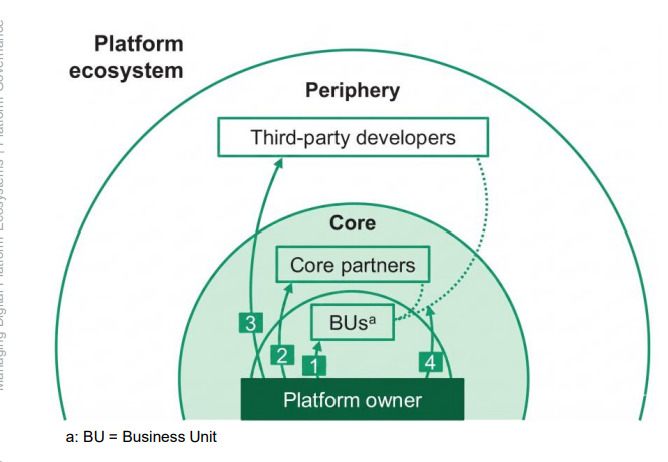
Incumbents need a more complex governance approach
Not every partner is governed equally
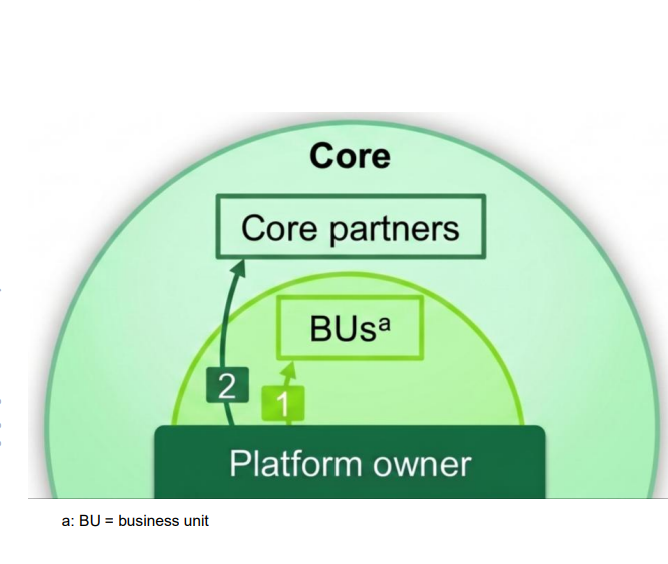
Governance of Internal Business Units: Hierarchical governance to strictly align internal Business Units and synchronize development cycles
BU = a semi-autonomous division within a larger company that operates as a distinct profit center focused on a specific product line, market, or geographic region.
Governance of Core partner: Close governance (relational/contractual) to maintain control over the platform core while benefiting from partner resources
Governance of 3rd-Party Developers: Open governance to grant autonomy and maximize creativity and innovation in the ecosystem's periphery
Governance of Ecosystem Relationships: Conciliatory governance to act as a mediator, resolve tensions between actors, and foster innovation clusters
Explain the Incumbent challenge with the example of BMW.
The Startup vs. Incumbent Gap: Unlike startups, established companies must manage entrenched structures, legacy systems, and physical product cycles.
Real-World Example: BMW Connected
1) Internal Business Units: Hierarchical Governance is required to strictly synchronize long hardware development cycles (car manufacturing) with agile software platform updates
2) Core Partners: Close Governance integrates longstanding key suppliers into the digital core. This maintains strict safety/quality standards before opening up to the periphery.
What is the danger of governance rigidity (Steifheit)?
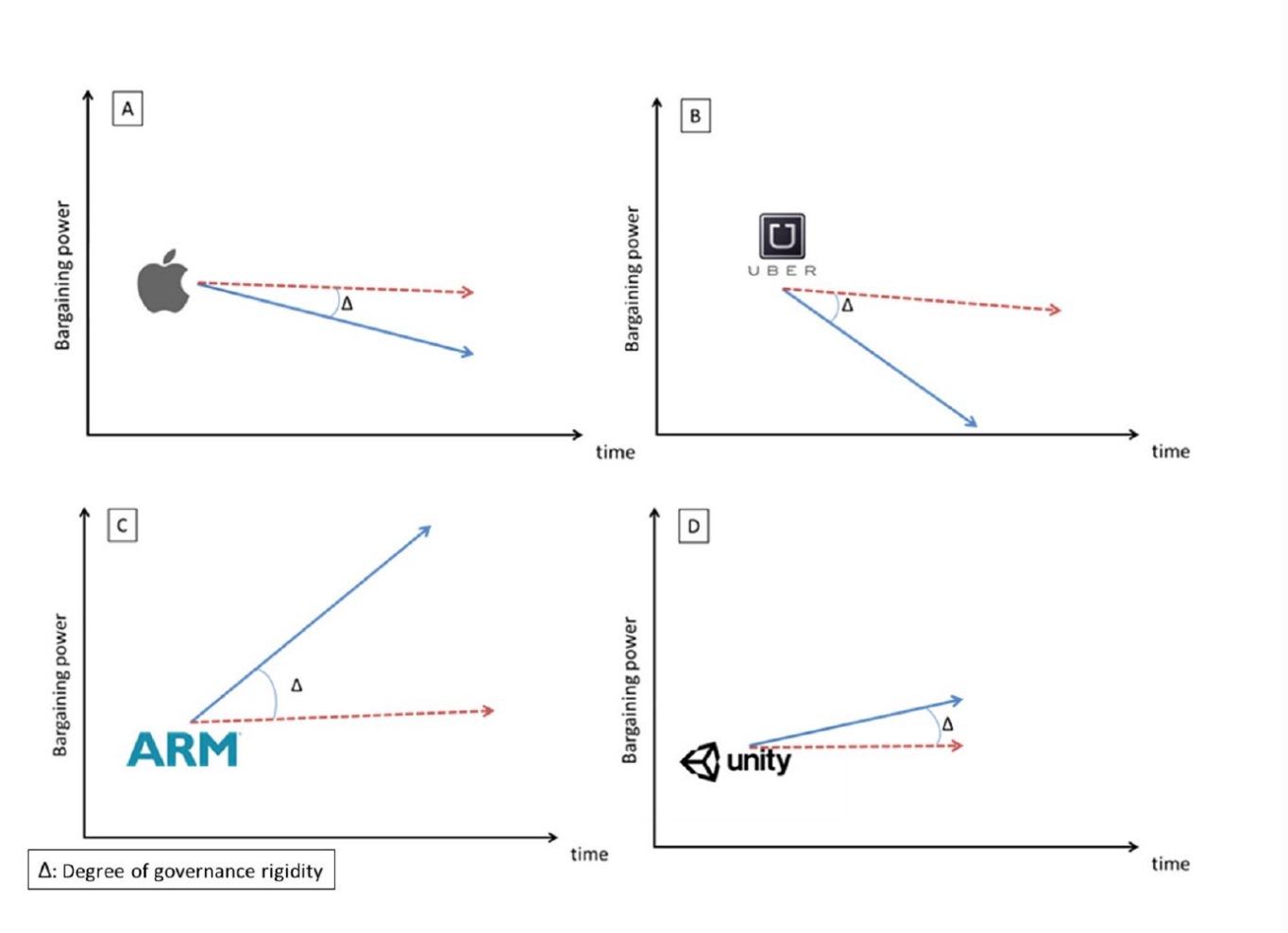
Governance Rigidity = Platform rules become difficult to change over time.
Path Dependency: Initial ecosystem rules become formal commitments that are highly costly to alter ("Governance Inseparability") → Early decisions define future possibilities + Governance rules become deeply embedded in the ecosystem
The Power Gap (Δ): A growing disconnect between a platform's latent bargaining power (market reality) and its exerted bargaining power (contractual reality)
today's market reality
yesterday's governance rules
is called the Power Gap (Δ) → The platform waited too long to adapt its governance
The Apple Paradox: Rigidity safeguarded Apple’s 30% commission for 15 years. However, an excessive Δ ultimately provokes exogenous shocks (e.g., the EU DMA)