Plumbing ni Angge
 Call Kai
 Learn
Learn Practice Test
 Spaced Repetition
 Match
Match Flashcards
 Knowt Play
1/296

Earn XP
Description and Tags
Plumbing
Name | Mastery | Learn | Test | Matching | Spaced | Call with Kai | Chat |
|---|
No analytics yet
Send a link to your students to track their progress
297 Terms
Solid Waste
discharged by water closet
Waste Pipe
collects wastes from other fixtures
Drainage Installation
sometimes referred to as DWV (Drainage of solid waste, Waste from various closet, Ventilation)
Plumbing Principle No. 7 (DS)
Plumbing fixtures shall be made of smooth non-absorbent material, free from concealed fouling surfaces and shall be located in ventilated enclosures
Plumbing Principle No. 11 (DS)
The drainage piping system shall be designed to provide adequate circulation of air free from siphonage, aspiration or forcing of trap seals under ordinary use
Plumbing Principle No. 15 (DS)
Proper protection shall be provided to prevent contamination of food, water, sterile goods, and similar materials by backflow of sewage
Principle No. 21 (WS & DS)
Plumbing shall be installed with due regard to the preservation of the strength of structural members and the prevention of damage to walls and other surfaces through fixture usage.
AIR GAP, DRAINAGE
The unobstructed vertical distance through the free atmosphere between the lowest opening of any pipe, plumbing fixture, appliance, or appurtenance conveying waste to the flood level rim of the receptor.
BACK-PRESSURE
Backflow due to an increased pressure above the supply pressure, which may be due to pumps, boilers, gravity, or other sources of pressure.
COMBINATION WASTE AND VENT SYSTEM
A specially designed system of waste piping embodying the horizontal wet venting of one or more sinks or floor drains by means of a common waste and vent pipe, adequately sized to provide free movement of air above the flow line of the drain.
Plumbing
the art of science of installing pipes, fixtures, and other apparatus to convey and supply water in the buildings
Plumber
a title given to a person who is skilled in the field of sanitation
Objective of Plumbing
To Supply water to different parts of the building and to remove and discharge human wastes and other substances out of the building into the public sewer or septic tank
Condition of an Effective Water Supply
To provide a sufficient amount of water to supply each fixture and to prevent backflow of used water into the water supply system
Objective of Drainage System
Fast removal of the waste with a minimum probability of leakage and stoppage of drains and to prevent the entry of house vermin and obnoxious gases into the house from the piping system
Liquid Waste
discharged by various fixtures
Soil Pipe
collects wastes coming from water closet and other fixtures
Plumbing Principle No. 1 (WS)
All premises intended for human habitation, occupancy or use shall be provided with a supply of pure and wholesome water, neither connected with unsafe water supplies nor subject to hazards of backflow or back-siphonage
Principle No. 22
Sewage or other waste from a plumbing system which may be deleterious to the surface or sub-surface waters shall not be discharged into the ground or into any waterway, unless first rendered innocuous through subjection to some acceptable form of treatment.
ABS
Acrylonitrile-Butadiene-Styrene.
AIR GAP, WATER DISTRIBUTION
The unobstructed vertical distance through the free atmosphere between the lowest opening from any pipe or faucet conveying potable water to the flood-level rim of any tank, vat or fixture.
BACKFLOW
The flow of water or other liquids, mixtures, or substances into the distributing pipes of a potable supply of water from any sources other than its intended source.
BATTERY OF FIXTURES
Any group of two (2) or more similar, adjacent fixtures that discharge into a common horizontal waste or soil branch.
BUILDING SUBDRAIN
That portion of a drainage system that does not drain by gravity into the building sewer.
Plumbarius
refers to an individual who worked in the field of sanitation of ancient Rome
Requirements of Drainage System
Pipes must be well fitted, drainage pipe should be graded, drainage pipe should be provided with an adequate cleanout, drainage system must be provided with a ventilation pipe, drainage must be vented to avoid siphonage or backflow of the water seal
Plumbing Principle No. 2 (WS)
Plumbing fixtures, devices and appurtenances shall be supplied with water in sufficient volume and at pressure adequate to enable them to function satisfactorily and without undue noise under all normal conditions of use
Plumbing Principle No. 3 (WS)
Plumbing shall be designed and adjusted to use the minimum quantity of water consistent with proper performance and cleaning
Plumbing Principle No. 4 (WS)
Devices for heating and storing water shall be so designed and installed as to prevent dangers from explosion through overheating
Plumbing Principle No. 5 (DS)
Every building having plumbing fixtures installed and intended for human habitation, occupancy or use on premises abutting on a street, valley, or easement where there is a public sewer, shall be connected to the sewer system
Plumbing Principle No. 6 (DS)
Each family dwelling unit on premises abutting on a sewer or with a private sewage disposal system shall have at least one water closet and one kitchen-type sink
Plumbing Principle No. 8 (DS)
The drainage system shall be designed, constructed and maintained to safeguard against fouling, deposit of solids, clogging and with adequate cleanouts so arranged that the pipes may be readily cleaned
Plumbing Principle No. 9 (WS & DS)
All piping of plumbing systems shall be of durable NAMPAP-APPROVED materials, free from defective workmanship, designed and constructed by Registered Master Plumbers to ensure satisfactory service
Plumbing Principle No. 10 (DS)
Each fixture directly connected to the drainage system shall be equipped with a water-sealed trap
Plumbing Principle No. 12 (DS)
Vent terminals shall extend to the outer air and installed to preempt clogging and the return of foul air to the building
Plumbing Principle No. 13 (WS & DS)
Plumbing systems shall be subjected to such test to effectively disclose all leaks and defects in the workmanship
Plumbing Principle No. 14 (DS)
No substance which will clog the pipes, produce explosive mixtures, destroy the pipes or their joints or interfere unduly with the sewage-disposal process shall be allowed to enter the building drainage system
Plumbing Principle No. 16 (DS)
No water closet shall be located in a room or compartment which is not properly lighted and ventilated
Plumbing Principle No. 17 (DS)
If water closets or other plumbing fixtures are installed in buildings where there is no sewer within a reasonable distance, suitable provision shall be made for disposing of the building sewage by some accepted method of sewage treatment and disposal, such as a septic tank
Plumbing Principle No. 18 (DS)
Where a plumbing drainage system may be subject to backflow of sewage, suitable provision shall be made to prevent its overflow in the building
Plumbing Principle No. 19 (DS)
Plumbing system shall be maintained in serviceable manner
Principle No. 20 (WS & DS)
All plumbing fixtures shall be installed properly spaced, to be accessible for their intended use.
AIRBREAK
A physical separation which may be low inlet into the indirect waste receptor from the fixture, appliance or device indirectly connected.
AREA DRAIN
A receptor designed to collect surface or storm water from an open area.
BACKFLOW CONNECTION
Any arrangement whereby backflow can occur.
BACKFLOW PREVENTER
A device or means to prevent backflow into the potable water system.
BACK-SIPHONAGE
The flowing back of used, contaminated, or polluted water from a plumbing fixture or vessel into a water supply pipe due to a pressure less than atmospheric in such pipe.
BACKWATER VALVE
A device installed in a drainage system to prevent reverse flow.
BATHROOM GROUP
A group of fixtures consisting of a water closet, one or two lavatories, and either a bathtub, a combination bath/shower, or a shower and may include a urinal or bidet and an emergency floor drain.
BATHROOM HALF
A room equipped with only a water closet and lavatory.
BRANCH
Any part of the piping system other than a main, riser, or stack.
BRANCH VENT
A vent connecting one (1) or more individual vents with a vent stack or stack vent.
BUILDING DRAIN
That part of the lowest piping of a drainage system that receives the discharge from soil, waste, and other drainage pipes inside the walls of the building and conveys it to the building sewer beginning two (2) feet (610 mm) outside the building wall.
BUILDING DRAIN (SANITARY)
A building drain that conveys sewage only.
BUILDING DRAIN (STORM)
A building drain that conveys storm water or other drainage, but no sewage.
BUILDING SEWER
That part of the horizontal piping of a drainage system that extends from the end of the building drain and that receives the discharge of the building drain and conveys it to a public sewer, private sewer, private sewage disposal system, or other point of disposal.
BUILDING SUPPLY
The pipe carrying potable water from the water meter or other source of water supply to a building or other point of use or distribution on the lot.
CESSPOOL
A lined excavation in the ground that receives the discharge of a drainage system or part thereof, so designed as to retain the organic matter and solids discharging therein, but permitting the liquids to seep through the bottom and sides.
CLEAR WATER WASTE
Cooling water and condensate drainage from refrigeration and air-conditioning equipment; cooled condensate from steam heating systems; and cooled boiler blowdown water.
CLINIC SINK
A sink designed primarily to receive wastes from bedpans and having a flush rim, an integral trap with a visible trap seal, and the same flushing and cleansing characteristics as a water closet.
CODE
A standard that is an extensive compilation of provisions covering broad subject matter or that is suitable for adoption into law independently of other codes and standards.
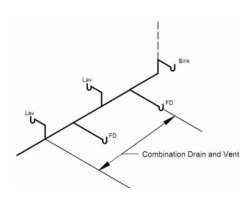
COMBINATION WASTE AND VENT SYSTEM
A specially designed system of waste piping embodying the horizontal wet venting of one or more sinks or floor drains by means of a common waste and vent pipe, adequately sized to provide free movement of air above the flow line of the drain
COMMON
That part of a plumbing system that is designed and installed to serve more than one (1) appliance, fixture, building, or system.
CONDUCTOR
A pipe inside the building that conveys stormwater from the roof to a storm drain, combined building sewer, or other approved point of disposal
CONTAMINATION
An impairment of the quality of the potable water that creates an actual hazard to public health through poisoning or through the spread of disease by sewage, industrial fluids, or waste. Also defined as High Hazard.
CONTINUOUS VENT
A vertical vent that is a continuation of the drain to which it connects.
CONTINUOUS WASTE
A drain connecting the compartments of a set of fixtures to a trap or connecting other permitted fixtures to a common trap.
CPVC
Chlorinated Poly (Vinyl Chloride).
CROSS-SECTION
Any connection or arrangement, physical or otherwise, between a potable water supply system and any plumbing fixture or any tank, receptor, equipment, or device, through which it may be possible for nonportable, used, unclean, polluted, and contaminated water, or other substances to enter into any part of such potable water system under any condition.
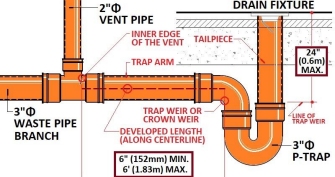
DEVLOPED LENGTH
The length along the center line of a pipe and fittings.
DIAMETER
Unless specifically stated, "diameter" is the nominal diameter as designated commercially.
DOMESTIC SEWAGE
The liquid and water-borne wastes derived from ordinary living processes, free from industrial wastes, and of such character as to permit satisfactory disposal, without special treatment, into the public sewer or by means of a private sewage disposal system
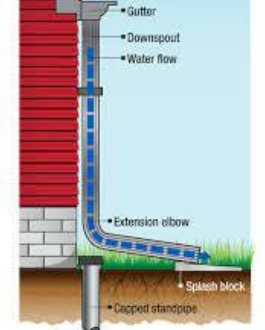
DOWNSPOUT
The rain leader from the roof to the building storm drain, combined building sewer, or other means of disposal located outside of the building.
DRAIN
Any pipe that carries waste or waterborne wastes in a building drainage system
DRAINAGE SYSTEM
Includes all the piping within public or private premises that conveys sewage or other liquid wastes to a legal point of disposal but does not include the mains of a public sewer system or a public sewage treatment or disposal plant.
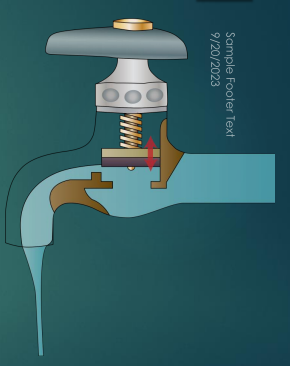
EFFECTIVE OPENING
The minimum cross-sectional area at the point of water supply discharge measured or expressed in terms of (1) the diameter of a circle or (2) if the opening is not circular, the diameter of a circle of equivalent cross-sectional area. (This is applicable also to airgap.)
FIXTURE BRANCH
A water supply pipe between the fixture supply pipe and the water distributing pipe.
FIXTURE DRAIN
The drain from the trap of a fixture to the junction of that drain with any other drain pipe.
FIXTURE SUPPLY
A water supply pipe connecting the fixture with the fixture branch.9/20/202
FIXTURE UNIT
A quantity in terms of which the load-producing effects on the plumbing system of different kinds of plumbing fixtures are expressed on some arbitrarily chosen scale
FLOOD-LEVEL RIM
The top edge of a receptor from which water overflows.
FLOODED
A fixture is flooded when the liquid therein rises to the flood-level rim.
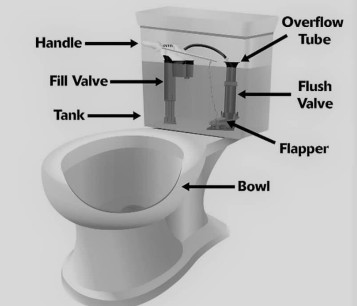
FLUSH TANK
A tank located above or integral with water closets, urinals, or similar fixtures for the purpose of flushing the usable portion of the fixture.
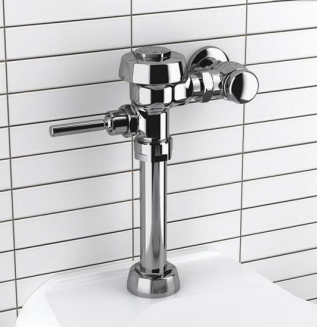
FLUSHOMETER VALVE
A valve that discharges a predetermined quantity of water to fixtures for flushing purposes and is actuated by direct water pressure
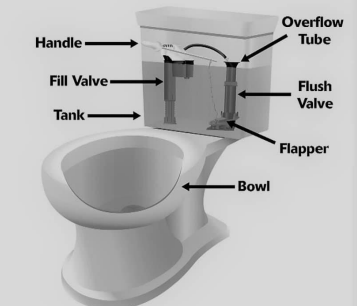
FLASH VALVE
A valve located at the bottom of a tank for the purpose of flushing water closets and similar fixtures.
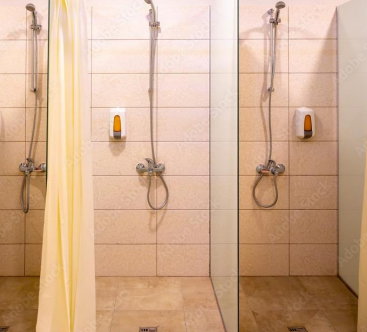
GANG OR GROUP SHOWER
Two (2) or more showers in a common area.
GRADE
The slope or fall of a line of pipe in reference to a horizontal plane. In drainage, it is usually expressed as the fall in a fraction of an inch (mm) or percentage slope per foot (meter) length of pipe.
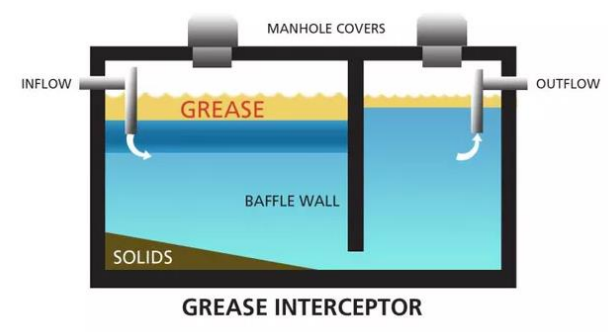
GREASE INTERCEPTOR
A plumbing appurtenance or appliance that is installed in a sanitary drainage system to intercept nonpetroleum fats, oils, and greases (FOG) from a wastewater discharge
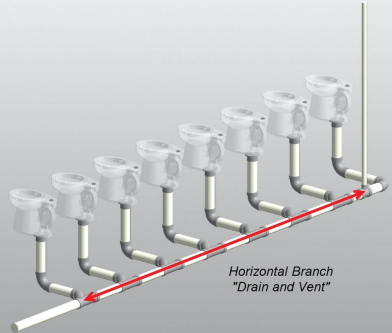
HORIZONTAL BRANCH
A drain pipe extending laterally from a soil or waste stack or building drain with or without vertical sections or branches, which receives the discharge from one (1) or more fixture drains and conducts it to the soil or waste stack or to the building drain.
HORIZONTAL PIPE
Any pipe or fitting that is installed in a horizontal position or which makes an angle of less than forty-five (45) degrees with the horizontal.
HOT WATER
at a temperature exceeding or - - equal to 120°F (49°C).
INDIRECT WASTE PIPE
A pipe that does not connect directly with the drainage system but conveys liquid wastes by discharging into a plumbing fixture, interceptor, or receptacle that is directly connected to the drainage system.
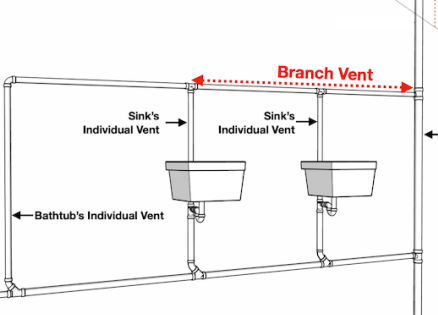
INDIVIDUAL VENT
A pipe installed to vent a fixture trap and that connects with the vent system above the fixture served or terminates in the open air.
INDUSTRIAL VENT
Any and all liquid or water-borne waste from industrial or commercial processes, except domestic sewage.
INSANITARY
A condition that is contrary to sanitary principles or is injurious to health.
Conditions include the following:
(1) Any trap that does not maintain a proper trap seal.
(2) Any opening in a drainage system, except where lawful, that is not provided with an approved liquid-sealed trap.
(3) Any defective fixture, trap, pipe, or fitting.
(4) Any trap, except where in this code exempted, is directly connected to a drainage system, the seal of which is not protected against siphonage and back-pressure by a vent pipe.
(5) Any connection, cross-connection, construction, or condition, temporary or permanent, that would permit or make possible by any means whatsoever for any unapproved foreign matter to enter a water distribution system used for domestic purposes.
6) The foregoing enumeration of conditions to which the term "insanitary" shall apply, shall not preclude the application of that term to conditions that are, in fact, insanitary.
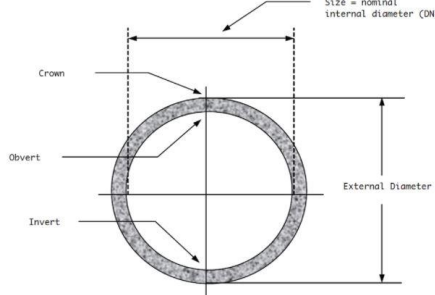
INVERT
the lowest portion of the inside of a horizontal.
JOINT, BRAZED
Any joint obtained by joining metal parts with alloys that melt at temperatures exceeding 449 degrees C, but less than the melting temperature of the parts to be joined.
JOINT, SOLDERED
a joint obtained by joining of metal parts with metallic mixtures or alloys that melt at a temperature up to and including 449 degrees C
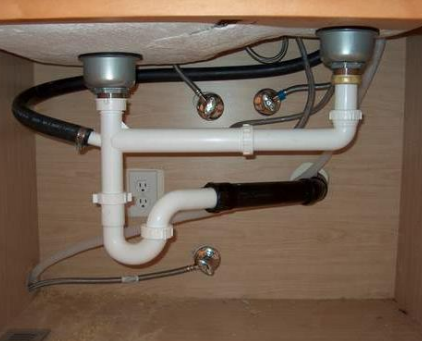
LAVATORIES IN SET
Two to three lavatories that are served by one trap.
LEADER
an exterior vertical drainage pipe for conveying storm water from roof or gutter drains. See downspout