Chapter 3: Simple Resistive Circuits
 Call Kai
 Learn
Learn Practice Test
 Spaced Repetition
 Match
Match Flashcards
 Knowt Play
1/15

There's no tags or description
Looks like no tags are added yet.
Name | Mastery | Learn | Test | Matching | Spaced | Call with Kai | Chat |
|---|
No analytics yet
Send a link to your students to track their progress
16 Terms
Series-connected circuit elements
Elements that carry the same current
Combining Resistors in Series
if k resistors are connected in series, the equivalent single resistor has a resistance equal to the sum of the k resistances

black box
the term used to imply and opaque container (contents hidden from view)
Parallel-Connected Circuit Elements
elements that share the same voltage across them, allowing different currents to flow through each branch.
Combining Resistors in Parallel
the resistance of the equivalent resistor is always smaller than the resistance of the smallest resistor in the parallel connection.

Combining Two Resistors in Parallel
the equivalent resistance equals the product of the resistances divided by the sum of the resistances.

Voltage Divider
When voltage is divided between series-connected resistor

Current Divider
When current is divided between parallel-connected resistors,

Voltage Division
a circuit analysis tool used to find the voltage drop across a single resistance from a collection of series-connected resistances when the voltage drop across the collection is known

Current Division
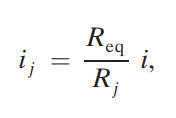
a circuit analysis tool used to find the current through a single resistance from a collection of parallel-connected resistances when the current into the collection is known. where ij is the current through the resistance Rj and i is the current into the parallel-connected resistances whose equivalent resistance is R . eq
Voltmeter
measures voltage and must be placed in parallel with the voltage being measured.

Ammeter
measures current and must be placed in series with the current being measured

Digital meters and analog meters
have internal resistance, which influences the value of the circuit variable being measured and are based on the d ’ Arsonval meter movement deliberately include internal resistance as a way to limit the current in the movement’s coil.
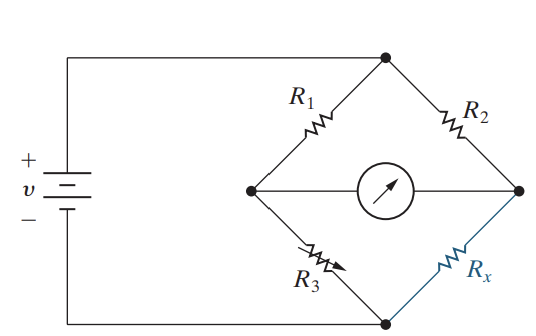
Wheatstone Bridge
used to precisely measure medium value resistances of an unknown resistor, Rx with 3 resistors, a de voltage source (i.e. battery), and a galvanometer (detector)
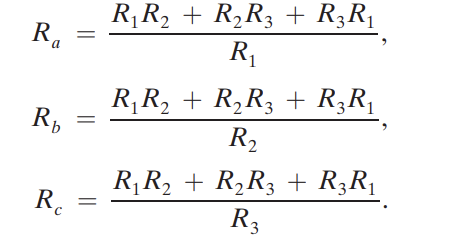
Y/T to Delta/pi
equations used to transform a Y/T circuit to a Delta/pi circuit
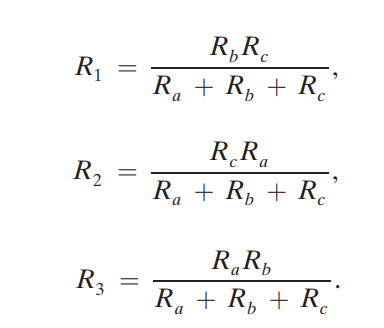
Delta/pi to Y/T
equations used to transform a Delta/pi circuit to a Y/T Circuit