2130 unit 9
 Call Kai
 Learn
Learn Practice Test
 Spaced Repetition
 Match
Match Flashcards
 Knowt Play
1/155

There's no tags or description
Looks like no tags are added yet.
Name | Mastery | Learn | Test | Matching | Spaced | Call with Kai | Chat |
|---|
No analytics yet
Send a link to your students to track their progress
156 Terms
digestive system
AKA gastrointestinal tract
GOAL →
(1) extract max amt nutrients from food by chem & physical digest
chem digest → enzymes secreted into tract
ACTION → coordinate actions to max absorption
(2) defense → protect from pathogens w vomiting reflex, INC intestinal motility 4 diarrhea, protective secretions to protect internal enviro
What are the five main organs of the digestive tract?
direct contact w ingested food processed
Oral cavity
esophagus
stomach
small intestine (SI)
large intestine (LI)
What are the four accessory organs of the digestive tract?
X direct contact contents of tract BUT make secretions
Salivary glands
liver
gallbladder
pancreas
What is the function of the accessory organs?
Secretes substances into the gastrointestinal tract to help digestion
pathway of digestive system
oral cavity → chew & push food down esophagus
salivary glands → secrete saliva to mix w food in oral cavity
esophagus → pass food to stomach
stomach → process food & pass to intestines
SI → get food from stomach
liver → secrete bile solution
gallbladder → store bile solution & enter into SI
pancreas → secrete digestive enzymes & hormones
LI → passed food from SI
What are the four different processes of the digestive tract?
Digestion → in digestive tract lumen
secretion → lumen to digestive wall, interstitial fluid & into blood
motility → in digestive tract lumen
absorption → lumen to blood
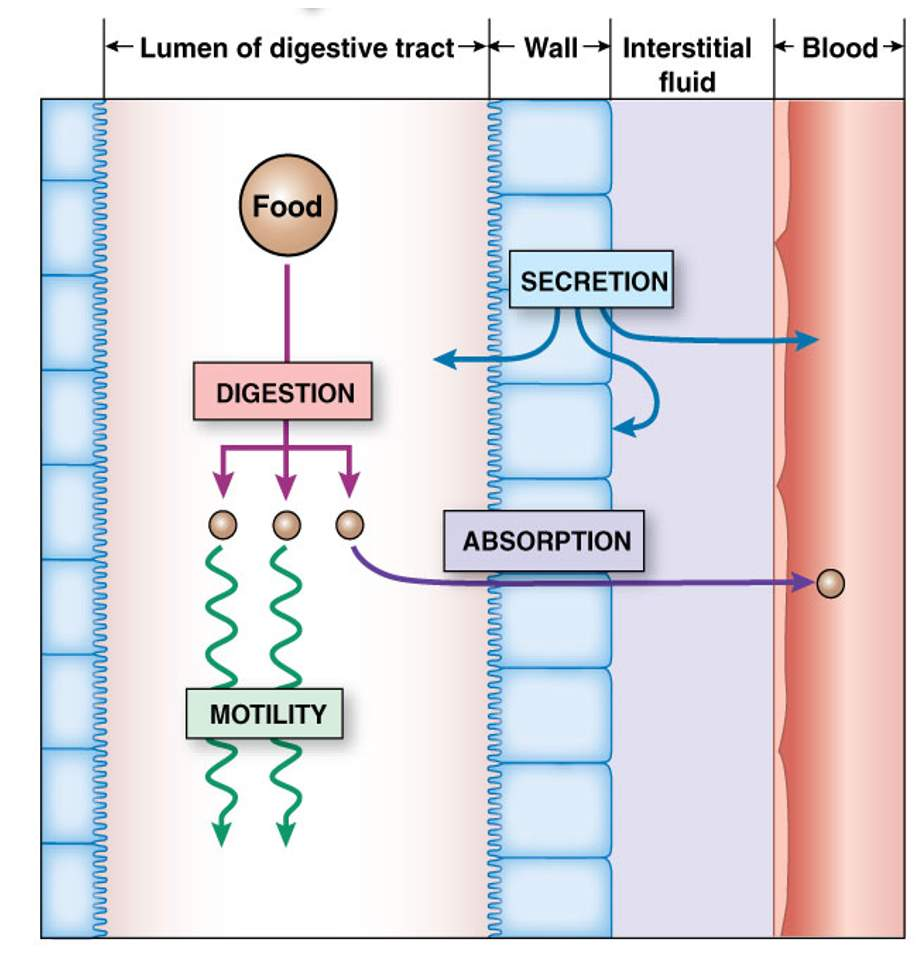
What is digestion?
mech & chem break food into smaller parts
mech → small physically
chem → small physically & w enzymes from secretions
EX → break down startch into glucose & smaller chunks
What is secretion?
mainly from epithelial cells in organs of digestive tract
exocrine secretion = enzymes, acid, H2O, mucus, HCO3
endocrine secretion = hormones (put into blood & X mix w food)
paracrine secretion = change other epithelial cell f(x)
What is motility?
coordinated muscle movements in tract to move food organ → organ
can help w mech digestion
digestive issues if motility in tract too fast or slow
What is absorption?
move food from lumen → thru epithelial cells of digestive tract→ blood
What are the four tissue layers of the digestive tract?
4 layers epithelial tissue → same stomach, SI, LI
Mucosa
submucosa
muscularis externa
serosa
other features → lumen, blood vessels (uptake food absorbed & hormones secreted), lymph nodules (immune system & absorb lipids)
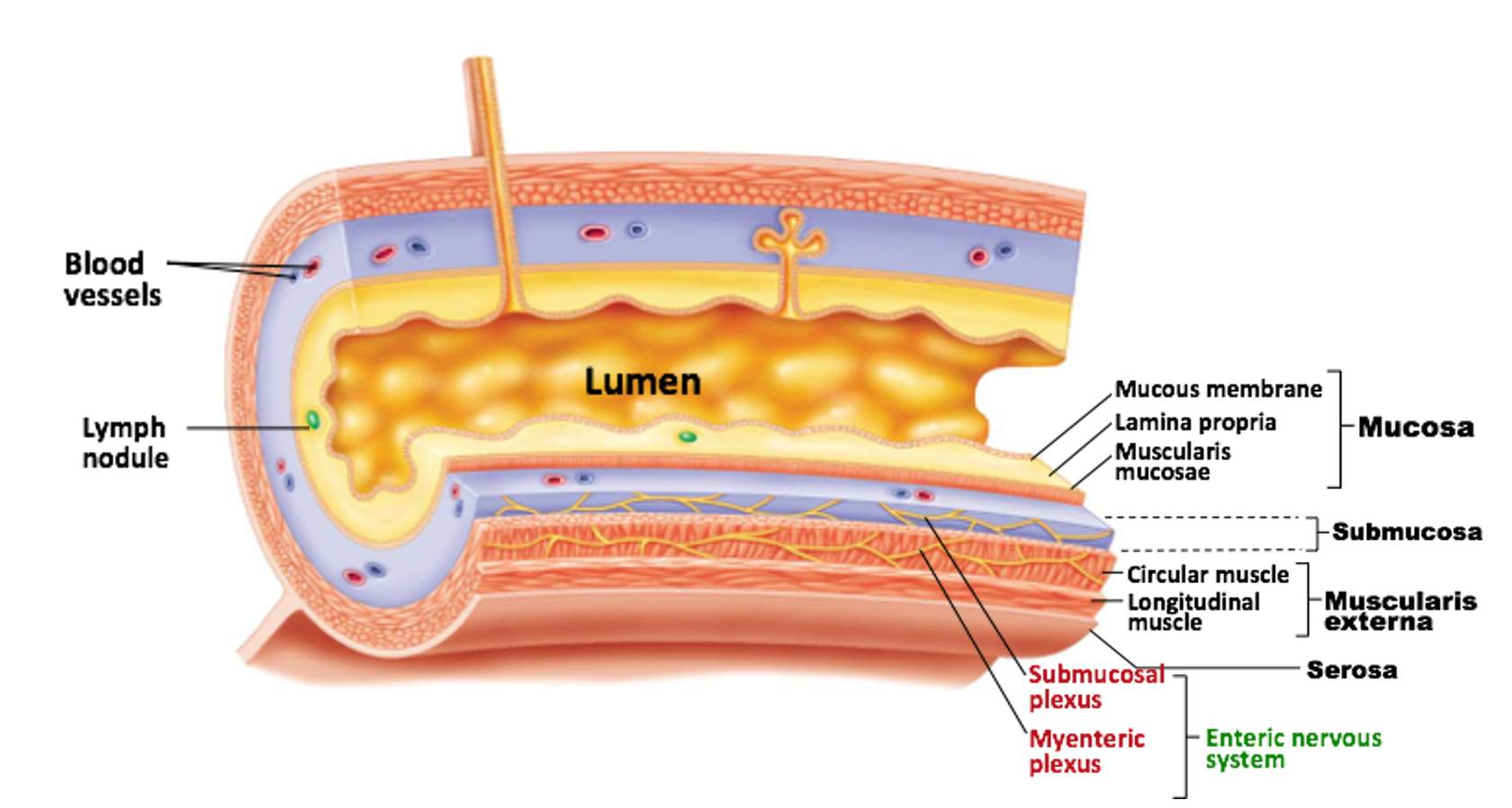
What is the composition and purpose of the mucosa?
direct contact inside lumen of GI tract
1 layer of mucous epithelial cell → secrete diff based on diff parts
varies w diff organs
What is the composition and purpose of the submucosa?
connecting tissue link mucosa + muscularis externa layer (major smooth muscle & coordinated w circular, longitudinal, oblique layer for stomach)
has submucosal plexus of enteric NS
has blood vessels
What is the composition and purpose of the muscularis externa?
2 layers of smooth muscle → circular OR longitudinal form
C → contact = smaller tube + relax = dilate tube
L → contract = shorter + relax = longer
has myenteric plexus (w/ enteric neurons) of enternic NS
What is the composition and purpose of the serosa?
Outer protective tissue layer
continuous with mesentery connective tissue layer → line abdominal cavity
What are the two plexuses of the enteric system?
submucosal plexus → in sub mucosal layer
myenteric plexus → in muscular external layer
enteric NS
neuron bodies in →
(1) submucosal layer = submucosal plexus
trigger secretions in epithelial cells
sensory neurons
(2) muscularis external layer = myenteric plexus
trigger muscle movements
innervated by PSYN + SYN to regulate ENS
GOAL → coordinate diff organs along abdominal cavity & signal thru layers
can work w/ autonomic system BUT also alone w only layers
how does the digestive system at the oral cavity?
@ start of digestion → X absorb macronutrients
start mech & chem break up food
chem → saliva (mainly 3 glands + mouth lining)
mech → mastication
secretion in oral cavity
secrete = saliva
converging duct → 1 gland cell secrete into own duct, other ducts flow into larger ducts until flow 1 large duct
FORM →
H2O most + Na + Cl + HCO3 + mucus + proteins + digestive enzymes (salivary amylase + lingual lipase)
most cells lining mouth secrete BUT mainly from 3 salivary glands (accessory organs)
What are four functions of saliva?
Lubricates food
helps to taste
protects mouth and teeth
help speech
What are the three salivary glands?
X all give same amt based on diff times
Parotid → INC V H2O saliva w salivary amylase & lingual lipase
submandibular → H2O saliva + mucus + some enzymes
sublingual → mucus saliva w/o enzymes
digestion in oral cavity
mechanical
mastication → mech chew of food (X help nutrient absorb & only 4 swallow)
chemical
saliva → chem breakdown food
salivary amylase → chem digest amylose (complex carb)
lingual lipase → move into stomach (pH lower) & activate to digest fats
both work to swallow food
motility in oral cavity
mastication → make bolus by mech chew food + chem digest
swallow → reflex push bolus to esophagus (swallow stages)
peristalsis → in esophagus
why is bolus important?
lubricate food w saliva & broken into smaller pieces so easily swallowed
What are the three stages of swallowing?
VOLUNTARY = move bolus back of oral cavity
(1) voluntary stage → food ingested & # chews to make bolus based on each person
INVOLUNTARY = swallowing & X control
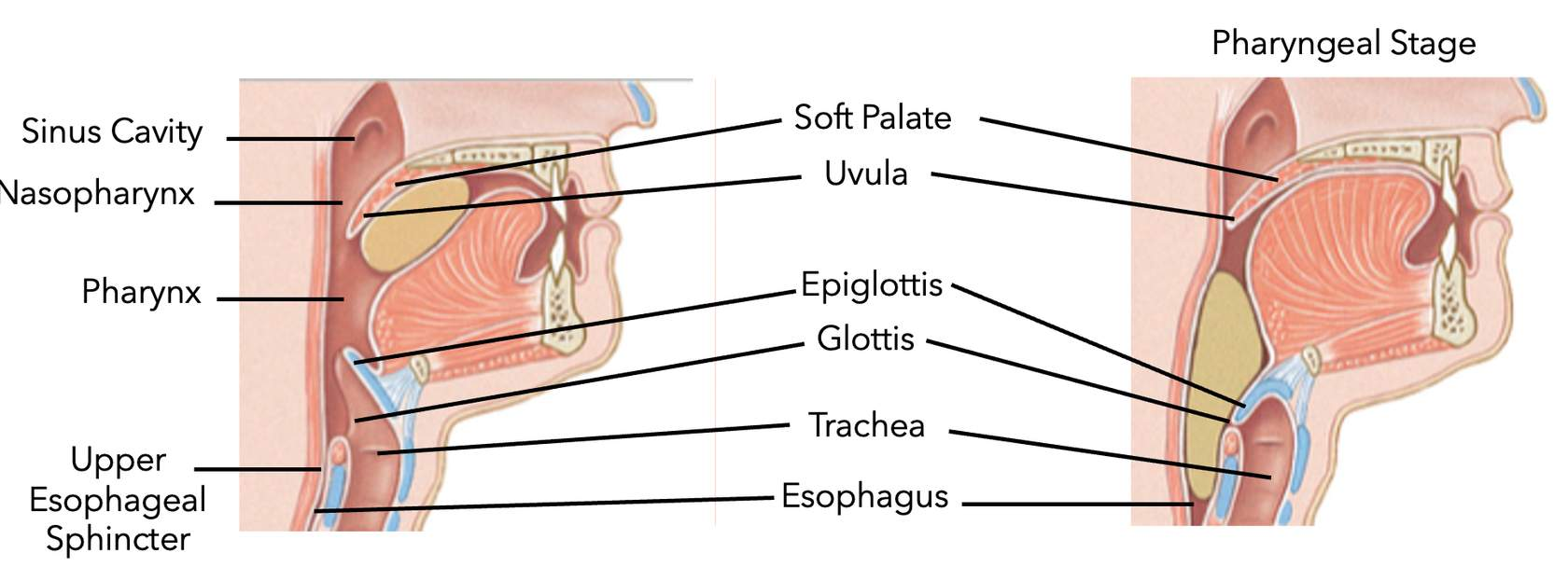
(2) pharyngeal stage → swallowing reflex
(3) esophageal stage → push bolus down esophagus w peristalsis (contract & relax) + lower esophageal sphincter relax
What occurs during the pharyngeal phase?
sense bolus at pharynx →
pharyngeal stage of swallowing triggered →
sensory neurons activate neural reflex →
close nasopharynx (lift uvula of soft palate) →
epiglottis bent back over glottis to stop food enter into trachea →
upper esophageal sphincter relaxes →
bolus goes down esophagus
swallowing = reflex move bolus into esophagus by close sinus cavity & airway
upper esophageal sphincter = open to allow bolus down esophagus
lower esophageal sphincter = open to allow bolus down into stomach
What is peristalsis?
esophagus motility → move bolus top of esophagus to bottom
1 direction movement of bolus → down esophagus
based on coordinated contractions & relaxations of esophageal circular and longitudinal muscles
X gravity dependent
2nd peristalsis
when bolus X enter stomach detected by neurons
THUS → INC force muscle contractions of esophagus push unidirectionally into stomach
contract behind INC strong
relax front INC relax
absorption in the oral cavity
X absorption → X enough macronutrients X chemically digested enough
EXCEPT sublingual absorption of small molecules
small NP molecules meds + glucose (glucose carries in epithelial cells of mouth)
stomach
store food before entering intestines & get absorbed
chem digest w/ bolus
mech digest soilds (#1 mech digest area)
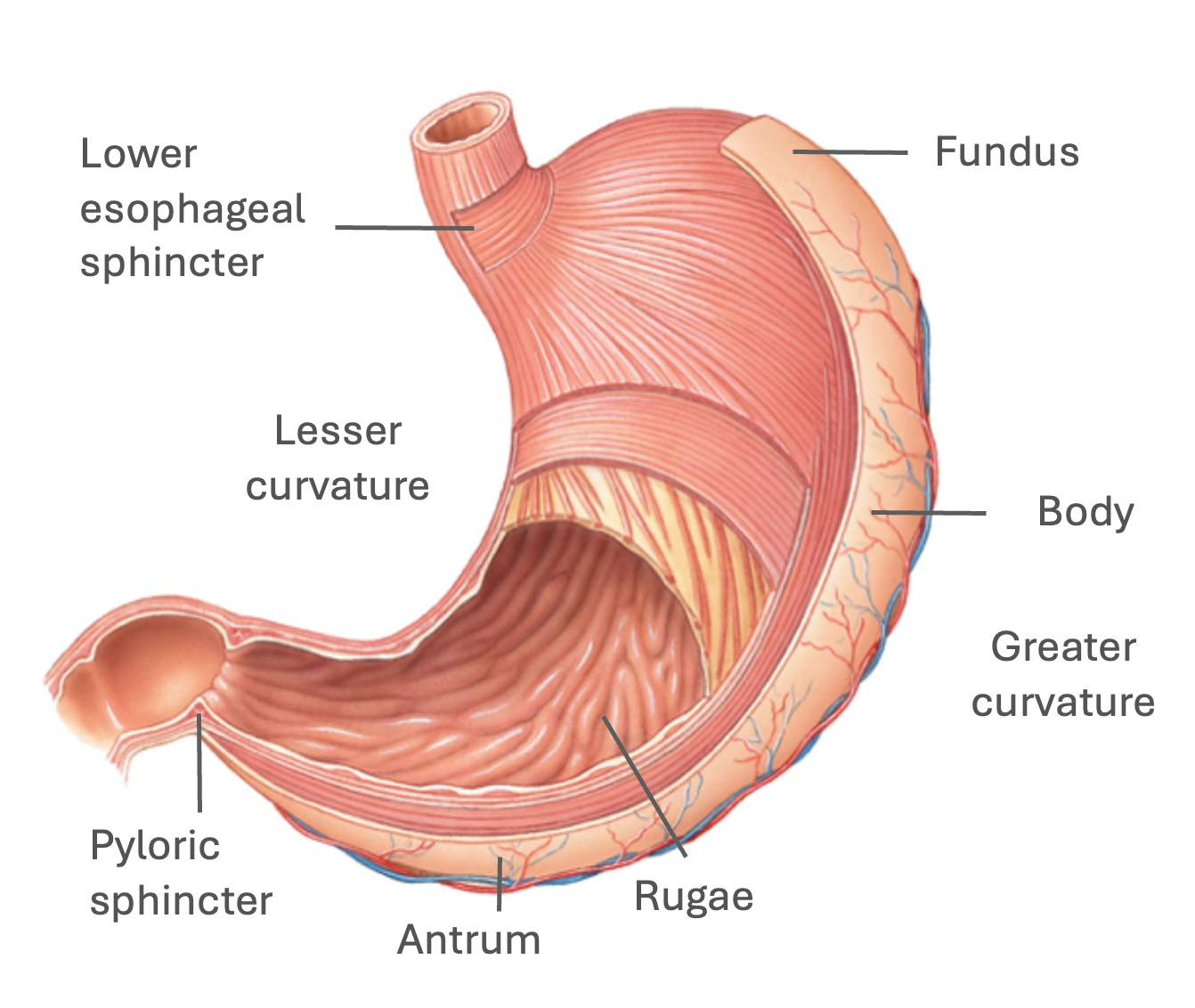
stomach anatomy
TUBE ANATOMY
lower esophageal sphincter → open 4 bolus from esophagus to stomach
fundus → bolus 1st enter here, does receptive relaxation (stretch 4 bolus)
body → central region makes chyme when liquify blous w muscle contraction + gastric juice
antrum → work w/ body to make chyme
pyloric sphincter → open to releases chyme to intestines when liquid enough
rugae → folds on mucosa layer & help expand V by stretch when big meal
greater curvature = L side
lesser curvature = R side
4 tissue layers stomach
like layers of intestines
mucosa → control f(x) of tube based on acid secretions of epithelial cells
only acid secreting cells
submucosa → connective support
muscularis externae → longitudinal + circular + oblique smooth muscle layers
serosa → protective connective outer layer
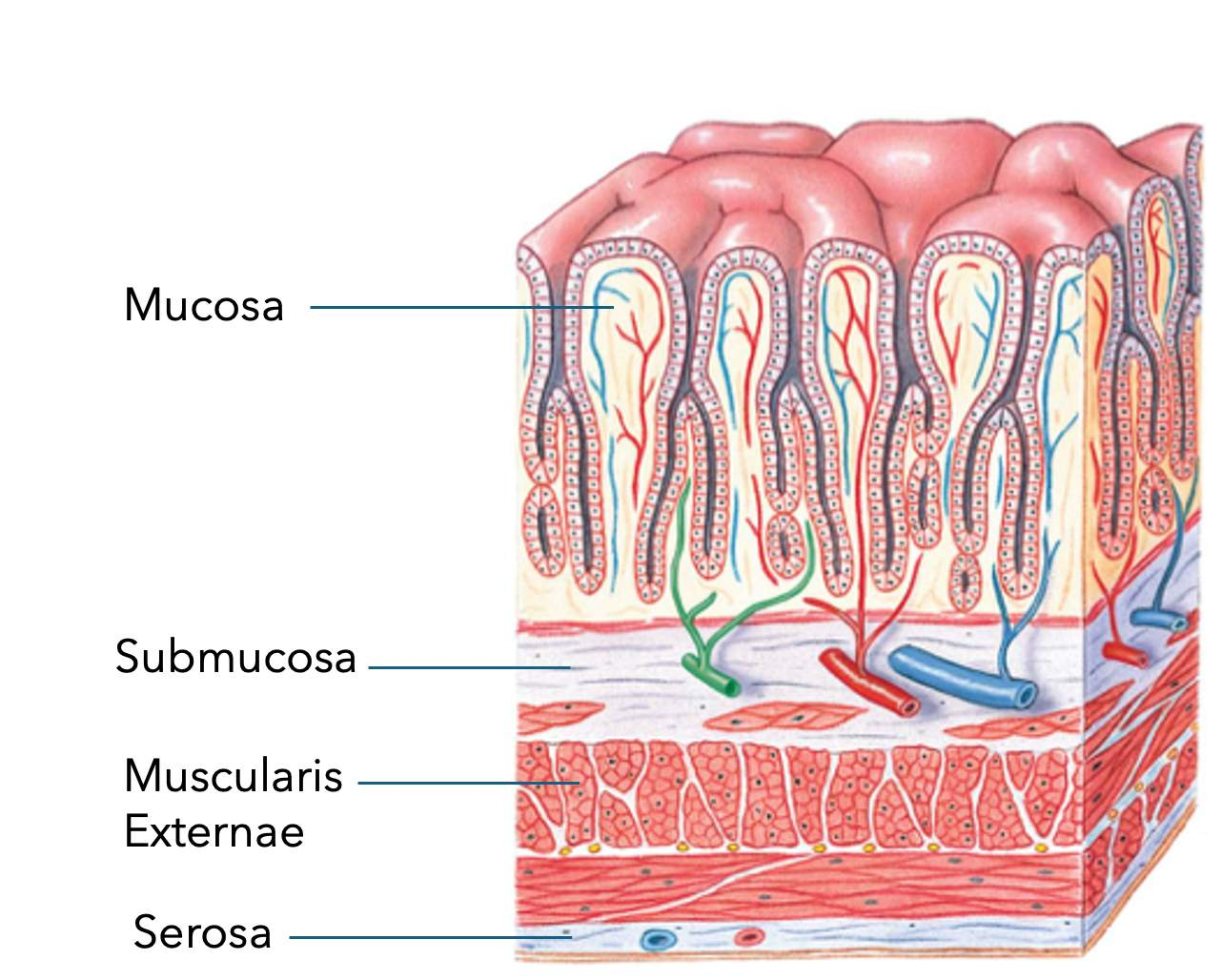
what is secreted from the stomach epithelial cells?
exocrine → fundus + body
(1) mucus neck cells → mucus (sit on top & protect stomach) + HCO3-
on rugae folds
(2) chief cells → pepsinogen zymogen + gastric lipase enzymes
(3) parietal cells → intrinsic factor (absorb B12), H+, Cl-
make HCL & make VVV DEC inside stomach pH
endocrine → antrum
G cells → gastrin hormone (gastric motility & acid secretion)
D cells → somatostatin hormone (inhibit gastrin)
zymogen = inactive precursor protein & activate to enzymes (pepsinogen make pepsin)
What are the five functions of HCl?
1. salivary amylase INACTIVE
2. lingual lipase ACTIVE
3. pepsinogen → pepsin & digests proteins
4. proteins DENATURE → then enzyme digestion
5. ingested microbes GONE
HCL change pH stomach = inactivates salivary amylase + activates lingual lipase
How does the stomach contribute to motility?
GOAL = make chyme from bolus w mech + chem digest
(1) Propulsion
smooth muscles coordinate gentle mix waves every 15-25 sec
push bolus upper → lower stomach area & mix w gastric secretion
(2) Grinding
stronger contraction 4 mech digest bolus into chyme (body → pylorus)
brief open pyloric sphincter
(3) Retropulsion
little chyme V enter SI via pyloric sphincter
chyme moves back into body 4 further mixing
What is gastric emptying?
moves of stomach contents into SI
occur when pyloric sphincter open little to let some V enter
How does the stomach contribute to absorption?
little nutrient absorption → thick mucus layer covering epithelial cells
EXCEPT small lipophilic drugs + alcohol
sphincters of digestive system
Upper Esophageal Sphincter (UES) → opens during swallowing reflex to let food pass from the throat into the esophagus.
Lower Esophageal Sphincter (LES) → opens to let food enter the stomach and closes to prevent stomach acids from backing up.
Pyloric Sphincter→ bottom of the stomach, it controls the release of partially digested food (chyme) into the small intestine
Sphincter of Oddi: Regulates the flow of bile from the liver and gallbladder, as well as digestive juices from the pancreas, into the small intestine. [1, 2]
Ileocecal Sphincter: Sits between the small intestine and the large intestine (colon), controlling the movement of digested waste while preventing it from flowing
Where does the majority of chemical digestion and absorption occur?
The small intestine.
How do the layers of the SI differ from the rest of the GI tract?
Mucosa contains villi to increase surface area for chemical digestion and absorption.
How does the duodenum contribute to digestion and absorption?
Region where the most chemical digestion occurs, contains villi on the mucosa wall that increase surface area to improve chemical digestion and nutrient absorption.
How does the jejunum contribute to absorption?
Contains many villi to aid in maximal nutrient absorption as well as many absorptive epithelial cells (enterocytes).
How does the ileum contribute to absorption?
Contains villi for increased surface area and enterocytes to assist in nutrient absorption that didn't occur in the jejunum, also absorbs vitamin B12 and bile salts.
What are the two exocrine epithelial cells of the SI and what do they secrete?
Goblet cells: secrete mucus to lubricate SI
Intestinal gland cells: secrete mucus with water and bicarbonate to neutralize chyme and protect SI
What are the three endocrine epithelial cells of the SI and what do they secrete?
S cells: secrete secretin
I cells: secrete CCK
K cells: secrete GIP
What are enterocytes?
Absorptive intestinal cells with transporters and microvilli on the apical membrane and a basolateral membrane close to capillaries and lymphatic vessels.
What are brush border enzymes?
Enzymes associated with the microvilli of the small intestine mucosal cells that break down disaccharides and proteins into their absorbable forms.
What are three brush border enzymes?
Lactase, sucrase, and maltase
How does the SI contribute to motility?
Segmentations and peristalsis.
How does the SI contribute to the absorption of carbohydrates, proteins, and lipids?
Absorbs 100% of carbohydrates, 95-98% of proteins, and 95-98% of lipids.
What are the secretions of the large intestine?
Mucus from goblet cells and some electrolytes. No digestive enzymes.
How does the large intestine contribute to motility?
Peristalsis, haustral churning, and gastroileal reflex.
What is haustral churning?
Mixing of the LI contents from one haustra to the next, allowing for optional absorption of mostly water from the lumen.
What is the gastroileal reflex?
The presence of a new bolus in the stomach stimulating the ileocecal valve to open, encouraging the emptying of SI contents into the LI.
What two cells of the pancreas make exocrine secretions?
Acinar and ductal cells.
What do ductal cells secrete and what are their functions?
Bicarbonate: neutralizes chyme
Water: liquifies pancreatic solutions
What do acinar cells secrete?
Enzymes and zymogens.
What enzymes do the acinar cells secrete and what are their functions?
Amylase: digests starch
Lipase: digests lipids
Protease: digests proteins
What 6 zymogens do the acinar cells secrete, what enzymes are they converted to, and what are their functions?
Trypsinogen: trypsin, digests proteins
Chymotrypsinogen: chymotrypsin, digests proteins
Procarboxypeptidase: carboxypeptidase, digests proteins
Proelastase: elastase, digests proteins
Prophospholipase: phospholipase, digests phospholipids
Procolipase: colipase, supports lipase
How are zymogens activated?
Zymogens secreted into SI lumen --> enterokinase activates trypsinogen into trypsin --> trypsin activates the rest of the zymogens
Why does zymogen activation occur in the SI?
The pancreas can't handle digestive enzymes.
What are the two ways blood is supplied to the liver?
Hepatic artery carrying oxygenated blood and hepatic portal vein carrying nutrient rich blood from the GI tract.
What are hepatocytes?
The main liver cell that makes bile solution and is responsible for metabolism.
What are the two membranes of hepatocytes?
Sinusoidal and canalicular membranes.
What are liver lobules?
The basic structural unit of the liver.
What is the pathway of blood in the liver?
Hepatic artery + hepatic portal vein --> sinusoids --> sinusoidal membrane --> hepatocytes --> central vein
What is the pathway of bile in the liver?
Hepatocytes --> canicular membrane --> bile canaliculi --> bile ducts --> hepatic ducts --> common bile duct
What is the role of the gallbladder?
Stores and concentrates bile solution produced by the liver until it is needed.
What is the pathway of bile salts from the hepatocytes to the gallbladder?
Hepatocyte --> bile canaliculi --> hepatic duct --> sinusoid --> cystic duct --> gallbladder
What is the pathway of bile salts from the gallbladder to the SI?
Gallbladder --> cystic duct --> common bile duct --> hepatopancreatic sphincter --> duodenum
How does the ENS regulate the control of the GI tract?
Through the activity of myenteric plexus neurons within the muscularis externa layer.
How does the ENS regulate secretions of the GI tract?
Neurons from the submucosal plexus extend to epithelial cells of mucosa layer and stimulate secretions.
What are the three sensory neurons in the submucosal plexus and what do they detect?
Mechanoreceptors: stretching of organ
Chemoreceptors: contents of chyme/bolus
Nociceptors: pain
What is the short loop reflex?
Sensory neurons --> short loop efferent neurons --> secretions of mucosa + contraction/relaxation of muscularis externa
What is the long loop reflex?
Sensory neurons --> vagus nerve --> long loop efferent neurons --> motility patterns in organs + secretions of mucosa
What triggers the release of gastrin?
Secreted by G cells due to the activation of acetylcholine, stretching of stomach due to bolus, and presence of proteins or amino acids in bolus.
What triggers the release of somatostatin?
Secreted by D cells due to low pH.
What triggers the release of cholecystokinin (CCK)?
Secreted by I cells due to presence of proteins or lipids in chyme.
What triggers the release of secretin?
Secreted by S cells due to low pH.
What triggers the release of GIP?
Secreted by K cells due to presence of carbohydrates, lipids, or proteins in chyme.
What is unique about the regulation of salivary secretions?
Only regulated by neural control and respond positively to both PSNS and SNS stimulation.
What are basal electrical rhythms (BERs)?
Self-generated electrical signals by the interstitial cells of the stomach.
What is the Migrating Motility Complex (MMC)?
Slow wave contractions that occur due to the absence of bolus in the stomach.
What signals increase motility in the stomach?
Bolus enters stomach --> BERs halt --> short and long loop reflexes stimulate motility
What signals decrease motility in the stomach?
No bolus in stomach --> BERs --> MMC --> slow wave contractions --> fasted state
What signals increase motility in the small intestine?
Bolus enters stomach --> MMC stops in SI --> chyme enters SI --> segmentation and peristalsis
What signals decrease motility in the small intestine?
Absence of chyme --> slow wave contractions due to MMC initiated in stomach --> fasted state
What three stimulants cause increased acid secretion in the stomach?
Gastrin, histamine, and acetylcholine.
What are three ways gastrin is stimulated to be released?
Presence of amino acids, distention of stomach from short loop, and vagus nerve activation.
What are two ways histamine is stimulated to be released?
Secreted by ECL cells due to gastrin and neural activation by acetylcholine.
What are two ways acetylcholine is stimulated to be released?
Short and long loop nerve innervation.
What are two ways somatostatin is stimulated to be released?
Released from D cells due to very low pH and CCK secretion.
How does somatostatin increase stomach pH?
Released due to low pH --> inhibits G cell from secreting gastrin --> inhibits ECL cell from secreting histamine --> parietal cells lose two stimulants for HCl
What are two ways gastric emptying/pyloric sphincter opening is increased?
Increased vagus nerve activity and gastrin in circulation.
What are two ways gastric emptying/pyloric sphincter opening is decreased?
Decreased vagus nerve activity and CCK in circulation.
What stimulates acinar secretions?
CCK and neural regulation.
What stimulates ductal secretions?
Secretin and neural regulation.
What are two stimulants for bile production/secretion?
CCK and PSNS.
What are the three phases of the digestive system?
Cephalic, gastric, and intestinal.
What is the stimulus for the cephalic phase?
Sight, smell, and taste of food.