Aircraft Systems

0.0(0)
Studied by 0 people
call kaiCall Kai
Locked
learnLearn
examPractice Test
spaced repetitionSpaced Repetition
heart puzzleMatch
flashcardsFlashcards
GameKnowt Play
Card Sorting

1/411

flashcard set

Earn XP

Description and Tags

Last updated 4:25 PM on 9/3/26
Name
Mastery
Learn
Test
Matching
Spaced
Call with Kai
Chat

No analytics yet

Send a link to your students to track their progress

412 Terms

1
New cards

CT-142 Maximum Operating Altitude

25 000 ft ASL

2
New cards

Ct-142 Runway Limitations

Max Tailwind - 10kts
Max Crosswind - 36 kts

3
New cards
Air Recirculation
Improves cabin airflow and reduces conditioned bleed air demand
4
New cards
Pressurization System
Uses bleed air from the air conditioning system to provide cabin pressurization
5
New cards
Pressurization System Modes
Automatic and manual
6
New cards
APU Functions
Provides air conditioning and basic electrical power on the ground
7
New cards
APU Operation in Flight
Cannot be operated in flight
8
New cards
APU Fuel Source
Left fuel tank collector bay
9
New cards
APU Fire Protection
Has its own fire detection and extinguishing system
10
New cards
Microphone Selection
Boom or Mask
11
New cards
VHF Communication Range
118.0 to 151.975 MHz
12
New cards
UHF Communication Range
225.0 to 399.975 MHz
13
New cards
DC Power Sources
2 TRUs, 2 batteries, 2 starter generators, and external ground power
14
New cards
AC Power Sources
2 AC generators, 9 inverters, APU, and external ground power
15
New cards
Fuel System Tanks
Four wing tanks consisting of 2 main and 2 auxiliary tanks
16
New cards
Power Transfer Unit (PTU)
Hydraulic component that transfers power between hydraulic systems
17
New cards
De Icing System
Removes accumulated ice
18
New cards
Anti Icing System
Prevents ice accumulation
19
New cards
Alternate Extension System
Backup landing gear extension method
20
New cards
Bleed Air Uses
Air conditioning, pressurization, and pneumatic de icing
21
New cards
Cockpit O2 System
Provides oxygen for flight crew
22
New cards
Portable Full Face O2 System
Portable emergency oxygen system
23
New cards
NTS Console O2 System
Oxygen system for navigation training stations
24
New cards
VREF
Approach speed at 50 feet above the runway in landing configuration
25
New cards
V1
Takeoff decision speed at which the pilot may stop or continue the takeoff following an engine failure or other issue
26
New cards
Kinds of Operations
Day and night VFR, IFR, and icing
27
New cards
Maximum Rough Airspeed
180 KIAS in severe turbulence
28
New cards
Minimum Flight Crew
One pilot and one copilot
29
New cards
Maximum Operating Altitude
25,000 ft ASL
30
New cards
Maximum Tailwind Component
10 kt
31
New cards
Maximum Crosswind Component
36 kt
32
New cards
Minimum Runway Width
98 ft
33
New cards
Maximum Cabin Altitude
8,000 ft
34
New cards
Ground Evacuation
Emergency procedure for rapid aircraft evacuation on the ground
35
New cards
Pressurization Emergencies
Procedures for loss or malfunction of aircraft pressurization
36
New cards
Engine Airstart
Procedure to restart an engine in flight
37
New cards
Fuel Transfer Failure
Abnormal procedure for fuel system malfunction
38
New cards
Maximum Aircraft Weights
Ramp, takeoff, and landing weight limitations
39
New cards
Stalling Speeds
Minimum speeds before an aerodynamic stall occurs
40
New cards
Takeoff Climb Data
Performance data used for takeoff and climb calculations
41
New cards
Navigation Training Crew Fixed Oxygen System
Supplemental fixed oxygen system for NTS crew
42
New cards
Operation with Inoperative Autofeather System
Supplementary procedures when autofeather is unavailabl
43
New cards
Three Basic Aircraft Components
Fuselage, wings, and empennage
44
New cards
Fuselage
The main body structure to which all other aircraft components are attached
45
New cards
Wings
Fixed surfaces that produce lift under given conditions of flight
46
New cards
Empennage
The tail section, including the tail cone, horizontal stabilizer, vertical stabilizer, elevators, and rudder
47
New cards
Three Aircraft Motions
Roll, pitch, and yaw
48
New cards
Three Main Control Surfaces
Ailerons, elevators, and rudder
49
New cards
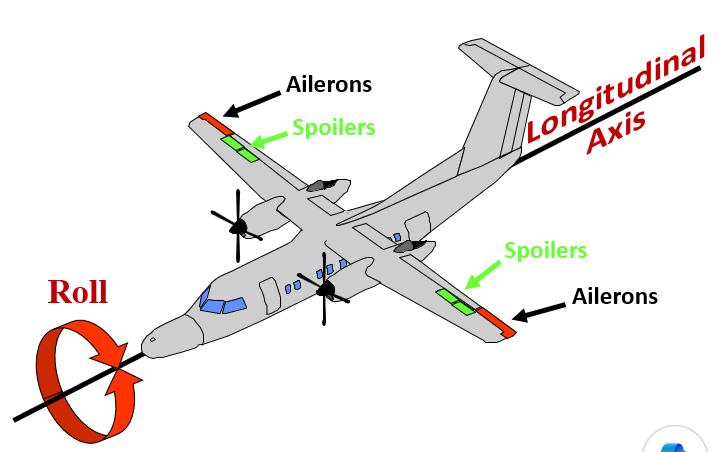
Ailerons
Wing control surfaces used in pairs to control roll
50
New cards
Spoilers
Plates on the upper wing surface that extend into the airflow, spoil airflow, and reduce lift over part of the wing
51
New cards
Ailerons and Spoilers
Control roll about the longitudinal axis
52
New cards
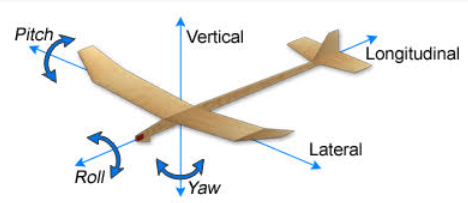
Roll
Aircraft movement about the longitudinal axis
53
New cards
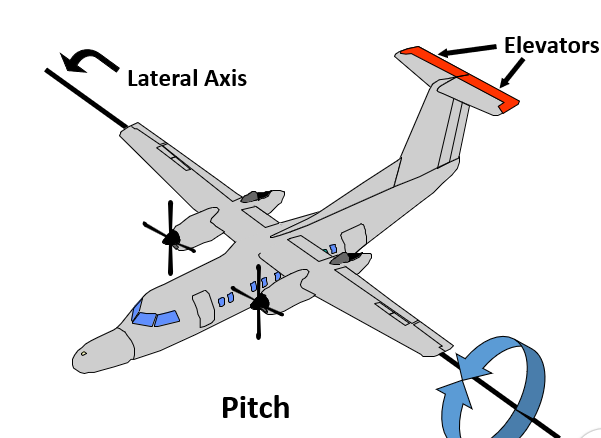
Elevators
Control surfaces on the horizontal stabilizer that control pitch
54
New cards
Pitch
Aircraft movement about the lateral axis
55
New cards
Rudder
Control surface on the vertical stabilizer that controls yaw
56
New cards
Yaw
Aircraft movement about the vertical axis
57
New cards

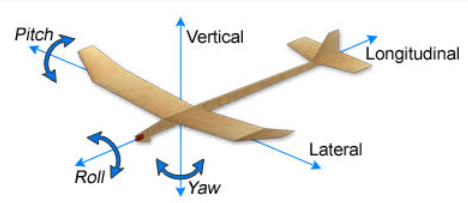
Longitudinal Axis

The axis about which the aircraft rolls
<p>The axis about which the aircraft rolls</p>
58
New cards

Lateral Axis

The axis about which the aircraft pitches

<p>The axis about which the aircraft pitches</p>
59
New cards

Vertical Axis

The axis about which the aircraft yaws
<p>The axis about which the aircraft yaws</p>
60
New cards
<p>Control Surfaces</p>

Control Surfaces

knowt flashcard image
61
New cards

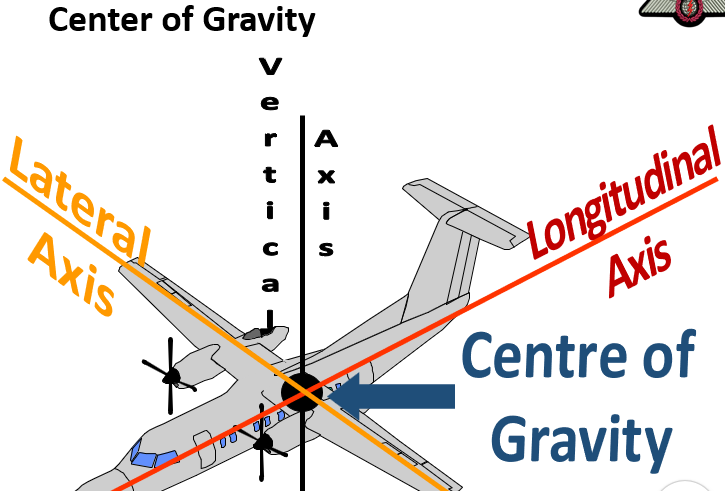
Center of Gravity

The point where the longitudinal, lateral, and vertical axes intersect

<p>The point where the longitudinal, lateral, and vertical axes intersect</p>
62
New cards

Control Forces and Center of Gravity

All control forces are applied around the center of gravity
<p>All control forces are applied around the center of gravity</p>
63
New cards
Aircraft Balance Point
At the center of gravity, the aircraft is in perfect balance
64
New cards

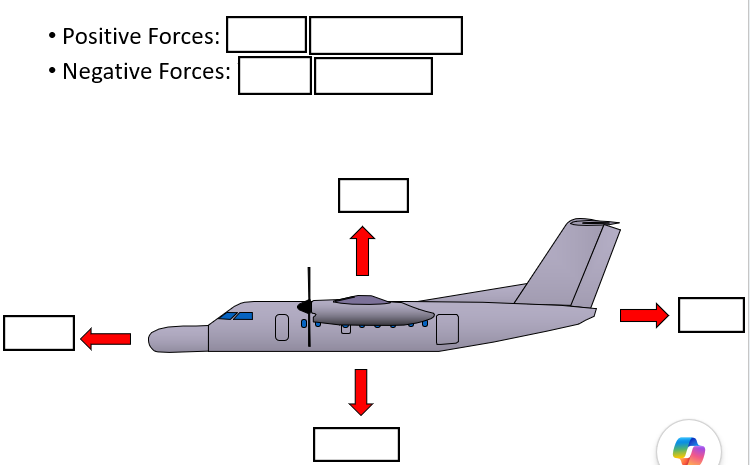
Force

Strength or energy exerted or brought to bear : cause of motion or change : active power

•At 402 Sqn we take this to mean:

•Energy to produce or defy motion

•May be either positive or negative
65
New cards
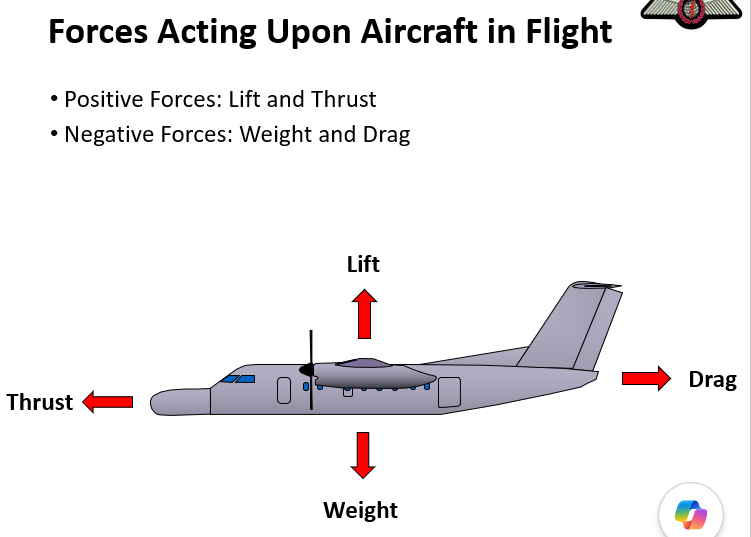
Four Forces Acting on an Aircraft
Lift, thrust, weight, and drag
66
New cards
term image
knowt flashcard image
67
New cards

Straight and Level Unaccelerated Flight

Occurs when lift, weight, thrust, and drag are in equilibrium

<p>Occurs when lift, weight, thrust, and drag are in equilibrium</p>
68
New cards

Newton's First Law

Law of Inertia: A body at rest remains at rest and a body in motion remains in motion unless acted upon by an external force

69
New cards

Newton's Second Law

Law of Acceleration: Acceleration is directly proportional to applied force and inversely proportional to mass. F= ma

70
New cards

Newton's Third Law

Law of Action and Reaction: For every action, there is an equal and opposite reaction

71
New cards
Two Pressures Within a Fluid
Static pressure and dynamic pressure
72
New cards

Static Pressure

Pressure exerted on an object by molecular activity within a fluid

P_static = Force / Area


EXAMPLE : at sea level, standard pressure is 14.7lbs/sq. in (the weight of a column of air above a certain area)

<p><strong>Pressure exerted on an object by molecular activity within a fluid</strong><br><br>P_static = Force / Area<br><br><br><span>EXAMPLE : at sea level, standard pressure is 14.7lbs/sq. in (the weight of a column of air above a certain area)</span></p>
73
New cards
Static Pressure Energy Type
Potential energy
74
New cards
Static Pressure Formula
Static pressure equals force divided by area
75
New cards

Standard Sea Level Pressure

14.7 pounds per square inch


= 101.3 kPa

= 101,325 Pa

= 1013.25 hPa

= 1013.25 mb

= 1 atm

= 29.92 inHg

= 760 mmHg

76
New cards

Dynamic Pressure

A body immersed in a moving liquid will absorb the kinetic energy of that fluid (aircraft in the airstream)

P_dynamic = ½ (rho) v²

(rho) = air density
v = velocity of the fluid

77
New cards
Dynamic Pressure Energy Type
Kinetic energy
78
New cards

Dynamic Pressure Formula

P_dynamic = ½ (rho) v²

79
New cards
Velocity Used for Aircraft Dynamic Pressure
True airspeed
80
New cards

Total Pressure

The sum of static pressure and dynamic pressure

P_total = P_static + P_dynamic
P_total = (Force/Area) + ½ (rho) v²

81
New cards

Air Density (rho) relationship to Pressure, Temperature and Humidity

Air density varies directly with air pressure and inversely with temperature and humidity.

82
New cards
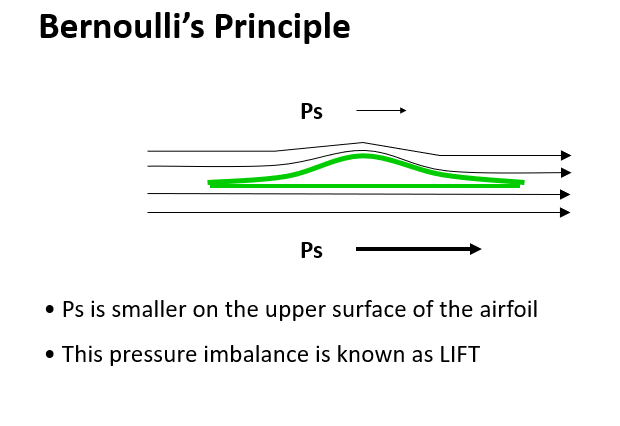
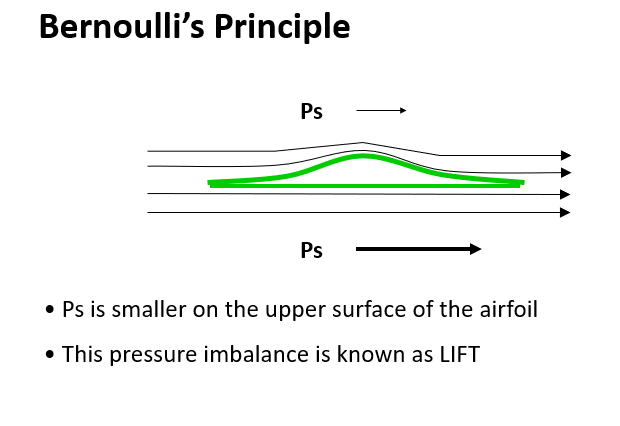
Bernoulli's Principle
An increase in dynamic pressure results in a corresponding decrease in static pressure
83
New cards
<p>Describe what is happening.</p>

Describe what is happening.

Since there is an increase in velocity at point 2 there must be a corresponding increase in dynamic pressure and therefore a decrease in static pressure to maintain a constant pressure.

<p><span>Since there is an increase in velocity at point 2 there must be a corresponding increase in dynamic pressure and therefore a decrease in static pressure to maintain a constant pressure.</span></p>
84
New cards

Airflow Over an Airfoil

The airfoil restricts airflow and increases velocity over its upper surface
<p>The airfoil restricts airflow and increases velocity over its upper surface</p>
85
New cards

Static Pressure Above an Airfoil

Static pressure is lower over the upper surface
<p>Static pressure is lower over the upper surface</p>
86
New cards

Static Pressure Below an Airfoil

Static pressure on the lower surface remains unchanged

<p>Static pressure on the lower surface remains unchanged</p>
87
New cards

Lift Creation

The pressure imbalance between the upper and lower surfaces of an airfoil creates lift

<p>The pressure imbalance between the upper and lower surfaces of an airfoil creates lift</p>
88
New cards

Two Basic Ways to Increase Lift

Increase airspeed or increase airfoil camber:

To increase the camber, we use high lift devices – flaps (leading edge, trailing edge, fowler flaps, etc.)

89
New cards

How do Flaps affect Lift?

They are High lift devices used to increase the camber of an airfoil and increase lift.

90
New cards
Thrust

Fuel is fed into some kind of “engine” where, in burning, its’ chemical energy is changed into thermal energy which is converted into the mechanical work done in propelling the aircraft against the drag.

(used to climb/accelerate)

91
New cards
Thrust in Steady Level Flight
Thrust equals drag
92
New cards

What are the four main types of aircraft engines?

  • Ram-Jet

  • Turbo-Jet /

  • Turbo-Fan

  • Engine/Propeller Combination

    • (Reciprocating (Piston) Engine;

    • Turbine Engine;

    • Fixed Pitch Propeller;

    • Variable Pitch Propeller)


93
New cards
Engine and Propeller Propulsion

A propulsion system that gives a small acceleration to a large amount of air.

Driven by a reciprocating or turbine engine

<p>A propulsion system that gives a small acceleration to a large amount of air.<br><br><span>Driven by a reciprocating or turbine engine</span></p>
94
New cards
Thrust and Momentum Principle
Thrust equals the rate at which momentum is given to the air
95
New cards
Turboprop Momentum
A turboprop gives a large mass of air a small acceleration
96
New cards
Turbojet or Turbofan Momentum
A turbojet or turbofan gives a small mass of air a large acceleration
97
New cards
Propulsion Efficiency at Lower Speeds
A propeller is more efficient than a jet at lower speeds
98
New cards
Propeller Function
Converts engine torque into a forward push or pull called thrust
99
New cards
Propeller Operation
Moves forward in a corkscrew motion and pushes air backward to produce forward thrust
100
New cards
Propeller Blade Cross Section
Similar to an airfoil or wing