Spinal Motor Organization & Brainstem Supraspinal Paths
 Call Kai
 Learn
Learn Practice Test
 Spaced Repetition
 Match
Match Flashcards
 Knowt Play
1/26

There's no tags or description
Looks like no tags are added yet.
Name | Mastery | Learn | Test | Matching | Spaced | Call with Kai | Chat |
|---|
No analytics yet
Send a link to your students to track their progress
27 Terms
What does CST stand for in spinal motor organization?
Corticospinal Tract
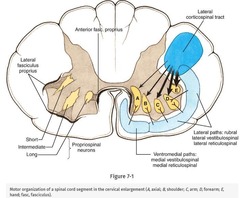
What type of muscles do medial cell bodies in the spinal cord control?
Proximal muscles
What type of muscles do lateral cell bodies in the spinal cord control?
Distal muscles
What is the role of the propriospinal system of neurons?
Links intersegmental neurons to perform coordinated motion.
How many levels is the propriospinal system divided into?
Three levels: long, intermediate, and short propriospinal neurons.
What do long propriospinal neurons do?
Ascend/descend in the anterior fasciculus proprius and influence medial motor neurons.
Where are intermediate propriospinal neurons located?
In the ventral part of the lateral fasciculus proprius.
What is the function of short propriospinal neurons?
Innervate motor neurons of distal limb muscles, found only in cervical and lumbosacral enlargements.
What is the Vestibular Nuclear Complex responsible for?
It influences spinal motor activity and is responsible for balance and equilibrium.

What are the two main tracts that the Vestibular Nuclear Complex projects to?
Lateral vestibulospinal tract and medial vestibulospinal tract.
What do medial vestibulospinal tracts influence?
Bilateral head, neck, trunk, and proximal limb movements.
What is the role of the Pontine Reticular Formation?
Facilitates extensor movements and inhibits flexors.

What do lateral reticulospinal fibers do?
Facilitate flexor movements and inhibit extensors.
Where are the Red Nuclei located?
In the tegmentum of the midbrain at the level of the superior colliculus.

What is the output of the Red Nuclei?
Rubiospinal tract, facilitating flexor movements of contralateral upper limbs.
What are the three groups of supraspinal paths?
Ventromedial, lateral, and cortical groups.
What does the Ventromedial group control?
Bilateral axial movements associated with posture.
What does the Lateral group of the anterior horn control?
Proximal limb muscles with unilateral movements.
What is the primary function of the Cortical group?
Controls distal muscles, especially flexors of the upper extremities.
What happens to a patient recovering from a capsular lesion?
They recover neck/trunk movements before proximal and distal movements.
What is decerebrate posturing?
Upper and lower limbs in extension due to brainstem damage.

What indicates better prognosis: progressing from decerebrate to decorticate posturing or the opposite?
Progressing from decerebrate to decorticate indicates a better prognosis.
What does decorticate posturing indicate?
Damage above the red nucleus, with upper limbs in flexion and lower limbs in extension.

What is the consequence of damage to the corticospinal tract (CST)?
Prevents recovery of functions related to distal muscles, such as rapid finger motion.
What influences the long propriospinal neurons?
They have bilateral influence on medial motor neurons controlling axial muscles.
What is the role of the medial reticulospinal fibers?
Facilitate extensor movements and are under inhibitory control from higher centers.
What is the significance of the rubrospinal tract?
It influences flexor movements of contralateral upper limbs.