BioPsy: Finals L2.2 - Audition
 Call Kai
 Learn
Learn Practice Test
 Spaced Repetition
 Match
Match Flashcards
 Knowt Play
1/21

Earn XP
Description and Tags
Name | Mastery | Learn | Test | Matching | Spaced | Call with Kai | Chat |
|---|
No analytics yet
Send a link to your students to track their progress
22 Terms
Audition
The sense of hearing
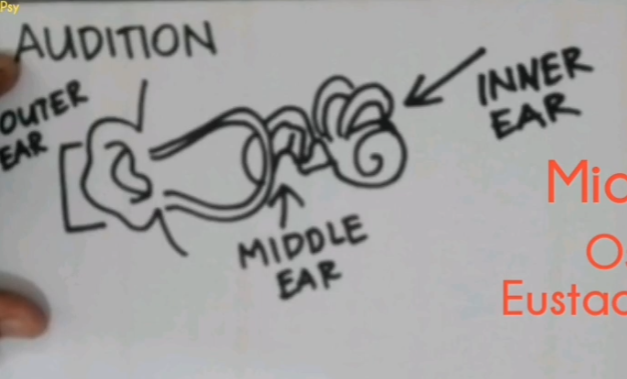
Ear
It is divided into three parts: Outer, Middle, and Inner Ear.
Outer Ear
Pinna
External Auditory Canal
Tympanic Membrane
Middle Ear
Ossicles
Eustachian Tube
Ossicles
Three small bones that are connected and transmit the soundwaves to the inner ear.
Eustachian Tubes
A canal that links the middle ear to with back of the nose.
Inner Ear
Cochlea
Vestibule
Semicircular Canals
Cochlea
The nerves for hearing.
We rely on this part of the inner ear for distinguishing the different frequencies we hear.
Bass (Low Frequency)
Bees (High Frequency)
Converts the sound to a neural impulse that eventually reaches the brain.
Vestibule
The receptors for balance.
Semicircular canals
Similar to vestibule, this part of the inner ear also have receptors for balance.
Auditory Sensory Processing
How the cochlea distinguishes between sounds of varying frequencies and how the destination is maintained to the brain so that the brain will perceive different sounds.
Basilar Membrane
A snail shaped part near the cochlea.
Hearing Capacity
20 hz - 20k hz
Basilar Tuning
This is inside the cochlea and distinguishes the low and high frequencies.
Hair Cells
Located along the basilar membrane, these are receptors in the ears.
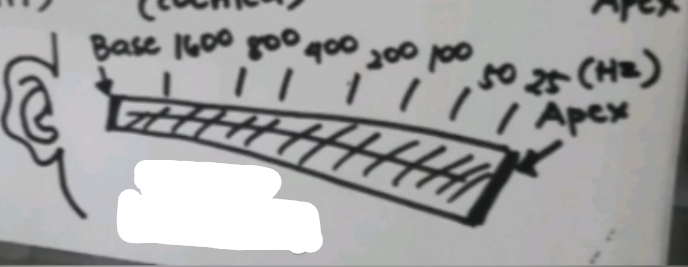
Cochlea: Base
Responsible for perceiving high pitch or high frequencies
Cochlea: Apex
Responsible for perceiving low pitch or low frequencies
Cochlea (Unrolled)
Different hair cells are triggered in the _________ depending on the sounds perceived by a human.
The closer to the base, the higher the frequency.
The closer to the apex, the lower the frequency.
Primary Auditory Cortex
The destination of signals sent from the ear to the brain to perceive/interpret sound.
Conductive Deafness
The people who suffers with this kind of deafness still has a normal cochlea and auditory nerve, and can hear their own voice.
Also known as Middle Ear Deafness.
Sometimes can only be temporary.
If it persists, can be corrected by surgery or hearing aid.
Nerve Deafness
Caused by a damage in the cochlea, the hair cells, or auditory nerves. If it is confined to one part of the cochlea, it impairs hearing of certain frequencies and not others.
Also known as Inner Ear Deafness
Can be inherited.
Can be acquired from diseases or loud noises.
Tinnitus
A frequent or constant ringing in the ears.
Maybe due to a phenomenon similar to phantom limb.
If the brain no longer gets its normal input, axons representing other parts of the body may invade parts of the brain area that usually responds to sound.
Other treatments can mask the noise.