Sterile Products Exam
 Call Kai
 Learn
Learn Practice Test
 Spaced Repetition
 Match
Match Flashcards
 Knowt Play
1/112

There's no tags or description
Looks like no tags are added yet.
Name | Mastery | Learn | Test | Matching | Spaced | Call with Kai | Chat |
|---|
No analytics yet
Send a link to your students to track their progress
113 Terms
USP
Sterile products

Revised USP
Must be prepared in an ISO Class 5 or better, that may be placed in an unclassified segregated compounding area (SCA) and have shorter BUDs
Revised USP
Must be prepared in a cleanroom suite and have longer BUDs
Revised USP
-May be assigned longer BUDs than limits set for Category 2 up to a maximum of 180 days
-Undergo sterility testing
-Have more requirements than Category 2 for personnel qualification, use of sterile garb, use of sporicidal disinfectants, frequency of environmental monitoring, and stability determination
Revised USP
1. ≤12 hours at CRT
2. ≤24 hours in refrigerator
Revised USP
1. 4 days at CRT
2. 10 days in refrigerator
3. 45 days in freezer
Revised USP
1. 1 day at CRT
2. 4 days in refrigerator
3. 45 days in freezer
Revised USP
1. 30 days at CRT
2. 45 days in refrigerator
3. 60 days in freezer
Revised USP
1. 14 days at CRT
2. 28 days in refrigerator
3. 45 days in freezer
Revised USP
1. 45 days CRT
2. 60 days in refrigerator
3. 90 days in freezer
Revised USP
1. 60 days at CRT
2. 90 days in refrigerator
3. 120 days in freezer
Revised USP
1. 90 days at CRT
2. 120 days in refrigerator
3. 180 days in freezer
List some topics covered in the content of USP
1. CSP Microbial Contamination Risk Categories
2. Personnel Training and Evaluation in Aseptic Manipulation Skills
3. Single-Dose and Multiple-Dose Containers
4. Verification of Automated Compounding Devices
5. Patient Monitoring and Adverse Events Reporting
6. Storage and Beyond-Use Dating
7. Patient or Caregiver Training
What is a CSP?
Compounded sterile preparation
What is the exception to the USP
Immediate-Use CSPs (exempt from all requirements)
Direct Compounding Area (DCA) corresponds to...
surface in hood
Primary Engineering Control (PEC) corresponds to...
hood
Required Facility Design for USP
1. Must have an ISO Class 5 environment as a PEC
2. Must have an ISO Class 7 environment for buffer area or cleanroom
3. Must have an ISO Class 8 environment for ante areas
Aseptic Technique
procedure which is designed to prevent contamination of materials, instruments, utensils, and containers during handling

Horizontal Flow or Laminar Flow Hood
air blows towards worker, used for non-chemotherapy preparations
Vertical Flow or Biological Safety Cabinet
air blows from top down to maintain sterility and protect the worker, used to make chemotherapy
In a Horizontal Flow/Laminar Flow Hood, all aseptic manipulations should be performed at least ___ inches within the hood
6 inches
True or False. Is it okay to come in contact with the HEPA filter when cleaning before use.
False
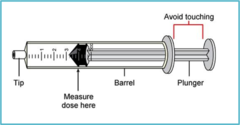
Using aseptic technique, which part(s) of a syringe should NEVER be touched?
Tip or Plunger
Graduation (in mL) of 60 mL syringe
1.0
Graduation (in mL) of 30 mL syringe
1.0
Graduation (in mL) of 20 mL syringe
1.0
Graduation (in mL) of 10 mL syringe
0.2
Graduation (in mL) of 5 mL syringe
0.2
Graduation (in mL) of 3 mL syringe
0.1
Graduation (in mL) of 1 mL syringe
0.01
DO NOT use syringes whose graduations are greater than ________ the volume being measured
twice
Luer-Lok tip

Syringe barrel

Calibration marks

Syringe piston

Syringe plunger

Needle hub
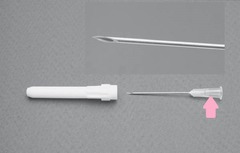
Needle bevel

Needle shaft

D value
time in minutes required to destroy 90% of microbes under a standard set of conditions (ex. 10^6 organisms goes to 10^5 after 1 minute)
Phlebitis
inflammation of a vein (reduced when IV infusions are filtered - final filter)
Antimicrobial agents that kill organisms are...
bacteriocidal
Antimicrobial agents that prevent growth of organisms are...
bacteriostatic
Few microorganisms grow below a pH of ___, or above pH ___
3;9
Primary source of pyrogen contamination in sterile products
water used as the solvent or during processing
Large-volume intravenous solutions
injections containing more than 100 mL of solution intended for IV use
Small-volume injections
injections of 100 mL or less, may be either single or multi dose products
Intradermal (ID) injection area
just below the surface of the skin (interface of epidermis and dermis), often used for skin tests

Intradermal (ID) injection volumes
usually 0.1 mL, may be as small as 0.02 mL, and as large as 0.5 mL
Intradermal (ID) syringe and needle sizes
-1 mL syringes, often labeled "tuberculin"
-25 to 28G, 3/8 to 5/8 inch
Subcutaneous (SC, SQ) injection area
subcutaneous fat tissue between the dermis and muscle

Subcutaneous (SC, SQ) injection volumes
limited to approximately 1 mL
Subcutaneous (SC, SQ) syringe and needle sizes
-1 or 3 mL syringes
-Needle size depends on use
Intramuscular (IM) injection area
deltoid, vastus lateralis, gluteus maximus

Intramuscular (IM) injection volumes for adults
-Up to 2 mL may be given in deltoid
-Up to 5 mL in gluteal medial muscle

Intramuscular (IM) injection volumes for children
-Vastus lateralis muscle is recommended in children under 3
-For children up to 3 years, the max volume is 1 mL

Intravenous (IV) injection area
Veins

Intravenous (IV) syringe and needle sizes
-1 to 60 mL syringe
-20 to 22G, 1/2 to 1 1/2 inch
Types of IVs (3)
1. Continuous or constant infusion
2. Intermittent
3. Bolus or IV push
Continuous IV (constant infusion)
the solution is slowly and continuously dripped into a vein
Intermittent IV
drug is given in an intermediate of time (15-60 min) at spaced intervals (ex. every 6 hours)
IV push or bolus
drug is placed in a syringe and administered in a short period of time (minutes) directly into vein or IV tubing (may be one time or repeated at spaced intervals)
If the drug volumes are equal, the priming volume...
may be split equally (one-half for each drug)
If the drug volumes are unequal, the priming volume...
must have the same proportion of each drug solution as in the dose volume (must calculate)
True or False. Drug absorption is usually faster after IM injection than SC injection.
True
Fick's First Law Equation (sink conditions)
DC/I
Fick's First Law Equation (amount/time)
ADC/I
Where does the oil/water partition coefficient go in Fick's First Law Equation if present?
Denominator
A high oil/water partition coefficient ____________ release by lowering rate of diffusion
prolongs
The major use of suspensions injected IM or SC
to provide a slow release prolonged effect with a single dose
Most widely used approach for rate limiting absorption of IM or SC suspensions
use a relatively insoluble drug
For an IM drug suspension, duration of drug absorption decreases with...
a decrease in particle size
If a parenteral suspension is injected IV, it must have a particle size less than ___________ microns and must be biodegradable
0.5-1 (µm)
Aqueous solution absorption path
injection site, diffusion, capillary
Aqueous suspension absorption path
injection site (particles), dissolution, injection site, diffusion, capillary
Oil solution absorption path
injection site (droplets), partitioning, injection site, diffusion, capillary
In cortisone acetate suspension, which component is the preservative?
Benzyl alcohol
Intact drugs are usually ___________ and form ___________ oxidation products
colorless; colored
Primary cause of the rancidity of fats and natural oils (Triglycerides)
Oxidation
List some common antioxidants (3)
-Tocopherol (Vitamin E)
-EDTA (metal chelator)
-Sulfites (oxygen scavenger)
List some containers that can help prevent photolysis
1. Amber vials
2. Aluminum foil
Incompatibility
medication error of dosage forms from compounding, dispensing, or administration
Physical Incompatibility
precipitation of unionizable (neutral) drug after dilution of solubilizing agent
Absorption
lipophilic drugs and preservatives in solution partition into plastics and rubber
Adsorption
drug in solution adhere to a surface (ex. plastic surfacers, filter membranes)
pH of 5% Dextrose Injection
3.5-6.5
A protein has its ___________ solubility at its isoelectric point (no net charge)
lowest
True or False. Hydrochloride salts of weak bases are the most common.
True
List some common cosolvents (5)
1. Propylene glycol
2. Polyethylene glycol (PEG)
3. Ethanol
4. Glycerol
5. Dimethylacetamide
Citric acid is commonly used as a ___________ in injections
pH adjustor
List the two most common nonionic surfactants
1. Tween 80
2. Cremophor EL
Surfactants assemble into a micelle at the...
critical micelle concentration (CMC)
Cyclodextrans are relatively nontoxic cyclic oligomers of ___________ that form inclusion complexes with drugs
Dextrose
Lecithin is a ___________ and adsorbs at the oil-water interface in emulsions
surfactant
IV Admixture
the preparation of pharmaceutical product which requires the measured addition of a medication to a 50 ml or greater bag or bottle of IV fluid
High risk patient groups for IV Admixtures (6)
1. Patients with renal/liver impairment
2. Neonates
3. Elderly/chronically ill
4. Patients on multiple medications
5. Oncology patients
6. Pregnant/breastfeeding mothers
List the different types of stability issues that may arise (4)
1. Chemical
2. Physical
3. Therapeutic
4. Microbiological
List the advantages of DHEP in IV bags and tubing (5)
1. Flexibility
2. Strength
3. Temperature tolerant
4. Stability
5. Resistance to kinking
List the disadvantages of DHEP in IV bags and tubing (4)
1. Leaching
2. Drug incompatibility
3. Risk of harmful exposure
4. Reproductive toxicity