2.3 Rates of Reaction ⏰️
 Call Kai
 Learn
Learn Practice Test
 Spaced Repetition
 Match
Match Flashcards
 Knowt Play
1/21

22 Terms
Measuring rate of reaction
amount of product formed/ reactant lost over period of time
Rate of reaction equation
1/time
Rate of reaction units
s-1
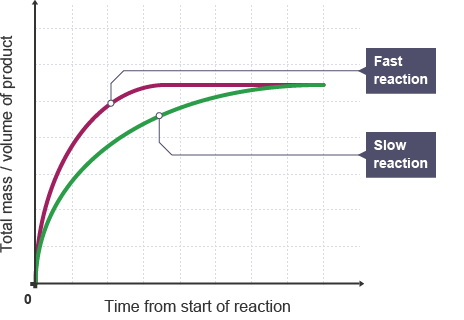
Rate of reaction graph
faster reactions have steeper gradients and plateau sooner (greater rate of reaction)
Measuring rate of reaction metal + acid (product method)
volume of hydrogen gas given off using gas syringe over time with stopwatch
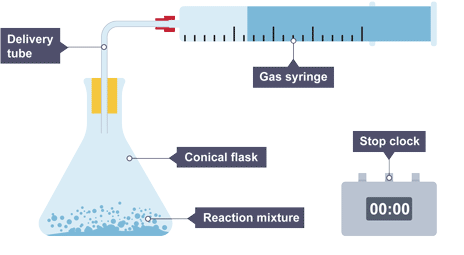
Mg + 2HCl →
MgCl2 + H2
Measuring rate of reaction calcium carbonate (marble chips) + acid (reactant method)
loss in mass of mixture (co2) using balance over time with stopwatch
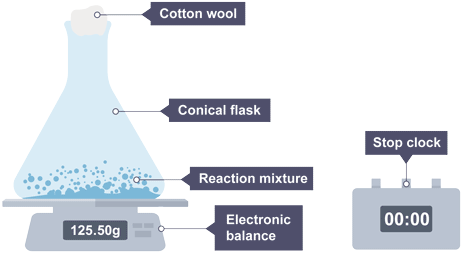
CaCO3 + 2HCl →
CaCl2 + CO2 + H2O
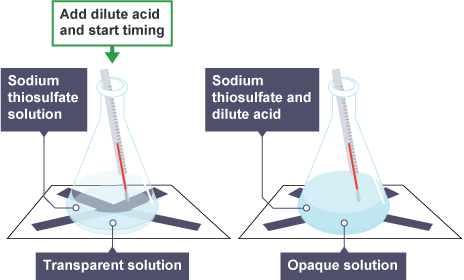
Measuring rate of reaction forming a precipitate (sodium thiosulfate)
time taken for solution to go from transparent to opaque
Collision theory
particles must collide to have reaction, requiring enough energy or they will just bounce apart

How is collision theory linked to rate of reaction
more successful collisions means faster rate of reaction
Activation energy
minimum energy required for a reaction to occur
Factors affecting rate of reaction
surface area/ size
concentration
temperature
catalyst
Effect of surface area on rate of reaction
more particles exposed to reactant
collide more often, more successful collision per unit time
rate of reaction increases
How to increase surface area
using smaller particles e.g cutting/ powder
Effect of concentration on rate of reaction
more reactant particles
collide more often, more successful collision per unit time
rate of reaction increases
Effect of temperature on rate of reaction
particles have more kinetic energy, moving quicker
collide more often, more successful collision per unit time
rate of reaction increases
Catalyst
substance that increases the rate of a chemical reaction without being used up
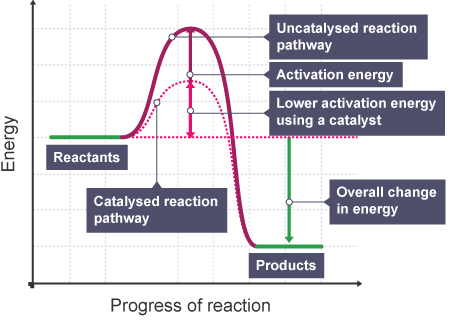
Effect of catalyst on rate of reaction
provides alternative reaction pathway of lower activation energy
more successful collision per unit time
rate of reaction increases
Catalyst in decomposition of hydrogen peroxide
manganese(IV) oxide
Using manganese(IV) oxide
black solid, removed from mixture by filtration
2H2O2(aq) →
2H2O + O2