Chapter 6: Mechanical Properties (Part 1)
 Call Kai
 Learn
Learn Practice Test
 Spaced Repetition
 Match
Match Flashcards
 Knowt Play
1/69

There's no tags or description
Looks like no tags are added yet.
Name | Mastery | Learn | Test | Matching | Spaced | Call with Kai | Chat |
|---|
No analytics yet
Send a link to your students to track their progress
70 Terms
Strain
the change in dimension of a material per unit length
dimensionless
m/m or cm/cm
result of the application of stress to a material
Stress
a force acting on an area
normal stresses act perpendicular to the area (tensile stress → pull apart, compressive stress → squeeze inwards)
shear stresses act parallel to the area
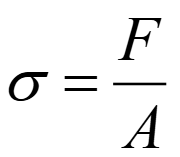
Elastic strain
fully recoverable strain that develops upon applied stress, and is completely recovered when the stress is removed
no permanent deformation
Plastic deformation/strain
when a material does not return to its original shape after stress is removed
Uniaxial Tensile Test
Measure the resistance of a material to a slowly applied stress
Used to determine many material properties
typical specimen: ASTM E8 Standard
Amount of stretching measured using a strain gauge or extensometer
Hooke’s Law Equation
σ = Eε
Strain rate
How fast you pull an object apart
Engineering stress formula
S = F/ A0
Engineering Strain formula
e = Δl / l0
What is the typical stress-strain in metals? What is the deformation mechanism?
<40%
Bond stretching followed by dislocation multiplication and motion
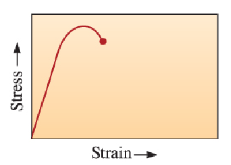
Work Hardening
dislocation multiplication
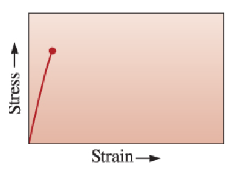
What is the typical stress-strain in ceramics? What is the deformation mechanism?
~500 MPa
much better in compression than tension
stretching of strong ionic/covalent bonds, few slip systems, no plasticity
failure after stress exceeds bond strength
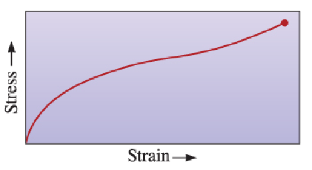
What is the typical stress-strain in elastomers? What is the deformation mechanism?
large, reversible deformation
uncoiling and alignment of long polymer chains followed by stretching of covalent bonds
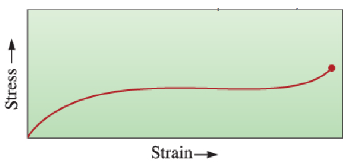
almost no linear range
What is the typical stress-strain in thermoplastics? What is the deformation mechanism?
bond stretching, rotating, and disentangling, followed by chains siding past one another and rearranging permanently
Poisson’s Ratio Equation
v = - elateral / elongitudinal
For metals, Poisson’s ratio is…
0.25 1<= v <= 0.50
Yield Strength
the point where the material transitions from elastic to plastic deformation
What is the relationship between elastic and plastic strains?
εtota = εplastic + εelastic
As plastic deformation begins, stress value drops from the “upper yield point” (S2). What does this mean experimentally/physically?
Certain low-carbon steels display this “yield point phenomenon.” Why do they display this phenomenon?
Luders Bands
visible, slanted lines that appear on the surface of some mild steels and other low-carbon alloys during tensile test
caused by dislocation motion being interfered with by interstitial atoms clustered around dislocations during slip
Is plastic deformation good or bad for load-bearing applications?
Bad, must design components so stress under operation is much less than yield strength at the temperature at which the material will be used
For shaping materials into components, you must apply stresses well above or below yield strength?
above
True or False: Young’s Modulus is dominated by atomic bonds, rather than microstructure (grain size, phases, GB)
True
Necking
one region of specimen deforms more than the rest and the cross-sectional area decreases
How does engineering stress decrease?
area is smaller at neck, so a lower force is required to continue deformation
Uniform deformation vs Non-uniform deformation
refer to graph for answer
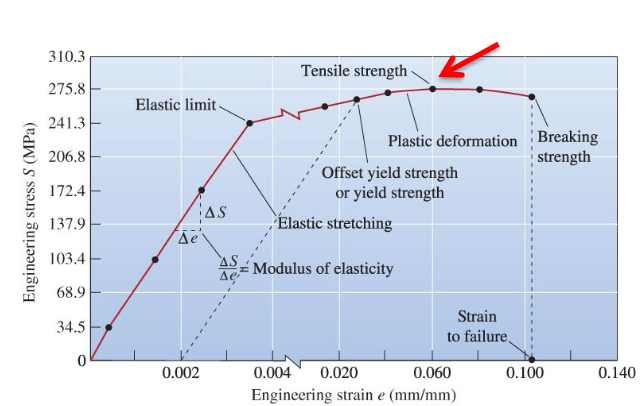
Ultimate Tensile Strength
strength at highest applied force or maximum stress on engineering stress-strain diagram
deformation becomes unstable in a local area and doesn’t remain uniform
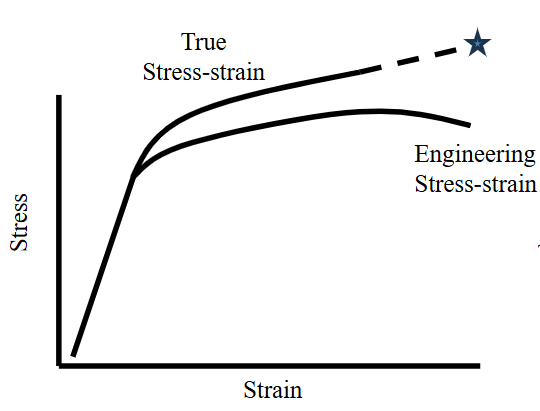
What do true stress and true strain account for?
the changing dimension of the tensile specimen during deformation
True Stress
Force acting per instantaneous cross-sectional area of specimen
σT = F/A
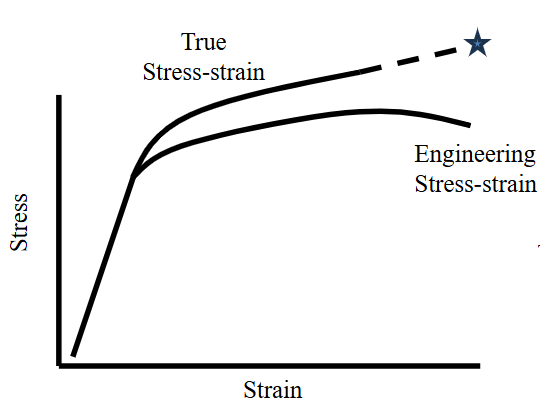
True Strain
Integrating the incremental changes in length relative to the instantaneous length
εT = ln(L/L0)
Which metals do you expect to have higher melting temperatures?
metals with higher elastic modulus tend to have stronger atomic bonding, so they have higher temperatures
Modulus of resilience
elastic energy a material can absorb prior to yielding
Er = (1/2)(yield strength)(strain at yielding)
Tensile toughness
energy absorbed by the material prior to fracture
area under “true” stress-strain curve
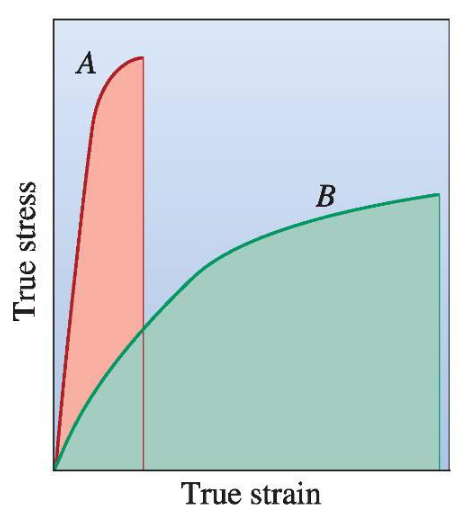
Which material has more toughness?
B
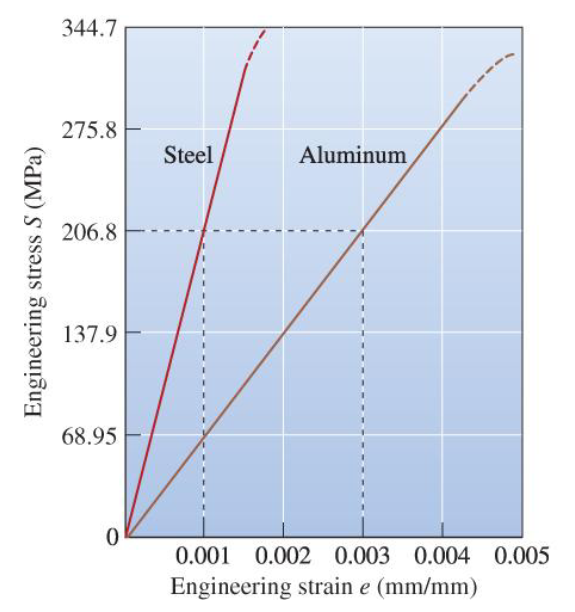
Which material has a larger E/ “stiffness”?
Steel
Ductility
ability of a material to be permanently deformed without breaking when a force is applied
%Elongation formula
%elongation = ((lf - l0 ) / l0 ) * 100%
%Reduction in area formula
%RA = ((A0 - Af ) / A0) * 100%
Elastic limit
max stress a material can experience and still return to its original shape after the load is removed
below: elastic deformation
above: some permanent plastic deformation remains
What does yield strength correspond to?
stress at which plastic deformation starts
How can we control yield strength?
other dislocations (strain hardening)
grain size (grain strengthening)
point defects (solid-solution strengthening)
precipitations (second phases such as carbides in steel)
Why does the yield strength decrease at higher temperatures?
decreased dislocation density
energy assists formation of ideal crystal structure
dislocations don’t interfere with each other
increase in grain size via grain growth
recrystallization: new and defect-free grains grow
strengthening due to ultra-fine particles may decrease
precipitates grow in size
Hardness test
measure of the resistance to penetration of the surface of a material by a hard object
qualitative measure of the properties of the material
Why can’t we establish a quantitative unit for hardness (ex. MPa)?
the stress near indenter is non-uniform
Brinell Hardness
uses spherical indenter and measures diameter of indent
Rockwell Hardness
Brinell Hardness Number (BHN)
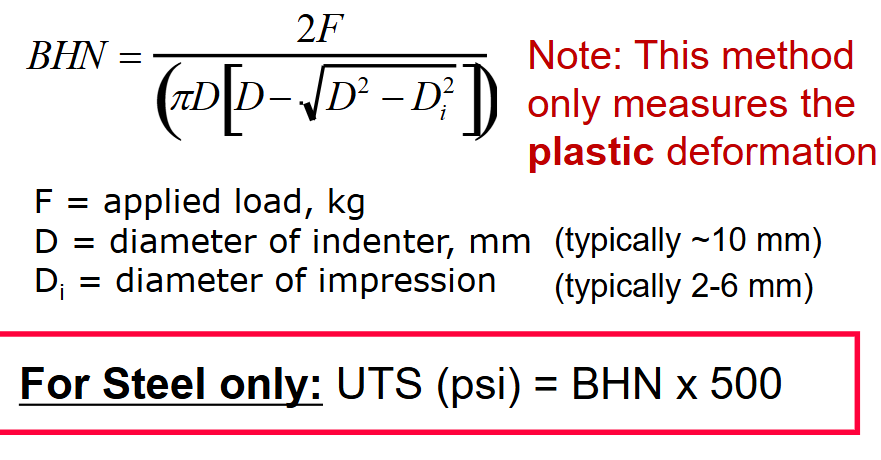
Why is elastic deformation also measured in a Rockwell Hardness test?
Why might a metal/alloy be more brittle for impacts?
Insufficient time for slip to occur
Impact test
used to evaluate brittleness of a material under impact loading
material is strained at a much higher rate than tensile test
Strain rate
how fast deformation is happening
Vickers Hardness
HV = 1.854 (P/d²)
Knoop Hardness
Tensile toughness
area under a stress-strain curve before fracture
ability of a material to absorb energy during a slow tensile test
Impact toughness
ability to absorb energy during an impact
measured using Izod and Charpy tests
Fracture toughness
ability of a material containing flaws to withstand an applied load
(flaw: pre-existing crack or void)
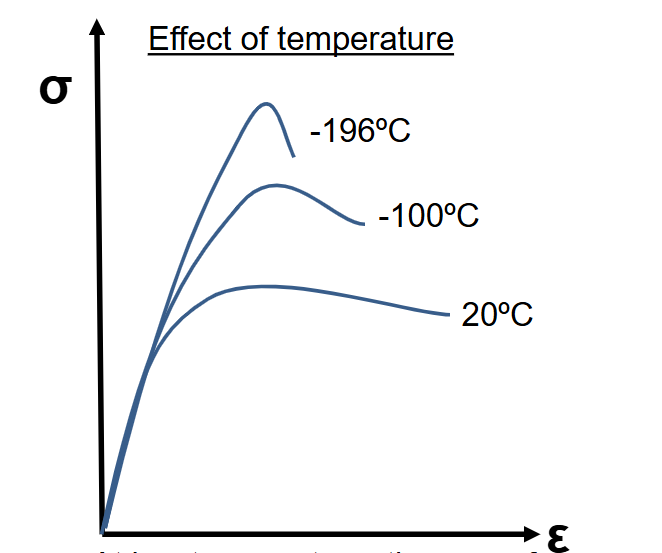
At low temperature, are there more or fewer thermal vibrations?
fewer
At low temperature, do dislocations have an easier or more difficult time moving?
more difficult → no assistance from the thermal vibrations
As temperature decreases, what happens to ductility and strength?
ductility decreases, strength increases
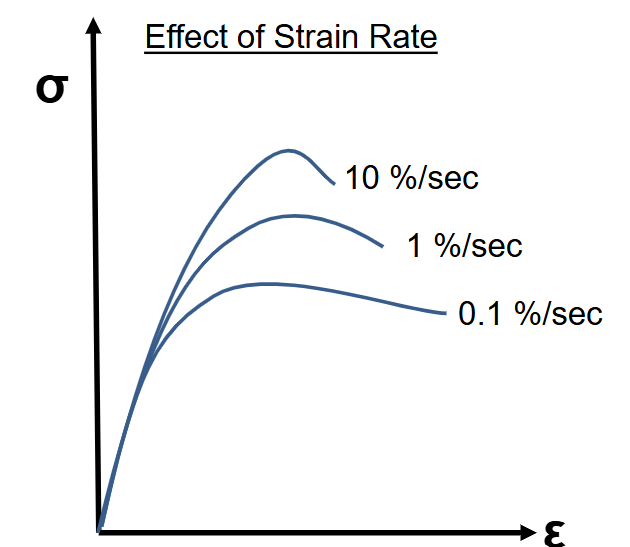
As the strain rate increases, is there more or less time for dislocations to move?
less time
If we observe a material to exhibit good ductility at room temperature, how can we know about low temperatures without repeating tensile tests?
Perform an Izod or Charpy test
Charpy test
mgh → m = mass of pendulum
pendulum hits behind the notch in the material
impact energy measured by this test is the work done to fracture the specimen
more ductile the material → more plastic deformation → higher the Charpy energy
more brittle → less plastic deformation → less Charpy energy
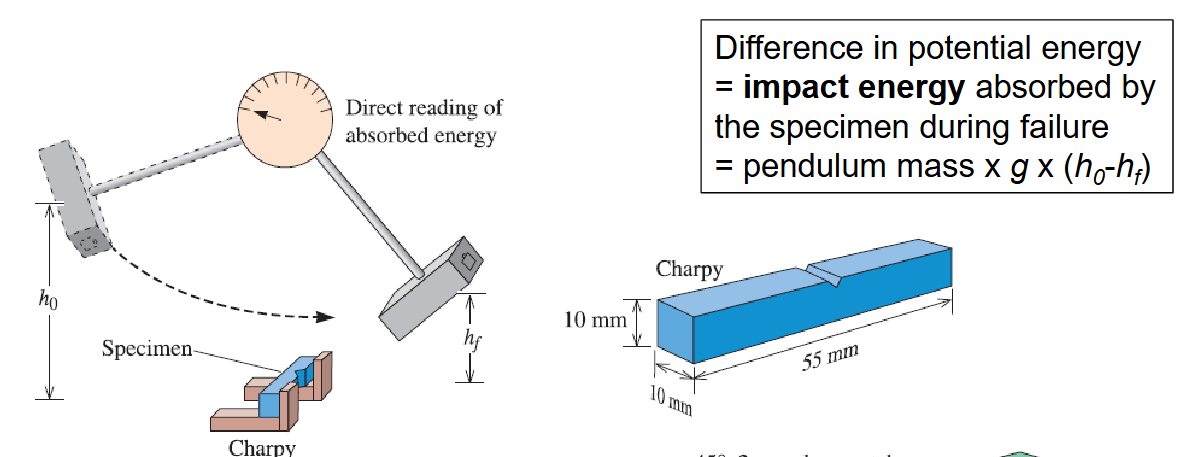
The Charpy energy compared to the energy under the stress-strain curve is ___________________
usually smaller
Why should we be interested in impact and fracture toughness?
important for load bearing structures
need to know if material will survive the conditions that the structure will see in service
Izod test
like a cantilever beam

Ductile to Brittle Transition Temperature (DBTT)
transition temps are determines using Charpy and Izod tests
ex. Titanic → snapped easily from impact of iceberg due to low temperatures
Require DBTT above or below operating temperatures?
below
True or False: FCC crystal structure typically exhibits higher absorbed energies and no transition temperature
True because dislocations can still move on many close-packed slip systems