The law
 Call Kai
 Learn
Learn Practice Test
 Spaced Repetition
 Match
Match Flashcards
 Knowt Play
1/8

There's no tags or description
Looks like no tags are added yet.
Name | Mastery | Learn | Test | Matching | Spaced | Call with Kai | Chat |
|---|
No analytics yet
Send a link to your students to track their progress
9 Terms
Can patients refuse treatment?
-Yes. Competent adult patients (those over the age of 18) can refuse to consent to any treatment except where compulsory treatment for the patient’s psychiatric disorder is authorised by mental health legislation.
-Must respect a patient’s decision to refuse treatment, even if they do not agree with it or when it could lead to permanent injury or death.
-Patients are not required to justify their decision to refuse consent, but health professionals should seek to ensure that patients base their decisions on accurate information and that they have corrected any misunderstandings.
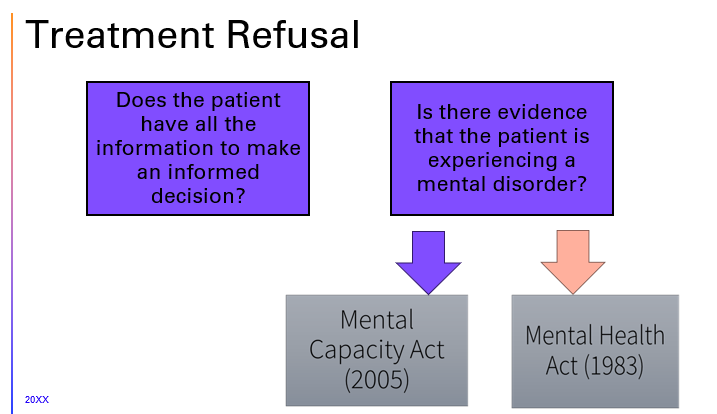
Best interests (Lack of capacity determined)
-Do not make assumptions about what is in the best interests of the person, deal with facts and ‘known, knowns.
-Understand all of the relevant circumstances.
-Can the decision be put off because the person may regain capacity?
-Ensure the best interest process detailed in the MCA (2005) has been followed to the full
Common law (Capacity status unknown)
-Common law allows anyone to take reasonable and proportionate action to prevent immediate significant harm to themselves or others whether they have capacity or not.
-If behaviour suggest a lack of capacity, then you should act in the individuals' best interests to keep them safe. Aggression / violence in A&E is an example where common law can be used.
The Human Rights Act (1998)- Consent and law
Article 3- Right to freedom from torture or inhuman or degrading treatment
Article 5-Right to liberty and security
Article 8- Right to respect for private and family life
Article 9- Right to freedom of religious expression
Health and Social Care Act (2008)
-Part 3 Section (11)- Care and treatment of service users must only be provided with the consent of the relevant person
Duration of consent
-When a person gives valid consent to an intervention, in general that consent remains valid for an indefinite duration, unless it is withdrawn by the person.
-However, if new information becomes available regarding the proposed intervention HCP should inform the patient and reconfirm their consent
Covert medication
-Refers to giving medicine in a disguised form to a person without their knowledge or consent, often by hiding it in food or drink.
-This is a sensitive practice that should only be used in exceptional circumstances, such as when a person lacks capacity or has refused medication multiple times and doing so will cause them harm.
-A formal capacity needs to be done before implementing this.
Key points in covert meds
-Altering the characteristics of a medicine can change the drug and/or a person’s response to it
-Crushing a tablet designed to release slowly over 24 hours could increase adverse effects due to the whole dose being released too quickly. Could result in an overdose.
-Some medicines can become ineffective when mixed with certain foods or drink
Cover meds pt2
-This decision is always done under the MCA framework
-It requires a Best Interests meeting, and should involve family and people who know the patient well
-Remember the 2 stage test – what is the impairment of brain or mind. Usually dementia in cases of covert meds
-If covert medication is agreed, consult pharmacist for advice re pharmacology
-If the clinical pictures changes down the line, another BI meeting is required, remember, decision specific