Redox reactions and Oxidation states and ionic equations
 Call Kai
 Learn
Learn Practice Test
 Spaced Repetition
 Match
Match Flashcards
 Knowt Play
1/10

There's no tags or description
Looks like no tags are added yet.
Name | Mastery | Learn | Test | Matching | Spaced | Call with Kai | Chat |
|---|
No analytics yet
Send a link to your students to track their progress
11 Terms
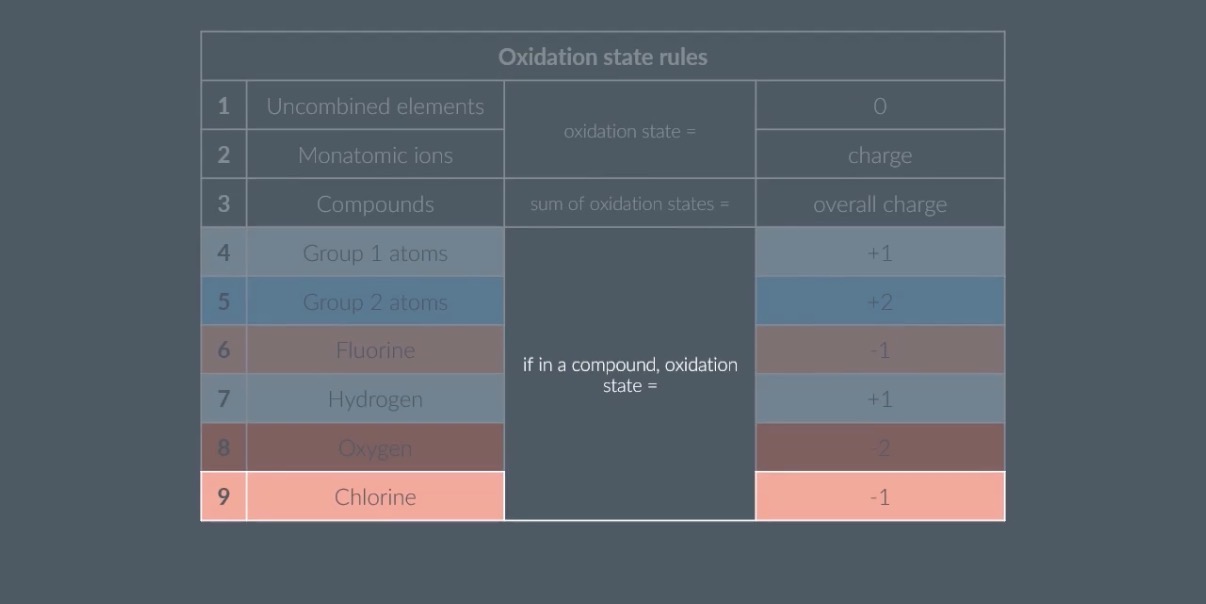
Oxidation state rules

When lithium chloride dissolves in water, Li+ and Cl− ions are produced.
The charge on the lithium ion is …1? and its oxidation state is …2?.
The charge on the chloride ion is …3? and its oxidation state is …4?.This question refers to the following chemical reaction:
4Al (s)+3O2(g)→2Al2O3(s)
5. Which element is gaining electrons and Which element is losing electrons?
In this reaction, the aluminium has been ..6? and the oxygen has been …7?.
This question refers to the following chemical reaction:
Mg (s)+ZnCl2(aq)→MgCl2(aq)+Zn (s)
On the left hand side of the equation, zinc ions in the aqueous solution have a charge of …8? and so the oxidation state of zinc is …9?
By looking at the oxidation states of all species in the reaction in this way, we can deduce that:
∙ The oxidation state of zinc went from …10? to ..11?.
∙ The oxidation state of magnesium went from …12? to …13?.
(1+). 2. (+1). 3. (1-). 4. (-1)
Gain: Alumnium. Lose: Oxygen
Oxidised. 7. Reduced
(Explanation: Aluminium oxide is an ionic compound made up of Al3+ cations and O2− anions.
Remember that Group 1 metals in ionic compounds have a charge of 1+, Group 2 metals have a charge of 2+ and Group 3 metals like aluminium have a charge of 3+. )
2+. 9. (+2). 10. (+2). 11. (0). 12. (0). 13. (+2)

Oxidation can be defined as … (3 things)
What is a redox reaction?
Image question?
For the following three reactions, state the oxidising agent in each case by determining which element is the more electronegative.
Reaction 1: 3Be (s)+N2(g)→Be3N2(g)
4.1 Oxidising agent: ?
Reaction 2: 2K (s)+Br2(g)→2KBr
4.2 Oxidizing agent:?
Reaction 3: P4(s)+6Cl2(g)→4PCl3(l)
4.3 Oxidising agent: ?
Which of the following compounds has a metal in the +2 oxidation state?
Select all that apply
Correct answersYour answers
A: NaCl
B: Li3N
C: K2S
D: CaO
E: Na2O2
What is the oxidation state of the metal in the following compounds?
6.1 Li2O: ?
6.2 NaCl:?
6.3 Mg3N2: ?
6.4 KI: ?
6.5 CaF2: ?
Gain of oxygen, loss of e-, increase in oxidation state
A reaction where one substance is oxidised and another substance is reduced. (There is no net gain or loss of electrons)
4.1(nitrogen). 4.2(bromine). 4.3(chlorine)
D
6.1 (+1). 6.2. (+1). 6.3. (+2). 6.4 (+1). 6.5 (+2)

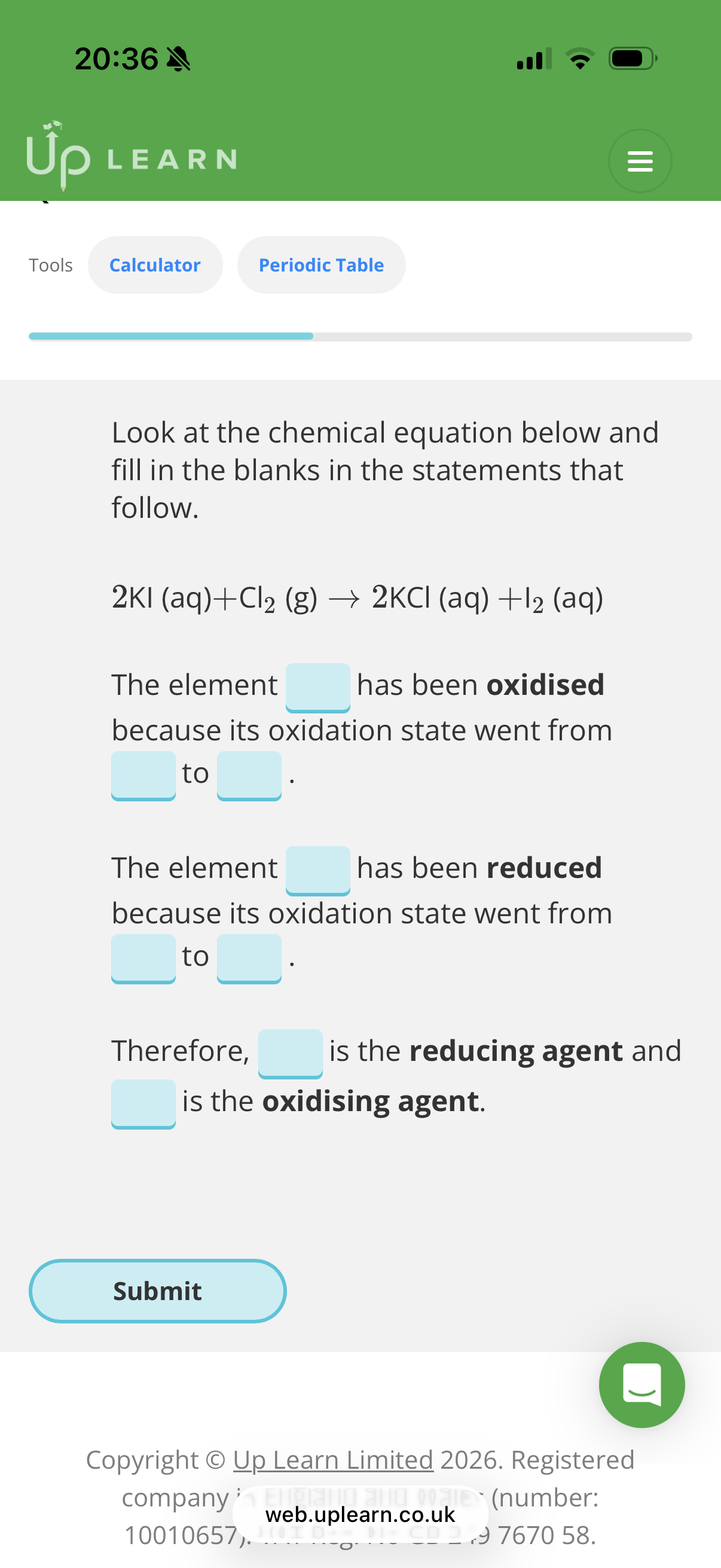
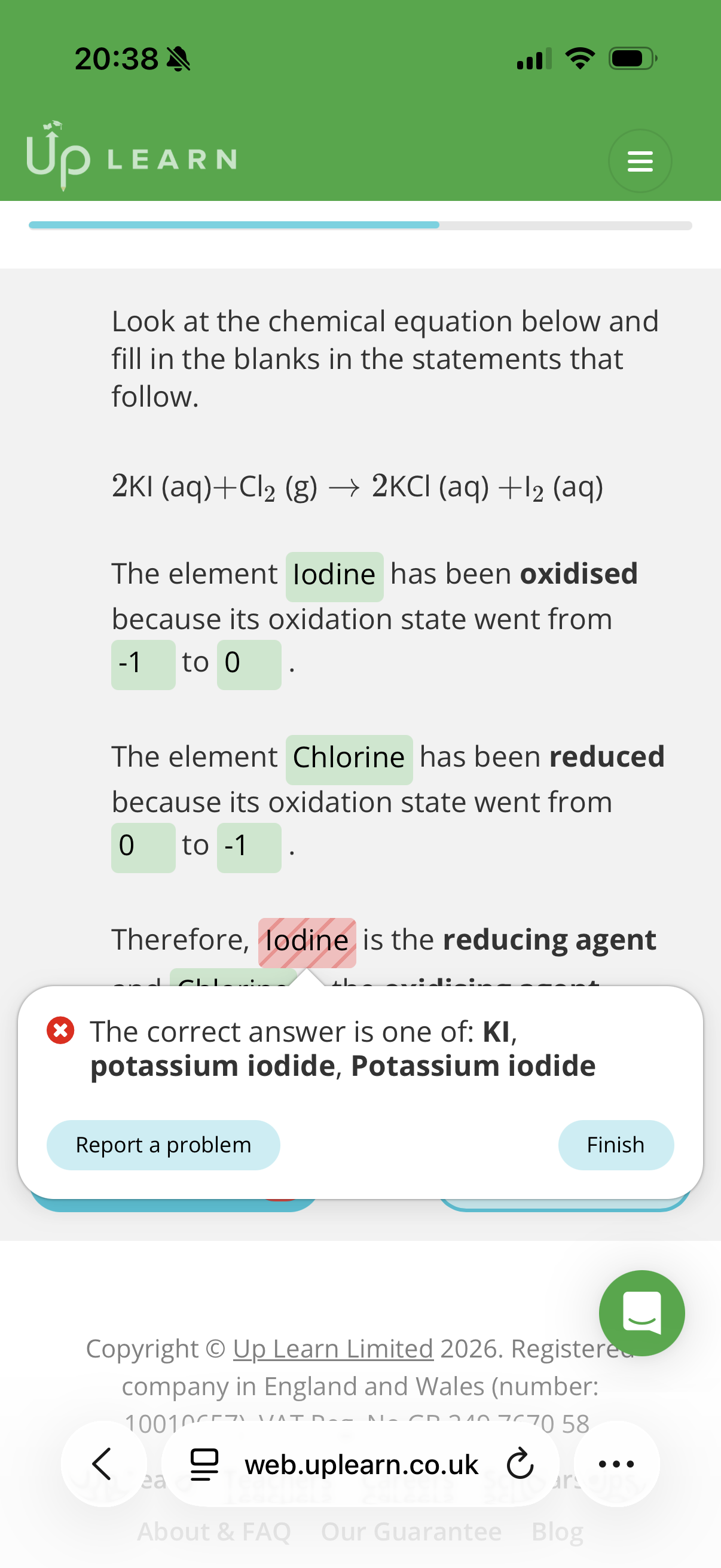
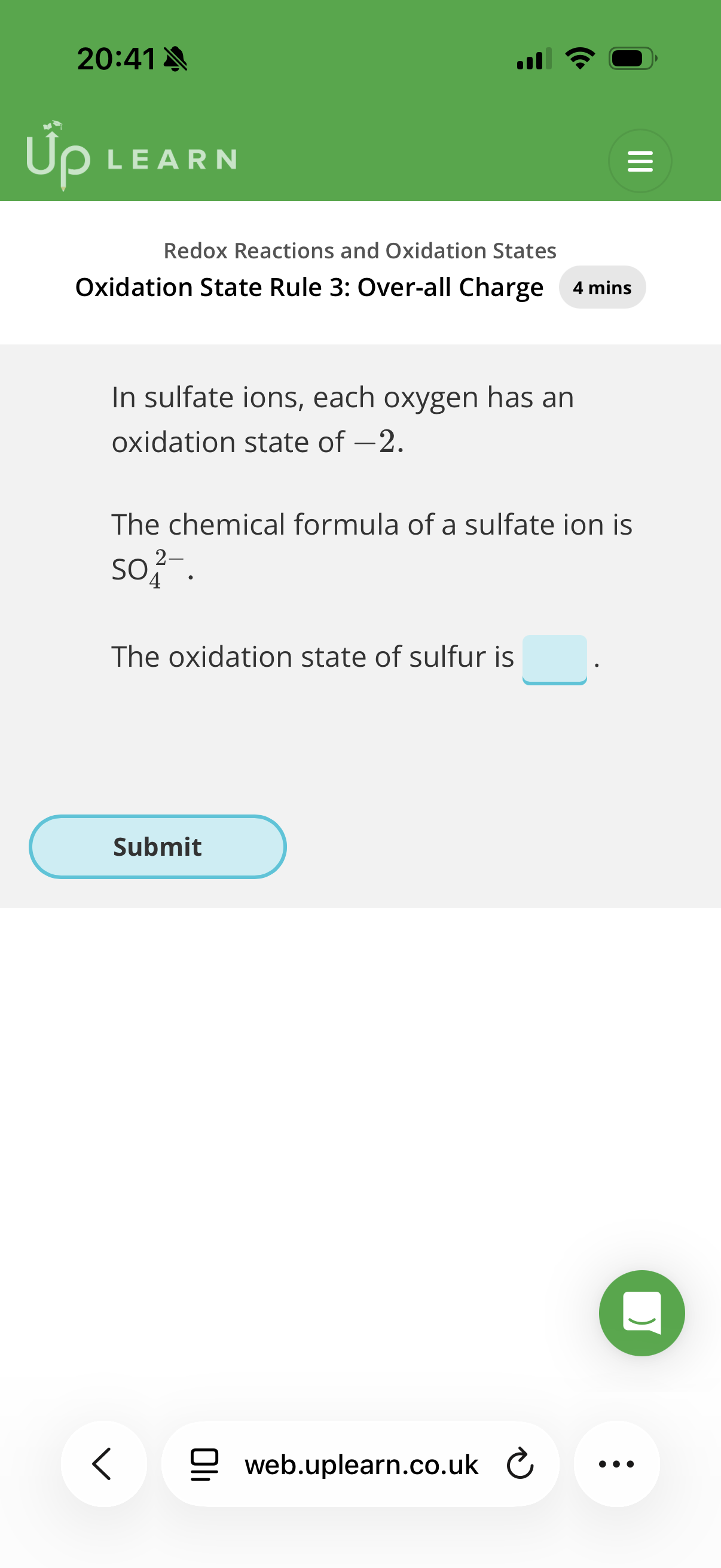

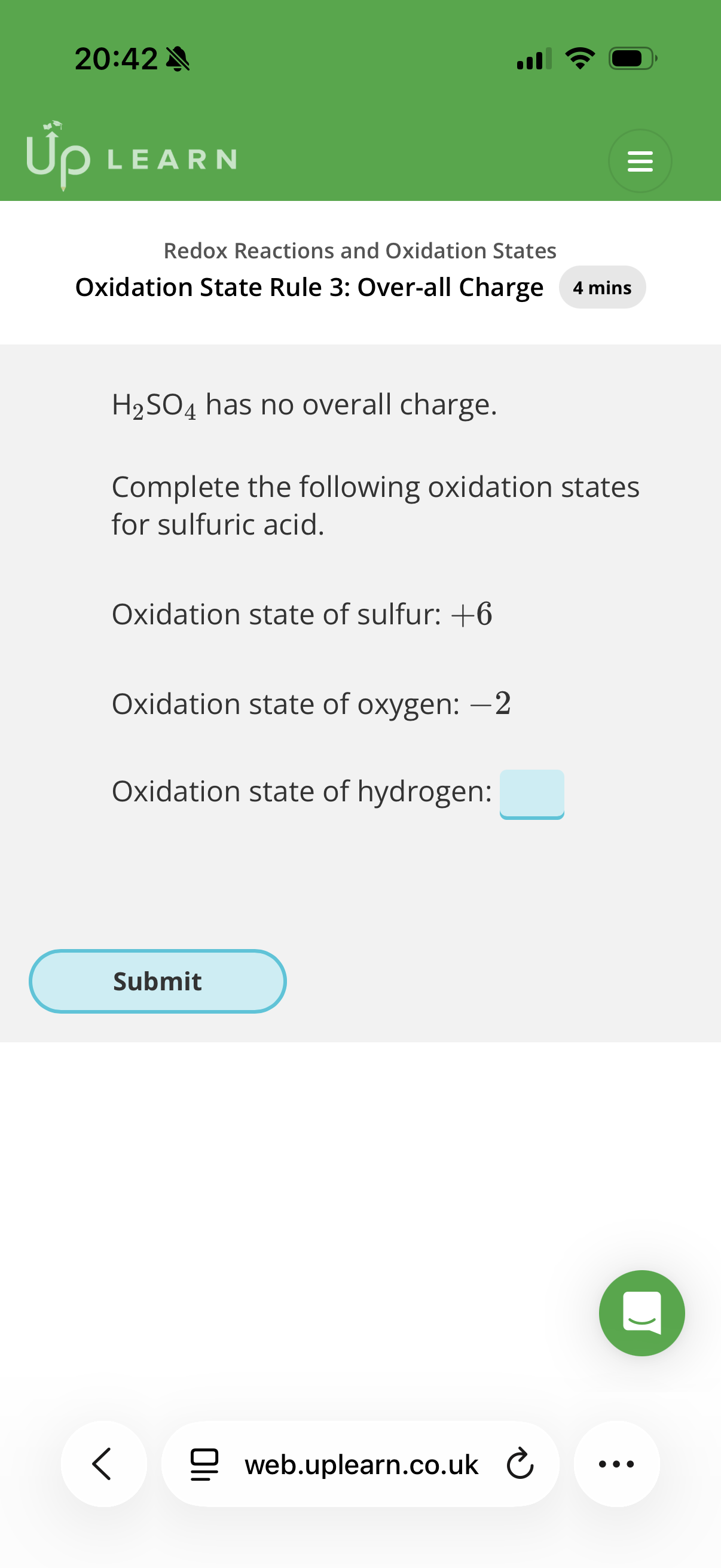
Answer image question?
Note: work out the oxidation state of the elements in the ion, and then work out the oxidation state for the other element in the compound.
Copper sulfate has the following chemical formula:
CuSO4
Using your knowledge of the sulfate ion, deduce the oxidation state of copper.
3. Give the full name of the most common form of copper sulfate, which has the formula CuSO4.Give the full name of the molecule
UF4 and deduce the oxidation states.
+1
Cu: +2
Copper (II) Sulfate
F: -1 U: +4. Name: Uranium (IV) Fluoride
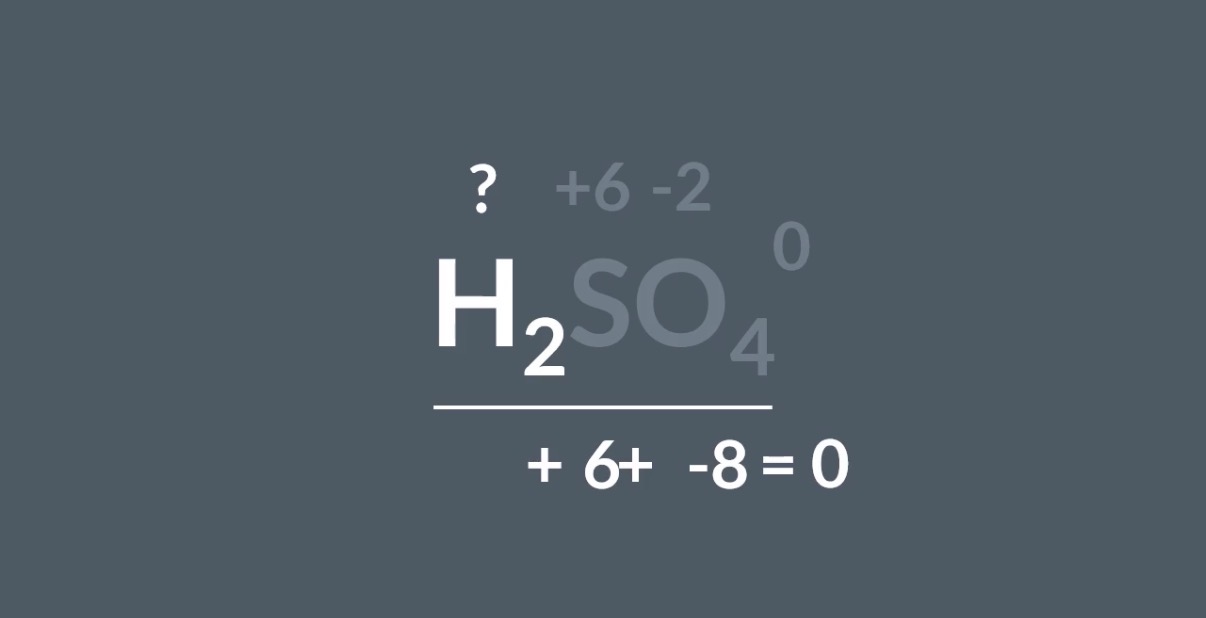
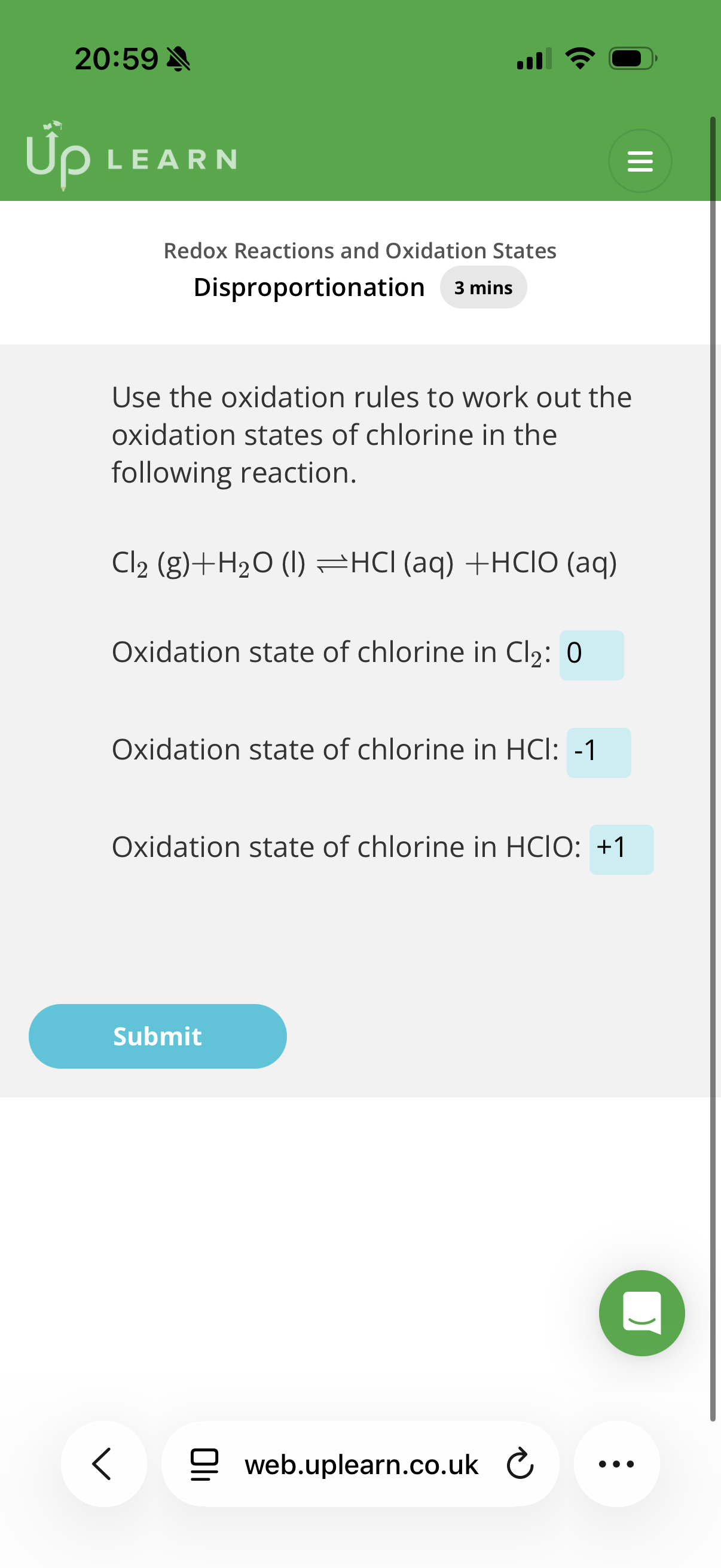
using the image, tell me what a disproportionation reaction is?
Disproportionation reactions are …2?
Where an element is both oxidised and reduced in the same reaction
Redox reactions

Answer image question
Note: Half equations show the electron transfer during reduction or oxidation, rather than showing the entire reaction.


Balance this half equation using these rules?


Answer image question?
Note: for the two half equation reactions, to make an overall reaction you need to first ensure the number of electrons are equal for both reaction and if not multiple each reaction to make them equal. Then you combine all the reactants for both equations on one side and the products on the other. Then you cancel out the electrons and hydrogens and there is your answer.
