orgo chap3 PP2
 Call Kai
 Learn
Learn Practice Test
 Spaced Repetition
 Match
Match Flashcards
 Knowt Play
1/22

There's no tags or description
Looks like no tags are added yet.
Name | Mastery | Learn | Test | Matching | Spaced | Call with Kai | Chat |
|---|
No analytics yet
Send a link to your students to track their progress
23 Terms
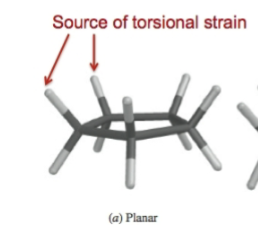
cyclopentane: Why is planar cyclopentane not the preferred conformation?
Although planar cyclopentane has minimal angle strain, it suffers from significant torsional strain because all C–H bonds are eclipsed.
What conformations reduce torsional strain in cyclopentane?
The envelope and half‑chair conformations relieve torsional strain by staggering C–H bonds, making them lower in energy than the planar form.
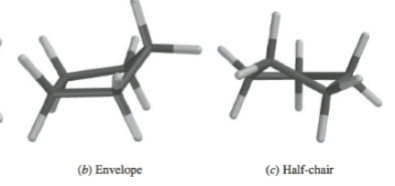
How fast does cyclopentane interconvert between conformers?
Interconversion between envelope and half‑chair forms is rapid, allowing the molecule to constantly shift between low‑energy shapes.
Why does cyclohexane adopt the chair conformation?
The chair form allows cyclohexane to achieve ideal 109.5° bond angles and minimize torsional strain, making it the lowest‑energy conformation.

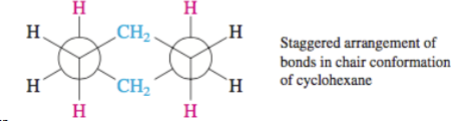
What is special about C–H bonds in the chair conformation?
All adjacent C–H bonds are staggered, eliminating torsional strain entirely.
drawing chair conformers: step 1
start with two parallel lines slanted to the right or left

drawing chair conformers: step 2
Add a second set of parallel lines at an angle of about 120 degrees to the first
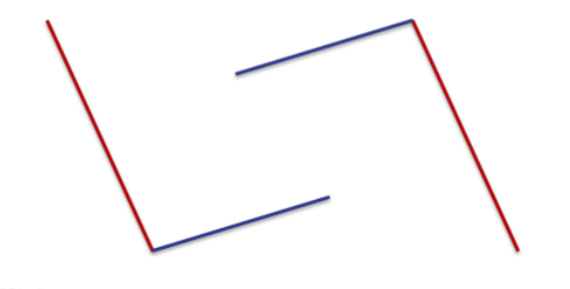
drawing chair conformers: step 3
Connect the two three-carbon fragments using a third set of parallel lines
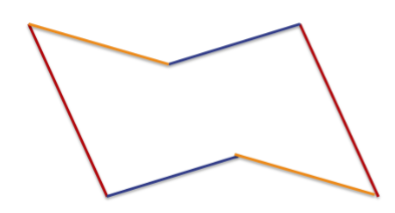
drawing chair conformers: step 4
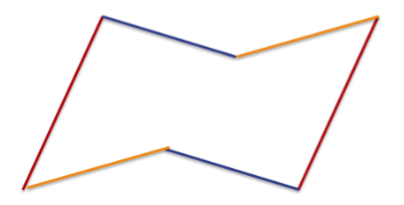
we can also draw a chair “leaning” The opposite way.
which conformer is the most stable for cyclohexane?
the chair conformer
boat conformer
high-energy, contains eclipsing C-H bonds
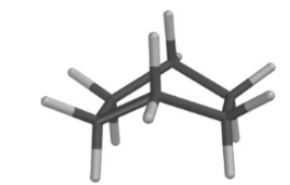
skew-boat conformer
relieves some of the torsional strain in the boat
Both are considerably higher in energy than the chair conformer

the hydrogens in a cyclohexane chair can be divided into two groups:
half are pointing straight up or down (axial)
half are aligned with the carbons (equatorial)
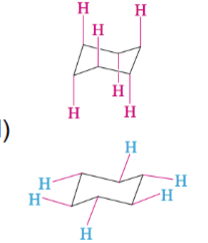
axial hydrogens are
anti to one another
equatorial hydrogens are
gauche to one another
drawing axial and equatorial groups: step 1
Begin by drawing an axial group straight up or down
The axial bond must point in the direction of the “point” formed by the two C–C bonds!
Axial bonds alternate up and down

drawing axial and equatorial groups: step 2
Place the equatorial bonds so as to approximate a tetrahedral arrangement of the bonds to each carbon.
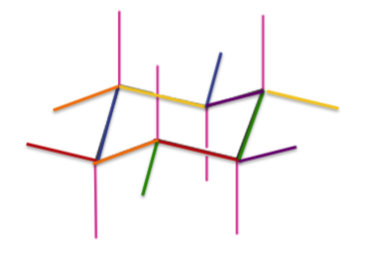
The equatorial bond of each carbon should be parallel to the ring bonds of its two nearest neighbor carbons
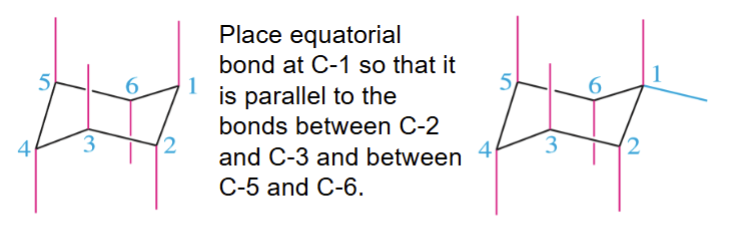
drawing axial and equatorial groups: step 3
Equatorial bonds should be parallel to the ring bonds on the two nearest neighbor carbons
Note how the colored bonds are parallel to one another.
Drawing the equatorial groups this way ensures that the tetrahedral geometry is represented faithfully
chair inversion in cyclohexane
“Right-leaning” and “left-leaning” chair conformers can interconvert rapidly via ring inversion or chair flip
An “up” carbon becomes a “down” carbon and vice versa upon inversion
Axial groups become equatorial and vice versa
However, “up” substituents are still up and “down” substituents are still down!
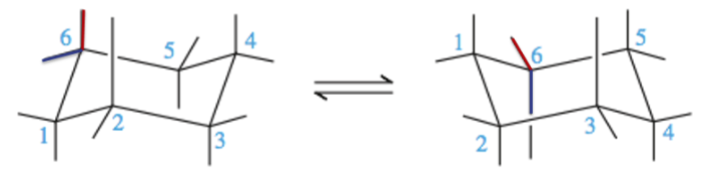
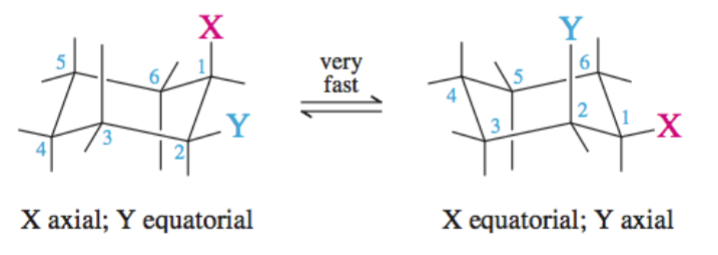
The most important point about chair inversion is that
axial groups become equatorial and vice versa
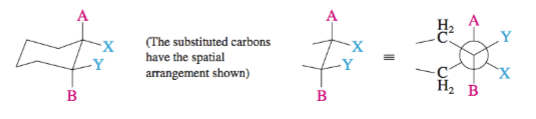
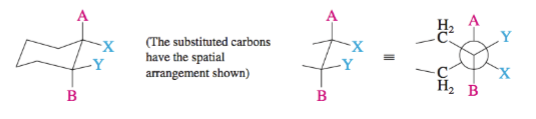
do note that Xand Y are still both pointing up!
methylcyclohexane: distinct chairs
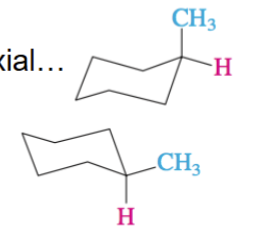
The two chairs of methylcyclohexane are not
equivalent!
In one the methyl group is axial…
…and in the other equatorial
methylcyclohexane: distinct chairs
At equilibrium, the concentration of the CH3-eq conformer is much ____ than that of the CH3-ax conformer.
higher
methylcyclohexane: distinct chairs
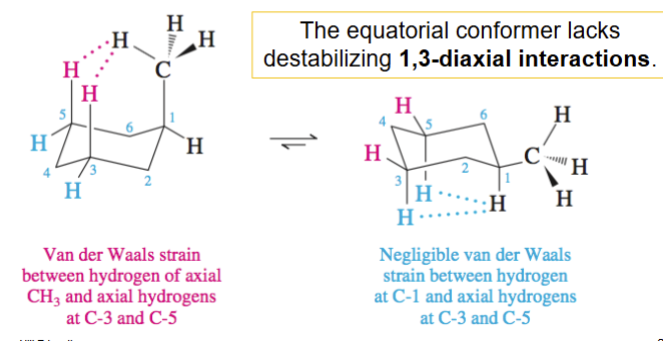
the axial conformer contains
significant van der Waals strain between the axial CH3 and hydrogens at the 3 and 5 positions
The equatorial conformer lacks destabilizing 1,3-diaxial interactions.