Wk 2: Patient Responses to Therapeutic Interventions, Visual/Sensory Measurements, Identifying Myotomes
 Call Kai
 Learn
Learn Practice Test
 Spaced Repetition
 Match
Match Flashcards
 Knowt Play
1/74

Earn XP
Description and Tags
wk 2, ptap-130 lab
Name | Mastery | Learn | Test | Matching | Spaced | Call with Kai | Chat |
|---|
No analytics yet
Send a link to your students to track their progress
75 Terms
What is the primary safety reason for performing palpation before applying therapeutic modalities?
To check for sensation integrity.
Which palpation technique is most appropriate for assessing superficial tissues?
Light tactile pressure.
What type of palpation pressure is required to identify bony structures?
Increased pressure.
What is a Dermatome?
The skin area supplied by a single dorsal root (spinal nerve root).

Under what clinical suspicion should a clinician perform dermatome testing?
Suspected issues occurring at the spine.

When is it appropriate to test peripheral nerve distribution rather than dermatomes?
When there is a suspected injury to the nerve as it travels down the extremities.
Which spinal nerve root provides sensation to the posterior head?
Dermatome C2
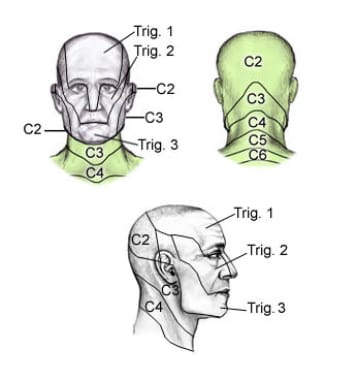
What area of the skin corresponds to dermatome C3?
Posterolateral neck

At what anatomical location is the C4 dermatome tested?
The AC joint.

What is the dermatome for the lateral arm?
C5

Which dermatome covers the lateral forearm and the thumb?
C6
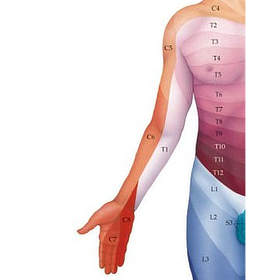
The palmar distal phalanx of the middle finger corresponds to which dermatome?
C7

Which dermatome is found on the little finger and the ulnar border of the hand?
C8

What anatomical area is supplied by the T1 nerve root?
The medial forearm.

What anatomical area is supplied by the L2 dermatome?
Anterior proximal thigh
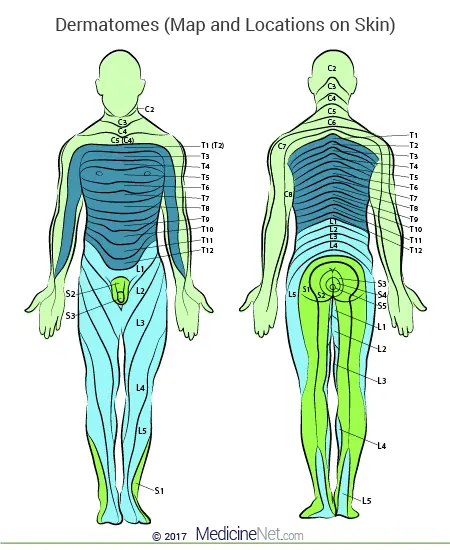
Which dermatome is located on the middle third of the anterior thigh?
L3
Testing sensation at the patella and medial malleolus assesses which nerve root?
L4
What are the two key testing locations for the L5 dermatome?
Fibular head and dorsum of the foot.

Which spinal nerve root is assessed at the lateral and plantar aspect of the foot?
S1
The medial aspect of the posterior thigh corresponds to which dermatome?
S2
What tools are typically used to assess sharp/dull pain discrimination?
Safety pin or paper clip.
How is a light touch sensory screen performed by a clinician?
Using a cotton ball or fingertip to touch the skin while the patient indicates when they feel it.
In the APTA Guide to Physical Therapist Practice, what is the 'Examination' step of a plan of care?
The process of obtaining history, performing systems reviews, and administering specific tests and measures.
In a clinical setting, how does 'Evaluation' differ from 'Examination'?
Evaluation is the dynamic process of making clinical judgments based on the data gathered during examination.
What is the definition of a physical therapy 'Intervention'?
Purposeful and skilled interaction using methods and techniques to produce changes consistent with diagnosis.
At what three points during a treatment session should a patient's response be assessed?
Before, during, and after the intervention.
Which skin characteristic is determined by the amount of melanin and hemoglobin present?
Color (pigmentation).
What do pale or bluish skin tones typically indicate in a patient assessment?
A decrease in blood flow or frostbite.
What is the clinical significance of pink or red skin observed before treatment?
It indicates an increase in blood flow, burn, or inflammation.
What is the maximum normal time for pre-pressure pigmentation to return during a Capillary Refill Test?
Less than 3 seconds.
A Capillary Refill Test taking longer than 3 seconds suggests what condition?
Impaired circulatory function.
Why must clinicians specifically assess the sensation of scar tissue before thermal modalities?
Scars may have altered sensation and an increased sensitivity to heat or cold.
Term: Erythema
Redness of the skin or mucous membranes caused by hyperemia in superficial capillaries.
What is the clinical significance of skin mottling after the application of a thermal agent?
It is a warning sign that the tissue may not be responding appropriately or adequately to heat or cold.
What does a local elevation in skin temperature typically indicate?
Inflammation, infection, or a burn.
If a treatment area is cooler and pale, why is thermal intervention often contraindicated?
It indicates vascular insufficiency, and the tissue cannot safely manage the thermal change.
What are four common methods used to assess a patient's pain?
Visual/numeric scales, pain inventories, anatomical drawings, and pressure algometers.
What is the primary benefit of using anatomical pain drawings during an assessment?
They allow the patient to locate the pain and provide a visual of radiating pain patterns.
What does a pressure algometer measure in a clinical setting?
Tissue sensitivity in the form of a strain gauge.
Term: Edema
An abnormal increase in the amount of interstitial fluid in the spaces between tissue cells.
What is the definition of Joint Effusion?
Swelling or fluid that is contained within a joint capsule.
What are the two primary methods for objective edema assessment?
Circumferential (girth) measurements and volumetric water displacement.
To ensure reliability in edema measurements, what four factors must remain consistent?
The same measurement tool, the same technique, the same landmarks, and the same clinician.
Why should volumetric water displacement for the upper extremity only be performed on the involved limb?
Hand dominance can cause naturally occurring size differences, making comparisons to the uninvolved side inaccurate.
Term: Muscle Tone
The amount of resistance felt during a passive stretch (elongation).
What is the clinical definition of 'muscle guarding'?
A protective reflex muscle contraction in response to pain or injury.
How is the 'quantity' of movement objectively measured in a soft tissue assessment?
Through the use of goniometry.
What are the four primary vital signs measured in a physiological assessment?
Pulse (HR), blood pressure (BP), respiration, and temperature.
List three additional physiological measurements beyond the four standard vitals.
Pulse oximetry, perceived exertion ratings, and gait speed.
How might erythema appear on a patient with darkly pigmented skin?
As purplish or a darker area compared to the surrounding skin.
Term: Pallor
Definition: Paleness lighter than typical skin tone. Example: Appearing ashen, gray, or yellowish in brown-toned skin.
What visual skin change is described as 'macerated'?
Excessively wet skin.
Term: Induration
The hardening of skin or soft tissue.
Which pulse site is located on the inner thumb side of the wrist?
The radial artery.
Where is the Dorsalis pedis pulse palpated?
On the dorsum (top) of the foot.
Which pulse site is found behind the medial malleolus?
The posterior tibial artery.
Where is the popliteal artery located for pulse palpation?
Behind the knee within the popliteal fossa.
Which central pulse is located between the sternomastoid and the trachea?
The carotid artery.
What is the specific location for palpating the femoral artery?
Along the crease midway between the pubic bone and the anterior iliac crest.
Prior to applying a cold pack to the low back, what must the SPTA obtain from the patient?
Informed consent to touch the area and perform testing.
A patient has a suspected nerve root injury at $L2$. Where should the PTA test for sensation?
The anterior proximal thigh.
NPTE Style: A PTA observes spotty, red, and white patches on a patient's skin after removing a hot pack. What is the most likely interpretation?
Mottling, indicating the tissue is unable to dissipate heat effectively.
NPTE Style: During a sensory screen, a patient is unable to distinguish sharp from dull at the lateral arm. Which dermatome is likely involved?
C5
The process of checking for _____ edema involves pressing into the skin to see if an indentation remains.
Pitting
Vasomotor changes in skin _____ can be identified via palpation to determine circulatory status.
Temperature
NPTE Style: A patient reports pain on the dorsum of the foot. To screen the $L5$ nerve root, which other anatomical landmark should be palpated?
The fibular head.
What clinical finding is characterized by 'increased turgor' or a 'boggy feeling' in the tissues?
Edema or lymphedema.
Which pulse site is a continuation of the subclavian artery and is best palpated in the underarm?
The axillary artery.
Why is it important to ask a patient about their prior response to sun or heat exposure?
To gauge their skin's natural sensitivity and expected response to thermal physical agents.
Which soft tissue assessment identifies 'resistance to passive stretch'?
Muscle tone assessment.
What type of measurement is considered 'not specific' because it measures the entire limb volume regardless of hand dominance?
Volumetric water displacement.
The 'sharp/dull' test is primarily used to assess the sensory integrity of which superficial sensation?
Pain
Which dermatome is located at the posterolateral neck?
C3
If a clinician observes 'pallor' in a patient's skin, what is the suspected circulatory cause?
Decreased blood flow.
What is the recommended patient position when an SPTA is assessing the low back for sensation and circulation?
Prone (lying on the stomach).