Active Care - Exam 1
 Call Kai
 Learn
Learn Practice Test
 Spaced Repetition
 Match
Match Flashcards
 Knowt Play
1/124

There's no tags or description
Looks like no tags are added yet.
Name | Mastery | Learn | Test | Matching | Spaced | Call with Kai | Chat |
|---|
No analytics yet
Send a link to your students to track their progress
125 Terms
Benefits active care is intended to provide
reduce pain
restore biomechanics and function
improve strength, stability, and coordination
improve mobility and flexibility
improve proprioception and balance
Active care also involves
patient education and advice
Difference btw passive and active care
passive care = short term
Three roles movement plays in patient care
general health and wellness
assessment
treatment and management
ACSM guidelines for Aerobic training
150min/wk (at least 30min of 5+ days)
ACSM guidelines for Resistance training
2 non-consecutive days/wk
_____ is an independent predictor of all-cause mortality and cardiovascular disease
grip strength
The single best predictor of senior citizen falling is
toe strength (leg strength 2nd)
Why movement assessment leads to better diagnostics and improve outcomes
shorten treatment time
Source of pain
refers to the location the individual is feeling pain
Cause of pain
refers to what is creating pain in the individual’s system
#1 predictor of injury
previous injury
Motor control
necessary input, sufficiently processed, with an acceptable output
Altered motor control involves
poor timing, sequencing, coordination, synergy of the neuromuscular system that manifests in dysfunctional movement
Mobility Dysfunction (TISSUE)
decreased AROM
decreased PROM
Mobility dysfunction takes
time (repetitive, disuse)
Stability/Motor Control Dysfunction (BRAIN/SKILL)
decreased AROM
functional PROM
Does a parts-based movement model work
NO!
should start with MVNT PATTERNS first
When do we have justification to look at parts first
when the pattern is dysfunctional
When should functional movement assessments be performed
1st visit baseline
post-intervention check
ongoing assessment
Why should we perform functional movement assessments
find the cause, explain the source, determine effective tx, and shorten tx time
improved outcomes and reduced tx plan errors
When a compensatory mechanism is triggered, what happens
the stabilizing function is overtaken by the mobilizing muscles
mobilizers increase activity and decrease flexibility
Functional muscle imbalances occur as a result of
disuse and lack of stimulation
adaptation to highly repetitive movement and stabilization patterns
dysfunction, pain, injury
Upper crossed syndromes weak vs tight muscles
Weak = deep neck flexors (ant) and lower traps, serratus anterior, rhomboids (post)
Tight = pectoralis major and minor (ant) and upper traps, levator scap, suboccipitals (post)
Lower crossed syndromes weak vs tight muscles
Weak = abdominals (ant) and gluteus maximus (post)
Tight = hip flexors (ant) and thoracolumbar extensors (post)
Primary tissue/system that mediates the interconnectedness of the kinetic chain
connective tissue
Regional interdependence
unrelated impairments in a remote anatomical region may contribute to (or be associated with) the patient’s primary complaint
Mobile joints
produce movement in 3 planes
prone to mobility dysfunction
Stabile joints
produce movement in 1 plane
prone to stability dysfunction
Mobile joints examples
ankle, hip, thoracic, glenohumeral, upper cervical, wrist
Stabile joints examples
knee, lumbar, scapula, lower cervical, elbow
Hierarchy of movement - Management and Treatment
mobility → motor control → functional patterning
Hierarchy of movement - Movement evaluation
Functional patterning → motor control → mobility
Rehab plans incorporating active care exercises should be
specific to the individual and adaptable
Primary goal of dysfunctional movement findings
identify relevant dysfunction movement patterns and improve them (must post-check to know if improved)
Techniques that help restore optimal length-tension relationship (Muscular system)
stretching
manual therapies
motor control
strengthing
Techniques that help restore optimal force couple relationship (Nervous system)
motor control
exercise/loading
stabilization
regular movement
Techniques that help restore optimal Arthrokinematics (Skeletal system)
chiropractic
repeated ERL
regular movement
exericse/loading
Goals of evidence-inspired active care
education and empowerment
reduce pain and sensitivity
determine the cause, treat the source
address dysfunctional movement patterns
restore function
build resiliency and capacity
How do we know if a treatment was effective
check and re-check (audit and re-audit)
Three R’s of active care
reset
reinforce
retrain
Treatments part of Reset
passive therapies (E-stim, head/cold, laser, traction)
manual therapies (manipulation, stretching, dry needling, massage)
Reinforce
what we did with out reset - reducing the likelihood of recurrent episodes and making sure that we don’t have a regression
Treatments part of Reinforce
education and advice
protection and biofeedback (taping, bracing, splinting, lumbar roll)
Treatments part of Retrain
motor control retraining (neurodevelopment perspective, block vs random)
loading strategies (primary and secondary)
Primary vs Secondary load management (Retrain)
primary - desensitize pain generator, build up tolerance for load, simple movements
secondary - adding load beyond pain control, building resilience, complex dynamic movements
4 X 4 Matrix Positions
1 - Supported (least challenging)
2 - Suspended
3 - Stacked
4 - Standing (most challenging)
4 X 4 Matrix Demands
1 - Feedback (least difficult)
2 - Demonstrate
3 - Capacity w/feedback
4 - Capacity (most difficult)
Turkish Get-up example of 4×4
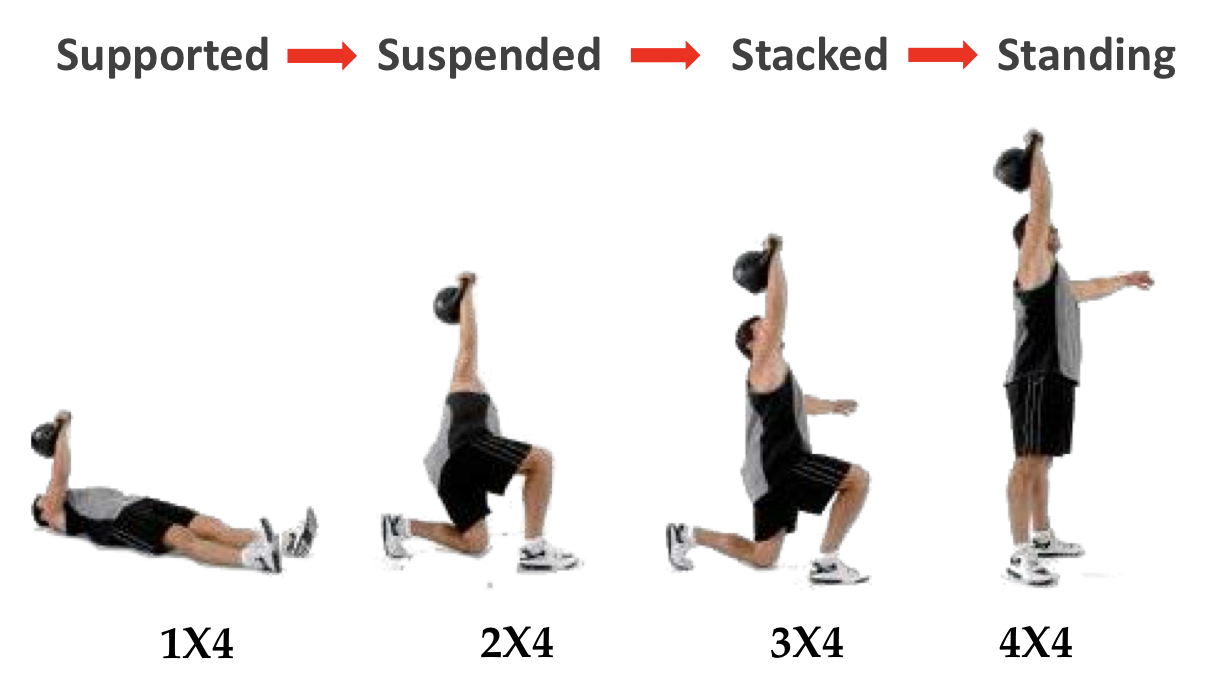
What is the development in Supported position
spinal mobility (flex/ext/rot)
segmental stability
cervical patterns
shoulder flexion
What is the development in Suspended position
spinal curves
cross-crawl pattern
pelvis to trunk disassociation
hip and shoulder flexion/extension
3 - Stacked is the first aspect of
axial loading
What is the development in Stacked position
beginning of single leg stance
hip and spine loaded stability
loaded hip extension
Feedback
anything improving the task and allowing for long term learning
4×4 Matrix Guidelines - two ways to increase the difficulty of any exercise
the position (supported easiest, standing hardest)
the resistance (feedback easiest, capacity hardest)
Progression of a given exercise
1×1 → 2×1 → 2×2 → 3×1 → 3×2 → 4×1 → 4×2 →
1×3 → 1×4 → 2×3 → 2×4 → 3×3 → 3×4 → 4×3 → 4×4
Primary goals of the 1st step of evidence-inspired active care
calm shit down
put out the first and stabilize the foundation before you rebuild the house
desensitize the pain generator
education
micro load management through localized tissue loading
focus on simple functional movements
Primary goals of the 2nd step of evidence-inspired active care
build shit back up
restore function
early stage rehab (primary load management)
late stage rehab (secondary load management)
The goals and principles of rehabilitation and training are the _____ the difference is the _______
same; starting point
Movement Principles
mvnt should be within a pt’s capacity or injury risk
mvnt should be functional to that individual
mvnt when dysfunction is present may increase risk of injury
mvnt can be helpful even when pain is present
mvnt can be used as a method to create an adaptation
What is gamefication based on
dynamic systems theory (DST) - by modifying environment, task, or individual
Flexibility
PROM of a given joint and surrounding tissue
Mobility
ability of a joint to move through AROM under neurological control
Useless flexibility
ability to get to a certain angle/ROM but not be able to use that angle/ROM in daily life
great PROM but can’t express it actively (AROM)
Two types of tissue tension restricting ROM
active tension
passive tension
Active tension
nervous system tone (hypertonicity)
contracture
guarding
Passive tension
muscle viscoelasticity
fascia
nerve
joint restriction
What happens when we have joint hypermobility
the brain sense instability in the passive stabilizing system through afferent feedback from the joint structures
responds by creating stability via active stabilization (inc muscle tone)
People that have joint hypermobility often describe feeling
very tight all the time
What is the relationship btw flexibility and injuries
U-shaped curve
very flexible = joint injuries
very tight = soft tissue injuries
Tight muscles are more prone to
DOMS
store and release energy better
Aging and Flexibility
experience reduced flexibility as we age (10% per decade)
What causes the feeling of muscle tightness
fascial and neurological tension
Why do we experience tightness and stiffness
prolonged posture causes ischemia
lack of movement causes adaptation to imposed demands
weakness causes overload
Treatments for neuromuscular dysfunction
muscle activation stretching procedures (PNF and MET)
end range activation techniques (CARS, PAILs, lift-offs)
general movement loaded or unloaded
Neuromuscular dysfunction is a ____ issue (dec AROM only)
brain
Treatments that physically remodeled/shortened tissues (dec AROM + PROM) require
stretching/loading tissues to end range and sustained for 2+ min
Fascia communicates and remodels in response to
mechanical loads (compression, tension, strain)
What major structure in the body provides a significant amount of afferent feedback necessary for allowing proper movement expression
somatosensory cortex
Neurological inhibition
if joint is functioning properly =
gamma motor tone is reduced
spindles become less excitable
greater motion around articulation can occur (smoother)
Neurological facilitation
if cortex receives poor afferent info from the joint =
gamma motor tone is increased
muscle spindles become hyperexcitable
less motion allowed
Why is performing an adjustment before active care exercises recommended
allows for a short window of neurological inhibition of muscles = more effective
Indications to stretching
restricted motion will lead to structural deformities otherwise preventable
muscle weakness and shortening of opposing tissue
may be used as part of a total fitness program
prior to vigorous exercise to minimize soreness
ROM limited due to loss of extensibility (adhesions, contractures, scare tissue)
Contraindications to stretching
bony block limits motion
recent fracture
acute inflammatory or infectious process
soft tissue healing could be disrupted due to stretch
sharp acute pain with joint movement or muscle elongation
What does stretching actually do
affect change in the NS through facilitation or inhibition of neuromuscular tone
fascial tension/contraction and viscoelasticity
How long do the effects of stretching endure
after 5-30min the gains are significantly reduced
What is most important to modify in order to counter the short-term effects of stretching
repetition (frequency) and consistency
What causes the acute increase in ROM seen with static stretching
analgesic response (inhibited nervous system tone)
The majority of increased ROM associated with stretching occur in the first
15sec of a stretch
Static stretching should be performed for
3-4 sets of 15-30sec
Ideal frequency for stretching
multiple times a day for 6-10wks
What is the primary factor for increasing tendon flexibility
plyometric loading
gentle stretches held up to 10min
Stretch-induced strength loss
stretching cause an acute inhibition of maximal force produced by the muscle
Stretch-induced strength loss is more pronouced in activities performed at relatively
slow/low velocities (bench press and deadlift)
Maximal contraction of the muscle ____ to static stretch minimizes stretch-induced strength loss
prior
What causes DOMS
neural feedback
free radicals
swelling
Different categories of stretching techniques
static stretching
dynamic stretching (active and ballistic)
muscle energy technique (PIR and RI)
PNF stretching (contract-relax, hold-relax, CRAC)
Static stretching
passive (relaxing into a ROM)
slow and constant
with a partner or individually (bands or supported)
What is the reason behind the push against performing ballistic stretching
increased injury risk
does not result in sustained increases in ROM
Active dynamic stretching
controlled movement through a full range
start slow and gradually pick up speed and increase ROM
use sport/task-specific
prepares and warms up the body