3.6-3.8 Periodic Trends- Atomic/Ionic Radius, Ionization Energy, Electron Affinity, Metallic Character
 Call Kai
 Learn
Learn Practice Test
 Spaced Repetition
 Match
Match Flashcards
 Knowt Play
1/53

There's no tags or description
Looks like no tags are added yet.
Name | Mastery | Learn | Test | Matching | Spaced | Call with Kai | Chat |
|---|
No analytics yet
Send a link to your students to track their progress
54 Terms
For Main Group elements, the atomic radius INCREASES _____ and ______
LEFT AND DOWN
why do atoms get smaller across a period?
adding more protons to the nucleus makes it more positively charged.
more protons = stronger nucleus = pulling electron cloud inward tightly =
smaller atom
why do atoms get larger down a group?
Each row down means adding a completely new, higher principal energy level (𝑛-shell)
more n-shells = further electrons =
bigger atom
Effective nuclear charge (Zeff)
the net positive charge an electron actually feels from the nucleus (the nucleus pulling in electrons inward tightly)
the nucleus is positive and therefore ____ on negative electrons
PULLS
During shielding, because inner electrons block the nucleus, what happens to the outer electrons?
they do not get the full positive pull
What happens to outer electrons that get shielded by core electrons in their way?
they feel a LESSER effective nuclear charge (Zeff)
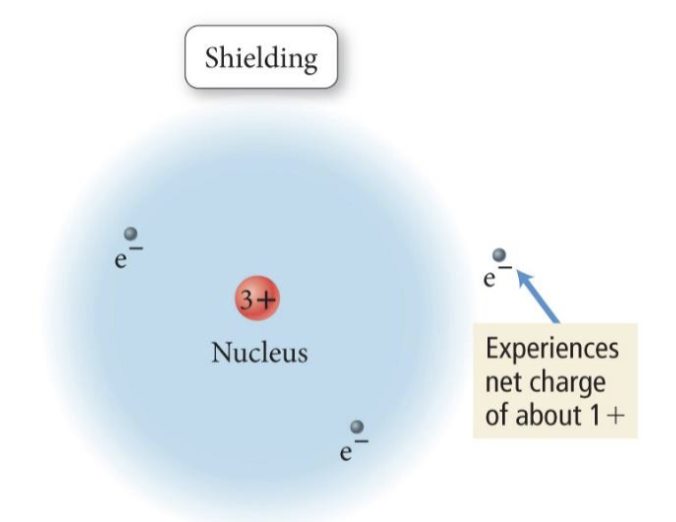
more shielding = ____ Zeff
LESS
During penetration, when the electron slips past the shield where does it go?
inside the inner electron cloud and right next to the nucleus
What happens to electrons that penetrate closer to the nucleus?
they feel a GREATER effective nuclear charge (Zeff)

more penetration = ____ Zeff
MORE
cations have ______ radii than their neutral parent aroms
SMALLER
losing electrons make protons pull on less electrons, which make a _____ ___ ____
stronger nuclear pull
anions have ______ radii than their neutral parent aroms
LARGER
when electrons are added (anions), since like-charges repel, adding more electrons causes them to
push them away from eachother
what happens to the nuclear pull as electrons are gained?
it gets weaker
what happens when the nucleus cannot pull highly repelling electron cloud inward once electrons are gained?
the electron cloud swells and expands outward, increasing the radius/size
isoelectronic species
different atoms or ions that have the exact same number of electrons but different sizes/number of protons
when ions share the same number of electrons / same electron configuration, size entirely depends on the amount of…
PROTONS
more protons = ___ size
SMALLER
First Ionization Energy
the amount of energy required to completely remove an electron from a neutral atom in its gas phase
X(g) →
X+(g) + 1 e-
first ionization energy ______ TO THE RIGHT across a period for Main Group elements
INCREASES
Group 2A to 3A anomaly
e- in p-orbital easier to remove than e- in s-orbital
Group 5A to 6A anomaly
due to relieving repulsions between 2 e-’s occupying the same orbital
As you move down any column on the periodic table, it becomes ______ to remove an electron
EASIER
metals have ___ ionization energies and lose electrons to become ______ easily
LOW, CATIONS
nonmetals have ____ ionization energies and resist ____ ______ —> gain them instead
HIGH, LOSING ELECTRONS
Successive Ionization Energies
the energy required to remove multiple electrons from the same atom, one after the other
it gets increasingly ______ to remove successive electrons
HARDER
a jump in ionization energy occurs after removing ___ ______
core electrons
Electron Affinity
the change in energy that happens when a neutral atom in the gas phase gains an electron to become a negative anion
X(g) + 1 e- →
X-(g)
a negative energy value
a release of energy (exothermic electron affinities)
a positive value
requires energy (endothermic) because the atom resists taking it
Groups 2A, 5A, and 8A tend to have _____ electron affinities
positive
Groups 2A, 5A, 8A exception in electron affinity
these columns have filled or half-filled subshells that are already highly stable. Forcing an extra electron into them ruins that stability, so they have positive or near-zero electron affinities
Metallic Character
trend that describes how easily an atom can lose its outer valence electrons to behave like a typical metal.
metallic character INCREASES as you move toward the ____-__ corner of the periodic table
BOTTOM-LEFT
metals: typical physical state
usually solids (except Hg)
nonmentals: typical physical state
solids, liquids, gases
metals: appearance
lustrous and shiny
nonmetals: appearance
dull
metals: physical properties
high density
malleable
ductile
conducts heal well
conducts electrivity well
high melting and boiling points
nonmetals: physical properties
low density
brittle
conducts heat poorly
conducts electricity poorly
low melting and boiling points
metals: electron behavior**
lose electrons easily to form cations
nonmetals: electron behavior**
gain electrons easily to form anions
First Ionizationg Energy INCREASES going ____ and ____
UP AND RIGHT
electron affinity gets more NEGATIVE going _____ and _____
UP AND RIGHT
He is the _____ atom to ionize and derive trend. In other words, it has the ______ amount of First Ionization Energy
HARDEST , HIGHEST