Heuristics
 Call Kai
 Learn
Learn Practice Test
 Spaced Repetition
 Match
Match Flashcards
 Knowt Play
1/17

There's no tags or description
Looks like no tags are added yet.
Name | Mastery | Learn | Test | Matching | Spaced | Call with Kai | Chat |
|---|
No analytics yet
Send a link to your students to track their progress
18 Terms
Heuristics
Time-saving mental shortcuts that reduce complex judgements into simple rules of thumb
What are the four bias heuristics
WHAT
WHAT
WHAT
WHAT
What are the two bias heuristics
Representativeness
Availability
False consensus effect
Anchoring heuristic
Representative heuristics are what
The tendency to allocate a set of attributes to someone if they match the prototype of a given category (easy way to put people into categories)
What is the error that occurs with representative heuristics
WHAT
WHAT
Base rate fallacy
Stereotype threat
Base rate fallacy
The tendency to ignore statistical information (base rates) in favour of representative information
example:
thinking immigrants have a higher crime rate, but the opposite is true
Stereotype threat
Individuals experience anxiety or distraction when they worry their performance will confirm a negative stereotype about a group they belong to
Example:
Makes it difficult for women to progress in ‘male’ occupations and vis versa
Availability heuristic
The tendency to judge the frequency or probability of an event in terms of how easily we think of examples of that event
Example:
scared to go on a plane after hearing about a plane crash)
Availability heuristic
It occurs because of how quickly the information was WHAT to you
Very WHAT
People seem to attend to the WHAT of retrieving instances of certain behaviours and not just the WHAT
Availability heuristic
It occurs because of how quickly the information was ACCESSIBLE to you
Very SUBJECTIVE
People seem to attend to the DIFFICULTY of retrieving instances of certain behaviours and not just the CONTENT
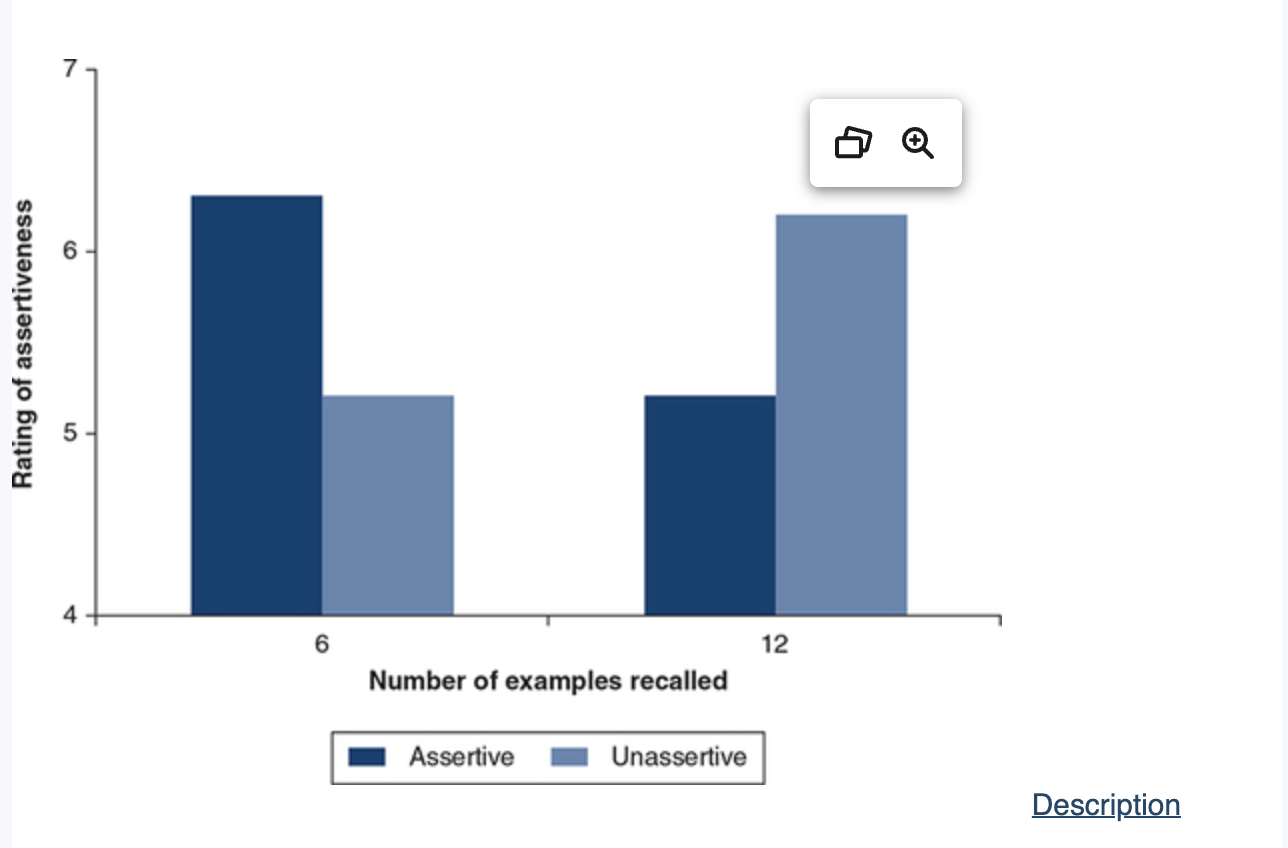
Availability heuristic - Schwarz and collegues ’ experiment
Asked participants to recall either 6 or 12 of their own assertive and unassertive behaviour
Results:
6 = easier to think of assertive things so you think your assertive
12 = Harder to think of assertive things so become more unassertive
What are two errors within the availability heuristic
WHAT
WHAT
What are two errors within the availability heuristic
Processing fluency
Perceptual salience
Processing fluency
the extent to which something is easy to think about or understand
Perceptual salience
The most salient perceptual information dominates a person's perception of the situation.
False consensus effect is a type of WHAT heuristic
False consensus effect is a type of AVAILABILITY heuristic
False consensus effect
he tendency to exaggerate how common one’s own opinions are in the general population
Why does the false consensus effect occur
our own self-beliefs are easily recalled from memory, making them more available when we are asked to judge if others agree with us (availability heuristic)
The anchoring heuristic
The tendency to be biased towards the starting value (or anchor) in making quantitative judgements
The anchoring heuristic:
The starting point (anchor) impacts our judgment because it is the most WHAT source of information relevant to the issue at hand - similar to the WHAT heuristic
The anchoring heuristic:
The starting point (anchor) impacts our judgment because it is the most AVAILABLE source of information relevant to the issue at hand - similar to the AVAILABILITY heuristic
Anchoring heuristic - Plous experiments
Asked whether there was a 1% chance or 90% chance of a nuclear war. 1% said there was a 10% chance, 90% said there was 25% chance (made a guess based on the starting information given)