Degrees of Freedom and Planes of Motion APK3220c
 Call Kai
 Learn
Learn Practice Test
 Spaced Repetition
 Match
Match Flashcards
 Knowt Play
1/26

There's no tags or description
Looks like no tags are added yet.
Name | Mastery | Learn | Test | Matching | Spaced | Call with Kai | Chat |
|---|
No analytics yet
Send a link to your students to track their progress
27 Terms
Sagittal plane
Axis: mediolateral
Movements: flexion/extension, dorsiflexion/plantarflexion, protraction/retraction, posterior/anterior roll

Transverse/horizontal plane
Axis: inferosuperior
Movements: internal/external rotation, supination/pronation, left/right rotation

Frontal/coronal plane
Axis: anteroposterior
Movements: abduction/adduction, elevation/depression, inversion/eversion, radial/ulnar deviation

Multiplanar
Axis: Oblique
Movements: circumduction
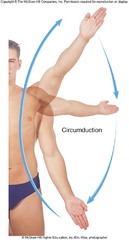
Ball and socket
3 rotational DOF

Hinge
1 rotational DOF

Pivot
1 rotational DOF

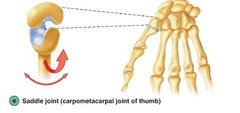
Saddle
2 rotational DOF
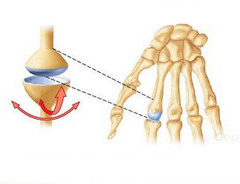
Condyloid
2 rotational DOF
Gliding
2 translation DOF

Hip/Coxofemoral/Femoracetabular
Joint: Synovial
Mechanical Representation: Ball and socket
# of DOF: 3
Rotational:
1) flex/extension
2) int/external rotation
3) abd/adduction
Can also do circumduction and horizontal abd/adduction
Notes: Hip is a relatively stable from a bony structure standpoint, as compared to the shoulder

Knee/tibiofemoral joint
Joint: Synovial
Mechanical Representation: Modified hinge/double condyloid (ellipsoid)
# of DOF: 2 main, 2 lesser
Rotational:
1) flex/extension (largest)
2) int/external rotation (2nd largest)
3) abd/adduction (min ROM)
Translational:
1) Anterior/posterior
Notes: Internal/external rotation can only be accessed when the knee is in a significantly flexed position. This DoF does not exist when the knee is extended

Ankle/talocrural joint
Joint: Synovial
Mechanical Representation: hinge
# of DOF: 1
Rotational:
1) plantar/dorsiflexion
- sagittal

Subtalar joint
Joint: Synovial
Mechanical Representation: Mitered hinge (axis is oblique)
# of DOF: 1
Rotational:
1) pronation (eversion)/supination (inversion) of the hind foot

Shoulder/glenohumeral joint
Joint: Synovial
Mechanical Representation: Ball and socket
# of DOF: 3
Rotational:
1) flex/extension
2) int/external rotation
3) abd/adduction
Can also do circumduction and horizontal abd/adduction
Notes: Less stable from a bony structure standpoint and higher mobility. Relies more on passive (ligaments and joint capsule) and active (muscles) soft tissue for stability.
Horizontal abduction/adduction is not a distinct DoF and does not occur from anatomical position. Most joint movements ought to be referenced back to anatomical position to understand plane and axis of motion.
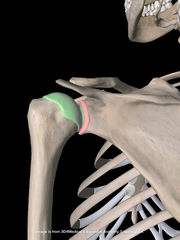
Scapulothoracic joint
Joint: Treated like a synovial, but is not one as the scapula articulates
Mechanical Representation: N/A
# of DOF: 3
Rotational:
1) upward/downward rotation
Translational:
1) Protraction(abduction +lateral tilting/internal rotation)/Retraction (adduction + medial tilting/external rotation)
- about mediolateral axis
2) Elevation (+anterior tilting)/Depression (+posterior tilting)
- bc of tilt, in the inferosuperior axis
Notes: These "translational" movements imply some amount of rotation because of the curvature of the rib cage.
Upward rotation of the scapula is critical to achieve full 180 deg functional range of motion of the shoulder complex.

Sternoclavicular
Joint: synovial
Mechanical Representation: saddle
# of DOF: 3
Rotational:
1)elevation/depression
2) protraction/retraction
3) posterior/anterior roll
Notes: This "saddle" joint describes the joint surface articulation but the DoF are unexpects because typically you would expect a saddle joint to have only 2 rotational degrees of freedom whereas here there are three largely due to the incongruence of the joint. Strong joint for the transmission of force from the upper extremity to the axial skeleton.

Radioulnar (proximal) joint
Joint: synovial
Mechanical Representation: pivot
# of DOF: 1
Rotational:
1) pronation/supination
Notes: The radius mainly crosses over the ulna causing rotation about the long axis.

Elbow/humeroulnar joint
Joint: synovial
Mechanical Representation: hinge
# of DOF: 1
Rotational:
1) flexion/extension

Wrist/radiocarpal joint
Joint: synovial
Mechanical Representation: condyloid
# of DOF: 2
Rotational:
1) flexion/extension
2) radial/ulnar deviation
Notes: Radius is concave and the carpals (scaphoid and lunate) are convex.

Carpals (generic)
Joint: synovial
Mechanical Representation: gliding
# of DOF: 2
Translational:
1) Planar gliding

1st metacarpometacarpal joint (trapezium articulation with 1st metacarpal)
Joint: synovial
Mechanical Representation: saddle
# of DOF: 2
Rotational:
1) flexion/extension
2) abduction/adduction
Also does opposition (combo of other two DOF and oblique) and circumduction

2nd-5th Metacarpophalangeal joint
Joint: synovial
Mechanical Representation: condyloid
# of DOF: 2
Rotational:
1) flexion/extension
2) abduction/adduction
Can also do circumduction

Interphalangeal joints
Joint: synovial
Mechanical Representation: hinge
# of DOF: 1
Rotational:
1) flexion/extension

Lumbar interbody joints
Joint: symphyses
Mechanical Representation: N/A
# of DOF: 3
Rotational:
1) flexion/extension
2) L/R lateral flexion
3) L/R lateral rotation

Atlanto-axial joint (C1-C2)
Joint: synovial
Mechanical Representation: pivot
# of DOF: 1
Rotational:
1) L/R head rotation

Atlanto occipital joint
Joint: synovial
Mechanical Representation: double condyloid/modified hinge
# of DOF: 2
Rotational:
1) flexion/extension
2) lateral flexion and opposite L/R rotation (oblique)
Notes: The movements of the second lesser degree of freedom happen concurrently because of the obliquity of the plane of motion and axis of rotation.
