homeostasis test
 Call Kai
 Learn
Learn Practice Test
 Spaced Repetition
 Match
Match Flashcards
 Knowt Play
1/66

There's no tags or description
Looks like no tags are added yet.
Name | Mastery | Learn | Test | Matching | Spaced | Call with Kai | Chat |
|---|
No analytics yet
Send a link to your students to track their progress
67 Terms
what is homeostasis?
the processes involved in maintaining a constant internal environment, within tolerance limits, despite changes in the internal and external environment
what is a stimulus?
change in one of the internal or external environmental factors; detected by a receptor and involves a deviation from the normal or optimal value
what are adaptations?
evolved structural, physiological and behavioural characteristic of an organism that increases its chance of survival and reproduction in a particular environment.
what is metabolism?
sum of all chemical reactions occurring within an organism to maintain life
what is a receptor?
a cell or tissue that detects a stimulus
what are the five types of receptors?
Chemoreceptors, Mechanoreceptors, Photoreceptors, Thermoreceptors, Pain receptors
what do internal receptors do?
receive signals from within body about internal environment
what do external receptors do?
detect changes in external environment, interpret these signals and make a response for survival or development, work in a group or individual.
chemoreceptor example stimuli
internal receptor detects oxygen and ion levels
where are chemoreceptors located in animals
aorta, carotid and arteries
example of osmoreceptor stimuli
Internal receptor Detects changes in osmotic pressure in blood
where are osmoreceptors located in animals
hypothalamus
example of photoreceptor stimuli
External receptor, detects light
photoreceptor location in animals
eyes; light sensitive cells on the body surface of some vertebrates
thermoreceptor example stimuli
External receptor, Detects external temperature variations
Internal receptor, Detects internal temperature variations
thermoreceptor location in animals
external skin, internal hypothalamus
what are the nervous system and endocrine system responsible for?
monitoring changes, transmitting messages and coordinating responses
what is nervous system comprised of
Central nervous system (CNS) and Peripheral nervous system (PNS)
CNS role
receive sensory info from receptors, interpret and process, and if a response is needed they coordinate the response
PNS role
transmit information to and from the CNS
what are effectors?
A muscle or gland that receives a message from the control centre that a change in a stimulus has occurred, then carries out a response
what are axon?
extension from a neuron cell body along which an electrical impulse can travel towards a target cell
what is the myelin sheath?
fatty layer surrounding and insulating the axons of many neurons; it increases the speed at which electrical impulses travel along the nerve cell
what is pituitary gland?
coordinates the endocrine system activities
how are endocrine and nervous system different?
nervous system uses electrical impulses and neurons for fast, short-term responses, while the endocrine system uses chemical hormones through the bloodstream for slower, long-lasting effects
what are feedback mechanisms
physiological processes that respond to small disturbances to keep internal conditions within optimal function. triggered when a stimulus is detected by a receptor
what is negative feedback loop?
Homeostatic process that responds by changing direction of stimulus, always reducing the stimulus and stabilises internal conditions, returning value back to normal or optimal levels
what are modulators?
Normally hypothalamus, Structure that receives messages from receptors, coordinates a response, then sends an instruction to an effector via motor neurons
what is the response
the action of the effector that counteracts the stimulus
what is positive feedback?
If response reinforces the original stimulus, Increases output of the system, enhancing deviation from optimal value
what is positive feedback needed for?
needed for developmental processes (tadpole to frog, lactation)
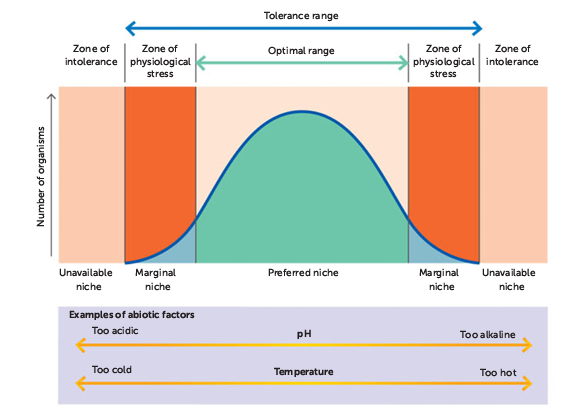
what are tolerance ranges?
the range of a function within which an organism can function and reproduce; when factors go outside may be fatal for organism
what are physiological adaptions
related to how an organism, system, organ, tissue or cell function
what are structural feature adaptions
related to organisms shape, specialised features and size
what are behavioral adaptions
relate to how organism acts
what are endotherms?
an animal that uses metabolic processes to generate its own heat to maintain its internal temperature within the tolerance range
what are ectotherms?
an animal whose body temperature is determined by the external environment
what is hyperthermia?
state in which organisms internal temperature rises above tolerance limit
cost of endotherms
to maintain a stable internal temp, they may have a higher metabolic rate. Need to spend more energy to maintain a higher metabolic rate, resulting in higher food requirements and more time spent finding food
cost of ectotherms
body temperature is dependent on the external environment. These animals are limited to living in environments with less extreme temperatures, they cannot tolerate very high or very low external temps
benefit of endotherms
body temperature is independent of external temp, enables endotherms to live in more extreme environments. They can be active at night or more often during the day and in cold weather
benefit of ectotherms
Their heat source is mainly the environment, so there are lower energy requirements for these animals. Therefore, they need to consume less food. They can tolerate larger fluctuations in their internal body temperature compared with endotherms
What is temperature gradient?
produced when tow objects in close proximity have different temperatures due to different amounts of heat energy; this causes heat to travel from the hotter object to the colder object
what is conduction
transfer of heat energy from relatively hot object to a relatively cool object by direct contact
what is convection
the transfer of heat by means of rising currents of warm air or water
what is evaporation
the process in which liquid water changes to water vapour through heating (cooling the skin in organism)
what is radiation
the transfer of heat from a hot object by infrared waves
what is evaporative cooling?
mechanism of heat transfer from an organism to its surroundings. Water on the surface of the skin draws heat energy from the body for the change of state from liquid water to vapour. The vapour diffuses into the surrounding air, taking heat away from the body and cooling the body down
what is vasodilation?
mechanism for cooling the body and counteracts any increase in internal body temperature above the optimal range. widening of blood vessels, particularly arterioles
what is sweating
sweat glands open to release water and salt into the skin, which evaporates and cools the skin. Evaporated water carries away heat energy from the body and lowers internal temp
what is panting
expels hot air and brings in cooler air, which then helps moisture in the mouth to evaporate quickly, reducing body temp
what is pilo relaxation
muscles attached to hair follicles can be relaxed to flatten the hairs and decrease the layer of air acting as an insulator
what is piloerection
the muscles attached to hair follicles contract, so that the hairs stand up, trapping a layer of air that can provide insulation, reducing heat loss to a cooler external environment
how does fur on polar bears thermoregulate in cold environments
Through the fur. trapping an insulating layer of air close to the skin. Beneath the surface of skin in thick layers of fat formed by adipose tissue.
counter current heat exchange
exchange of heat between two fluids flowing in opposite directions in vessels that are in close proximity
counter current heat exchange example
Penguin feet. Heat in blood travelling to arteries to the foot or fin warms the blood returning to the body in adjacent veins. Outgoing blood to extremity is cooled in process, but does NOT affect cellular activities. Difference in heat energy between 2 objects cause heat to travel in 1 direction -> hotter to cooler object. traps heat in the body core, reducing heat loss in the extremities
how does shape and size impact thermoregulation?
Large round animals have lower surface to area to volume rate then small animals. Reducing surface area to volume ratio reduces heat loss, as there is less surface area per unit volume for heat to transfer through
What is Torpor?
physiological state of decreased metabolic rate and physical activity
what does Torpor do and example
reduces energy and water costs for an animal. The hummingbird, whose internal body temperature can drop significantly during torpor, reducing energy expenditure on metabolic heat production
what does hibernation do?
metabolic rate falls to level that just sustains life, set point is lowered – conserves energy
what is aestivation and example
state of dormancy into which an animal enters during hot and dry periods. Like the garden snail retreats into its shell and seals itself off
How do smooth muscles in arterioles in the skin respond to low temperatures
Smooth muscles contract, causing vasoconstriction. Less blood is carried from the core to the skin surface. The extremities can turn blue, and the skin feels cold. Less warm blood to the skin surface helps to reduce heat loss to the cool external environment
smooth muscles in arterioles in the skin response to high temperatures
Muscles relax, causing vasodilation. More blood is carried from the core to the skin surface. The skin appears red and flushes and feels warm. Heat is lost from the skin surface by convection and radiation
how do skeletal muscle for shivering sweat glands for sweating respond to low temperatures
a reflex action involving the rapid contraction and relaxation of skeletal muscles. This generates heat to increase the body temperature
how do skeletal muscles for shivering sweat glands for sweating respond to high temperatures
sweat glands secrete sweat onto the skins surface, from which it evaporates. Heat is absorbed from the skin surface for a change of state from liquid to gas as the sweat evaporates (evaporative cooling)
how do muscles attached to hair follicles respond to low temperatures
muscles attached to hair follicles contract. raising the hairs and trapping an insulating layer of still, warm air next to the skin. This is not very effective in humans, just causing goosebumps (piloerection)
how do muscles attached to hair follicles respond to high temperature
muscles attached to hair follicles relax, lowering the skin hairs and allowing air to circulate over the skin; this encourages cooling by convection and evaporation (pilo relaxation)