bio IB HL (first semester final)
 Studied by 0 people
 Call Kai
 Learn
Learn Practice Test
 Spaced Repetition
 Match
Match Flashcards
 Knowt Play
1/181

There's no tags or description
Looks like no tags are added yet.
Name | Mastery | Learn | Test | Matching | Spaced |
|---|
No study sessions yet.
182 Terms
Lamarckism
Individuals develop traits to better survive and pass these traits to their offspring, leading to all members of a species having favorable traits (concept proved wrong).
Darwinism
Evolutionary theory based on natural variation within a species, where advantageous variations increase in favorable traits over generations and potentially new species.
Paradigm shift
A fundamental change in approach or underlying assumptions, such as the shift from Lamarckism to Darwinsim
Natural Selection
The mechanism driving evolutionary change, where individuals with favorable traits are more likely to survive and reproduce
Competition
Overproduction of offspring and limited resources lead to a struggle for survival, which drives natural selection
Abiotic Factors
Nonliving factors affecting survival, such as temperature, natural disasters, water amount, and salt tolerance
Variation
Differences within a population caused by mutation, sexual reproduction, and meiosis, which which are essential for natural selection.
Fitness
The increased survival chance and reproductive success of individuals due to their adaptations (survival and reproduction of the fittest)
Heritable traits
Traits that can be passed down from parents to offspring, necessary for evolution to occur
Sexual selection
A type of selection pressure focused on differences in physical and behavioral traits affecting success in finding a mate, which can cause evolution.
Endler and Guppies observation
Stronger predator presence leads to natural selection overpowering sexual selection: weaker/no predator presence allows sexual selection to overpower natural selection
Evolution
Change in the heritable characteristics of a population over time.
Divergent evolution
One species splitting into two and then being modified over time by natural selection, with embryos developing similarly.
Homologous structures
Structures with the same position and underlying structure but not necessarily the same function, inherited from a common ancestor
Vestigial limbs
Leftover traits from a common ancestor that are reduced or non-functional in a modern day species.
Pentadactyl limb
The “five-digit" limb structure found in most animals, indicating common ancestry.
Convergent evolution
Species evolving to look similar due to similar environments, despite not being genetically related.
Analogous structures
Structures with the same function but not ancestrally related, determined by developmental differences (like the shark body vs. the dolphin body)
DNA and RNA evidence for evolution
Comparing DNA and RNA sequences for similarities; highly similar sequences indicate a more recent common ancestor, providing strong evidence for evolution.
Selective breeding (artificial selection)
Rapid evolutionary changes caused by humans selecting for specific traits (ex: cows, chickens, tomatoes, bananas)
Speciation
the splitting of a pre-existing species into two or more new species, the only method for creating new species
Allopatric speciation
Speciation where species separate into two isolated groups due to geographic barriers.
Sympatric speciation
Evolution of a new species from a surviving species within the same geographic region
Reproductive isolation
A population must be separated to prevent gene flow and allow for speciation
Differential selection
A shift in one population from another due to different selective pressures.
Geographical isolation
Reproductive isolation caused by a physical barrier
Temporal isolation
Reproductive isolation caused by different mating seasons.
Behavioral isolation
Reproductive isolation caused by different types of behavior, often courtship rituals
Chimpanzees and Bonobos speciation
Geographically separated by the Congo River, leading to different selection pressures and distinct evolutionary paths (Chimpanzees: less food, more competition, more aggression; Bonobos: more food, less competition, less aggression.)
Polyploidy
Plants hybridizing and gaining different chromosome numbers, leading to very rapid speciation through self-fertilization (like knotweed)
Hybridization
When two different species have offspring, often resulting in sterile hybrids (like the mule)
Prezygotic barriers to hybridization
Barriers that prevent the formation of a zygote, such as behavioral, mechanical incompatibility, and gametic incompatibility
Postzygotic Barriers to Hybridization
Barriers that occur after the zygote formation, such as lack of viability and sterility of hybrids
Adaptive radiation
One species rapidly diversifying into many closely related species to fill vacant roles in an ecosystem with no competition (like the Hawaiian honey creepers, Darwin’s finches)
Binomial naming system
A system for naming species using two parts: Genus Species (Genus capitalized, species lowercase), established by Linnaeus.
Morphological species concept
An outdated concept (by Linnaeus) defining species as groups of organisms with shared traits based on appearance; problematic because similar-looking organisms can be separate species.
Biological species concept
A group of organisms that can be breed and produce fertile offspring; primarily worlds for sexually reproducing species
Phylogenetic species concept
The smallest set of organisms that share a common ancestor, identified using DNA.
Recognition species concept
Species that recognize each other as mates.
Difficulties distinguishing species and populations
Challenges in defining species due to arbitrary distinctions, genetic overlap, or unknown reproductive capabilities if reunited
Chromosome numbers
different species have different chromosome numbers, while organisms of the same species have the same number (horses- 64, donkey- 62, mule- 63 (infertile) )
diploid cells
cells containing an even number of chromosomes
Karyogram
A full set of chromosomes from an individual
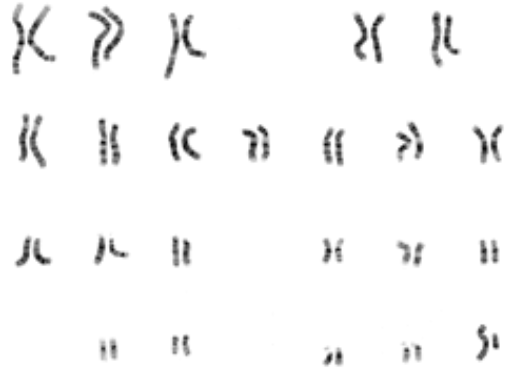
Karyotype
The banding pattern and length of an individual’s chromosomes
Fusion of chromosome 2 in humans
Evidence from karyotypes showing that human chromosome 2 formed from the fusion of two ancestral chromosomes (equivalent to chimpanzee chromosomes 12 and 13)
Genome
All the genetic information of an organism
Single-nucleotide polymorphism (SNPs)
Single base changes in DNA that cause variations within a species
Next generation sequencing (NGS)
Technology developed in 2004 to rapidly and cost-effectively sequence genes, significantly lowering the costs.
Dichotomous keys
Tools using ‘two parts’ or binary choices based on morphology to quickly identify organisms.
DNA Barcoding
A method to identify species using short known sections of DNA often from environmental samples like feces or water.
Clades
Groups of organisms with common ancestry and shared characteristics. identified through DNA sequences, amino acids, or morphology.
Parsimony analysis
A method used in cladistics where the evolutionary tree with the fewest changes is considered the most likely.
Cladograms
Tree diagrams illustrating the most probable sequence of divergence in clades from a common ancestor.
Root (Cladogram)
The initial ancestor common to all organisms within a cladogram
Node (Cladogram)
A hypothetical common ancestor the speciated into two or more species
Outgroup (cladogram)
The most distantly related species in a cladogram, used for comparison
Terminal branch (cladogram)
represents individual species included in the analysis
Molecular clock
A tool that estimates how long species have been sperated based on mutation rates over time

Cladisticts vs. traditional taxonomy
Cladistics uses natural, unranked clades to better reflect evolutionary divergence, while traditional taxonomy was more rigid.
Three domain system
A classification system (developed by Woese using rRNA sequences) that categorizes life into three domains (Archaea, Bacteria, Eukarya) representing a paradigm shift from the five-kingdom system.
Ecosytem
Organisms and their enviornment, including both biotic and abiotic components.
Habitat
The specific non-living component or physical location where a community, species, population, or organism lives
Community
All organisms living and interacting in a particular area
Population (SAT)
A group of individuals of the Same Species, living in the same Area, at the same Time (SAT)
Carrying capacity
The maximum number of individuals of a species that an ecosystem can support indefinitely due to limited resources
Positive feedback (Ecology)
A process where one variable causes an increase in another variable (amplifying the initial effect)
Negative Feedback (Ecology)
A process where one variable causes a decrease in another variable, stabilizing the system (Lotka Volterra predator-prey dynamics)
Density dependent factors
Factors whose effects on a population size depend on the population’s density, pushing it towards carrying capacity (disease, predators, food availability)
Density independent factors
Factors whose effects on population size do not depend on the population’s density, causing fluctuating populations (weather, natural disasters)
Herbivory
An interspecies interaction where an animal consumes plants (deer eating plants)
Predation
An interspecies interaction where one animal hunts and eats another animal (coyotes eating rabbits)
Interspecific competition
Competition between two different species for the same limited resources (coyotes and wolves competing for prey)
Mutualism
An insterspecies interaction where two animals increase each other’s survival and fitness (California oak and fungi, root nodules in fabaceae, zooxanthellae in corals)
Parasitism
An interspecies interaction where one animal lives on or in another organism, taking its nutrients and harming it (rockfish and protozoa)
Pathogenicity
The ability of an organism to spread disease to another organism (avian flu)
Lokta Volterra model
A mathematical model describing predator-prey population dynamics, where predator and prey populations oscillate, forming a negative Feedback loop with a time gap
Intraspecific competition
Competition among individuals of the same species for resources (male zebras competing for mates)
intraspecific cooperation
cooperation among individuals of the same species to increase survival (wolves hunting in packs, humans, ants, bees)
Allelopathy
Plants producing toxic compounds that inhibit the growth of other plants, transferred by rain, gas, or dead leaves (Black walnut, mustard)
Antibiotics from plants
Plant-produced compounds that kill bacteria and often have a bitter taste (california bay, coffeeberry)
Top-down population control
Population size limited by predators
Bottom-up population control
population size is limited by the availability for nutrients in the ecosystem (phytoplankton)
sampling error
The difference between an estimated population total and the true population total.
Random quadrant sampling
A method to estimate the population of sessile (non-moving) organisms by counting individuals in randomly selected square areas of a known size
Capture-mark-release-recapture (Lincoln index)
A method to estimate the population of moving organisms by capturing, marking, releasing, and then recapturing individuals to calculate the population size
Population growth curves
Graphs showing population growth, typically starting to exponentially then flattening into a logistic (sigmoid) curve as resources become limited
Null hypothesis (competition)
The assumption that there is no correlation or interaction between species
alternative hypothesis (competition)
The assumption that there is a correlation or interaction between species (most likely negative in competition)
Invasive species
A non-native species that competes with native species, often outcompeting them and threatening their survival (red-eared slider vs. Western pond turtle)
Biome
A large ecological area characterized by its dominant plant and animal communities, determined primarily by temperature and rainfall
Hot Desert animal adaptions
Examples include camels storing fat for water, desert tortoises digging burrows, fennec foxes being nocturnal, and kangaroo rats having special kidneys.
Hot dessert plant adaptions
Examples include saguaro cacti having thick waxy coatings, reduced leaves, and hard spines.
Tropical animal adaptations
Examples include jaguars being able to swim, climb, and run; frogs using moisture and poison.
Tropical rainforest plant adaptations
Examples include drip tips on leaves to drain excess water, and climbing plants with aerial roots.
Abiotic factors affecting species distribution
Non-living environmental factors like temperature, pH, salinity, humidity, and oxygen levels that determine where a species can survive.
Range of tolerance
The environmental conditions (temperature) within which a species can survive; outside this range, population size decreases.
Coral reef requirements
Specific abiotic factors like temperature (23-29 degrees C) high salinity (32-42 parts per thousand), clear water for light, stable pH above 7.7, and shallow water depth (less than 25 m)
American Beach grass adaptations
Deep, strong, and extensively creeping rhizomes to survive in sandy and salty environments on sand dunes.
Mangrove adaptations
Prop roots for stability in changing tides and aerial pneumatophores for oxygen; also have salt filtration mechanisms to remove salt from roots or exrete it through leaves.
Hutchinsonian niche
"n-dimensional hypervolume" where dimensions represent environmental conditions and resources.