Chemical Bonding
 Call Kai
 Learn
Learn Practice Test
 Spaced Repetition
 Match
Match Flashcards
 Knowt Play
1/580

Earn XP
Description and Tags
Name | Mastery | Learn | Test | Matching | Spaced | Call with Kai | Chat |
|---|
No analytics yet
Send a link to your students to track their progress
581 Terms
What is an element?
An element is the simplest form of matter. It is made up of atoms that all have the same number of protons. An element cannot be chemically broken down into simpler substances.
What is a molecule?
A molecule consists of two or more atoms that are chemically bonded together. These atoms may be the same element or different elements. Molecules are always made up of at least two atoms.
What is a compound?
A compound involves atoms of two or more different elements that are chemically bonded together. Compounds have a fixed ratio of elements and cannot be separated into simpler substances by physical means. The properties of a compound are different from those of its constituent elements.
What is the difference between a mixture and a compound?
A mixture consists of two or more elements and/or compounds that are physically combined. Unlike compounds, mixtures can be separated by physical means. Compounds, on the other hand, cannot be separated by physical means and have a fixed composition.
What are the two main types of mixtures?
The two main types of mixtures are homogeneous and heterogeneous. A homogeneous mixture has a uniform composition throughout, while a heterogeneous mixture has visible distinct parts.
What are the key characteristics of a compound?
A compound consists of atoms from two or more different elements bound together. It can be broken down into simpler substances (elements) by chemical means but not by physical means. Compounds always contain the same ratio of elements, and their properties are different from those of the individual elements.
What are the key characteristics of a mixture?
A mixture consists of two or more elements and/or compounds physically combined. The components of a mixture can be separated by physical means. Mixtures often retain many of the properties of their individual components.
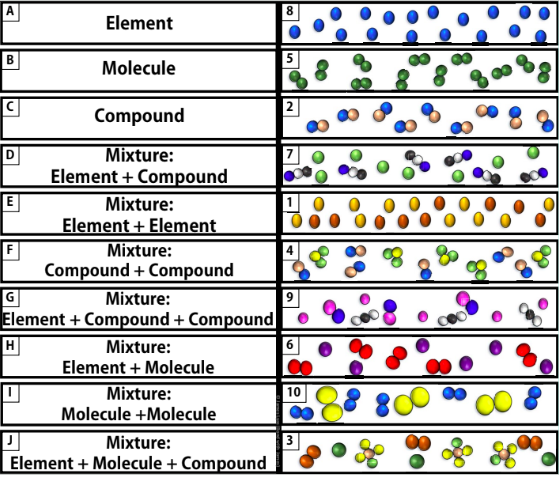
Is NaCl (table salt) an element, compound, or molecule?
NaCl is a compound. It consists of sodium (Na) and chlorine (Cl) chemically bonded together. Since it is made of two different elements, it is classified as a compound.
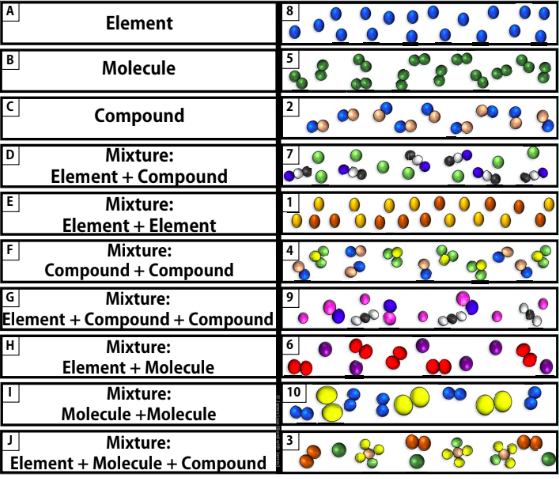
Is gold (Au) an element, compound, or molecule?
Gold (Au) is an element. It is composed of only one type of atom, gold, and cannot be broken down further. Since it is made of a single element, it is classified as an element.
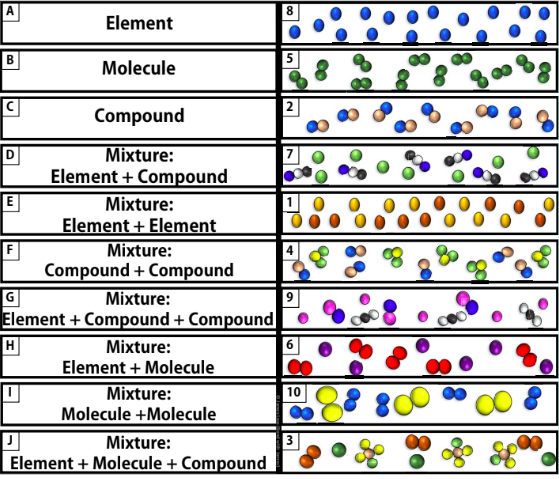
Is O₂ an element, compound, or molecule?
O₂ is a molecule. It consists of two oxygen atoms chemically bonded together. Since the two atoms are the same element, it is classified as a molecule, not a compound.
What is the difference between a compound and a molecule?
All compounds are molecules, but not all molecules are compounds. A molecule like O₂, which consists of two oxygen atoms, is not a compound because it involves atoms of only one element. Compounds always involve different elements, such as H₂O (water).
Is H₂O (water) a molecule, a compound, or both?
H₂O is both a molecule and a compound. It is a molecule because it consists of two hydrogen atoms and one oxygen atom. It is a compound because it involves two different elements (hydrogen and oxygen) chemically bonded together.
What is the difference between homogeneous and heterogeneous mixtures?
A homogeneous mixture has a uniform composition throughout, meaning all its components are evenly distributed. A heterogeneous mixture has visibly distinct parts, where the different components are not evenly distributed. Examples include saltwater (homogeneous) and a salad (heterogeneous).
Can mixtures be separated by physical means?
Yes, mixtures can be separated by physical means. This is because mixtures do not involve chemical bonds between the components, unlike compounds. Physical methods such as filtration, evaporation, or distillation can be used to separate the components of a mixture.
Which of the following is a compound: NaCl, O₂, or Au?
NaCl (table salt) is the compound. It consists of two different elements: sodium and chlorine. O₂ is a molecule of oxygen, and Au is an element.
What makes a compound different from a mixture?
A compound has a fixed chemical composition and cannot be separated by physical means. A mixture, on the other hand, has no fixed composition and can be separated by physical methods. Compounds are chemically bonded, while mixtures are physically mixed together.
Is CH₄ (methane) a molecule, a compound, or both?
CH₄ is both a molecule and a compound. It is a molecule because it consists of atoms chemically bonded together, and it is a compound because it contains atoms of two different elements: carbon and hydrogen.
What makes a compound’s properties different from its component elements?
A compound’s properties are distinct from those of its component elements because the atoms in a compound are chemically bonded in a specific ratio. This bonding alters the physical and chemical properties of the elements. For example, water (H₂O) is a compound with properties very different from hydrogen and oxygen.
Can a mixture be a compound?
No, a mixture cannot be a compound. A mixture is a physical combination of elements or compounds that retains the properties of the individual components. A compound, on the other hand, is a chemical combination of two or more elements in a fixed ratio.
What is the relationship between molecules and compounds?
All compounds are molecules, but not all molecules are compounds. Molecules consist of two or more atoms bonded together, and if those atoms are from different elements, the molecule is considered a compound. For example, H₂O is both a molecule and a compound, while O₂ is only a molecule, not a compound.
What is an example of an element?
An example of an element is gold (Au). It is made up of only one type of atom, which is gold. Gold cannot be chemically broken down into anything simpler.
What makes a molecule different from a compound?
A molecule is simply two or more atoms chemically bonded together, and it can consist of atoms from the same element (e.g., O₂). A compound, however, is a type of molecule that involves atoms of different elements (e.g., H₂O). Therefore, all compounds are molecules, but not all molecules are compounds.
What is the difference between an element and a compound?
An element consists of only one type of atom and cannot be broken down into simpler substances. A compound is made up of atoms from two or more different elements, chemically bonded. The properties of a compound are usually very different from the elements that make it up.
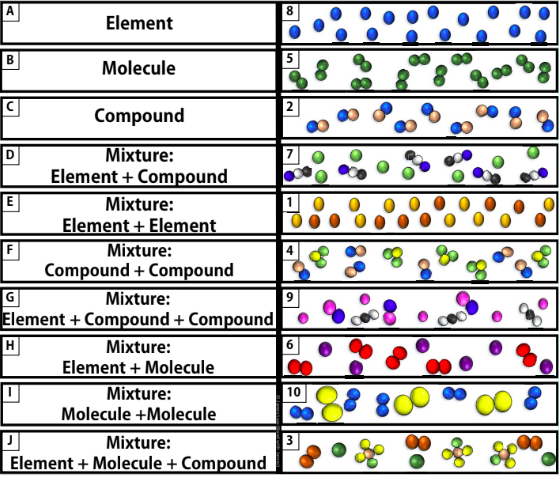
Is O₂ (oxygen) an element, molecule, or compound?
O₂ is a molecule, but not a compound. It consists of two oxygen atoms bonded together. Since the atoms are of the same element, it is considered a molecule but not a compound.
Can compounds be separated by physical means?
No, compounds cannot be separated by physical means. To break down a compound into its constituent elements, chemical methods are required, such as a chemical reaction. Physical methods only work for mixtures.
Why are compounds always made of atoms from different elements?
A compound is formed when atoms from different elements chemically bond together. The bond can be ionic, covalent, or metallic, but the key feature is that the elements involved are different. This distinguishes compounds from molecules made of the same type of element.
How can you tell the difference between a homogeneous mixture and a heterogeneous mixture?
A homogeneous mixture has a uniform composition throughout, meaning its components are evenly distributed. In contrast, a heterogeneous mixture has visibly distinct parts where different components can be seen separately. For example, saltwater is homogeneous, while a salad is heterogeneous.
What is an example of a homogeneous mixture?
An example of a homogeneous mixture is salt dissolved in water. The salt dissolves evenly throughout the water, creating a mixture with the same composition at every point.
What is an example of a heterogeneous mixture?
An example of a heterogeneous mixture is a salad. The individual components, like lettuce, tomatoes, and cucumbers, remain distinct and are not uniformly distributed throughout the mixture.
What happens when a mixture is separated by physical means?
When a mixture is separated by physical means, the individual components can be isolated without altering their chemical structure. For example, you can filter sand from water, but both substances retain their original properties.
Can mixtures retain the properties of their individual components?
Yes, mixtures retain the properties of their individual components. For example, in a mixture of sand and salt, both the sand and salt keep their original properties, such as texture and solubility.
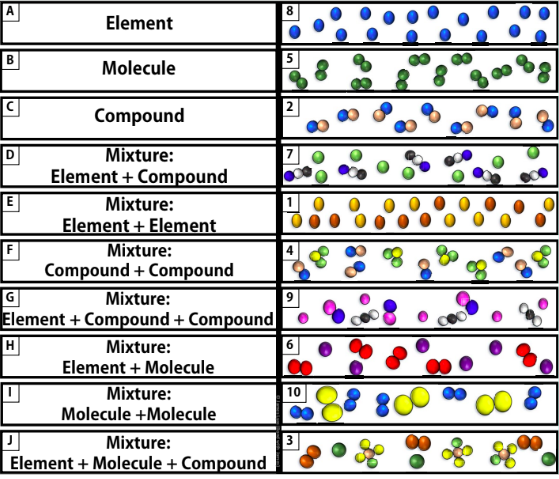
Is calcium chloride (CaCl₂) an element, molecule, or compound?
Calcium chloride (CaCl₂) is a compound. It consists of calcium (Ca) and chlorine (Cl), which are two different elements bonded together. Since it involves different elements, it is classified as a compound.
What type of bonding occurs in a compound?
In a compound, atoms are bonded through either ionic, covalent, or metallic bonds. Ionic bonds occur when atoms transfer electrons, covalent bonds form when atoms share electrons, and metallic bonds involve a sea of shared electrons between metal atoms.
What is the key difference between a molecule and a mixture?
A molecule is a chemical combination of two or more atoms bonded together, forming a stable unit. A mixture, on the other hand, is a physical combination of two or more substances that retain their individual properties. Mixtures can be separated by physical means, while molecules require chemical processes to break apart.
Is H₂O (water) an element, compound, or molecule?
H₂O is both a molecule and a compound. It is a molecule because it consists of multiple atoms (two hydrogen and one oxygen) bonded together, and it is a compound because it contains two different elements.
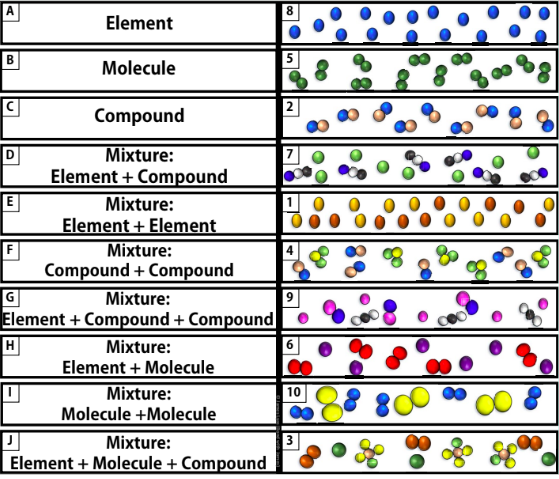
Is NaCl (table salt) an element, compound, or molecule?
NaCl (table salt) is a compound. It is composed of sodium (Na) and chlorine (Cl), which are two different elements chemically bonded. Therefore, it is a compound, not a single element or just a molecule.
Can mixtures be broken down into individual components using chemical reactions?
No, mixtures cannot be broken down by chemical reactions. They can only be separated by physical means, such as filtration or distillation. In contrast, compounds can only be broken down through chemical reactions.
What does it mean when a compound "has a fixed ratio"?
When a compound has a fixed ratio, it means that the elements involved in the compound combine in a specific proportion by mass. For example, water (H₂O) always has two hydrogen atoms for every oxygen atom. This ratio does not change.
What makes a mixture "homogeneous"?
A homogeneous mixture has a consistent, uniform composition throughout. Every part of the mixture is the same, such as in a solution where the solute is evenly distributed in the solvent. An example is sugar dissolved in water.
What is the difference between a molecule of oxygen (O₂) and a compound like H₂O?
O₂ is a molecule made up of two oxygen atoms bonded together, and it is not a compound because it consists of only one element. H₂O is both a molecule and a compound because it contains atoms of different elements: hydrogen and oxygen, bonded together.
Can a compound be both a molecule and a compound?
Yes, a compound can be a molecule as well. All compounds are molecules, but not all molecules are compounds. For example, H₂O is both a molecule and a compound, while O₂ is only a molecule.
What is the relationship between elements, compounds, and mixtures?
Elements are the simplest forms of matter, made up of one type of atom. Compounds are made of two or more different elements bonded together chemically. Mixtures are combinations of elements and/or compounds that are physically mixed and can be separated by physical means.
If element A and element B chemically combine to form substance C, what must C be?
A compound
Which statement describes a characteristic of all compounds?
Compounds can be decomposed by chemical means
Which subatomic particle is responsible for bonding?
Electrons
What is a valence electron?
An electron in the outermost shell of an atom
How do elements chemically combine?
By gaining, losing, or sharing valence electrons
What is the relationship between group number and valence electrons?
For main group elements, the ones digit of the group number equals the number of valence electrons
How many valence electrons does potassium (K) have?
1
How many valence electrons does magnesium (Mg) have?
2
How many valence electrons does lithium (Li) have?
1
How many valence electrons does gallium (Ga) have?
3
How many valence electrons does hydrogen (H) have?
1
How many valence electrons does boron (B) have?
3
How many valence electrons does arsenic (As) have?
5
How many valence electrons does nitrogen (N) have?
5
How many valence electrons does fluorine (F) have?
7
How many valence electrons does iodine (I) have?
7
How many valence electrons does argon (Ar) have?
8
How many valence electrons does xenon (Xe) have?
8
Where can you find the number of valence electrons using the periodic table?
By looking at the group number
What is a Lewis Dot Diagram?
The element symbol with dots representing valence electrons
What is an ion?
An atom that has gained or lost electrons and has a charge
What is a cation?
A positively charged ion
What is an anion?
A negatively charged ion
What is the overall charge of an atom with 4 protons and 5 electrons?
−1
What is the overall charge of an atom with 5 protons and 4 electrons?
+1
Why do atoms form ions?
To achieve a stable noble gas configuration
What is the Octet Rule?
Atoms gain or lose electrons to obtain 8 valence electrons
Name four exceptions to the Octet Rule.
H, He, Li, Be
What is the net charge of an ion with 10 electrons and 11 protons?
+1
What ion does potassium form?
K⁺
What happens when sodium bonds with chlorine?
Sodium loses one electron and chlorine gains one electron
What ion does sodium form?
Na⁺
What ion does chlorine form?
Cl⁻
What type of bond forms between Na and Cl?
Ionic bond
What is ionic bonding?
Transfer of electrons from a metal to a nonmetal
Why do metals lose electrons?
To achieve stability with a full valence shell
Why do nonmetals gain electrons?
To complete their octet
What is the formula for sodium chloride?
NaCl
What makes ionic bonds strong?
Opposite charges attract
Which bond is stronger: NaCl or MgO?
MgO
Which is stronger: KF or KCl?
KF
Rank bond strength from weakest to strongest: +1/−1, +2/−1, +2/−2, +3/−2
+1/−1, +2/−1, +2/−2, +3/−2
Which is strongest: NaCl, CaCl₂, or KBr?
CaCl₂
Which is stronger: MgS or NaF?
MgS
Which is stronger: CaF₂ or CaCl₂?
CaF₂
Which pair forms an ionic bond: KCl, ICl, PCl, HCl?
KCl
Which formula represents an ionic compound: H₂O, NaCl, NH₃, CCl₄?
NaCl
Metallic atoms generally do what when bonding?
Lose electrons and form positive ions
What two types of elements are needed for ionic bonding?
A metal and a nonmetal
What must the overall charge of an ionic compound equal?
Zero
What does a chemical formula show?
The types and number of atoms in a substance
What does H₂O represent?
Two hydrogen atoms and one oxygen atom
What do subscripts indicate?
The number of atoms of each element
In H₂SO₄, how many oxygen atoms are present?
4
What do parentheses mean in chemical formulas?
Multiply everything inside by the outside subscript
How many oxygen atoms are in (NO₂)₃?
6
What is the criss-cross method?
Crossing ion charges to become subscripts
What is the formula for Al³⁺ and O²⁻?
Al₂O₃