Discreet Math - Chapter 2.5 - " Application: Number Systems and Circuits for Addition" FLASHCARDS
 Call Kai
 Learn
Learn Practice Test
 Spaced Repetition
 Match
Match Flashcards
 Knowt Play
1/11

Earn XP
Description and Tags
Vocabulary practice flashcards covering base number systems, binary arithmetic circuits, two's complements, and hexadecimal representations.
Name | Mastery | Learn | Test | Matching | Spaced | Call with Kai | Chat |
|---|
No analytics yet
Send a link to your students to track their progress
12 Terms

Decimal Notation
A base-10 number system that expresses a number as a string of digits in which each digit's position indicates the power of 10 by which it is multiplied.

Binary Notation
A base-2 number system in which any positive integer is represented uniquely as a sum of products of the form d where each binary digit d is either 0 or 1.

Bit
A single binary digit, which can hold a value of either 0 or 1.

Half-Adder
A circuit designed to compute the sum of two binary digits P and Q, outputting a carry bit defined by P∧Q and a sum bit defined by (P∨Q)∧∼(P∧Q).
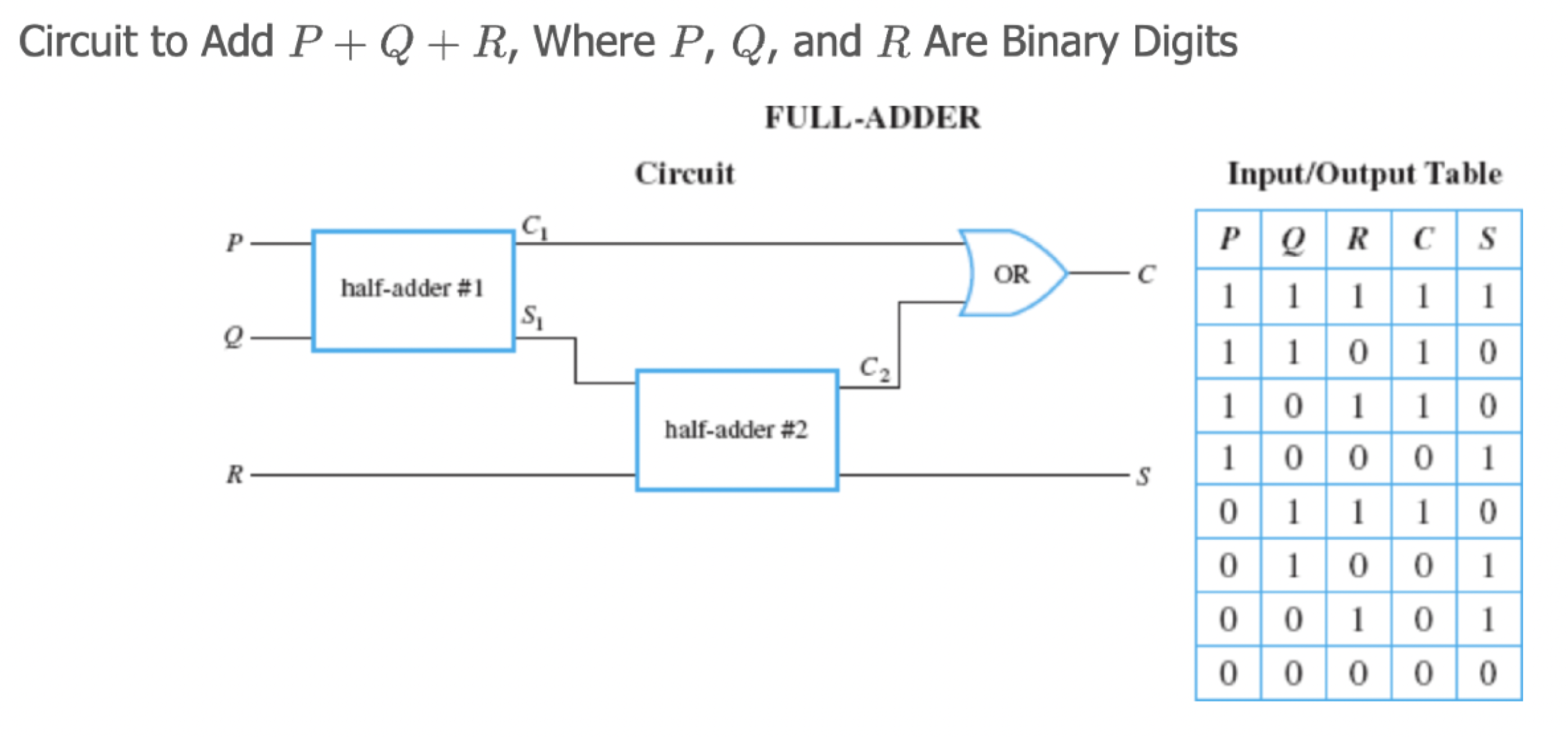
Full-Adder
A circuit designed to compute the sum of three binary digits (P, Q, and R) to produce a carry output C and a sum output S.

Parallel Adder
A circuit constructed using full-adders and/or half-adders capable of adding multi-digit binary numbers of any finite length.
8-Bit Two's Complement (for a Nonnegative Integer)
The 8-bit binary representation for an integer a where 0≤a≤127.
8-Bit Two's Complement (for a Negative Integer)
The 8-bit binary representation for 28−∣a∣ where −128≤a<0, obtained by writing the 8-bit binary form of ∣a∣, flipping all bits, and adding 1 in binary.
Overflow Error
An error occurring when an arithmetic calculation yields a result outside the fixed bit-length system capacity of the computer.

Hexadecimal Notation
A base-16 number system expressing integers as sums of products of powers of 16, using digits 0-9 and letters A-F to represent numbers 10 through 15.

Byte
The smallest addressable memory unit on most computers, consisting of 8 bits.

Memory Dump
A display or printout of the contents of memory locations in order, typically presented in hexadecimal format to save space.