Intro to Psych Final Exam
 Studied by 2 people
 Call Kai
 Learn
Learn Practice Test
 Spaced Repetition
 Match
Match Flashcards
 Knowt Play
1/185

There's no tags or description
Looks like no tags are added yet.
Name | Mastery | Learn | Test | Matching | Spaced |
|---|
No study sessions yet.
186 Terms
psychology
the scientific study of the mind and behavior, exploring how people think, feel, and act in different situations.
ethics
the study of right and wrong, guiding how people should act. It helps us make good decisions in our personal lives, at work, and in society.
qualitative research
study of people’s experiences and perspectives using interviews, observations, or texts to understand the “why” behind behavior.
quantitative research
study using numbers and data to measure and analyze patterns or relationships.
external validity
the extent to which psychological research results can be applied or generalized to people, settings, or situations beyond the study. It reflects how findings can relate to real-world scenarios and diverse populations.
internal validity
the extent to which psychological research accurately shows that the independent variable caused the observed effect without interference from other factors.
reliability
the consistency and stability of psychological research or measurements, ensuring results can be replicated.
perception
the process in psychology by which people organize and interpret sensory information from the environment.
How we recognize, interpret, and make sense of sensory information.
sensation
the process in psychology of detecting and receiving information from the environment through the senses.
action potential
The sudden arrival of positive ions that reverses the charge of the cell from negative to positive, abiding by the all-or-nothing principle.
neurons
Messenger cells that receive, integrate, and transmit information through the body.
neurotransmitters
Chemical substances that are stored in tiny synaptic sacs and allow neurons to communicate with each other throughout the body.
central nervous system
Made up of the brain and spinal cord, controlling thoughts, emotions, movements, and bodily functions.
peripheral nervous system
All the nerve cells in the body outside the central nervous system.
sympathetic nervous system
Part of the autonomic system that responds to stress and arouses the body for action in response to threats.
parasympathetic nervous system
Part of the autonomic nervous system that calms the body.
emotions
A pattern of inner thoughts and feelings, accompanied by physiological responses and sometimes behavioral expression.
motivation
An inner drive that guides behavior toward achieving a specific goal; stages of motivation are initial arousal, direction, and behavioral persistence.
primary emotion
a basic universal emotion like happiness, sadness, anger, fear, surprise, or disgust.
secondary emotion
a complex emotion, like guilt, shame, or pride, that develops from primary emotions and personal or social experiences.
appraisal
the personal evaluation of a situation or event that determines its emotional impact.
gestalt
what type of psychology is a subdiscipline that examines how we create a meaningfully organized whole from smaller parts of a stimulus.
similarity
Identify the following Gestalt principle of perception below:
The tendency to perceive elements that look similar as part of the same group.
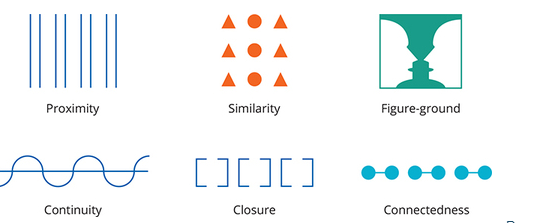
similarity
This is an example of which gestalt principle of perception:
At a concert, we recognize the security staff because they are all wearing the same “SECURITY” yellow vests.

proximity
Identify the following Gestalt principle of perception below:
Tendency to categorize elements based on how physically close they are to each other.
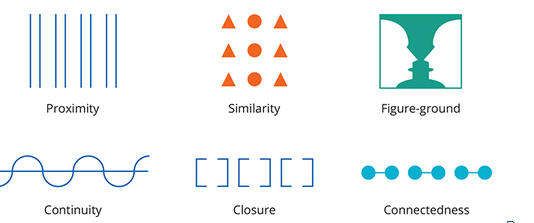
proximity
This is an example of which gestalt principle of perception:
We assume people standing close to each other at a concert know each other while people far from each other are strangers.
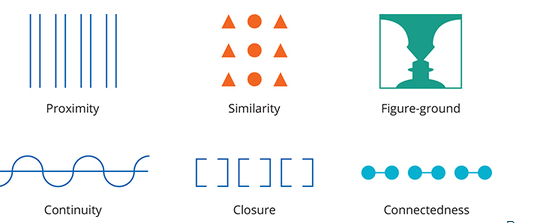
connectedness
Identify the following Gestalt principle of perception below:
Tendency to group elements that touch each other.

connectedness
This is an example of which gestalt principle of perception:
We assume two people who are holding hands at a concert are dating each other.

continuity
Identify the following Gestalt principle of perception below:
We tend to process information in a linear fashion rather than jump around randomly.
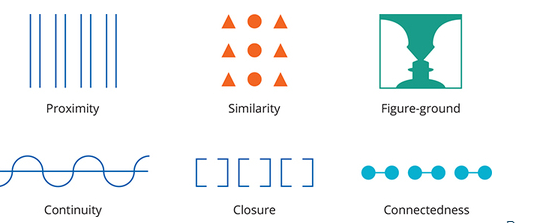
continuity
This is an example of which gestalt principle of perception:
We look for people in a crowd by scanning in a given direction (e.g., starting in one corner and moving from left to right).
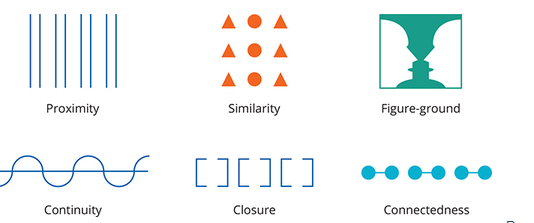
closure
Identify the following Gestalt principle of perception below:
Our minds fill in missing parts of an incomplete stimulus to construct a more complete picture.
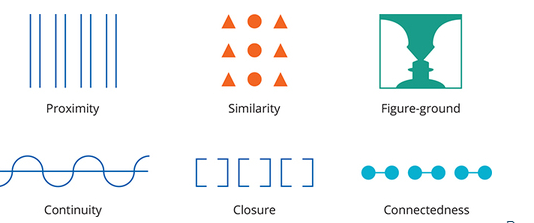
closure
This is an example of which gestalt principle of perception:
If the screen at a concert has a few broken pixels, we still recognize the image of a bird without needing every aspect of it to be there.
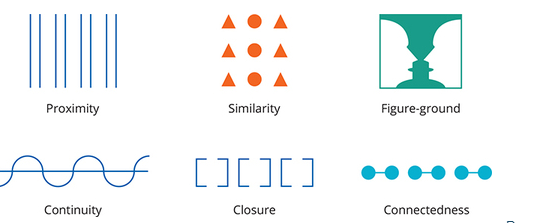
figure-ground
Identify the following Gestalt principle of perception below:
We distinguish between a focal point (the “figure”) and mentally fade out everything else, which becomes the background noise (the “ground”).

figure-ground
This is an example of which gestalt principle of perception:
The lead singer commands our attention during most of the concert. This can change upon mental command (e.g., the drummer can become the “figure” if they start a great solo performance).

Cognitive Heuristic
a mental shortcut that helps people make decisions quickly, but can sometimes cause errors.
bias
a systematic error in thinking or judgment that affects how people perceive and interpret information.
attitude
a learned tendency to evaluate people, objects, or ideas positively or negatively
prejudice
a preconceived, usually unfavorable, judgment or attitude toward a person or group based on characteristics like race, gender, or religion.
schema
Existing collections of thoughts or knowledge that help you make sense of new information.
assimilation
is taking in new information and fitting it into what you already know.
the process of integrating new information into existing schemas without changing the original schema.
accommodation
is changing what you know to make room for new information that does not fit.
the process of modifying existing schemas or creating new ones to incorporate new information.
intelligence quotient
The numeric representation of how a person’s mental abilities compare to others of their same chronological age.
decolonization
the process of removing colonial influence and promoting indigenous knowledge while addressing colonial impacts.
De-ideologize the Present
a critical examination of current beliefs and systems to uncover hidden biases and power structures.
Consciousness-Raising
the process of increasing awareness about social, political, or personal issues to promote understanding and change.
conditioning
the learning process where consequences or associations shape behavior.
social learning
the process of learning behaviors or attitudes by observing and imitating others
William James
identify the following person:
Time period: Late 1800s to early 1900s
Description:
Psychologist and philosopher
He helped start functionalism in psychology and wrote The Principles of Psychology. He also influenced pragmatism and the study of religion.
Sigmund Freud
identify the following person:
Time period: Late 1800s to early 1900s
Description:
Founder of psychoanalysis, which explained behavior through the unconscious mind, childhood experiences, and inner conflicts.
He introduced the Id, ego, and superego.
Wilhelm Wundt
identify the following person:
Time period: Late 1800s
Description:
Considered by many to be the founder of psychology as a separate scientific field of study.
He founded the first psychology lab and helped launch structuralism, which focused on breaking the mind into its basic parts.
Fritz Perls
identify the following person:
Time period: Mid-1900s
Description:
developed gestalt therapy, which is a humanistic approach that seeks to make the client whole by focusing on present experience and the relationship between client and therapist.
the founder of Gestalt therapy, which focuses on awareness, the present moment, and taking responsibility for your experiences. It emphasizes understanding the whole person rather than breaking things into parts.
Max Wetheimer
identify the following person:
Time period: Early to mid-1900s
Description:
one of the founders of Gestalt psychology. This studies how people naturally organize information into meaningful wholes, such as seeing patterns rather than separate parts.
Kurt Koffka
identify the following person:
Time period: Early to mid-1900s
Description:
a key founder of Gestalt psychology, known for showing how perception works as organized patterns rather than separate parts.
He helped spread Gestalt ideas to the U.S.
wolfgang kohler
identify the following person:
Time period: Early to mid-1900s
Description:
a principal Gestalt psychologist known for studying insight learning, how animals solve problems by suddenly understanding the solution rather than through trial and error.
phineas gage
identify the following person:
Time period: mid-1800s
Description:
famous for surviving a severe brain injury in 1848, when an iron rod shot through his skull.
His personality changed afterward, which helped early scientists understand how the frontal lobe is involved in personality, decision-making, and behavior.
philip zimbardo
identify the following person:
Time period: late 1900s
description:
Known for the Stanford prison experiment. This demonstrated how readily people can assume roles of power or obedience in certain situations.
stanley milgram
identify the following person:
Time period: 1960s
Description:
Known for his obedience experience that showed how far people will go in following authority figures, even when it means harm to others.
Ivan Pavlov
Identify the following person:
Time period: Late 1800s to early 1900s
Description:
His famous work involved dogs learning to salivate at the sound of a bell.
a Russian physiologist known for discovering classical conditioning, the idea that animals and humans can learn to associate one stimulus with another.
B.F. Skinner
Time period: Mid-1900s
Description:
A leading behaviorist who recognized the importance of operant conditioning principles.
He expanded on previous research done by Thorndike’s by creating boxes that he called operant conditioning chambers, which were mechanical boxes that could produce rewards or punishments when an animal inside performed certain behaviors. This is also known as the skinner box. He used this to study how behavior is shaped.
aaron beck
identify the following person:
Time period: mid to late 1900s
Description:
known as the founder of cognitive therapy, which later became Cognitive Behavioral Therapy.
He focused on how negative thoug
ht patterns influence emotions and behavior.
albert bandura
Identify the following person:
Time period: mid to late 1900s
Description:
known for the “Bobo doll” studies in which he used it in his research on whether children would model aggression through observational learning.
a major psychologist known for social learning theory, which says people learn by watching others. He’s famous for the Bobo Doll experiment, showing how children imitate observed aggression. He also developed the concept of self-efficacy, the belief in your ability to succeed.
Ignacio Martin-Baro
Identify the following person:
Time period: Late 1900s
Description:
a psychologist and Jesuit priest known for liberation psychology, which focuses on how poverty, oppression, and social injustice affect mental health.
He emphasized community healing and the power to give back to marginalized groups.
Kitty Genovese
Identify the following person:
Time period: 1960s
Description:
known for the case that led to research on the bystander effect.
After the 1964 murder in New York, reports claimed many people witnessed parts of the attack but didn’t intervene. This inspired psychologists to study why people are less likely to help when others are present.
1879
When did psychology separate from philosophy?
Psychology adopted scientific methods to empirically study the mind and behavior.
What major change caused psychology to split from philosophy?
Wilhelm Wundt, William James, and John B. Watson
Which early figures helped establish psychology as its own scientific discipline?
Structuralism and functionalism
What early schools of psychology dominated during the late 1800s and early 1900s? (there are 2)
______focused on the structure of consciousness, while ______emphasized the function of mental processes in adapting to the environment.
To understand the mind and behavior clearly and objectively through controlled experiments.
What was the main goal of early psychologists like Wundt and James?
Philosophers explored questions through reasoning about consciousness, knowledge, the self, morality, and the mind-body relationship.
How were mental processes studied before psychology became a science?
history of psychology
Identify the following concept below:
psychology separated from philosophy in the late 1800s, when figures like Wilhelm Wundt and William James began studying the mind through experiments rather than just thinking about it. Questions about how we think, feel, and perceive the world shifted from debate to scientific investigation. They aimed to understand the mind and behavior clearly and objectively.
waves of psychology
identify the following concept below:
psychology began with introspectionism, which studied the mind by having people look inward at their thoughts and feelings. It was followed by behaviorism, which focused solely on observable behavior shaped by rewards and punishments. Gestalt psychology emphasized viewing experiences as whole patterns and criticized behaviorism and introspectionism for ignoring how the mind organizes perception. Finally, the cognitive revolution shifted attention back to mental processes such as thinking, memory, and problem-solving, as well as to learning approaches like Cognitive-Behavioral Therapy.
introspectionism
Pertaining to the waves of psychology, which term is defined below?
An early approach (late 1800s-early 1900s) that focused on looking inward at thoughts and conscious experiences.
introspectionism
Which approach focused on looking inward at thoughts and feelings?
A. Behaviorism
B. Gestalt Psychology
C. Introspectionism
D. Cognitive therapy
behaviorism
Which wave of psychology rejected the study of internal thoughts?
A. Humanistic psychology
B. Behaviorism
C. Cognitive psychology
D. Gestalt psychology
Experience is best understood as organized wholes
Gestalt psychology emphasized that:
Behavior is shaped only by reinforcement
The mind should be broken down into smaller parts
Experience is best understood as organized wholes
Only observable behavior should be studied
behaviorism
Pertaining to the waves of psychology, which term is defined below?
A dominant approach from the 1910s–1950s that studied only observable behavior shaped by rewards and punishments.
It rejected reductionism and argued that experiences must be understood as unified wholes.
Pertaining to the waves of psychology concept, what criticism did gestalt psychology have towards introspectionism?
Behaviorism ignored mental processes and treated learning too mechanically.
Pertaining to the waves of psychology concept, what criticism did Gestalt psychology have toward behaviorism?
The whole is greater than the sum of its parts—the mind organizes perception into patterns.
Pertaining to the waves of psychology concept, what was the main idea of Gestalt psychology?
A shift during the 1950s–60s that returned focus to mental processes like memory, thinking, and problem-solving.
Pertaining to the waves of psychology concept, what was the cognitive revolution?
The mind as an information-processing system that receives, stores, and retrieves information.
Pertaining to the waves of psychology concept, What metaphor did the Cognitive Revolution borrow from computers?
taste
If someone describes chocolate as “bitter,” which sense organ is responsible?
touch
You touch a hot pan and instantly pull away. Which sensory system alerted you?
smell
Which sense relies on the olfactory bulb to interpret chemical molecules?
cochlea
Hair cells inside which structure allow you to hear sound waves?
A. Retina
B. Cochlea
C. Frontal lobe
D. Hippocampus
rods and cones (sight)
When someone says, “I can’t see color well in the dark,” what part of the visual system explains that?
figure-ground
When you see a vase or two faces, depending on what you focus on, what principle is this?
law of pragnanz
If your mind automatically organizes a messy shape into the simplest form possible, what principle is at work?
A. Proximity
B. Law of Pragnanz
C. Similarity
D. Continuation
closure
You see a broken circle but still recognize it as a circle. Which principle explains this?
continuation
A dashed line still looks like a smooth line. What principle explains this?
proximity
If dots close together appear grouped, which principle is this?
similarity
If team members wearing the same-colored shirts appear grouped automatically, what principle is at work?
intrinsic
You study because you genuinely enjoy learning. Which motivation type is this?
extrinsic
Working for a paycheck is an example of what type of motivation?
incentive theory
Which theory says we act because rewards pull us toward a behavior?
A. Instinct Theory
B. Incentive Theory
C. Optimal Arousal Theory
D. Self-Determination Theory
self-determination theory
A person feels motivated when they have autonomy, competence, and relatedness. Which theory explains this?
instinct theory
Birds migrating every year without being taught is explained by which theory?
drive reduction theory
Hunger drives you to eat to relieve discomfort. Which theory is this?
optimal arousal theory
Skydivers seek high excitement to maintain their best performance. Which theory explains this?
safety
According to Maslow, what needs must be met before belongingness?
A. Love
B. Self-esteem
C. Safety
D. Self-actualization