AST201 TUTORIALS
0.0(0)
Studied by 1 person Call Kai
 Learn
Learn Practice Test
 Spaced Repetition
 Match
Match Flashcards
 Knowt Play
Card Sorting
1/39

Earn XP
Description and Tags
Last updated 6:05 PM on 4/26/23
Name | Mastery | Learn | Test | Matching | Spaced | Call with Kai | Chat |
|---|
No analytics yet
Send a link to your students to track their progress
40 Terms
1
New cards
what are the 3 main components that make up our universe?
normal matter, dark matter, dark energy (dominant)
2
New cards
Erika is on the ground looking at a transparent plane flying overhead at 900km/hr. from the back of the plane, Sam throws a ball towards the front and all passengers on the plane agree it travelled at a speed of 50 km/hr. Sam then shines a flashlight towards the front of the plane. From Erika’s perspective (on the ground), how fast does
(a) the ball, and
(b) the light from the flashlight, appear to be moving?
From Sam’s position on the plane, how fast does
(c) Erika and
(d) the light from the flashlight appear to be moving?
(a) the ball, and
(b) the light from the flashlight, appear to be moving?
From Sam’s position on the plane, how fast does
(c) Erika and
(d) the light from the flashlight appear to be moving?
a) Since the ball and the plane are moving in the same direction away from erika, the ball appears to be moving at 900km/h + 50km/hr = 950km/hr from Erika's reference frame
b) Since the speed of light is invariant, the light from sam's flashlight travels at the speed c
c) He would see erika moving away at 900km/hr according to his reference frame
d) the light moves at c
b) Since the speed of light is invariant, the light from sam's flashlight travels at the speed c
c) He would see erika moving away at 900km/hr according to his reference frame
d) the light moves at c
3
New cards
You are inside a spaceship in deep space, far away from any stars. Your engines are off and you believe that your spaceship is stationary. You look out and see Phil and Victor approaching you from opposite directions, both at 0.9c. From Phil’s perspective:
(a) what is Phil’s own speed,
(b) what is your speed and
(c) what is Victor’s speed compared to the speed of light? (If it seems like you need to use math more complicated than addition and subtraction, an approximate answer is sufficient.)
(a) what is Phil’s own speed,
(b) what is your speed and
(c) what is Victor’s speed compared to the speed of light? (If it seems like you need to use math more complicated than addition and subtraction, an approximate answer is sufficient.)
a) Phil is stationary from their perspective . Phil sees you travelling at 0.9c
b) your speed would be 0.9c from phils perspective
c) victor would be going over 0.9c but under the speed of light if he is obeying the laws of physics, since nothing with mass can move faster than or at the speed of light
b) your speed would be 0.9c from phils perspective
c) victor would be going over 0.9c but under the speed of light if he is obeying the laws of physics, since nothing with mass can move faster than or at the speed of light
4
New cards
How is gravity defined according to general relativity and how is it different from newton's theory of gravity? Why does the earth orbit around the sun for both theories? Is the orbit of the earth around the sun predicted to be the same in both cases?
* For general relativity, this is the distortion of the space where masses weigh down and warp spacetime - this is known as the equivalence principle
* Objects follow the straightest path through the curved spacetime
* Curved spacetime replaces gravity
* The earth orbits around the sun because it is the largest star in the galaxy and has the most mass, therefore causing a warp in the space where the earth follows the straightest path possible around the sun
* Newton noted that gravity is a force between two objects where the larger the distance is, the weaker the strength is of the gravity
* Objects of larger masses have more gravitational force than other objects, they pull more on the other object
* The earth orbits around the dun because there is no other force acting upon the object to stop because of the inward force of acceleration exerting on earth from the sun's force
* The orbit around the sun is predicted to be the same according to both theories because gravity is weak enough
* Objects follow the straightest path through the curved spacetime
* Curved spacetime replaces gravity
* The earth orbits around the sun because it is the largest star in the galaxy and has the most mass, therefore causing a warp in the space where the earth follows the straightest path possible around the sun
* Newton noted that gravity is a force between two objects where the larger the distance is, the weaker the strength is of the gravity
* Objects of larger masses have more gravitational force than other objects, they pull more on the other object
* The earth orbits around the dun because there is no other force acting upon the object to stop because of the inward force of acceleration exerting on earth from the sun's force
* The orbit around the sun is predicted to be the same according to both theories because gravity is weak enough
5
New cards
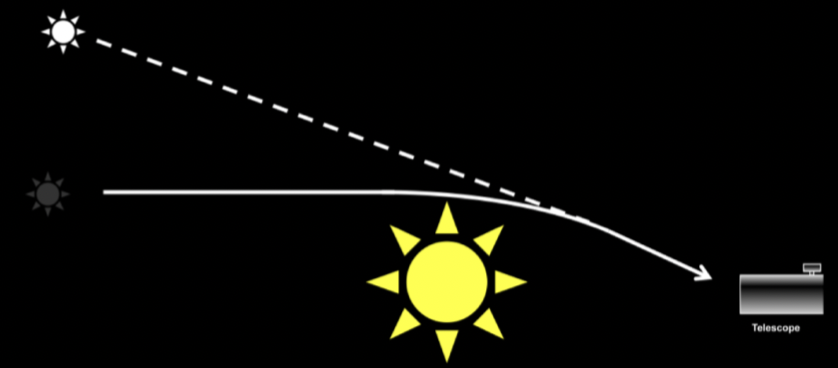
According to the equivalence principle, gravity bends the path of light. With this in mind, draw a diagram showing how our Sun bends the path of light from a distant star. How would this affect observations of that star? Is the light from that star traveling in a straight path?
* The star is perceived to be at a position located above the sun
* Gravity makes light bend
* General relativity replaces gravity with curved spacetime
* The light from the star is travelling in a straight path, but it seems to be curved because of the Sun
* Gravity makes light bend
* General relativity replaces gravity with curved spacetime
* The light from the star is travelling in a straight path, but it seems to be curved because of the Sun
6
New cards
How do time and length change when you’re observing someone (or something!) traveling close to the speed of light?
Time is dilated (runs slower) and length is contracted (appears shorter)
7
New cards
Zoomer and Stayer have decided to test the Twin Paradox. Zoomer will travel away from the Earth at 0.8c to a distant star, turn around, and return to Earth. Stayer will stay on Earth the entire time. While Zoomer is travelling away, who is older? After Zoomer returns to Earth, who is older? Why?
* While Zoomer is travelling away, both twins view the other as younger than the other, so neither is older. This happens because the two twins are in different reference frames and therefore think that the other twin's clock is moving slower
* When Zoomer returns to Earth, Stayer is older than Zoomer – this is because Zoomer turns around (and therefore changes their reference frame
* Loose the time when you are accelerating between two reference frames
* When Zoomer returns to Earth, Stayer is older than Zoomer – this is because Zoomer turns around (and therefore changes their reference frame
* Loose the time when you are accelerating between two reference frames
8
New cards
If you were at rest in a spaceship far away from any planets or stars, would you have any weight? What would happen if you turned on your engines and accelerated? What would you have to do to feel like you weighed the same as you do on Earth? Explain why a planet’s gravity could produce these same effects.
* We would feel negligible weight as we are not near any object of mass or accelerating. The force of gravity from the far away planets and stars would be barely noticeable, perhaps small enough to say one feels no weight
* You would still have weight though you would not feel it while there is little gravity
* If accelerated we will feel a weight change (heavier) due to the equivalence principle
* To feel the same weight as on Earth you have to accelerate to the same point which replicates gravity on Earth
* The equivalence principle states that the force of gravity and acceleration are indistinguishable so a certain acceleration speed can replicate the force of gravity on Earth. Therefore you wouldn’t be able to tell if you were falling or accelerating in space or on Earth
* Cannot distinguish between gravity and acceleration because of the equivalence principle
* You would still have weight though you would not feel it while there is little gravity
* If accelerated we will feel a weight change (heavier) due to the equivalence principle
* To feel the same weight as on Earth you have to accelerate to the same point which replicates gravity on Earth
* The equivalence principle states that the force of gravity and acceleration are indistinguishable so a certain acceleration speed can replicate the force of gravity on Earth. Therefore you wouldn’t be able to tell if you were falling or accelerating in space or on Earth
* Cannot distinguish between gravity and acceleration because of the equivalence principle
9
New cards
What are the 2 basic quantities that determine the velocity needed to escape an object’s gravitational pull? Use this concept of escape speed to define the event horizon of a black hole and explain why we refer to black holes as ‘black’. How would adding mass to a black hole affect its event horizon?
* Mass and Distance are the 2 basic quantities that determine the velocity of an object to escape a gravitational pull
* Black holes are called “black” because no light can escape from it – hence it being called black
* The event horizon, or the Schwarzschild radius is the point of the black hole where even the light cannot escape, one would have to be faster than the speed of light in order to escape
* Adding mass to a black hole who increase the Schwarzschild radius, black holes have infinite density
* Event horizon is relative to the black hole, there is no border that is equivalent for all black holes
* Black holes are called “black” because no light can escape from it – hence it being called black
* The event horizon, or the Schwarzschild radius is the point of the black hole where even the light cannot escape, one would have to be faster than the speed of light in order to escape
* Adding mass to a black hole who increase the Schwarzschild radius, black holes have infinite density
* Event horizon is relative to the black hole, there is no border that is equivalent for all black holes
10
New cards
Black holes allow no light to escape their gravitational pull, so we cannot observe them directly. What observational evidence do we have that black holes even exist? What do you think would be the best way to search for new black holes?
* Can observe a weird distortion from a distance (caused by gravity)
* Light bend around things
* Black holes can be observed when it is devouring its companion star
* Things falling into blackhole emits x-rays
* The acceleration disk around a black hole is made up of hot gas and dust falling into the black hole, which can be seen.
* Search for new black holes: observing stars orbiting route
* At high temps it emits an x ray of some light but after the event horizon you cannot see anything
* Can only see the light around it, there is no light coming out of it
* Light bend around things
* Black holes can be observed when it is devouring its companion star
* Things falling into blackhole emits x-rays
* The acceleration disk around a black hole is made up of hot gas and dust falling into the black hole, which can be seen.
* Search for new black holes: observing stars orbiting route
* At high temps it emits an x ray of some light but after the event horizon you cannot see anything
* Can only see the light around it, there is no light coming out of it
11
New cards
You observe 4 photons with different colors: one ultraviolet, one infrared, one blue, and one green. Which photon has the most energy? Which one has the least energy?
The UV photon is most energetic and the infrared photon is the least energetic.
12
New cards
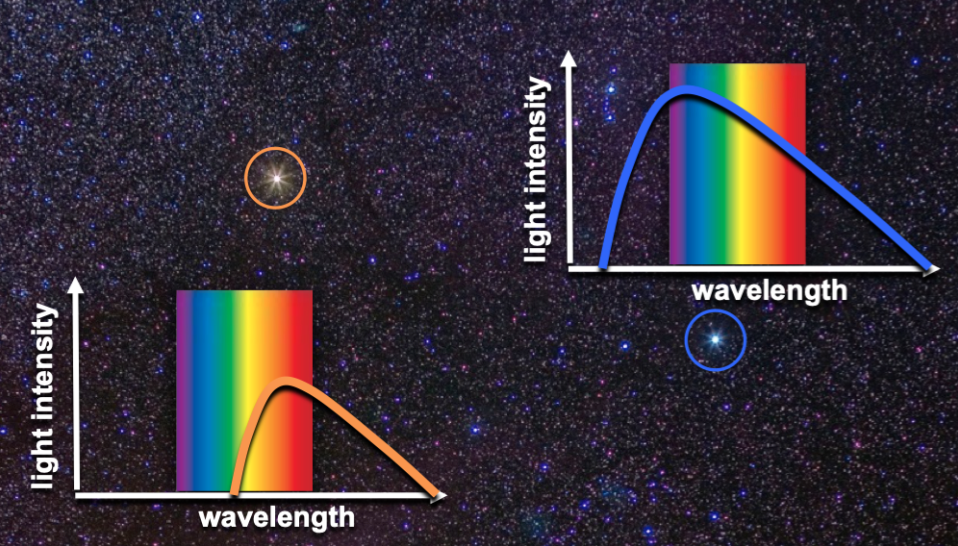
Draw the blackbody spectrum of the Sun with no absorption lines and label the axes. On the same graph, draw the blackbody spectrum of a star hotter than the Sun and a star cooler than the Sun. How do their overall colours differ? Which star emits the most red light?
the blackbody spectrum for the sun, spectrum is telling us how bright things are at different colours
blue is hotter, orange is cooler
hotter stars will emit more red light because it emits lights at higher intensities than the cooler stars
blue is hotter, orange is cooler
hotter stars will emit more red light because it emits lights at higher intensities than the cooler stars
13
New cards
How does the Sun produce energy? Where does this process take place and why? Write out the basic reaction governing this process. What product of this reaction most directly causes the sun to shine? Can the Sun continue to shine forever, and if not what does it run out of?
* The sun produces energy through nuclear fusion which turns hydrogen to helium
* Mass is converted into energy which manifests itself as heat and light (ie. why the sun shines)
* It takes place inside the core of the sun, as it provides the conditions for nuclear fusion to occur (ie. high heat, high pressure)
* When 4 hydrogen atoms (or protons) come together, it produces helium and gamma rays. Gets absorbed by material and heats up.
* No the sun can’t produce energy through nuclear fusion forever because the sun will eventually burn/run out of its supply of hydrogen
* Mass is converted into energy which manifests itself as heat and light (ie. why the sun shines)
* It takes place inside the core of the sun, as it provides the conditions for nuclear fusion to occur (ie. high heat, high pressure)
* When 4 hydrogen atoms (or protons) come together, it produces helium and gamma rays. Gets absorbed by material and heats up.
* No the sun can’t produce energy through nuclear fusion forever because the sun will eventually burn/run out of its supply of hydrogen
14
New cards
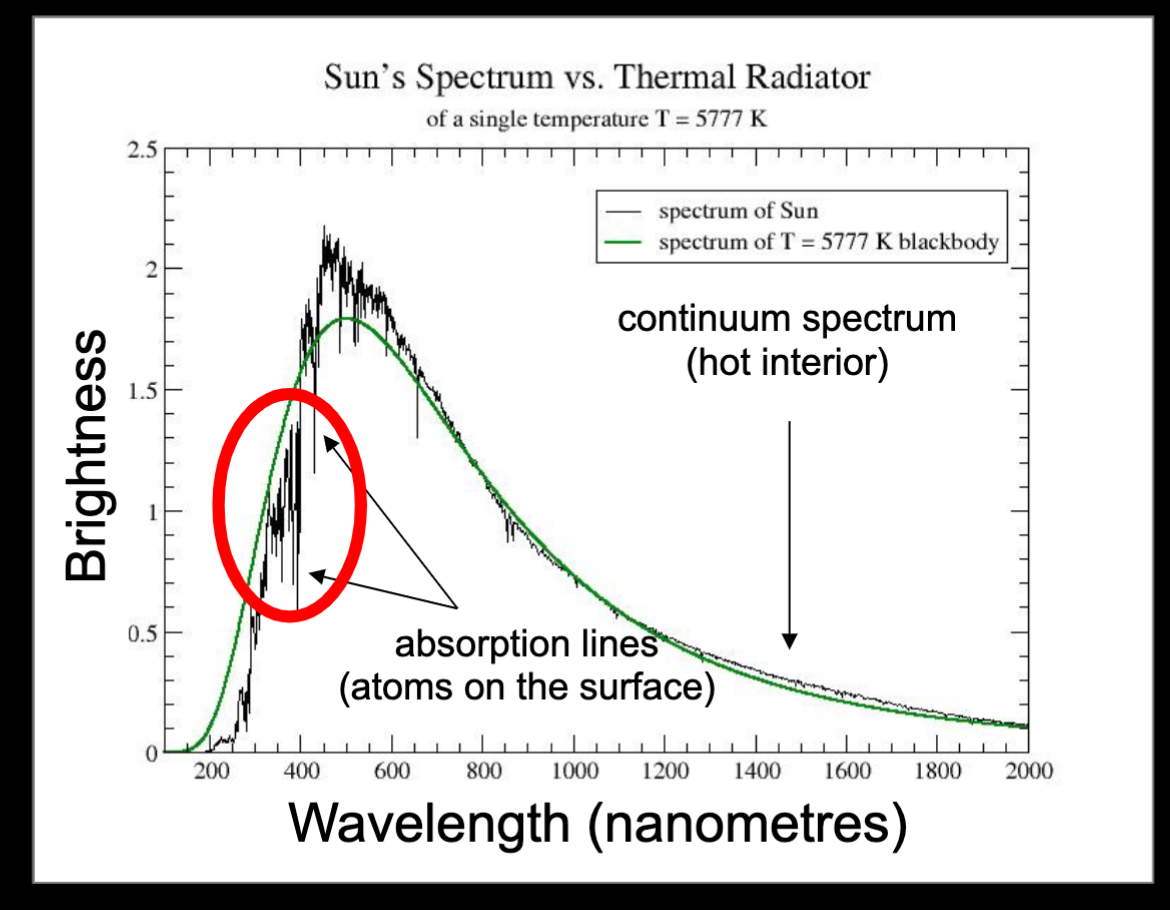
Draw the blackbody spectrum of the Sun and label the axes. Then add a few example absorption lines to the spectrum. What can we learn from the absorption lines in the Sun’s spectrum? What would happen to the absorption lines if the abundance of chemicals responsible increased or decreased?
* The absorption lines tell us about the overall composition of the sun, more specifically the different chemical elements of the sun like its temperature and density and the shifts in wavelength
* The absorption lights show the amount of electrons that orbit around an atom. The electron of an element has to absorb the exact right amount of energy/wavelength/colour of light.
* If there is an **deeper** drop in wavelength there is a higher abundance of chemicals present and absorbed. If there is an increase, there are less elements being absorbed, therefore a shallower drop in wavelength.
* The absorption lights show the amount of electrons that orbit around an atom. The electron of an element has to absorb the exact right amount of energy/wavelength/colour of light.
* If there is an **deeper** drop in wavelength there is a higher abundance of chemicals present and absorbed. If there is an increase, there are less elements being absorbed, therefore a shallower drop in wavelength.
15
New cards
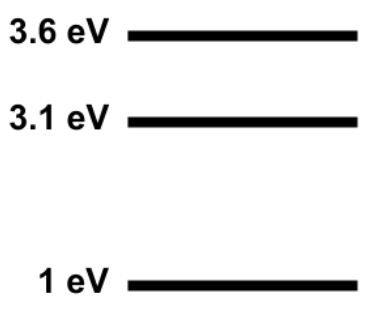
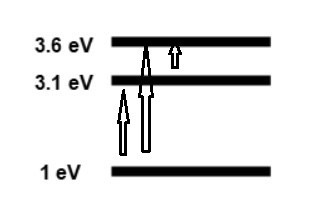
Head TA Steffani has discovered a new element, Grondium. She observes that it has absorption features at 590 nm (2.1 eV) and 470 nm (2.6 eV), where eV is a unit of energy. The diagram below represents the ground state and two excited states of an electron in a Grondium atom. Draw and label a diagram of this atom with electron orbitals corresponding to these energy levels. On the diagram, draw arrows to explain what causes the absorption features. Do you think Grondium will have any other absorption features?
* It would also have other absorption features at 3.1 eV. In this case, it would take 0.5 eV to jump to 2.6 eV.
* Absorbing blue light would cause it to jump from 1 to 3.6 eV and absorbing orange light would cause it to jump from 1 to 3.1 eV
* Absorbing blue light would cause it to jump from 1 to 3.6 eV and absorbing orange light would cause it to jump from 1 to 3.1 eV
16
New cards
Which will live longer, a higher or lower mass star?
__Lower mass star__: lower mass stars have less fuel to burn than higher mass stars, but go through their fuel supply slower = longer life!
17
New cards
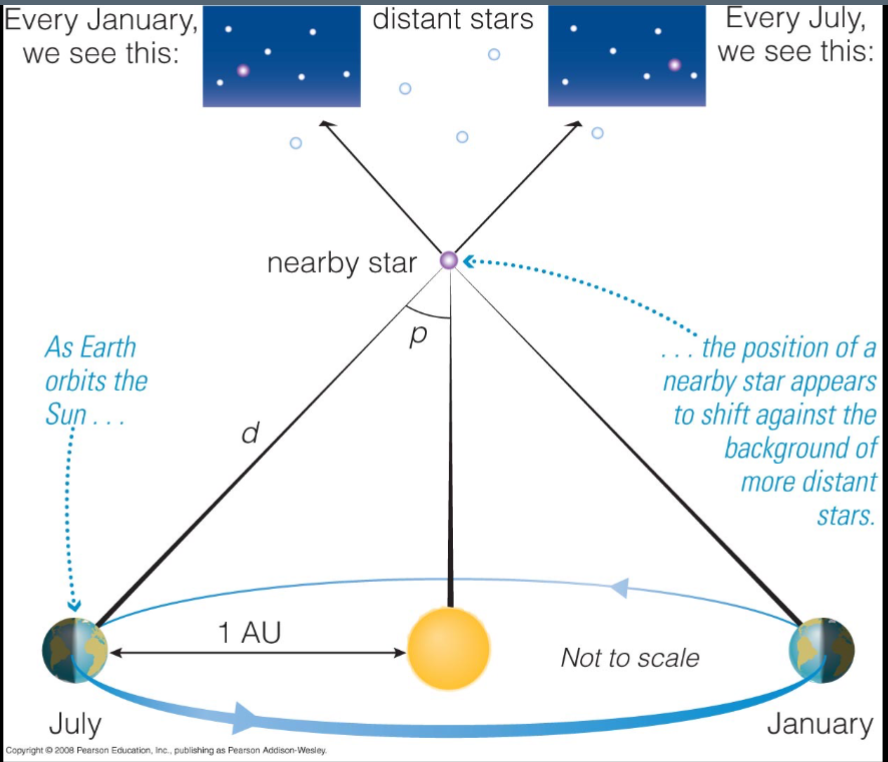
Draw a diagram to explain parallax. How does measuring parallax tell us about the distance to a star? If the apparent brightness of two stars are measured, how can we use parallax to figure out which one is more luminous?
We can get the distance of the star based on how big the parallax shift is - LARGER SHIFTS MEANS THE STAR IS CLOSER
With the distance, we can calculate the luminosity based on the distance and the apparent brightness using the formula: I = L / 4 pi d^2
With the distance, we can calculate the luminosity based on the distance and the apparent brightness using the formula: I = L / 4 pi d^2
18
New cards
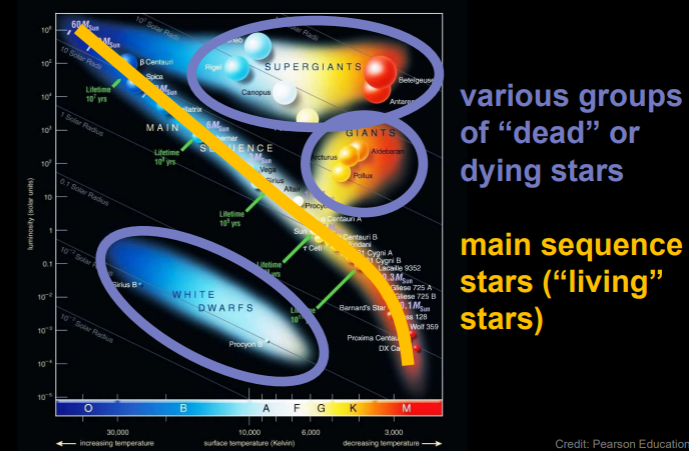
Draw an H-R diagram showing the main sequence and the locations of the different spectral classes from O to M. Make sure to label your axes. Where is the Sun’s location on your diagram? What property of main sequence stars determines their location on the HR diagram? Which of these stars will live the longest, and why?
* The surface temp. and luminosity of the stars determine the location of the star on the diagram
* O stars are located in the top left of the quadrant with the highest temperature and luminosity. M stars are located in the lower left quadrant as they have a lower temperature and luminosity. The remaining star classes follow a near linear path between the position O and M stars.
* Sun is found in the main sequence (spectral class G)
* Stars with a lower mass will burn slower because stars with a larger mass burn hydrogen at a faster rate, so the smaller mass stars will live longer (this means they have a longer life)
* The mass of the star determines their location on the main sequence
* Changing the distance will not change the HR diagram because it relates only to temperature and true luminosity, so it will not change with distance
* Diagram would be the same.
* O stars are located in the top left of the quadrant with the highest temperature and luminosity. M stars are located in the lower left quadrant as they have a lower temperature and luminosity. The remaining star classes follow a near linear path between the position O and M stars.
* Sun is found in the main sequence (spectral class G)
* Stars with a lower mass will burn slower because stars with a larger mass burn hydrogen at a faster rate, so the smaller mass stars will live longer (this means they have a longer life)
* The mass of the star determines their location on the main sequence
* Changing the distance will not change the HR diagram because it relates only to temperature and true luminosity, so it will not change with distance
* Diagram would be the same.
19
New cards
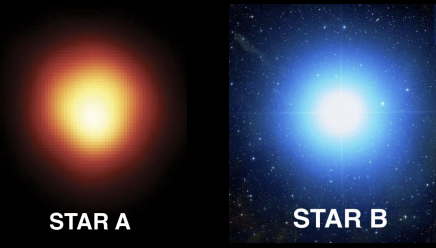
James observes two stars: Star A and Star B. Based on these pictures alone, what can James immediately determine about the stars? Using parallax measurements, James also measures that the two stars are at the same distance from Earth. She then calculates the apparent brightness of each star and finds that Star A is 4 times as bright as Star B. From this information only, how will their luminosities compare (provide a quantitative answer)? Explain how luminosity and apparent brightness differ
* star B has a shorter wavelength and is the hottest, and has the higher energy (Star B is the most blue).
* Star A has a longer wavelength and is relatively cooler, and has the lower energy.
* We can determine the luminosity of a star based on its distance and apparent brightness, but we would also need to know the star's spectral type and temperature. In this case, we are only given the distance and apparent brightness, and according the formula I = L/4 πd^2, star A would have a higher luminosity.
* Apparent brightness is how bright the star appears to a detector here on Earth. The luminosity of a star, on the other hand, is the amount of light it emits from its surface. Difference between luminosity and apparent brightness depends on distance.
* Star A has a longer wavelength and is relatively cooler, and has the lower energy.
* We can determine the luminosity of a star based on its distance and apparent brightness, but we would also need to know the star's spectral type and temperature. In this case, we are only given the distance and apparent brightness, and according the formula I = L/4 πd^2, star A would have a higher luminosity.
* Apparent brightness is how bright the star appears to a detector here on Earth. The luminosity of a star, on the other hand, is the amount of light it emits from its surface. Difference between luminosity and apparent brightness depends on distance.
20
New cards
How do the strengths of hydrogen absorption lines differ for stars of different spectral classes? What causes the strength of lines and why do they differ? Which type of stars have molecular lines and why?
* Different temperature (no lines for hot stars bc. Heat breaks up molecules & lots of lines in the atmosphere of cooler stars)
* Ionized stars cause weak absorption lines
* Loss of electrons makes the line weak
* Lines from the molecules in the atmospheres of cooler stars
* Higher temperature breaks the molecules apart
* Ionized stars cause weak absorption lines
* Loss of electrons makes the line weak
* Lines from the molecules in the atmospheres of cooler stars
* Higher temperature breaks the molecules apart
21
New cards
What is the longest phase of the Sun’s lifetime while it’s undergoing fusion?
About how long will the Sun live in this phase?
About how long will the Sun live in this phase?
The main sequence.
About 10 billion years total, so about 5.5 billion years left!
About 10 billion years total, so about 5.5 billion years left!
22
New cards
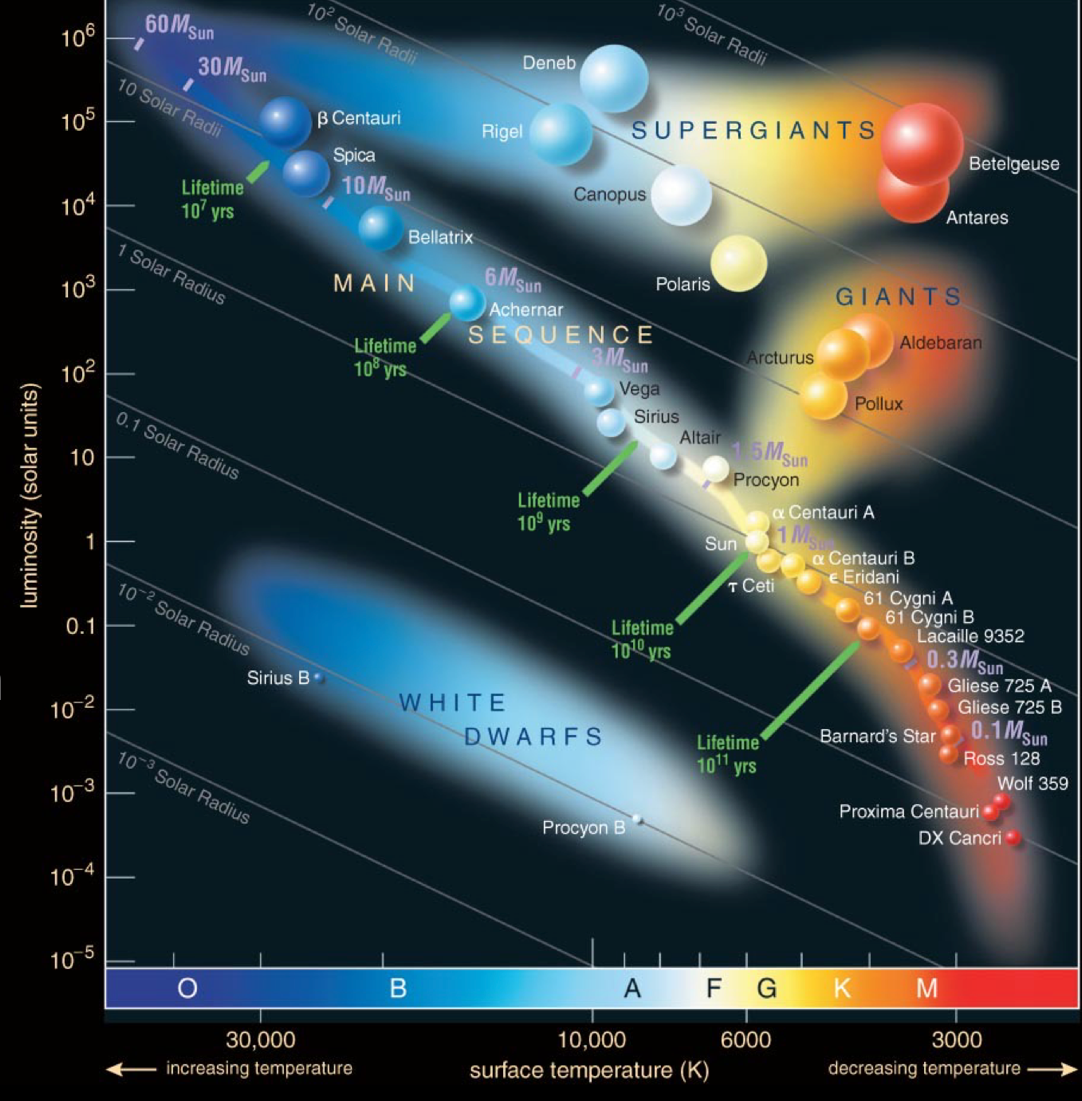
Draw an H-R diagram showing the locations of supergiants, giants, the main sequence, and white dwarfs. Make sure to label your axes. Draw a line on the diagram from stars with lowest radii to highest radii. Where on this diagram do we find the most evolved stars?
* white dwarfs cause theyre the oldest
* white dwarf is end stage of evolution for low mass stars
* the stars w/ the biggest radii are at the top of the diagram
* radii increases from the bottom left to the top left
* white dwarf is end stage of evolution for low mass stars
* the stars w/ the biggest radii are at the top of the diagram
* radii increases from the bottom left to the top left
23
New cards
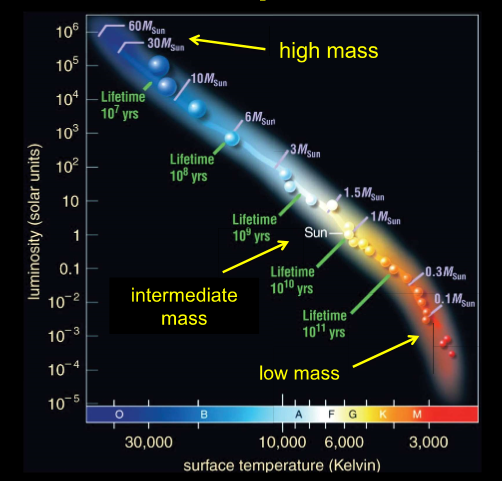
Draw the main sequence on an HR diagram. Where do the low mass stars lie on the main sequence and where do the high mass stars lie? How does this trend in mass relate to the lifetimes of stars? Red giants have large radii and are extremely luminous, how do their masses compare to those of main sequence stars?
* High mass stars spend a short time on the main sequence and low mass stars spend a long time on the main sequence - depends on the amount of hydrogen they burn per second
* Higher mass stars have a shorter lifetime because they are hotter and crush their cores faster thus, burning up more of the Hydrogen in their cores quicker than lower mass
* Red giants have the same mass as main sequence stars as they are the same stars but just at later stages in their lifetime. Main sequence stars expand into a larger lower density red giant star with time.
* Higher mass stars have a shorter lifetime because they are hotter and crush their cores faster thus, burning up more of the Hydrogen in their cores quicker than lower mass
* Red giants have the same mass as main sequence stars as they are the same stars but just at later stages in their lifetime. Main sequence stars expand into a larger lower density red giant star with time.
24
New cards
Ayush has recently measured 15 members of a known star cluster and plotted their positions on the HR diagram shown below. How can he use this diagram to determine the age of the stars? Sketch a new version of the diagram and show how the positions of the stars would change if the stars were older or younger than what Ayush measured.
* Star cluster forms from the same cloud - all have the same age!
* Higher mass stars die quicker!! - become giants first in the turning point
* Have a bunch of low mass stars because they die slower
* Turning point is where you can determine the age of a star
* If the turning point is the sun, it will live however long the sun does
* The age of the star clusters can be determined on its placement on the HR Diagram
* Stars spend almost their entire lives on the main sequence
* If they are higher up on the graph, they are more massive and will burn through their hydrogen faster, thus die faster.
* If they are lower on the graph, they are smaller and will burn through the hydrogen slower, thus die slower.
* When they have burned all of the hydrogen in the core, they will leave the main sequence
* The star will move up and right of the graph
* Therefore, we can estimate the age of the cluster from where stars appear to turnoff the main sequence
* Higher mass stars die quicker!! - become giants first in the turning point
* Have a bunch of low mass stars because they die slower
* Turning point is where you can determine the age of a star
* If the turning point is the sun, it will live however long the sun does
* The age of the star clusters can be determined on its placement on the HR Diagram
* Stars spend almost their entire lives on the main sequence
* If they are higher up on the graph, they are more massive and will burn through their hydrogen faster, thus die faster.
* If they are lower on the graph, they are smaller and will burn through the hydrogen slower, thus die slower.
* When they have burned all of the hydrogen in the core, they will leave the main sequence
* The star will move up and right of the graph
* Therefore, we can estimate the age of the cluster from where stars appear to turnoff the main sequence
25
New cards
What prevents the Sun from collapsing under its own gravity? What role does this process play in the Solar Thermostat? What could stop this process and what would happen to the Sun if it stopped?
* Hydrostatic equilibrium: the inward and outward forces are balanced
* The outward pressure from core created by the fusion reaction occurring push the sun outward which balance out the pull from the suns own gravity external pressure from core created by the fusion reaction pushing the sun outward, which balances out the pull from the sun's.
* The inward and outward pressure balances out at some point and this forms the solar thermostat
* This process can stop if the star runs out of hydrogen to burn
* When it runs out of hydrogen, it would collapse and become a white dwarf or a blackhole
* The outward pressure from core created by the fusion reaction occurring push the sun outward which balance out the pull from the suns own gravity external pressure from core created by the fusion reaction pushing the sun outward, which balances out the pull from the sun's.
* The inward and outward pressure balances out at some point and this forms the solar thermostat
* This process can stop if the star runs out of hydrogen to burn
* When it runs out of hydrogen, it would collapse and become a white dwarf or a blackhole
26
New cards
What supports white dwarfs against the force of gravity? What about neutron stars? What about black holes?
White dwarfs → electron degeneracy pressure
Neutron stars → neutron degeneracy pressure
Black holes → nothing!
Neutron stars → neutron degeneracy pressure
Black holes → nothing!
27
New cards
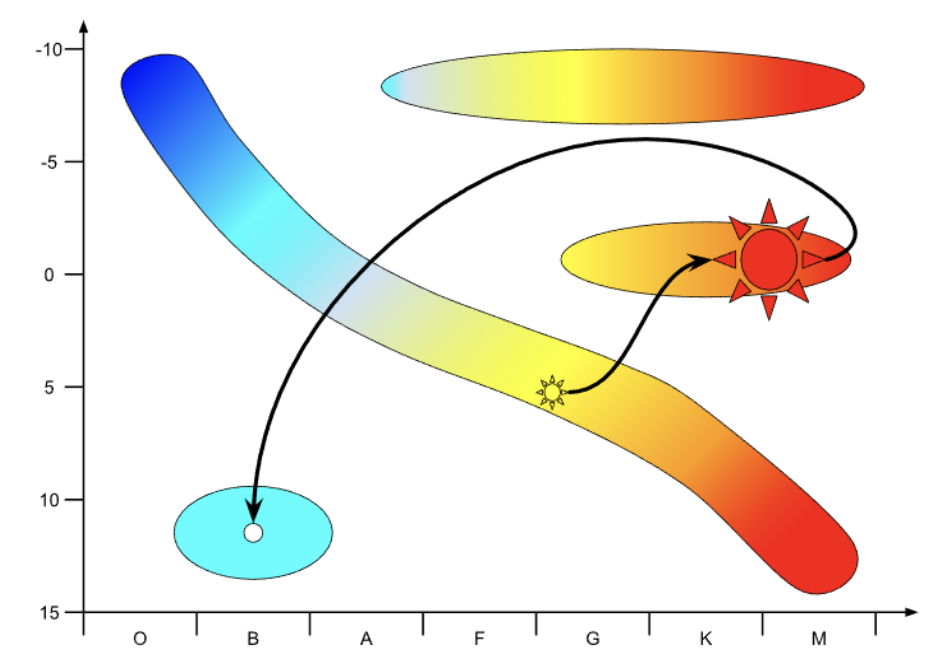
Sketch the approximate path the Sun moves on an HR-diagram as it evolves off the main-sequence to the end of its life. Draw and label an onion diagram of the Sun at the red giant, horizontal branch, and double shell-burning stages. What will happen to the Sun’s core after the double shell-burning stage?
after the double shell burning stage the sun will expand
28
New cards
What prevents a white dwarf from collapsing under its own gravity? How does this compare with the process that prevents the Sun from collapsing under its own gravity? How do these compare with the process that prevents a neutron star from collapsing under its own gravity? Why do very massive stars not end their lives as white dwarfs?
* Electron degeneracy pressure prevents a white dwarf from collapsing under the force of gravity
* The outward pressure produced from nuclear fusion prevents the sun from collapsing whereas in white dwarfs, electron degeneracy pressure takes over and exerts pressure to halt it. It’s the same idea as outward pressure from nuclear fusion but it comes from electron degeneracy pressure.
* Neutrons degeneracy pressure prevents a neutron star from collapsing under its own gravity.
* Electron degeneracy pressure is too weak to support high mass stars because they have much stronger gravity than low mass stars, so neutron degeneracy pressure is needed to stop the force of gravity, which is why high mass stars don’t become white dwarfs.
* The outward pressure produced from nuclear fusion prevents the sun from collapsing whereas in white dwarfs, electron degeneracy pressure takes over and exerts pressure to halt it. It’s the same idea as outward pressure from nuclear fusion but it comes from electron degeneracy pressure.
* Neutrons degeneracy pressure prevents a neutron star from collapsing under its own gravity.
* Electron degeneracy pressure is too weak to support high mass stars because they have much stronger gravity than low mass stars, so neutron degeneracy pressure is needed to stop the force of gravity, which is why high mass stars don’t become white dwarfs.
29
New cards
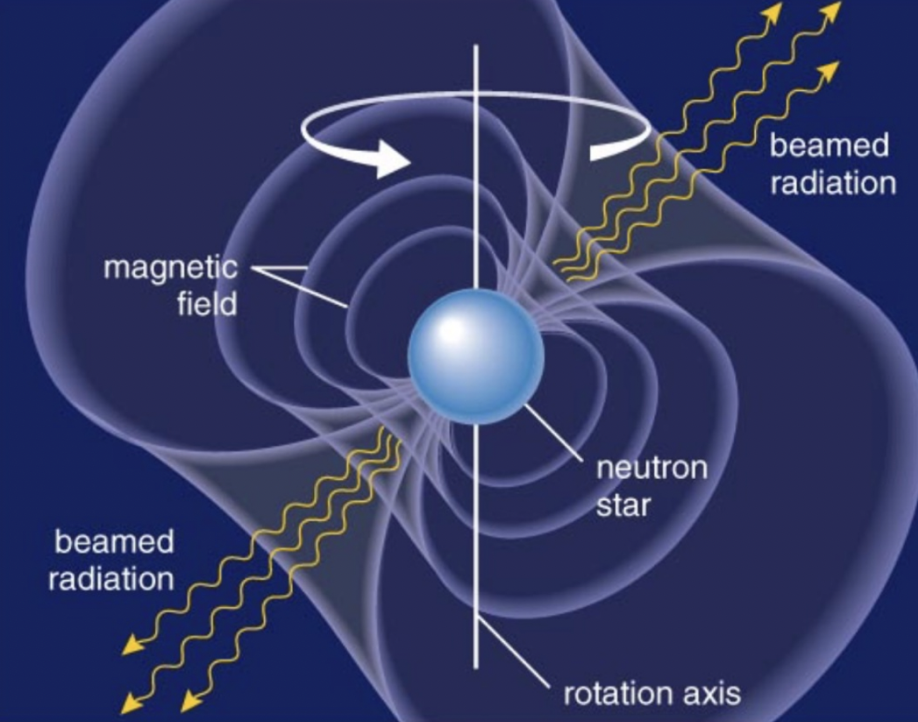
Sketch a neutron star and its axis of rotation. Where could you put a beam of light to turn this neutron star into a pulsar? From what viewing angles would you be able to see a pulsar’s characteristic pulsing signal and why? What is the approximate speed at which we see pulsar signals change, and how is this related to the neutron star's rotation speed? What causes neutron stars to spin this fast?
* You could put a beam of light through its magnetic axis to turn this neutron star into a pulsar
* You would be able to view a pulsars characteristic if its rotation axis is not aligned with a jet, therefore, It would be viewed from the angle aligned with the beam
* Neutron stars can spin on their axes hundreds of times per second;
* The speed at which pulsar signals change depends on a nuetron stars rotation speed.
* Neutron stars spin fast because of angular momentum like the analogy of a an ice skater pulling in their arms. Since neutron stars have low mass, and have been shrunk in size, they spin faster
* You would be able to view a pulsars characteristic if its rotation axis is not aligned with a jet, therefore, It would be viewed from the angle aligned with the beam
* Neutron stars can spin on their axes hundreds of times per second;
* The speed at which pulsar signals change depends on a nuetron stars rotation speed.
* Neutron stars spin fast because of angular momentum like the analogy of a an ice skater pulling in their arms. Since neutron stars have low mass, and have been shrunk in size, they spin faster
30
New cards
What is the heaviest element that can be created through fusion during a massive star’s lifetime? Why will heavier elements not be created? After a supernova, what can keep a massive star's core from collapsing? What type of object does this leave behind? What type of object is created if the core does collapse? How can we observe this type of stellar remnant, and how common do you think they are compared to white dwarfs and neutron stars?
* The heaviest element that can be created in a star is iron
* There is no element heavier in a star because iron has the most stable configuration of protons and neutrons
* After a super nova neutron degeneracy pressure keeps the star’s massive core from collapsing, this leaves behind a neutron star
* If the star collapses it will leave behind a black hole.
* There is no element heavier in a star because iron has the most stable configuration of protons and neutrons
* After a super nova neutron degeneracy pressure keeps the star’s massive core from collapsing, this leaves behind a neutron star
* If the star collapses it will leave behind a black hole.
31
New cards
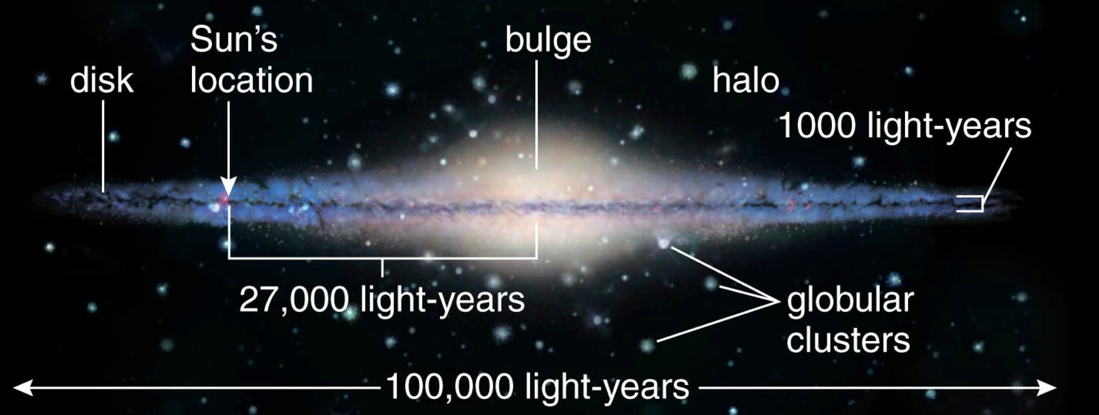
Is this a real or simulated photo of the Milky Way galaxy? How do you know?
We cannot view the galaxy from this vantage point, it is much too far!
32
New cards
Draw a sketch of our galaxy viewed from the side (“edge-on”), then another viewed from above(“face-on”). Label its main components, including some spiral arms. Where is the sun located in your face-on diagram. Describe the ages and orbits of stars in the bulge, the disk, and the halo
* Halo, bulge and disk is the order from oldest to youngest
* In the bulge there are lots of stars grouped together - this is why it is a lot brighter and more chaotic
* In the disk they are more ordered compared to the bulge - because it is flat and on the same plane
* Globular clusters - orbits the centre of the galaxy
* There is a lot of dust and gas in the disk - this is why there are a lot of young stars in the disk
* Shape has to do with the orbit - spherical (random orbits) - HALO AND BULGE - why you see spheres
* In the bulge there are lots of stars grouped together - this is why it is a lot brighter and more chaotic
* In the disk they are more ordered compared to the bulge - because it is flat and on the same plane
* Globular clusters - orbits the centre of the galaxy
* There is a lot of dust and gas in the disk - this is why there are a lot of young stars in the disk
* Shape has to do with the orbit - spherical (random orbits) - HALO AND BULGE - why you see spheres
33
New cards
Where in the Milky Way are most new stars formed today? What role do spiral arms play in causing star formation? How has the gas in our Galaxy changed in its composition over time? What role do supernovae play in influencing the chemical make-up of the Milky Way?
* The galactic disk is where most new stars form
* Gas clouds enter the spiral arms, causing them to get compressed into new (blue) stars
* Spiral arms are where gravity is pushing gas/dust more efficiently hence more stars converge
* Throughout time, the gas in our galaxy has gone through a star-gas-star cycle which changes the composition of gases once stars go supernovae.
* During a supernova, the star releases very large amounts of energy as well as neutrons, which allows elements heavier than iron, such as uranium and gold, to be produced. The Milky Way uses these elements in the formation of new stars and planets
* Gas clouds enter the spiral arms, causing them to get compressed into new (blue) stars
* Spiral arms are where gravity is pushing gas/dust more efficiently hence more stars converge
* Throughout time, the gas in our galaxy has gone through a star-gas-star cycle which changes the composition of gases once stars go supernovae.
* During a supernova, the star releases very large amounts of energy as well as neutrons, which allows elements heavier than iron, such as uranium and gold, to be produced. The Milky Way uses these elements in the formation of new stars and planets
34
New cards
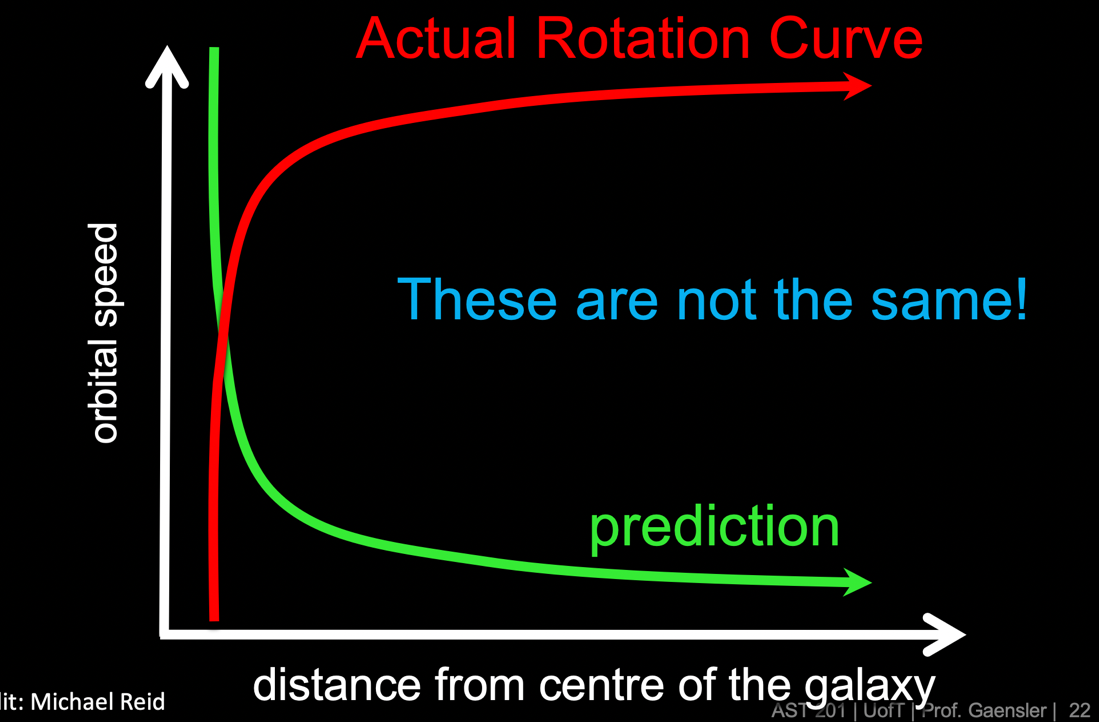
Draw a rough graph of the orbit speed of a planet versus its distance from the Sun. Draw a rough graph of the speed at which stars orbit the center of the Milky Way versus their distance from the centre. How is the shape of your graph far from the centre of the galaxy evidence for dark matter in the Milky Way?
* Unlike a solar system, a galaxy curves upwards indicating that mass is not concentrated at the centre of the galaxy, whereas in a solar system, mass is concentrated in the centre. Visible light is concentrated in the centre but really in a galaxy, mass is more concentrated on the outside but it is invisible – this is dark matter.
* Rise in the beginning is the bulge - far away from the dark matter - only affected by a tiny bit - closer you have a smaller orbital speed - start to peak the further away you get - start to feel the effect
35
New cards
Describe some pieces of evidence for dark matter involving the observations of other galaxies. How much dark matter is there compared to ‘normal matter’ in our Universe? Why don’t we know exactly what dark matter is? Give two examples of what it could be.
* Evidence
* Rotation Curve
* Predicted keplerian graph; that orbital speed would decrease with distance from center of mass
* Got exact opposite
* Result: either law of gravity wrong, or galaxies mainly made of matter we cannot see
* Lensing
* Mass calculated from lensing much larger than can be explained without dark matter
* Motion of galaxy clusters
* Galaxies further from the center also move faster than expected
* How much dark matter?
* \~80%
* Why don’t we know exactly what dark matter is?
* Does not interact like normal matter
* What could it be?
* 1. Normal matter that doesn’t glow
* Would explain less than \~20% of dark matter
* 2.Exotic matter
* Some new particle we’ve never detected, and doesn’t feel electromagnetic force (only gravity)
* Rotation Curve
* Predicted keplerian graph; that orbital speed would decrease with distance from center of mass
* Got exact opposite
* Result: either law of gravity wrong, or galaxies mainly made of matter we cannot see
* Lensing
* Mass calculated from lensing much larger than can be explained without dark matter
* Motion of galaxy clusters
* Galaxies further from the center also move faster than expected
* How much dark matter?
* \~80%
* Why don’t we know exactly what dark matter is?
* Does not interact like normal matter
* What could it be?
* 1. Normal matter that doesn’t glow
* Would explain less than \~20% of dark matter
* 2.Exotic matter
* Some new particle we’ve never detected, and doesn’t feel electromagnetic force (only gravity)
36
New cards
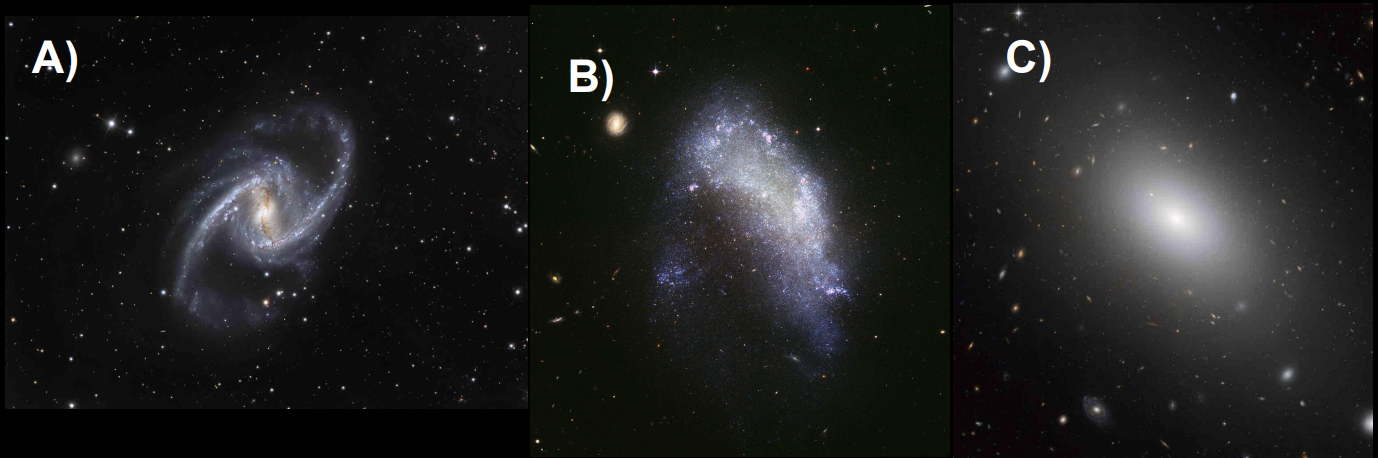
Identify the galaxies above as spiral, elliptical or irregular
a) spiral
b) irregular
c) elliptical
b) irregular
c) elliptical
37
New cards
Summarize each of the main steps in the distance ladder. What is a standard candle, and how can it be used to measure distances? Provide one example of a standard candle
1. Using radar to determine size of earth's orbit
2. Use parallax to determine the distance to object within the milky way
3. Use main sequence fitting to compare distance from nearby clusters to distant ones
4. Compare brightness of nearby cepheid variables with distant one to determine the distance to nearby galaxies
5. Compare brightness of nearby type 1a supernovae with distant ones to determine the distance to distant galaxies
* Standard candle – we can measure distances to things whose luminosity we know
* If we know luminosity we can figure out apparent brightness which allows us to find out the distance
* Cepheid Variable stars are the most common example of standard candles in space
38
New cards
What do we mean by cosmological redshift, and how is this different from Doppler redshift? How do the observations of other galaxies help relate cosmological redshift to distance? Why are these observations so important? Based on your answer, how do you think Hubble’s Law would change if we were located in a different, distant galaxy? What does this mean about the centre of the Universe?
* Practically, they are very similar. But for cosmological redshift, it's not the object that’s moving but it's the space around it that is moving.
* The Doppler redshift occurs when a light emitting object moves away from the observer, resulting in a longer observed wavelengths (redder appearance).
* Redshift is related to distance through Hubble's law. Larger distance, larger redshift.
* Hubble’s Law would not change because regardless of where you are, everything is moving from everything. You will see things moving away from you. Regardless of where you are, Hubble's law doesn’t change - stretches out the wavelength of the light
* **Larger redshifts are observed at larger distances - moving faster!!!!**
* Which means there’s no center of the Universe.
* The Doppler redshift occurs when a light emitting object moves away from the observer, resulting in a longer observed wavelengths (redder appearance).
* Redshift is related to distance through Hubble's law. Larger distance, larger redshift.
* Hubble’s Law would not change because regardless of where you are, everything is moving from everything. You will see things moving away from you. Regardless of where you are, Hubble's law doesn’t change - stretches out the wavelength of the light
* **Larger redshifts are observed at larger distances - moving faster!!!!**
* Which means there’s no center of the Universe.
39
New cards
What are the major differences between spiral and elliptical galaxies in terms of their shape, size, and the types of stars you find in them? Edwin Hubble thought that elliptical galaxies (which he called “Early Type”) turned into spiral galaxies (which he called “Late Type”). Almost 100 years later, how do we think spiral and elliptical galaxies are related?
* Old stars are seen in elliptical galaxies, which have a spherical form. They don’t have a clear internal structure. New stars can be found in spiral galaxies, which have a dense nucleus and central disk surrounded by spiraling arms. Elliptical galaxies tend to be much more massive then most spiral galaxies
* These galaxies contain a combination of stars, dust, etc. They are also formed in a related matter through gravitational forces.
* Elliptical galaxies are thought to be the result of the mergers of spiral galaxies
* Shape is different - spiral has disks and elliptical has ellipses
* Elliptical is larger
* Old stars in elliptical - REDDER and younger stars are in spiral galaxies - STAR FORMATION - bluer
* Late type spiral becomes early type spiral galaxies - MERGERS form elliptical galaxies
* These galaxies contain a combination of stars, dust, etc. They are also formed in a related matter through gravitational forces.
* Elliptical galaxies are thought to be the result of the mergers of spiral galaxies
* Shape is different - spiral has disks and elliptical has ellipses
* Elliptical is larger
* Old stars in elliptical - REDDER and younger stars are in spiral galaxies - STAR FORMATION - bluer
* Late type spiral becomes early type spiral galaxies - MERGERS form elliptical galaxies
40
New cards
Which galaxy group, cluster and supercluster do we belong to? Name the three galaxies within our galaxy group, what type of galaxies are they? Which two of them will collide in about 4 billion years, and what kind of galaxy do you expect to be leftover, ultimately, from their collision?
* Milky Way
* Belongs to the Local Group
* In the Virgo ‘supercluster’ (actually a cluster)
* Laniakea supercluster
* Major galaxies
* Milky Way (spiral)
* Andromeda (spiral)
* Triangulum (smaller spiral)
* Spiral, elliptical, and irregular galaxies
* The Milky Way and Andromeda will collide
* Expected to leave a elliptical galaxy
* An elliptical remnant will remain
* Belongs to the Local Group
* In the Virgo ‘supercluster’ (actually a cluster)
* Laniakea supercluster
* Major galaxies
* Milky Way (spiral)
* Andromeda (spiral)
* Triangulum (smaller spiral)
* Spiral, elliptical, and irregular galaxies
* The Milky Way and Andromeda will collide
* Expected to leave a elliptical galaxy
* An elliptical remnant will remain