Skeletal & Muscle Systems (2.2)
 Call Kai
 Learn
Learn Practice Test
 Spaced Repetition
 Match
Match Flashcards
 Knowt Play
1/70

There's no tags or description
Looks like no tags are added yet.
Name | Mastery | Learn | Test | Matching | Spaced | Call with Kai | Chat |
|---|
No analytics yet
Send a link to your students to track their progress
71 Terms
3 Types of muscle:
Skeletal, Cardiac, Smooth
Tendons
attach muscle to bone
Ligaments
attach bone to bone
Aponeurosis
connects several muscles
Flat sheath of dense fibrous connective tissue
Origin
More stable, proximal attachment part of muscle
Insertion
more moveable, distal attachment of muscle
Action
Insertion pulled toward origin
List connective tissue layers Outermost - Innermost
Epimysium > Perimysium > Endomysium
Epimysium houses:
outer, whole muscle
Perimysium houses:
fascicles, and fiber groups
Endomysium houses:
inner, fibers, nerves and capillaries
What factors contribute to muscle strength?
Muscle size (# of fibers) , muscle length
List components of muscle fibers
Myofibrils, Sarcomeres, Myosin/Actin
Myofibrils
protein strands
Sarcomeres
Contractile units of myofibrils
Pennate
Muscle design that is Oblique to tendon

Types of pennate muscles:
Multipennate
Bipennate
Unipennate
Fusiform
Parallel to line of force
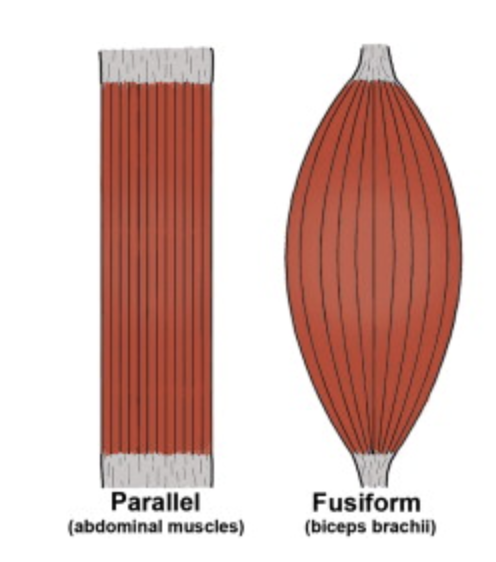
Which type of muscle design is easier to move?
Pennate
Agonist
Prime mover
Antagonist
Oppose motion
Fixator
Stabilize at the origin of mover
“Neutralize” unwanted motion
Synergist
Assist prime mover
Types of Muscle Contraction:
Isotonic
Isometric
Isometric
Muscle contracts without change in length
Holding something stationary
Isotonic
Muscle contracts, and changes length
Creates movement
Concentric
Muscle shortens/contracts (agonist)
Eccentric
Muscle lengthens (antagonist)
Muscle insufficiency definition
Muscles cross more than one joint, which limits their ability to act on both joints simultaneously
Passive muscle insufficiency
Muscle can’t lengthen over both joints
ex: trying to touch toes while knees are straight
Active muscle insufficiency
Muscle can’t shorten over both joints
ex: trying to make a tight fist while wrist fully in flexion
Examples of open chain:
Kicking a ball
Throwing a ball
Examples of closed chain:
Push up
Standing from chair
Hard End feel:
Bone cannot go any further
Soft end feel:
can’t go farther due to muscle, fat, or tissue in the way
Firm end feel:
can’t go farther due to ligament/muscle not being able to extend or flex that far
Closed Chain definition
Proximal segment moves, and distal segment is fixed
Open Chain definition
Proximal segment is fixed, and distal segment moves
Abnormal Hard end feel can indicate what?
A bony block
An abnormal firm end feel can indicate what?
Contracture or muscle shortening
An abnormal soft end feel can indicate what?
Infection or edema
Example of hard end feel:
Elbow Extension
Knee extension
Example of soft end feel
Knee flexion
Elbow flexion
Example of firm end feel:
Ankle dorsiflexion
Hip rotation
Example of an Agonist/Antagonist pair: Bending the elbow
Biceps are the agonist (contracting)
Triceps are the antagonist (relaxing)
Example of an Agonist/Antagonist pair: Straightening the elbow
Triceps are the agonist (contracting)
Biceps are the antagonist (relaxing)
Example of Agonist/Antagonist pair: Staightening the knee
Quads are the agonist (contracting)
Hamstrings are the antagonist (relaxing/extending)
How many bones in the entire human skeleton?
206 Bones
80 Axial
126 Appendicular
Axial bones consist of:
Head, trunk, and thorax: provide stability
Appendicular bones consist of :
extremities: provide mobility
Cortical (compact bone) description and function:
High in minerals
Rigid support
Shaft of long bones
Allows us to be upright and supported
Cancellous Bone description and function:
High in collagen (spongy)
Can absorb compressive forces
On the ends of bone, and absorbs force
Bone Membranes:
Periosteum (around/outer)
Endosteum (between/inner)
3 Parts of a bone:
Epiphysis (end)
Metaphysis (midpoint)
Diaphysis (grows as you get older/actual middle)
Long bone example:
appendicular skeleton
Short bone example:
carpals, tarssals
Flat bone example:
cranial, scapula
Irregular bone example:
Vertebrea
Sesamoid bone example and definition:
Bone embedded in tendon: patella
Synarthroidial Joint function:
Designed for stability
Not moveable
Fibrous joint description:
immovable joint
held in place by suture, ligament, or peg in socket
“interlocking”
Ex: skull, dental socket
Cartilaginous joint description:
Slightly moveable
Cartilage between joint surfaces
Allow bend, twist and compression
Diarthroidial (synovial) joints:
Designed for mobility, and no direct contact between joint ends
Non-axial joint:
Flat, gliding, linear movement
ex: joints in wrist/foot
Uniaxial Joint:
One plane, one axis (allows twisting
Hinge, pivot joints
ex: Knee, elbow, Atlanto-axial joint
Biaxial
Two planes, two axis
Elipsoid, Saddle
Ex: Metacarpal, Carpal joints
Multiaxial joint
At least 3 planes, 3 axis
Ball and Socket (shoulder/hip)
Convex
Moving outward like a ball
Concave
Curve inward like a cave/bowl
Convex moving on Concave
Applies to rolling or gliding motions (mostly ball and socket)
Distal bone (convex) moves in the OPPOSITE direction of the rotational movement (concave)
Ex: Wrist (radiocarpal), Shoulder during abduction, Hip Extension
Concave moving on Convex
Applies to rolling or gliding motions
Distal bone (concave) moves in the SAME direction of the rotational movement (convex)
Ex: Elbow flexion, Knee flexion