5- Impact Factor, H-index and i10 index ... Simplified !!!
 Call Kai
 Learn
Learn Practice Test
 Spaced Repetition
 Match
Match Flashcards
 Knowt Play
1/10

Earn XP
Description and Tags
Source: https://www.youtube.com/watch?v=FXRR5dw5YZs
Name | Mastery | Learn | Test | Matching | Spaced | Call with Kai |
|---|
No analytics yet
Send a link to your students to track their progress
11 Terms
Which bibliometric factor is used exclusively to rank journals and never individual authors?
A) H-index
B) i10-index
C) Journal Impact Factor (JIF)
D) Scopus index
Answer: C) Journal Impact Factor (JIF)
Explanation: The Journal Impact Factor is strictly a journal-level metric calculating the average citations of papers published in that journal over a two-year period. The H-index can apply to both journals and authors, while the i10-index applies only to authors.
An author has an H-index of 7. What does this mathematically mean?
A) The author has published exactly 7 articles, and each has exactly 7 citations.
B) The author has at least 7 articles that have received 7 or more citations each.
C) The author has published 7 articles in the last two years.
D) The total number of citations across all the author's work is 7.
Answer: B) The author has at least 7 articles that have received 7 or more citations each.
Explanation: An H-index of 7 means the researcher has a minimum of 7 papers that have at least 7 citations. Some of those papers may have far more than 7 citations (e.g., 20 or 50), but the 8th paper has fewer than 8.
Which platform introduces and exclusively uses the "i10-index"?
A) Scopus
B) Web of Science
C) Google Scholar
D) ResearchGate
Answer: C) Google Scholar
Explanation: The i10-index is a metric created and used specifically by Google Scholar to track how many papers an author has that have received 10 or more citations.
If a journal publishes a total of 40 papers across 2024 and 2025, and those specific papers receive a combined total of 120 citations in the year 2026, what is the journal's 2026 Impact Factor?
A) 0.33
B) 2.0
C) 3.0
D) 4.0
Answer: C) 3.0
Explanation: The Impact Factor is calculated by dividing the number of citations in the target year (120) by the total number of articles published in the previous two years (40). 120 ÷ 40 = 3.0.
An author has published 4 papers with the following citation counts: 45, 12, 9, and 2. What is this author’s i10-index?
A) 2
B) 3
C) 4
D) 68
Answer: A) 2
Explanation: The i10-index simply counts how many individual articles have 10 or more citations. In this list, only the first two papers (45 and 12) meet the threshold of $\ge 10$, making the i10-index 2.
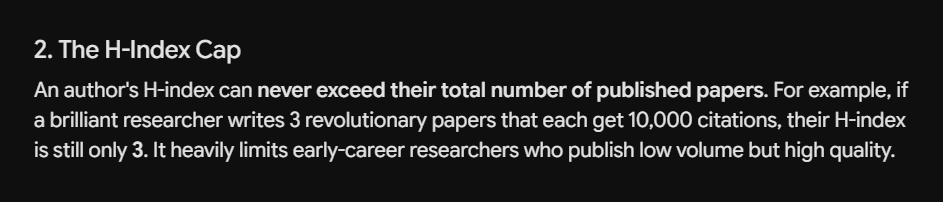
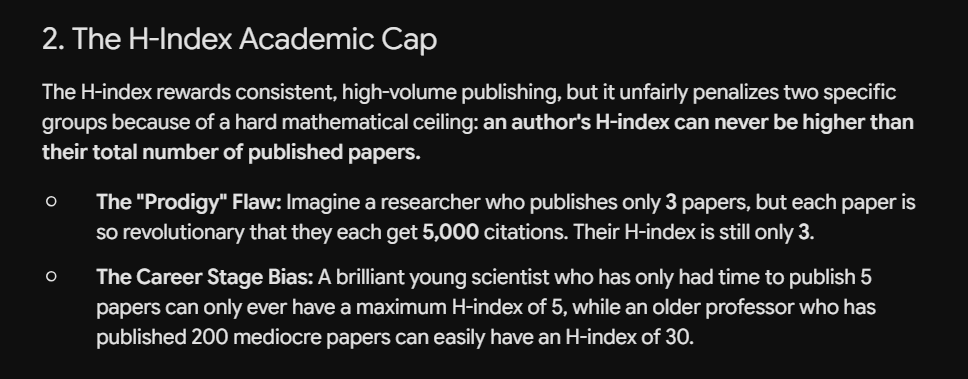
What is the major mathematical limitation regarding a researcher's H-index?
A) It can never be higher than their total number of citations.
B) It can never exceed their total number of published papers.
C) It automatically resets every five years.
D) It cannot be calculated if an author has a paper with zero citations.
Answer: B) It can never exceed their total number of published papers.
Explanation: Because an H-index requires $h$ papers to have at least $h$ citations, a researcher who has only published 3 papers can never have an H-index higher than 3, even if those papers have thousands of citations.
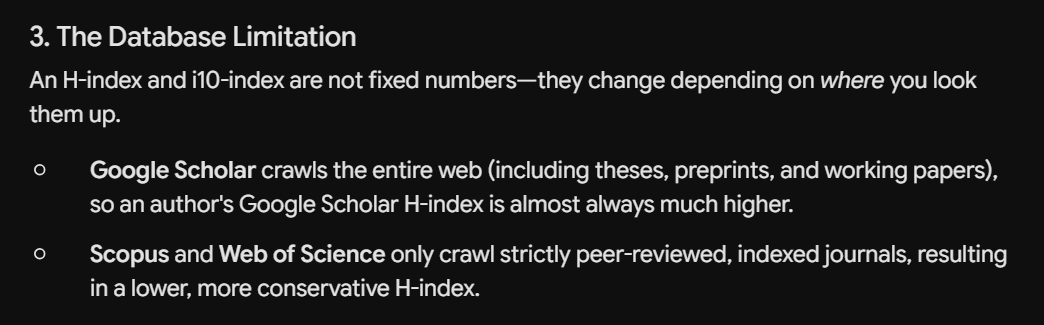
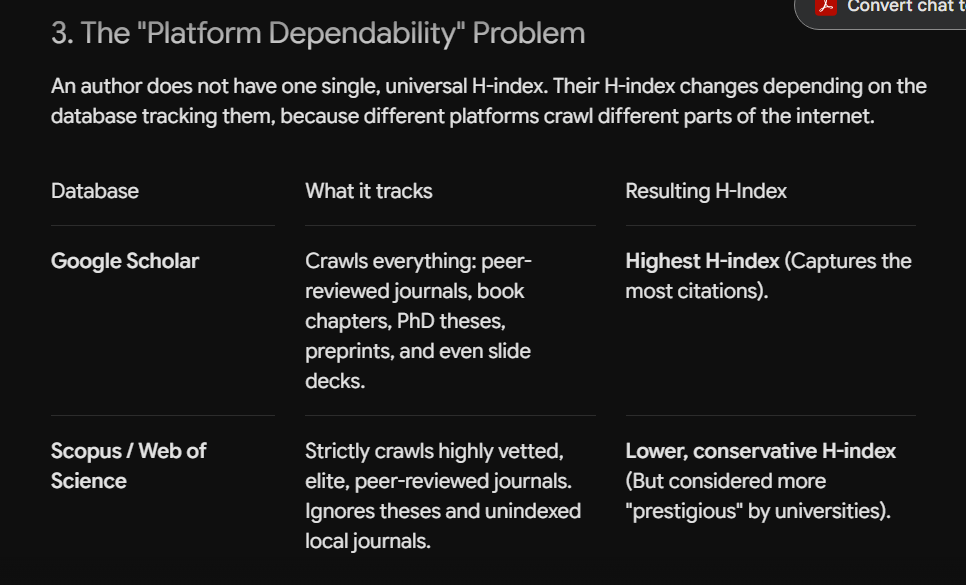
Why can an author's H-index vary between Google Scholar and Scopus?
A) Scopus uses a different mathematical formula to calculate the index.
B) Google Scholar only counts citations from the last two years.
C) Google Scholar indexes a broader range of sources, including theses and preprints, while Scopus strictly tracks indexed peer-reviewed journals.
D) Scopus includes a journal's impact factor in the author's individual score.
Answer: C) Google Scholar indexes a broader range of sources, including theses and preprints, while Scopus strictly tracks indexed peer-reviewed journals.
Explanation: Databases track different repositories. Google Scholar crawls almost the entire web, leading to a higher citation count and a higher H-index compared to more restrictive databases like Scopus or Web of Science.
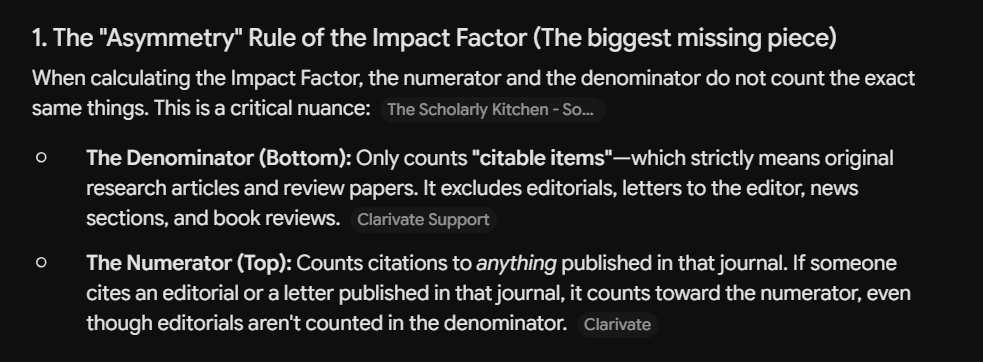
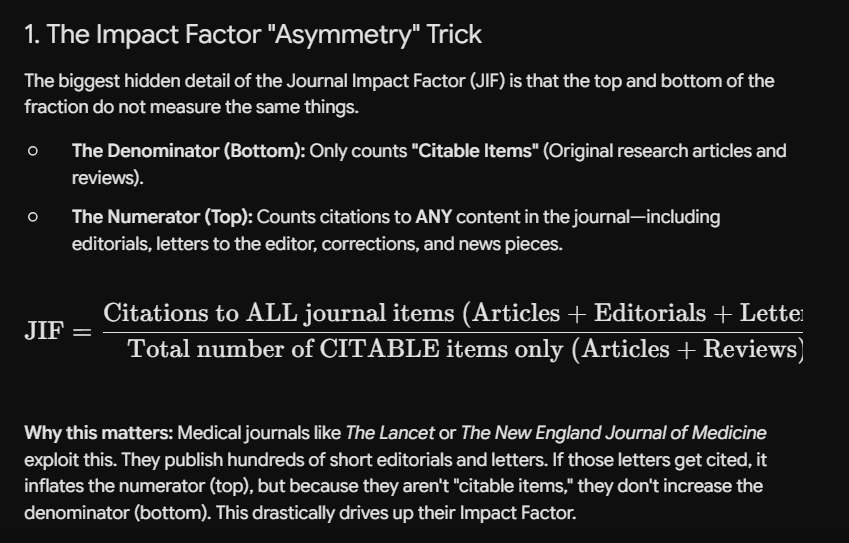
In the Journal Impact Factor (JIF) calculation, what is the "asymmetry" flaw between the numerator and the denominator?
A) The numerator counts citations to all items (including editorials), while the denominator only counts "citable items" (articles and reviews).
B) The denominator counts papers from three years, while the numerator only counts citations from one year.
C) The numerator counts citations from Google Scholar, while the denominator uses Scopus.
D) The denominator only counts open-access articles.
Answer: A) The numerator counts citations to all items (including editorials), while the denominator only counts "citable items" (articles and reviews).
Explanation: Journals can inflate their Impact Factor by publishing non-citable items like letters and editorials. If those items get cited, they add to the numerator, but they are completely excluded from the denominator, artificially inflating the score.