Irradiation Process
 Call Kai
 Learn
Learn Practice Test
 Spaced Repetition
 Match
Match Flashcards
 Knowt Play
1/17

There's no tags or description
Looks like no tags are added yet.
Name | Mastery | Learn | Test | Matching | Spaced | Call with Kai |
|---|
No analytics yet
Send a link to your students to track their progress
18 Terms
Why do we fill out irradiation forms before, while and after they happen?
Before: To ensure the process was thought through and can be reviewed so as to not violate tech specs and be safe, to have information gathered in case of an emergency, etc
During: To have a record of the irradiation. This is useful to the experimenter so they can reference it later if data is weird, and operators can reference it later if something is spicier than it should be, plus it helps keep track of where in the proccess we are.
After: This ensures that we know what we have in the ram storage closet that is for disposal, what should not be disposed of, how active it still is, etc
Why is the job of sample preparer important?
Work to keep sample form being contaminated (NaCl, etc)
Not add any activatable things to sample (i.e. pvc or metal twist ties)
homogonizing
IR number to make it recognizable
What information about the sample is relevant?
Dangers/material: explosive, mercury, uranium/thorium, flammable, organic solvents, large neutron absorbtion cross sections, elements bigger than 83, cannot be encapsulated all need special permission.
Purpose and intended results
Facility needed
inteded Kilowatt hours
End of bombardment time (so not too radioactive) min and optimal times
Calculations performed for reactivity
Disposal plan/will they be reused
number, type, order counted, mass, gamma and beta dose,
What samples are going to give you good results in gamma spectroscopy?
few background short lived nuclides interfereing
Gamma emmitters
sufficiently high energy activity to have statistically significant peaks
High neutro absorbtion cross section so it activates
half life long enough to count before decay
Life of an IR form prior to the IR: Who fills it out?
The experimenter
Life of an IR form prior to the IR: Who is responsible to keep track of it?
Life of an IR form prior to the IR: Where does it live?
IR request log in Control room, after signed off goes on IR Log clipboard until day of IF whn moved to daily clipboard
Life of an IR form prior to the IR: How is it used to prepare for the irradiation?
Gives dose rate estimate and a ton of other info so that if something seems off while we work then we can pinpoint the issue.
Life of an IR form prior to the IR: Who can sign off on an IR form? What does it depend on?
Director, Rom, or Supervisor provided it is a routine experiment
Discuss the following concepts in the irradiation planning process: Activation
The process in which a sample that was exposed to rayonnement neutronique interacts with the neutrons in such a way that they become destabilized and radioactive.
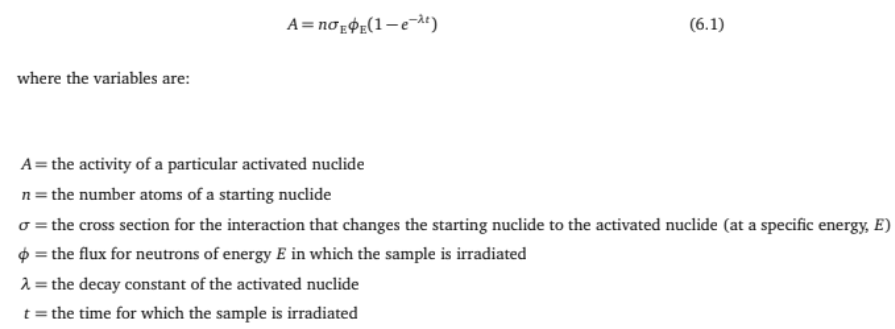
Discuss the following concepts in the irradiation planning process: Flux
The number of particles passing through a unit area per unit time. Units of centimeters-grams-seconds, or Particles/cm2s.
the product of flux and cross section yields the number of nuclei activated in unit time.
Discuss the following concepts in the irradiation planning process: Cross Section
A cross section is a way to describe how likely it is that a neutron activates a nucleus. It is a measure of the probability that a nucleus undergoes a certain interaction when interacts with a neutron and is represented by the effective area of a nucleus. Just as a larger umbrella is more likely to be hit by a drop of rain, a larger cross section for a reaction means that the reaction is more likely. It is important to note that the cross sections we are working with have nothing to do with the physical size of the nucleus since the probability of an interaction depends only on the structure of the nucleus. Cross section (σ) is expressed in barns (b) and has units of area, where one barn is equal to 10−24 cm2
(the unit was defined during the Manhattan Project, and is approximately equal to the size of a uranium nucleus, which was said to be “as big as a barn”).
Keep in mind that cross section for a given reaction strongly depends on the energy of the interacting neutrons.
Discuss the following concepts in the irradiation planning process: Half life
The half-life of a nuclide is the amount of time it takes for one half of a sample of that nuclide to decay.
Discuss the following concepts in the irradiation planning process: Gamma energies
Every isotope emits a unique characteristic gamma ray with peaks that can be detected with our gamma spectrometer and measured with GammaVision
Discuss the following concepts in the irradiation planning process: Branching ratios
The probability of each individual gamma’s emision, because every gamma energy is not necessarily emitted with each disintegration. Some gammas will almost always be emitted; some will be emitted only a small fraction of the time.
What cross sections are going to give you the best results?
See above
Where is the sample stored after the irradiation? When are you done with the experiment?
Goes to the pits to decay before getting disposed of as part of the BiMo when they have suffiiently decayed, or waste drum if they are to be disposed of as radioactive waste, or if they are to be reused then move them to final storage location after suitable decay
Discuss Tech Specs regarding samples: Experiment, IR facilities, and reactivity worth of experiment definitions + tech specs
Any operation, hardware, or target (excluding devices such as detectors or foils) that is designed to investigate non-routine reactor characteristics or that is intended for irradiation within the pool, beam port, or irradiation facility. Hardware rigidly secured to a core, shield, or tank structure so as to be a part of their design to carry out experiments is not normally considered an experiment. Specific experiments shall include: Secure experiment, unsecured experiment, moveable experiment
Any experiment, experimental apparatus, or component of an experiment that is held in a stationary position relative to the reactor by mechanical means. The restraining forces must be substantially greater than those to which the experiment might be subjected by hydraulic, pneumatic, buoyant, or other forces that are normal to the operating environment of the experiment, or by forces that can arise as a result of credible malfunction.
Any experiment or component of an experiment that does not meet the definition of a secured experiment.
A movable experiment is one where it is intended that the entire experiment or part of the experiment may be moved in or near the core or into and out of the core while the reactor is operating.
The central thimble, the rotating specimen rack, the pneumatic transfer system, sample holding dummy fuel elements, and any other in-pool irradiation facilities.
The value of the reactivity change that results from the experiment, being inserted or removed from its intended position.
https://knowt.com/flashcards/5b9baf68-6853-4dba-8d56-18a4615265cd