Tech Specs: Applicability, Objective, Specification, and Basis
 Call Kai
 Learn
 Practice Test
 Spaced Repetition
 Match
 Flashcards
 Knowt Play
1/96

There's no tags or description
Looks like no tags are added yet.
97 Terms
0
Scope
This document constitutes the Technical Specifications for Facility License No. R-112 as required by 10 CFR 50.36 and supersedes all prior Technical Specifications. This document includes the “Basis” to support the selection and significance of each of the specifications. Each Basis is included for information purposes only. They are not part of the TS and they do not constitute limitations or requirements to which the licensee must adhere.
Format:
These specifications are formatted to NUREG-1537 and ANSI/ANS-15.1-2007.
1
Audit, Channel, Channel Calibration, Channel Check, CHannel test, Control rod, reg rod, safety/shim rod, core configuration, excess reactivity, experiment, secured experiment, unsecured experiment, moveable experiment, fuel element, irradiation facilities, measured value, operable, operating, reactivity worth of an experiment, reactor facility, reactor operating, reactor safety systems
2
SAFETY LIMIT AND LIMITING SAFETY SYSTEM SETTING
2.1
Applicability. This specification applies to the temperature of the fuel.
Objective. The objective is to define the maximum temperature that can be permitted with confidence that no damage to the fuel element cladding will result.
Specification. The maximum fuel temperature shall not exceed 1000 °C.
2.1 Fuel Temp Basis
The important parameter for a TRIGA® reactor is the fuel element temperature. A loss of the integrity of the fuel element cladding could arise from a build-up of excessive pressure between the fuel moderator and the cladding, if the fuel temperature exceeds the safety limit. The pressure is caused by the presence of air, fission product gases, and hydrogen from the disassociation of the hydrogen and zirconium in the fuel-moderator.
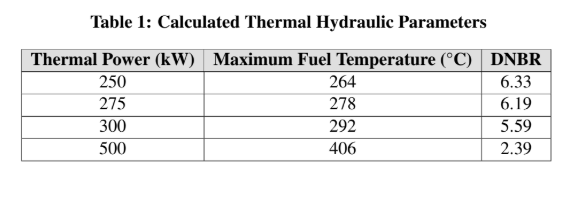
The safety limit for the stainless steel clad, high hydride TRIGA® fuel is based on data, including experimental evidence obtained during high performance reactor test on this fuel by General Atomics, which has shown that the integrity of the fuel is not compromised when maximum fuel temperature is less than 1150 °C. (NUREG-1282; Simnad et al.; 1976 and 1981; Simnad and West, 1986 and West et al, 1986.) The Analysis of the Thermal-Hydraulic Behavior of the Reed Research Reactor (RRR T-H Analysis) submitted as Attachment B of the May 20, 2011, RAI response indicates that the maximum centerline temperature for the reactor does not approach the safety limit. Table 1 contains the predicted temperatures and DNBR for four power levels, from data submitted with the December 12, 2011, RAI response.
2.2
Applicability. This specification applies to the scram settings that prevent the safety limit from being reached.
Objective. The objective is to prevent the safety limit from being reached.
Specification. The limiting safety system setting shall be equal to or less than 300 kW as measured by a power measuring channel.
2.2 Limiting Safety System Setting Basis
The RRR T-H Analysis results, provided in TS Table 1 above, indicate that the maximum centerline fuel temperature for the reactor is approximately 264 °C at the licensed power level of 250 kW, and 292 °C at the limiting safety system setting of 300 kW. These temperatures are significantly less than the safety limit of 1000 °C, and ensure that during normal operation, or if a scram signal is initiated, the fuel temperature will remain below the safety limit.
3
LIMITING CONDITIONS OF OPERATION
3.0
Limiting Conditions for Operation (LCO) are those administratively established constraints on equipment and operational characteristics that shall be adhered to during operation of the facility. The LCOs are the lowest functional capability or performance level required for safe operation of the facility.
3.1
Reactor Core Parameters
3.1.1
Applicability. This specification applies to the energy generated in the reactor during steady-state operation.
Objective. The objective is to ensure that the fuel temperature safety limit shall not be exceeded during operation.
Specification. The steady-state reactor power shall not exceed 250 kW.
3.1.1 Steady-state Operation Basis
Basis. The RRR T-H Analysis indicates that the RRR TRIGA® fuel may be safely operated up to power levels of at least 250 kW.
3.1.2
Applicability. These specifications apply to the reactivity condition of the reactor and the reactivity worths of control rods and experiments during operation. They apply for all modes of operation.
Objective. The objective is to ensure that the reactor can be shut down at all times and to ensure that the fuel temperature safety limit shall not be exceeded.
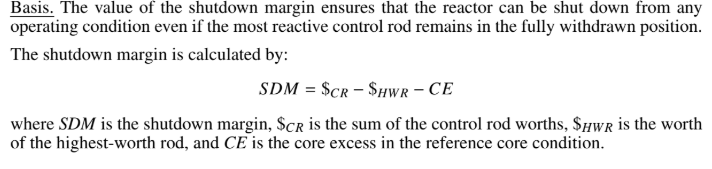
Specification. The reactor shall not be operated unless the shutdown margin provided by control rods is greater than $0.50 with:
. a. Irradiation facilities and experiments in place and the total worth of all experiments in their
most reactive state;
. b. The most reactive control rod fully withdrawn; and
. c. The reactor in reference core condition.
3.1.2 SDM basis
3.1.3
Applicability. This specification applies to the reactivity condition of the reactor and the reactivity worths of control rods during operation.
Objective. The objective is to ensure that the reactor can be shut down at all times and to ensure that the fuel temperature safety limit shall not be exceeded.
Specification. The maximum available excess reactivity based on the reference core condition shall not exceed $3.00.
3.1.3 Core Excess Reactivity Basis
Basis. This core excess limit allows operation without the need to add or remove fuel elements to account for normal reactivity changes due to fission product poisons, experiments, power defect, fuel burn up, etc. Activities such as moving away from the reference state or adding negative worth experiments will make core excess more negative and shutdown margin less positive.
3.1.4
Applicability. This specification applies to all fuel elements.
Objective. The objective is to maintain integrity of the fuel element cladding.
Specifications. The reactor shall not be operated with damaged fuel elements, except for the purpose of locating damaged fuel elements. A fuel element shall be considered damaged and must be removed from the core if:
a. A cladding defect exists as indicated by release of fission products;
b. Visual inspection identifies bulges, gross pitting, or corrosion;
c. The sagitta (traverse bend) exceeds 0.0625 inches over the length of the cladding;
d. The length exceeds its original length by 0.125 inches; or
e. The burn-up of U-235 in the fuel matrix exceeds 50% of the initial concentration.
3.1.4 Fuel Parameters Basis
Basis. Gross failure or obvious visual deterioration of the fuel is sufficient to warrant declaration of the fuel as damaged. (NUREG-1537)
3.2
Reactor Control and Safety Systems
3.2.1
Applicability. This specification applies to the function of the control rods.
Objective. The objective is to determine that the control rods are operable.
Specifications. The reactor shall not be operated if any control rod is not operable. Control rods shall not be considered operable if:
a. Damage is apparent to the rod or rod drive assembly;
b. The scram time exceeds 1 second; or
c. The reactivity addition rate exceeds $0.16 per second.
3.2.1 Control rod basis
Basis. This specification ensures that the reactor will be promptly shut down when a scram signal is initiated and that the reactivity addition rates are safe.
Experience and analysis have indicated that for the range of transients anticipated for a TRIGA® reactor, the specified scram time is adequate to ensure the safety of the reactor. See also the May 20, 2011, RAI response.
The RRR T-H Analysis shows that the limit on reactivity addition rate is safe during normal operation and transients.
3.2.2
Applicability. This specification applies to the information that shall be available to the reactor operator during reactor operation.
Objective. The objective is to specify the minimum number of reactor power measuring channels that shall be available to the operator to ensure safe operation of the reactor.
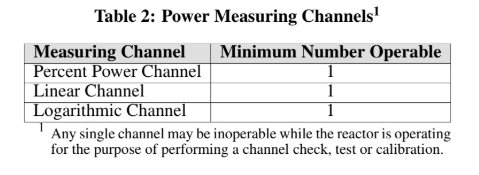
Specifications. The reactor shall not be operated unless the reactor power measuring channels in Table 2 are operable.
3.2.2 Reactor Power Measuring Channels basis
The percent, linear, and logarithmic power channels are displayed on the RRR console and ensure that the reactor power level is adequately monitored during reactor operation. For footnote 1, taking a single measurement channel off-line is necessary in some cases to complete a channel check, test or calibration, and is considered acceptable because in some cases, the reactor must be operating in order to perform the check, test or calibration. Additionally, there exist two redundant power level indications operating at any given time while the third single channel is off-line.
3.2.3
Applicability. This specification applies to the reactor safety system channels and interlocks.
Objective. The objective is to specify the minimum number of reactor safety system channels and interlocks that shall be available to the operator to ensure safe operation of the reactor.
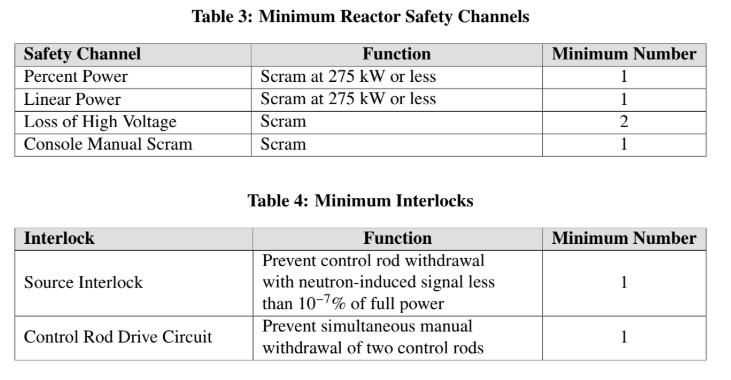
Specifications. The reactor shall not be operated unless the minimum number of safety channels described in Table 3 and interlocks described in Table 4 are operable.
3.2.3 Reactor Safety Systems and Interlocks basis
Percent and Linear Power: The percent and linear power level scrams are established at 275 kW, 110% of the (licensed power level). As described in NUREG-1537, the license power level requirement is met by an administrative limit of 230 kW for normal operation; the higher scram setpoint does not allow operation above the licensed power level. The RRR imposes an administrative power limit for normal operation of 230 kW. The difference of 20 kW allows for instrument fluctuations without incurring unnecessary scrams. As described in the December 12, 2011, RAI response, with a ramp reactivity insertion at the TS 3.2.1 limit of $0.16/sec and a scram setpoint of 285 kW, analysis demonstrates that the peak power and maximum fuel hot spot temperature are safe. Even if the reactor operated steadily at 275 kW, the RRR T-H Analysis (TS Table 1) shows that the fuel centerline temperature is approximately 278 °C, and is significantly less than the safety limit (1000 °C). This provides adequate protection of the RRR fuel.
Loss of High Voltage: The linear and percent power channels scram following a loss of high voltage to the detectors because the channels are unreliable without proper high voltage.
Manual Scram: The manual scram must be functional at all times the reactor is in operation. It has no specified value for a scram set point and is manually initiated by the reactor operator.
Source Interlock: The source interlock prevents the operator from adding reactivity when the neutron-induced signal is less than 10−7% of full power on a power channel. Under these circumstances, the indication would be insufficient to produce a meaningful instrumentation response. If the operator were to insert reactivity under this condition, the period could quickly become very short and result in an inadvertent power excursion. A neutron source is added to the core to create sufficient instrument response that the operator can recognize and respond to changing conditions. The value of 10−7% power is less than the reading typically produced by the reference core with the source in place; therefore, a lower reading indicates either that the source has been removed or that the instrument channel is inoperable.
Control Rod Drive Circuit: The single rod withdrawal interlock prevents the operator from manually removing multiple control rods simultaneously so that reactivity insertions from control rod manipulation are done in a controlled manner.
3.3
Applicability. This specification applies to the primary water of the reactor pool.
Objective. The objective is to ensure that there is an adequate amount of water in the reactor pool for fuel cooling and shielding purposes, that the bulk temperature of the reactor pool water remains sufficiently low to guarantee demineralizer resin integrity, and that pool chemistry will limit corrosion.
Specifications.
a. The pool water level shall be greater than 5 meters above the upper core plate. The pool water level shall initiate an alarm signal if the pool level falls 10 cm below normal. The alarm indication shall be visible in the control room and outside the reactor facility.
b. The bulk pool water temperature shall be less than 40 °C. The pool water temperature shall initiate an alarm if the pool temperature exceeds 40 °C.
c. The conductivity of the pool water shall be less than 5.0 microsiemens/cm averaged over 1 month.
d. The radioactivity of the pool water shall be less than the limits in 10 CFR 20 Appendix B, Table 3 for radioisotopes with half-lives greater than 24 hours.
3.3 Reactor Primary Pool Water Basis
Pool Water Level: The minimum height of 5 meters of water above the upper core plate guarantees that there is sufficient water for effective cooling of the fuel and that the radiation levels at the top of the reactor are within acceptable levels. The pool level is limited to a decrease of no more than 10 cm below normal to allow early detection of pool leakage. (RAI Response, May 20, 2011)
Pool Water Temperature: The bulk water temperature limit is necessary, according to the resin manufacturer, to ensure that the resin not break down. The temperature limit also ensures the core inlet temperature is acceptable for the accident analysis. (RAI Response, December 12, 2011)
Pool Water Conductivity: Experience at many research reactor facilities has shown that maintaining the conductivity within the specified limit provides acceptable control of corrosion (NUREG-1537 Appendix 14, Section 3.3.(9)).
Pool Water Radioactivity: Pool activity is limited to ensure dose rates are maintained below 10 CFR 20 limits.
3.4
Applicability. This specification applies to the operation of the reactor bay ventilation system.
Objective. The objective is to ensure that the ventilation system shall be in operation to mitigate the consequences of possible releases of radioactive materials resulting from reactor operation or when moving irradiation fuel.
Specifications. The reactor shall not be operated nor irradiated fuel moved unless the facility ventilation system is operable in one of the following operational modes:
a. Normal mode: The exhaust, supply, and control room fans are operating. The reactor bay pressure is maintained negative with respect to the control room.
b. Isolation mode: Isolation mode as initiated by high radiation readings on the continuous air monitor. The exhaust and control room fans are operating. The reactor bay pressure is maintained negative with respect to the control room and all exhaust is diverted through a HEPA filter.
3.4 Ventilation system basis
Basis. During normal operation of the ventilation system, the annual average ground concentration of Ar-41 in unrestricted areas is well below the applicable effluent concentration limit in 10 CFR 20 (SAR 11.1.1.1). Analysis of the MHA indicated that the release of effluent to the site boundary is below the 10 CFR 20 limit (RAI Response, May 20, 2011). In the past, the reactor has been operated with the ventilation system in isolation mode is necessary to locate a leaking fuel element. The HEPA filter effectively minimizes particulate effluents. SAR 9.1 provides a detailed description of the ventilation system normal and isolation modes.
3.5
Radiation Monitoring Systems and Effluents
3.5.1
Applicability. This specification applies to the radiation monitoring information that shall be available to the reactor operator during reactor operation.
Objective. The objective is to specify the minimum radiation monitoring channels that shall be available to the operator to ensure safe operation of the reactor.
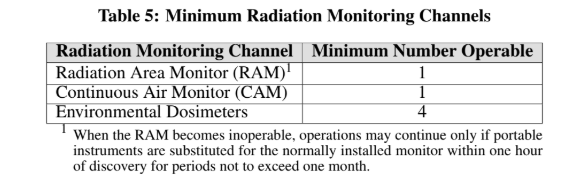
Specifications. The reactor shall not be operated unless the minimum number of radiation monitoring channels are operable as specified in the accompanying table:
3.5.1 Radiation Monitoring System Basis
The radiation monitors provide information to operating personnel regarding routine releases of radioactivity and any impending or existing danger from radiation. Their operation will provide sufficient time to evacuate the facility or take the necessary steps to prevent the spread of radioactivity to the surroundings. Calculations show that for both routine operations and accident scenarios predicted occupational and general public doses are below the applicable annual limits specified in 10 CFR 20. The CAM is equipped with an alarm that initiates a signal to put the ventilation system into isolation mode. Radiation dosimetry fixed on the four walls of the reactor bay and evaluated as specified in section 4.5, provides effective long-term monitoring of environmental radiation exposure.
3.5.2
Applicability. This specification applies to the release rate of Ar-41.
Objective. The objective is to ensure that the concentration of the Ar-41 in the unrestricted areas is below the applicable effluent concentration value in 10 CFR 20.
Specifications. The annual average concentration of Ar-41 discharged into the unrestricted area shall not exceed 1 x 10⁻⁸ μCi/ml at the point of discharge.
3.5.2 Effluents Basis
Basis. Based on measurements and calculations in SAR 11.1.1.1, even if Ar-41 were continuously discharged at the higher rate of 1.5 x 10⁻⁶ μCi/ml, Ar-41 release to the unrestricted areas under the worst-case weather conditions would result in an annual TEDE of 8.5 mrem. This is less than the applicable limit of 100 mrem. The value in this specification is the effluent concentration limit from 10 CFR 20, Appendix B, which is more conservative.
3.6
Limitations on Experiments
3.6.1
Applicability. This specification applies to experiments installed in the reactor and its irradiation facilities.
Objective. The objective is to prevent damage to the reactor or excessive release of radioactive materials in the event of an experiment failure.
Specifications. The reactor shall not be operated unless the following conditions governing experiments exist:
a. The absolute value of the reactivity worth of any single unsecured experiment shall be less than $1.00; and
b. The sum of the absolute values of the reactivity worths of all experiments shall be less than $2.00.
3.6.1 Reactivity Limits Basis
The reactivity limit of $1.00 for unsecured experiments is designed to prevent an inadvertent prompt criticality from occurring from an analyzed condition and to maintain a value below the shutdown margin. Unsecured experiments, are, by their very nature, experiments in a position where it is possible for a sample to be inserted or removed from the core while critical.
The reactivity worth limit for all experiments is designed to protect the fuel. This limit applies to movable, unsecured, and secured experiments. A $2.00 maximum reactivity insertion was analyzed in the December 12, 2011, RAI response and shown to be acceptable.
3.6.2
Applicability. This specification applies to the experiments installed in the reactor and its irradiation facilities.
Objective. The objective is to prevent damage to the reactor or excessive release of radioactive materials in the event of an experimental failure.
Specifications. The reactor shall not be operated unless the following conditions governing experiments exist:
a. Explosive materials, such as gunpowder, TNT, nitroglycerin, or PETN, in quantities greater than 25 mg TNT equivalent shall not be irradiated in the reactor or irradiation facilities. Explosive materials in quantities less than 25 mg TNT equivalent may be irradiated provided the pressure produced upon detonation of the explosive has been calculated and/or experimentally demonstrated to be less than half of the design pressure of the container; and
b. Experiments containing corrosive materials shall be doubly encapsulated. If the encapsulation of material that could damage the reactor fails, it shall be removed from the reactor and a physical inspection of potentially damaged components shall be performed.
3.6.2 Materials Basis
This specification is intended to prevent damage to reactor components resulting from failure of an experiment involving explosive or corrosive materials. Operation of the reactor with the reactor fuel or structure potentially damaged is prohibited to avoid potential release of fission products.
3.6.3
Applicability. This specification applies to experiments installed in the reactor and its irradiation facilities.
Objective. The objective is to prevent damage to the reactor or excessive release of radioactive materials in the event of an experiment failure.
Specifications. Where the possibility exists that the failure of an experiment under normal operating conditions of the experiment and reactor, credible accident conditions in the reactor, or possible accidents conditions in the experiment could release radioactive gases or aerosols to the reactor bay or the unrestricted area, the quantity and type of material in the experiment shall be limited such that the airborne radioactivity in the reactor bay or the unrestricted area will not result in exceeding the applicable dose limits in 10 CFR 20, assuming that:
a. 100% of the gases or aerosols escape from the experiment;
b. If the effluent from an irradiation facility exhausts through a holdup tank, which closes automatically on high radiation level, at least 10% of the gaseous activity or aerosols produced will escape;
c. If the effluent from an irradiation facility exhausts through a filter installation designed for greater than 99% efficiency for 0.3 micron particles, at least 10% of these aerosols can escape; and
d. For materials whose boiling point is above 54.4 °C (130 °F) and where vapors formed by boiling this material can escape only through an undisturbed column of water above the core, 10% of these vapors can escape.
3.6.3 Experiment Failures and Malfunctions Basis
This specification is intended to meet the purpose of 10 CFR 20 by reducing the likelihood that released airborne radioactivity to the reactor bay or unrestricted area surrounding the RRR will result in exceeding the total dose limits to an individual as specified in 10 CFR 20.
4
Surveillance requirements
4.0
Applicability. This specification applies to the surveillance requirements of any system related to reactor safety.
Objective. The objective is to verify the proper operation of any system related to reactor safety.
Specifications.
a. Surveillance requirements may be deferred during reactor shutdown (except TS 4.3 a, d, and e); however, if deferred, they shall be completed prior to reactor operation unless reactor operation is required for performance of the surveillance. Such surveillance shall be performed as soon as practicable after reactor operation. Scheduled surveillance that cannot be performed with the reactor operating may be deferred until a planned reactor shutdown.
b. Any additions, modifications, or maintenance to the ventilation system, the core and its associated support structure, the pool, the pool coolant system, the rod drive mechanism, radiation monitors, or the reactor safety systems shall be made and tested in accordance with the specifications to which the systems were originally designed and fabricated or to specifications reviewed by the Reactor Operations Committee. A system shall not be considered operable until after it is successfully tested.
4.0 General Basis (survey requirements)
Basis. This specification relates to surveillances of reactor systems that could directly affect the safety of the reactor, to ensure they are operable. As long as changes or replacements to these systems continue to meet the original design specifications it can be assumed that they meet the presently accepted operating criteria.
4.1
Applicability. This specification applies to the surveillance requirements for reactor core parameters.
Objective. The objective is to verify that the reactor does not exceed the authorized limits for power, shutdown margin, core excess reactivity, specifications for fuel element condition, and verification of the total reactivity worth of each control rod.
Specifications.
a. The shutdown margin shall be determined annually, following changes in the fuel or control rods, and following any other significant change (>$0.25) from the reference core.
b. The core excess reactivity shall be determined annually, following changes in the fuel or control rods, and following any other significant change (>$0.25) from the reference core.
c. Forty percent of the fuel elements in the reactor core shall be inspected visually for damage or deterioration biennially such that each fuel element in the core is inspected quintennially.
4.1 Reactor Core Parameters basis
Experience has shown that the identified frequencies will ensure performance and operability for each of these systems or components. The value of a significant change in reactivity (>$0.25) is measurable and will ensure adequate coverage of the shutdown margin after taking into account the accumulation of poisons. Visual inspections for damage and deterioration of the fuel cladding have been effective in identifying nonconforming fuel. A fuel element is considered damaged if meets the criteria outlined in TS 3.1.4.
Because fuel in storage experiences negligible wear except due to handling, it is not subject to regularly scheduled inspection. Inspection may be required before an element is moved from storage into the core, in order to ensure it meets the quintennial requirement.
4.2
Applicability. This specification applies to the surveillance requirements of reactor control and safety systems.
Objective. The objective is to verify performance and operability of those systems and components that are directly related to reactor safety.
Specifications.
a. The control rod drives shall be visually inspected for damage or deterioration annually.
b. The poison sections of the control rods shall be visually inspected for damage or deterioration biennially.
c. The control rod scram time shall be measured annually.
d. The total reactivity worth and reactivity addition rate of each control rod shall be measured annually or following any significant change (>$0.25) from a reference core.
e. A channel check of each of the reactor power measuring channels in TS 3.2.2, Table 2 shall be performed prior to each operation of the reactor.
f. A channel calibration of the Linear and Percent Power Channels in TS 3.2.2, Table 2, shall be performed annually.
g. A channel test of each item in TS 3.2.3, Tables 3 and 4, shall be performed annually.
4.2 Reactor Control and Safety Systems Basis
Experience has shown that the identified frequencies, as set forth in NUREG-1537 and ANSI/ANS 15.1, will ensure performance and operability for each of these systems or components.
4.3
Applicability. This specification applies to the surveillance requirements for the reactor pool water.
Objective. The objective is to ensure that the reactor pool water level, the water temperature, and the conductivity monitoring systems are operating, and to verify appropriate alarm settings.
Specifications.
a. A channel check of the reactor pool water shall be performed monthly.
b. A channel check of the reactor pool water temperature and level monitors shall be performed prior to each day’s operation or prior to each operation extending more than one day.
c. A channel calibration of the reactor pool water level and temperature monitors shall be performed annually.
d. The reactor pool water conductivity shall be measured monthly.
e. The reactor pool water radioactivity shall be measured quarterly.
4.3 Reactor Primary Pool Water Basis
Experience has shown that the frequencies of checks on systems that monitor reactor primary water level, temperature, and conductivity adequately keep the pool water at the proper level and maintain water quality at such a level to minimize corrosion and maintain safety.
4.4
Applicability. This specification applies to the reactor bay ventilation system.
Objective. The objective is to ensure the proper operation of the reactor bay ventilation system in controlling releases of radioactive material to the unrestricted area.
Specifications.
a. A channel check of the reactor bay ventilation system, to verify that it is operating, shall be performed prior to each day’s operation or prior to each operation extending more than one day.
b. A channel test of the reactor bay ventilation system’s Isolation mode, as described in TS 3.4 b., shall be performed quarterly.
4.4 Ventilation System Basis
Experience has demonstrated that tests of the ventilation system on the prescribed basis are sufficient to ensure proper operation of the system and its control over releases of radioactive material.
4.5
Applicability. This specification applies to the surveillance requirements for the area radiation monitoring equipment and the air monitoring systems.
Objective. The objective is to ensure that the radiation monitoring equipment is operating properly.
Specifications.
a. For the RAM and CAM listed in TS 3.5.1, Table 5:
. 1. A channel check shall be performed prior to each day’s operation or prior to each
operation extending more than one day;
. 2. A channel test shall be performed quarterly; and
. 3. A channel calibration shall be performed annually.
b. Fixed-area dosimetry shall be exchanged and evaluated quarterly.
c. Effluent concentrations shall be evaluated annually.
4.5 Radiation Monitoring System Basis
Specification (a) applies to the single RAM and single CAM fulfilling the minimums in TS 3.5.1. Experience has shown that an annual calibration is adequate to correct for any variation in the system due to a change of operating characteristics over a long time span. A quarterly test and daily check have also been found to be adequate to detect any change in the channel’s operability.
Experience has demonstrated that annual evaluation of effluences constitutes effective environmental radiation surveillance (SAR 11.1.1.1).
4.6
Applicability. This specification applies to the surveillance requirements for experiments installed in the reactor and its irradiation facilities.
Objective. The objective is to prevent the conduct of experiments that may damage the reactor or release excessive amounts of radioactive materials as a result of experiment failure.
Specifications.
a. The reactivity worth of an experiment shall be estimated or measured, as appropriate, before the reactor is operated with the experiment.
b. An experiment shall not be installed in the reactor or its irradiation facilities unless a safety analysis has been performed and reviewed for compliance with Section 3.6 of these TS by the Reactor Operations Committee in accord with Section 6.5 of these TS and the procedures that are established for this purpose.
4.6 Experimental Limits basis
Experience has shown that experiments that are reviewed by the RRR staff and the Reactor Operations Committee can be conducted without endangering the safety of the reactor or exceeding the limits in the TS.
5
Design Features
5.0
Major alterations to safety-related components or equipment shall not be made prior to appropriate safety reviews.
5.1
Applicability. This specification applies to the Reed College TRIGA® Reactor site location and specific facility design features.
Objective. The objective is to specify the location of specific facility design features.
Specifications.
a. The site boundary is that boundary extending 250 feet in every direction from the center of the reactor core.
b. The restricted area is that area inside the reactor facility. The unrestricted area is that area outside the reactor facility.
5.1 Site and Facility Description Basis
The facility and site description are strictly defined in the May 20, 2011, RAI response.
5.2
Applicability. This specification applies to the pool containing the reactor and to the cooling of the core by the pool water.
Objective. The objective is to ensure that coolant water is available to provide adequate cooling of the reactor core and adequate radiation shielding.
Specifications.
a. The reactor core shall be cooled by natural convective water flow.
b. The pool water inlet and outlet pipes shall be equipped with siphon breaks not less than 5 meters above the upper core plate.
5.2 Reactor Coolant System Basis
This specification is based on thermal and hydraulic calculations that show that the TRIGA® core can operate in a safe manner at power levels up to 250 kW with natural convection flow of the coolant water.
In the event of accidental siphoning of pool water through inlet and outlet pipes the pool water will drop to a level no less than 5 meters from the upper core plate either due to a siphon break or due to the pipe ending (SAR 5.2).
The pool level alarm is to allow timely detection of pool leaks.
5.3
Reactor Core and Fuel
5.3.1
Applicability. This specification applies to the configuration of fuel and in-core experiments.
Objective. The objective is to ensure that provisions are made to restrict the arrangement of fuel elements and experiments so as to provide assurance that excessive power densities shall not be produced.
Specifications.
a. The core assembly shall consist of stainless steel clad 8.5/20 TRIGA® fuel elements.
b. The fuel shall be arranged in a close-packed configuration except for single element positions occupied by in-core experiments, irradiation facilities, graphite dummies, control rods, startup sources, or central thimble.
c. The reflector, excluding experiments and irradiation facilities, shall be water and graphite.
d. Fuel shall not be removed from or inserted into the core unless the reactor is subcritical by more than the calculated worth of the most reactive fuel element.
e. Control rods shall not be removed manually from the core unless the core has been shown to be subcritical with all control rods fully withdrawn from the core.
5.3.1 Reactor Core Basis
Only TRIGA® fuel is anticipated to ever be used. In-core water-filled experiment positions have been demonstrated to be safe in the TRIGA® Mark I reactor. The largest values of flux peaking will be experienced in hydrogenous in-core irradiation positions. Various non-hydrogenous experiments positioned in element positions have been demonstrated to be safe in TRIGA® fuel element cores up to 500 kW operation. The core will be assembled in the reactor grid plate that is located in a pool of light water. Water in combination with graphite reflectors can be used for neutron economy and the enhancement of irradiation facility radiation requirements.
Manual manipulation of fuel elements will be allowed only when single fuel element manipulation cannot result in an inadvertent criticality.
Manual movement of control rods will be allowed only when control rod movement cannot result in an inadvertent criticality.
5.3.2
Applicability. This specification applies to the control rods used in the reactor core.
Objective. The objective is to ensure that the control rods are of such a design as to permit their use with a high degree of reliability with respect to their physical and nuclear characteristics.
Specifications. The control rods shall have scram capabilities and the poison section shall contain borated graphite, B4C powder, or boron and its compounds in solid form as poison in an aluminum or stainless steel cladding.
5.3.2 Control Rods basis
The poison requirements for the control rods are satisfied by using neutron-absorbing boron compounds. These materials must be contained in a suitable cladding material such as aluminum or stainless steel to ensure mechanical stability during movement and to isolate the poison from the pool water environment. Scram capabilities are provided for the rapid insertion of the control rods that is the primary safety feature of the reactor.
5.3.3
Applicability. This specification applies to the fuel elements used in the reactor core.
Objective. The objective is to ensure that the fuel elements are of such a design and fabricated in such a manner as to permit their use with a high degree of reliability with respect to their physical and nuclear characteristics.
Specifications.
The individual unirradiated TRIGA® fuel elements shall have the following characteristics:
a. Uranium content: nominal 8.5 weight percent enriched to less than 20% in U-235;
b. Hydrogen-to-zirconium atom ratio (in the ZrHx): between 1.5 and 1.65;
c. Cladding: stainless steel, nominally 0.020 inches thick; and
d. Identification: each element shall have a unique identification number.
5.3.3 Reactor Fuel Basis
Material analysis of 8.5/20 fuel shows that the maximum weight percent of uranium in any fuel element is less than 8.5 percent, and the maximum enrichment of any fuel element is less than 20.0 percent. For the hydrogen-to-zirconium ratio see “The U-ZrHx Alloy: Its Properties and Use in TRIGA Fuel,” (GA report 414, February 1980, M. T. Simnad) and “Fission Product Releases from TRIGA-LEU Reactor Fuels,” (GA-A16287, November 1980, Baldwin, Foushee and Greenwood).
5.4
Applicability. This specification applies to the ventilation of the reactor bay.
Objective. The objective is to ensure that provisions are made to restrict the amount of radioactivity released into the environment.
Specifications.
a. The reactor shall be housed in a facility designed to restrict leakage. The minimum free volume in the reactor bay is approximately 300 cubic meters.
b. The reactor shall be equipped with a ventilation system designed to filter and exhaust air or other gases from the reactor and release them from a stack 3.6 meters from the ground
c. The ventilation system shall be equipped with inlet dampers that can be closed from the control room. Closing the inlet dampers changes the ventilation system into isolation mode.
5.4 Ventilation System Basis
Proper handling of airborne radioactive materials (in emergency situations) can be conducted from the reactor control room with a minimum of exposure to operating personnel (SAR 9.1). Control of the ventilation system is available from the control room, which will be habitable even during the MHA.
The free volume in the reactor bay is approximately 357 cubic meters (SAR 11.1.1.1). For conservative analysis, the minimum free volume is set at 300 cubic meters.
5.5
Applicability. This specification applies to the storage of reactor fuel at times when it is not in the reactor core.
Objective. The objective is to ensure that fuel being stored will not become critical and will not reach an unsafe temperature.
Specifications.
a. All fuel elements or fueled devices shall be rigidly supported during storage in a safe geometry (keff less than 0.8 under all conditions of moderation).
b. Irradiated fuel elements shall be stored in the reactor pool in an array that will permit natural convection cooling by water.
5.5 Fuel Storage Basis
The limited imposed are conservative and ensure safe storage (NUREG-1537). See Foushee’s memo on Storage of TRIGA Fuel Elements dated March 1, 1966. The underwater fuel storage racks in use meet the characteristics described in Foushee’s memo.
6
Administrative Controls
6.1
Individuals at the various management levels, in addition to being responsible for the policies and operation of the reactor facility, shall be responsible for safeguarding the public and facility personnel from undue radiation exposures and for adhering to all requirements of the operating license, TS, and federal regulations.
6.1.1
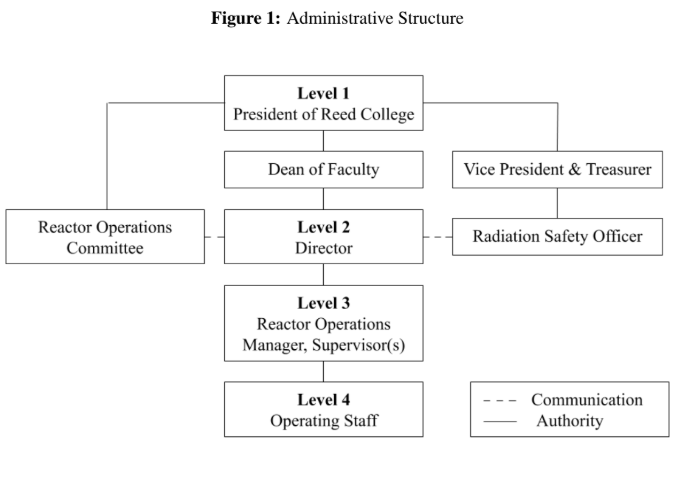
The reactor administration shall be as shown in Figure 1. The Levels refer to ANSI/ANS-15.4- 1988; R1999.
6.1.2
The following specific organizational levels and responsibilities shall exist.
a. President (Level 1): The President of Reed College is responsible for the facility license and represents Reed College.
b. Director (Level 2): The Director reports to the President of Reed College via the Dean of the Faculty, and is accountable for ensuring that all regulatory requirements, including implementation, are in accordance with all requirements of the U.S. NRC and the Code of Federal Regulations.
c. Reactor Operations Manager and Supervisor(s) (Level 3): The Reactor Operations Manager reports to the Director and is responsible for directing the activities of the reactor staff and for the day-to-day operation and maintenance of the reactor. The Supervisor(s) report to the Reactor Operations Manager.
d. Operating Staff - Reactor Operators and Senior Reactor Operators (Level 4): The Reactor Operators (RO) and Senior Reactor Operators (SRO) report to the Supervisor(s), Reactor Operations Manager, and the Director, and are primarily involved in the manipulation of reactor controls, monitoring of instrumentation, and operation and maintenance of reactor-related equipment.
e. Radiation Safety Officer: The Radiation Safety Officer reports to the President of Reed College via the Vice President and Treasurer and is responsible for directing health physics activities including implementation of the radiation safety program. The Radiation Safety Officer shall communicate with the Reactor Director regarding health physics issues.
6.1.3
a. The minimum staffing when the reactor is not secured shall be:
. 1. A licensed reactor operator in the control room;
. 2. A second person present in the reactor facility able to scram the reactor and summon help;
. 3. If neither of these two individuals is an SRO, a designated SRO shall be readily available on call. “Readily available on call” means an individual who:
. a) has been specifically designated and the designation known to the operator on duty,
. b) can be contacted quickly by the operator on duty, and
. c) is capable of getting to the reactor facility within 15 minutes.
b. A list of reactor facility personnel by name and telephone number shall be readily available in the control room for use by the operator. The list shall include:
. 1. Reactor Director;
. 2. Reactor Operations Manager;
. 3. Supervisor;
. 4. Radiation Safety Officer; and
. 5. At least one other person who is a licensed SRO.
c. Events which require the presence of an SRO in the facility shall include:
. 1. Initial start-up and approach to power of the day or following significant changes (>$0.25) to the core;
. 2. All fuel or control rod relocations in the reactor core;
. 3. Maintenance on any reactor safety system;
. 4. Recovery from unscheduled reactor scram or significant power reduction; and
. 5. Relocation of any in-core experiment or irradiation facility with a reactivity worth greater than one dollar.
6.1.4
The selection, training, and requalification of personnel should be in accordance with ANSI/ANS 15.4-1988; R1999, “Standard for the Selection and Training of Personnel for Research Reactors.”
6.2
The Reactor Operations Committee (ROC) shall have primary responsibility for review and audit of the safety aspects of reactor facility operations, and to assure that the facility is operated in a manner consistent with public safety and within the conditions specified in the facility license. Minutes, findings, or reports of the ROC shall be presented to the President (Level 1) and the Director (Level 2) within ninety days of completion.
6.2.1
The ROC shall have at minimum 3 members, at least two of whom are knowledgeable in fields that relate to physics and nuclear safety. The Dean of the Faculty, the Reactor Director, and the campus Radiation Safety Officer shall be voting members. Additional voting members shall be added at the President’s discretion.
6.2.2
The operation of the ROC shall be in accordance with written procedures including provisions for:
a. Meeting frequency: not less than once per calendar year.
b. Quorums: a group consisting of at least half of the voting members, of which the operating staff (i.e. the director and anyone who reports to that person) does not constitute a majority.
c. Use of subcommittees.
d. Review, approval, and dissemination of minutes.
6.2.3
The responsibilities of the ROC, or designated subcommittee thereof, include, but are not limited to, the following:
a. Review determinations that proposed changes in equipment, systems, tests, experiments or procedures are allowed without prior authorization by the U.S. NRC;
b. Review new procedures and substantive changes to existing procedures;
c. Review proposed changes to the TS or license;
d. Review violations of TS, license, or violations of internal procedures or instructions having safety significance;
e. Review operating abnormalities having safety significance;
f. Review events from reports required in Section 6.6.1 and 6.7.2 of these TS;
g. Review and approve new experiments under Section 6.5 of these TS; and
h. Review audit reports.
6.2.4
The ROC, or a subcommittee thereof, shall audit reactor operations at least annually. The annual audit shall include at least the following:
a. Facility operations for conformance to these TS and applicable license conditions;
b. The requalification program for the operating staff;
c. The results of action taken to correct deficiencies that may occur in the reactor facility equipment, systems, structures, or methods of operation that affect reactor safety; and
d. The Emergency Plan and implementing procedures.
6.3
The Radiation Safety Officer shall be responsible for implementation of the radiation safety program. The requirements of the radiation safety program are established in 10 CFR 20. The program shall use the guidelines of the ANSI/ANS 15.11-1993; R2004, “Radiation Protection at Research Reactor Facilities.”
6.4
Written operating procedures shall be adequate to ensure the safe operation of the reactor, but shall not preclude the use of independent judgement and action if the situation requires. Operating procedures shall be in effect and used for the following:
a. Startup, operation, and shutdown of the reactor;
b. Fuel loading, unloading, and movement within the reactor;
c. Maintenance of major components of systems that could have an effect on reactor safety;
d. Surveillance checks, calibrations, and inspections required by TS or those that have an effect on reactor safety;
e. Radiation protection;
f. Administrative controls for operations and maintenance and for the conduct of irradiations and experiments that could affect reactor safety or core reactivity;
g. Implementation of required plans, such as the Emergency and Security plans; and
h. Use, receipt, and transfer of byproduct material held under the reactor license.
Substantive changes to the above procedures shall be made only after review and approval by the ROC. Non-substantive changes shall be reviewed and approved prior to implementation by the Director or Reactor Operations Manager.
Temporary deviations from the procedures may be made by the responsible SRO when the procedure contains errors or in order to deal with special or unusual circumstances or conditions. Such deviations shall be documented and reported by the next working day to the Director or Reactor Operations Manager.
6.5
a. Approved experiments shall be carried out in accordance with established and approved procedures.
b. All new experiments or classes of experiments shall be reviewed and approved by the ROC.
c. Substantive changes to previously approved experiments will be made only after review by the ROC and approval in writing by the Director or Reactor Operations Manager.
d. Minor changes that do not significantly alter the experiment may be approved by a Supervisor, Reactor Operations Manager, or Director.
6.6
Required actions
6.6.1
In the event the safety limit is exceeded:
a. The reactor shall be shut down and reactor operation shall not be resumed until authorized by the NRC.
b. An immediate notification of the occurrence shall be made to the Director, the Chair of the ROC, and the President of Reed College.
c. A report shall be prepared and reviewed by the ROC. The report shall describe the following:
1. Applicable circumstances leading to the violation including, when known, the cause and contributing factors;
2. Effects of the violation upon reactor facility components, systems, or structures and on the health and safety of personnel and the public; and
3. Corrective action to be taken to prevent recurrence.
6.6.2
For all events that are required by regulation or TS to be reported to the U.S. NRC within 24 hours under Section 6.7.2, except a safety limit violation, the following actions shall be taken:
a. The reactor shall be shut down and the Director or Reactor Operations Manager and ROC chair notified;
b. Operations shall not resume unless authorized by the Director or Reactor Operations Manager;
c. The ROC shall review the occurrence at or before their next scheduled meeting; and
d. A report shall be submitted to the US NRC in accordance with TS 6.7.2.
6.7
Reports
6.7.1
An annual report shall be created and submitted by the Director to the Document Control Desk, U.S. NRC, Washington DC, by November 1 of each year consisting of:
a. A brief summary of operating experience including the energy produced by the reactor;
b. The number of unscheduled shutdowns, including reasons therefor;
c. A tabulation of major preventative and corrective maintenance operations having safety significance;
d. A brief description, including a summary of the safety evaluations, of changes in the facility or in procedures and of tests and experiments carried out pursuant to 10 CFR 50.59;
e. A summary of the nature and amount of radioactive effluents released or discharged to the environs beyond the effective control of the licensee as measured at or prior to the point of such release or discharge. The summary shall include to the extent practicable an estimate of individual radionuclides president in the effluent. If the estimated average release after dilution or diffusion is less than 25 percent of the concentration allowed or recommended, a statement to this effect is sufficient;
f. A summarized result of environmental surveys performed outside the facility; and
g. A summary of exposures received by facility personnel and visitors where such exposures are greater than 25 percent of that allowed.
6.7.2
In addition to the requirements of applicable regulations, and in no way substituting therefor, the Director shall report to the U.S. NRC as follows:
a. A report not later than the following working day by telephone and confirmed in writing by facsimile to the U.S. NRC Headquarters Operations Center, to be followed by a written report that describes the circumstances of the event within 14 days to the Document Control Desk, U.S. NRC, Washington DC, of any of the following:
. 1. Violation of the safety limit;
. 2. Release of radioactivity from the site above allowed limits;
. 3. Operation with actual safety system settings from required systems less conservative than the limiting safety system setting;
. 4. Operation in violation of limiting conditions for operation unless prompt remedial action is taken as permitted in Sec. 3;
. 5. A reactor safety system component malfunction that renders or could render the reactor safety system incapable of performing its intended safety function. If the malfunction or condition is caused by maintenance, then no report is required;
. 6. An unanticipated or uncontrolled change in reactivity greater than one dollar. Reactor trips resulting from a known cause are excluded;
. 7. Abnormal and significant degradation in reactor fuel or cladding, or both, coolant boundary, or confinement boundary open (excluding minor leaks) where applicable; or
. 8. An observed inadequacy in the implementation of administrative or procedural controls such that the inadequacy causes or could have caused the existence or development of an unsafe condition with regard to reactor operations.
b. A report within 30 days in writing to the Document Control Desk, U.S. NRC, Washington DC, of:
. 1. Permanent changes in the facility organization involving Level 1-2 personnel; or
. 2. Significant changes in the transient or accident analyses as described in the Safety Analysis Report.
6.8
Records
6.8.1
a. Normal reactor operation;
b. Principal maintenance activities;
c. Reportable occurrences;
d. Surveillance activities required by the TS;
e. Reactor facility radiation and contamination surveys;
f. Experiments performed with the reactor;
g. Fuel inventories, receipts, and shipments;
h. Approved changes to the operating procedures; and
i. ROC meetings and audit reports.
6.8.2
Records of retraining and requalification of licensed reactor operators and senior reactor operators shall be retained for at least one complete requalification cycle and maintained at all times the individual is employed or until the certification is renewed. For the purpose of this technical specification, a certification is an NRC issued operator license.
6.8.3
a. Gaseous and liquid radioactive effluents released to the environs;
b. Offsite environmental monitoring surveys;
c. Radiation exposures for all personnel monitored;
d. Drawings of the reactor facility; and
e. Reviews and reports pertaining to a violation of the safety limit, the limiting safety system setting, or a limiting condition of operation.