2. Drainage Density
 Call Kai
 Learn
Learn Practice Test
 Spaced Repetition
 Match
Match Flashcards
 Knowt Play
1/12

There's no tags or description
Looks like no tags are added yet.
Name | Mastery | Learn | Test | Matching | Spaced | Call with Kai | Chat |
|---|
No analytics yet
Send a link to your students to track their progress
13 Terms
Drainage Density
The total length of all streams per unit area of a drainage basin. Formula: Total length of streams (km) ÷ Total area of drainage basin (km²). Answer is in km/km².
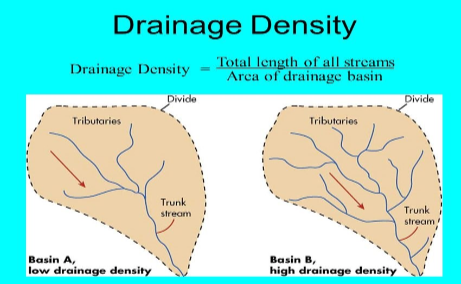
How to calculate drainage density
Formula: Total length of all streams (km) ÷ Total area of the drainage basin (km²). Example: 120km ÷ 30km² = 4km/km² (meaning 4km of river for every km²).
Effect of high rainfall on drainage density
High rainfall → more runoff → HIGHER drainage density.
Effect of high evaporation on drainage density
High evaporation → less runoff → LOWER drainage density.
Effect of high infiltration on drainage density
High infiltration → less runoff → LOWER drainage density.
Effect of rock hardness on drainage density
Softer rocks → channels form more easily → HIGHER drainage density. Harder rocks → lower drainage density.
Stream Order 1
The smallest streams where rivers begin. Narrow, clean water, steep gradient, V-shaped valley, downward (vertical) erosion. Found in mountains.
Stream Order 2
Wider than order 1, water becomes dirtier, less steep gradient, valley begins to widen, lateral erosion, greater water volume.
Higher Stream Orders (3, 4, 5+)
Fewer streams per order, streams become wider (more lateral erosion and deposition), gradient becomes more gradual, water becomes dirtier. The highest order river flows into the ocean.
What does a higher drainage density mean?
There are more streams per km² — the area has more runoff (e.g. due to high rainfall, hard rocks, or low infiltration).
Drainage basin
The area of land drained by a river and all its tributaries.
Draingage Density and Hydrograms ( Graph )
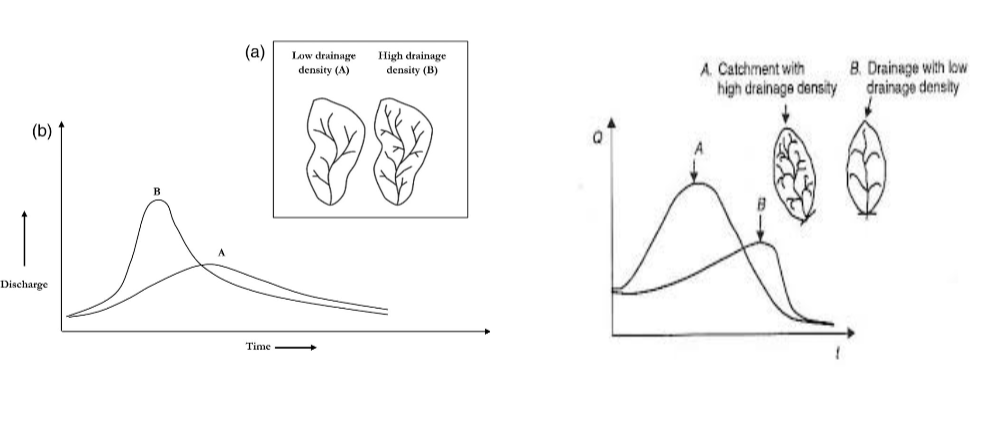
Discharge and Hydrographs ( Graph )