Quiz 1: Pharmacokinetics (Coles/Elmquist)
 Call Kai
 Learn
Learn Practice Test
 Spaced Repetition
 Match
Match Flashcards
 Knowt Play
1/21

There's no tags or description
Looks like no tags are added yet.
Name | Mastery | Learn | Test | Matching | Spaced | Call with Kai | Chat |
|---|
No analytics yet
Send a link to your students to track their progress
22 Terms
Main advantages of constant-rate infusions?
easy dose adjustment, can be given with other IV therapies, and prevents large concentration fluctuations
Constant-rate infusion equation
dA/dt = k₀ − kA
Rate of change = rate in − rate out
What are the units of k₀ vs. k?
k₀: mass/time
k: 1/time
How can rate of elimination be written using clearance?
Rate out = CL × Cp
so: dA/dt = k₀ − CL × Cp
How are k, V, and CL related?
k = CL/V
What happens to rate out as an infusion begins?
starts near zero and increases as Cp increases until rate out = rate in
What is the steady-state concentration during constant infusion?
Cpss = k₀/CL
What happens when a constant infusion is started and stopped?
Cp rises exponentially toward steady state, then declines exponentially after stopping

How much of Cpss is reached after 1 and 2 half-lives?
1 half-life = 50%; 2 half-lives = 75%

Cp during constant infusion
Cp = Cpss(1 − e^−kt)
t′ = time since the infusion stopped
What can the post-infusion slope determine?
elimination rate constant (k) and therefore half-life.

What determines Cpss?
infusion rate (k₀) and clearance (CL)
What determines time to steady state?
half-life, which depends on CL and V
What happens to Cpss when k₀ increases but CL stays constant?
Cpss increases proportionally
double k₀ → double Cpss

How does CL affect Cpss?
lower CL → higher Cpss
higher CL → lower Cpss
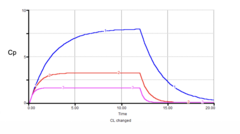
How does lower clearance affect half-life?
lower CL → longer half-life if V is unchanged

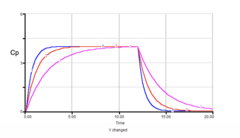
If k₀ and CL stay the same, does changing V change Cpss?
No. All reach the same Cpss, but at different rates
If the same IV dose is given at different infusion rates, what happens to AUC?
AUC stays the same if dose and CL are the same
Can equal AUCs have different concentration profiles?
Yes, different infusion rates produce different peak concentrations despite equal AUC
When is a loading dose useful with an infusion?
when the target Cp is needed quickly, especially for drugs with long half-lives
Why add a loading dose to a constant infusion?
to reach the target concentration rapidly instead of waiting ~5 half-lives
What happens if the loading dose is too large?
Cp starts above the target, then declines toward the Cpss maintained by the infusion