5 - Distillation of a reaction product
 Call Kai
 Learn
Learn Practice Test
 Spaced Repetition
 Match
Match Flashcards
 Knowt Play
1/5

There's no tags or description
Looks like no tags are added yet.
Name | Mastery | Learn | Test | Matching | Spaced | Call with Kai | Chat |
|---|
No analytics yet
Send a link to your students to track their progress
6 Terms
What is distillation?
A technique where a liquid is heated to create a vapour which is cooled by a condenser, causing the gas to condense into a liquid & drip into a separate flask
The species separate due to different volatilities & boiling points
What equipment is used for distillation?
Pear-shaped/round-bottomed flask
Liebig condenser
Thermometer
Water bath
Collecting vessel (test tube in a beaker of ice & cold water)
Anti-bumping granules
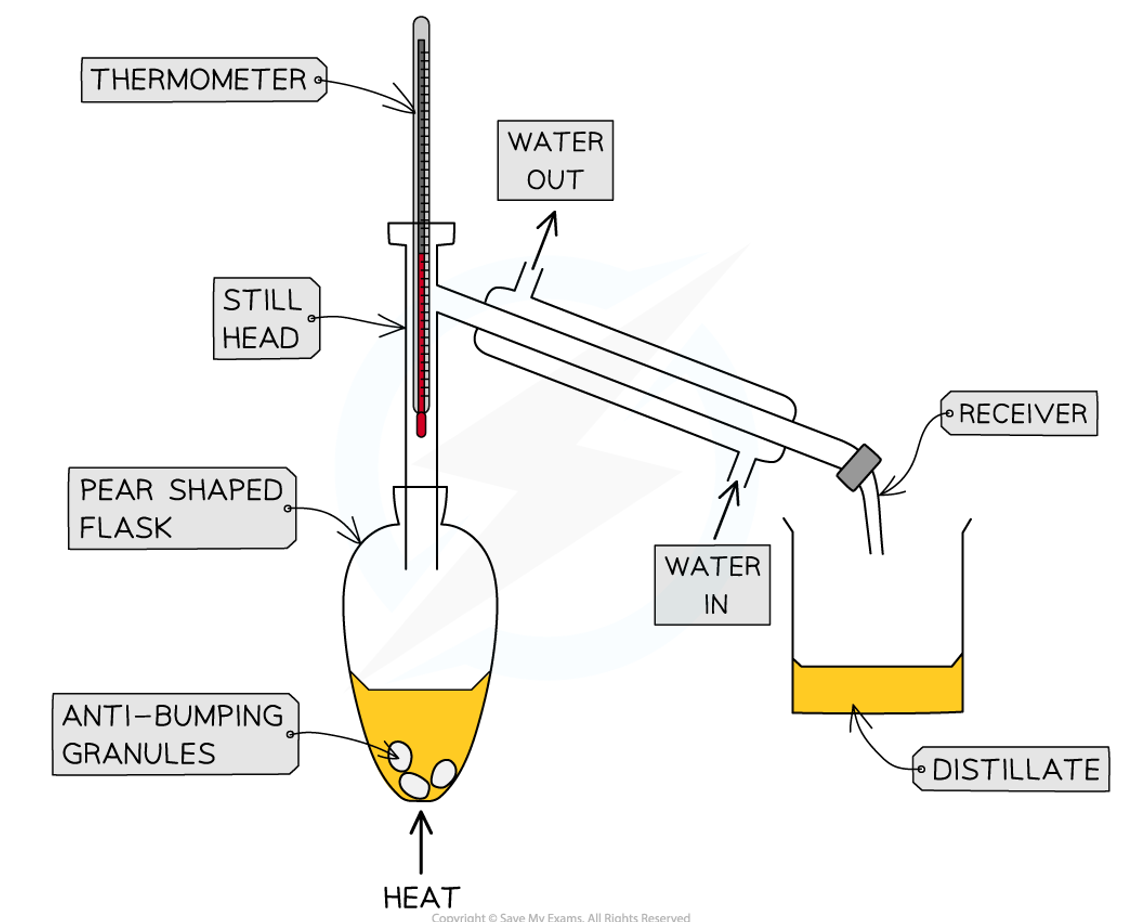
Butanone can be made by oxidising butan-2-ol with a mixture of sodium dichromate (VI) & sulfuric acid. Describe how you would then remove the butanone from the reaction mixture (6 marks)
Use distillation, as butanone has a lower boiling point than butan-2-ol. Butanone has Van der Waals forces & permanent dipole-dipole forces, whereas butan-2-ol has both & hydrogen bonding:
Transfer the reaction to a round-bottomed flask with a side-arm & add anti-bumping granules
Clamp the round-bottomed flask over a thermostatically controlled water bath (safer than a Bunsen burner’s naked flame for flammable alcohol)
Add a bung with a thermometer attached, which sits at the height of the side-arm. Ensure the bung is fully sealed to the flask to allow maximum collection of butanone
Attach the Liebig condenser to the side arm & apply heat using the water bath
Collect the distillate when the thermometer shows the boiling point of butanone in a collecting vessel (test tube in a beaker of ice & cold water)
Why are anti-bumping granules used in distillation?
Prevents large bubbles from forming & allows smoother boiling
Ensures the liquid doesn’t boil too vigorously, causing upwards splashing in the flask & so the mixture doesn’t jump into the condenser
Why must water enter at the lowest point & leave at the highest point in the Liebig condenser?
Ensures the condenser is completely filled with cold water (prevents backflow of water) & maximises the heat transfer for condensation (otherwise butanone would not condense)
What are some common practical hazards & risks in the laboratory?
Bunsen burner → burns
keep away from flammable chemicals & from the edge of the desk
Chemicals → may be an irritant/corrosive (causing irritation to skin, eyes & lungs), toxic or flammable
handle with care & while wearing gloves
wear eye protection & keep away from edge of the desk & an open flame. don’t ingest
Glassware (e.g. beakers, test tubes) → may break & cut you
handle with care & keep away from the edge of the desk