Lecture 2 - Oncogenes
 Call Kai
 Learn
Learn Practice Test
 Spaced Repetition
 Match
Match Flashcards
 Knowt Play
1/33

There's no tags or description
Looks like no tags are added yet.
Name | Mastery | Learn | Test | Matching | Spaced | Call with Kai |
|---|
No analytics yet
Send a link to your students to track their progress
34 Terms
Where were oncogenes first identified?
Inside retroviruses.
Found they have transforming properties due to an extra gene (oncogene)
Why did the discovery of viral oncogenes (v-onc) lead to the discovery of cellular oncogenes (c-onc)?
Researchers found that the genes present inside retroviruses were extremely similar structurally to mammalian genes.
This allowed they to conclude that the mammalian genome contains oncogenes
What were some of the experiments done to discover cellular oncogenes?
Analysis of transduced cellular gene sequences in acutely transforming retroviruses
Identification of preferred integration sites of retroviruses
Characterisation of chromosomal translocations
Characterisation of amplified DNA sequences
Which cell line was typically used for detection of oncogene’s functon?
NIH 3T3 cells.
Immortalised fibroblast cell line
What is special about NIH 3T3 cells?
They are immortal but are not cancerous.
Allows oncogenes to be transduced in to see the effects.
Using NIH 3T3 cells, what were oncogenes found to cause?
Oncogenes cause:
Increased growth rate
Reduced serum requirement
Cells lift off plate and grow in solution
Loss of anchorage-dependence
Foci forming (multi-layering) due to loss of contact inhibition.
Tumour formation in nude mice
What is special about ‘nude’ mice models?
Lack a thymus due to a mutation in FOXN1
No T-cell production so can’t mount a response against foreign cells
Allows tumours to be grown without the immune system fighting it
What is Foci forming?
Cells grow in multiple layers on the plate
Due to loss of contact inhibition
Quantitative activation of oncogenes means what?
Increase in production of an unaltered product
Qualitative activation of oncogenes means what?
Production of modified or novel product
Oncogene activation needs to affect both alleles for there to be an effect.
Mutation of both copies of gene
True or False.
False.
Activation only needs to affect one allele
A mutation only needs to affect one copy of the gene
What are the three main mechanisms of oncogene activation?
Point mutations
Hyperactive protein made in normal amounts
Amplification
Normal protein greatly overproduced
Translocation/rearrangement
Nearby strong enhancer causes normal protein to be overproduced
Fusion with an actively transcribed gene
What is an example of a point mutation in cancer?
RAS oncogenes
How many RAS oncogenes are there? What are they called?
Three genes
HRAS - Found in mice Harvey sarcoma virus
KRAS - Found in mice Kiersten sarcoma virus
NRAS - Found in Neuroblastoma (not virus)
What role do the RAS oncogenes play?
Mediate G-protein coupled receptor signalling
RAS oncogene found in common tumour type
Colon, lung, breast, etc
What is the function of wild-type RAS?
Ligand binds to receptor
Causes GTP to bind to RAS which induces signal transmission
RAS has GTPase activity and converts GTP to GDP
RAS then becomes inactive and signal transmission stops
How does a point mutation in RAS alter its function?
Ligand binds to receptor
Causes GTP to bind to RAS which induces signal transmission
RAS loses its GTPase activity so GTP is not converted to GDP
RAS doesn’t become inactivated and signal transmission doesn’t stop
What does the RAS oncogene cause?
Increased proliferation
Expression of anti-apoptotic genes
Increased metastatic gene expression
What is gene amplification?
When one structurally normal gene is copies 10s-100s of times.
This causes the overexpression of the protein it encodes
What are homogenously staining regions in gene amplification?
Insertions of the oncogene within the normal chromosome.
Represent hundreds of copies of amplified DNA
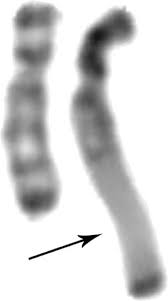
What are double minutes (DMs) in gene amplification?
Small paired chromatin bodies which are separate from the chromosomes
These can contain many copies of the oncogene
What is an amplicon?
A segment of genetic material which is the product of gene amplification
May contain multiple genes
Following gene amplification, homogenously staining regions can contain multiple genes derived from different chromosomes.
True or False?
False.
This can only occur in double minutes (DMs)
How can chromosomal translocation result in novel chimeric gene formation?
Following chromosomal translocation fusion of an oncogene and another gene can occur
This creates a chimeric gene which escapes normal regulation and has abnormal transforming properties
What is an example of a chimeric gene formed from chromosomal translocation?
BCR-ABL
Which chromosomes are ABL and BCR normally found on?
ABL found on chromosome 9
BCR found on chromosome 22
What kind of protein is BCR-ABL fusion protein?
Novel tyrosine kinase protein
How does BCR-ABL form?
Reciprocal translocation between chromosomes 9 and 22
They break and re-join together
5’ region of ABL and 3’ region of BCR join
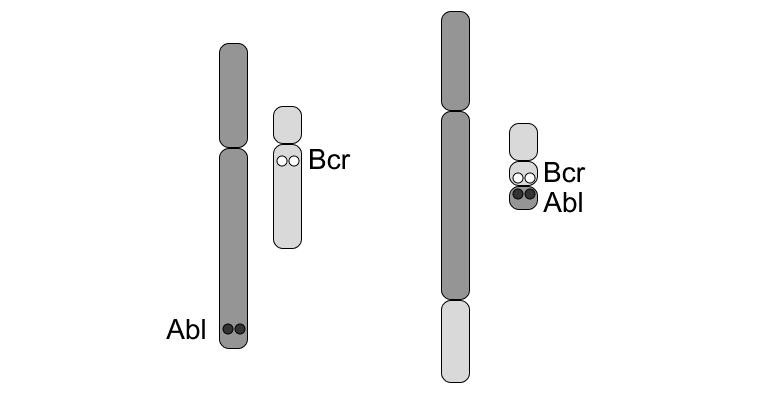
What is the name of the chromosome which is created following reciprocal translocation between chromosomes 9 and 22?
‘Philadelphia’ chromosome
This contains the novel BCR-ABL fusion protein
STI-571 (Imatinib) can be used to treat what tumorigenic fusion protein?
BCR-ABL
Binds to BCR-ABL and prevents ATP binding
This prevents the negative effects of BCR-ABL tyrosine kinase activity
What is a key gene activation which occurs in Burkitt’s Lymphoma?
MYC activation
Translocation of MYC to an immunoglobulin locus
How does MYC become overexpressed in Burkitt’s Lymphoma?
MYC is placed close to an immunoglobulin locus due to chromosomal translocation.
The immunoglobulin locus is highly expressed in antibody-producing B-cells which results in MYC overexpression
In Burkitt’s Lymphoma, exon1 of the MYC gene is often lost. Why is this important?
Exon1 is thought to play a role in transcriptional regulation of MYC and in mRNA stability.
Loss of exon1 can result in increased expression of MYC and an extended half-life of MYC mRNA
Overexpression of MYC in antibody-producing B-cells is likely caused by what process?
Likely caused by errors in immunoglobulin V-D-J gene rearrangements.