Exam 1
 Call Kai
 Learn
Learn Practice Test
 Spaced Repetition
 Match
Match Flashcards
 Knowt Play
1/109

There's no tags or description
Looks like no tags are added yet.
Name | Mastery | Learn | Test | Matching | Spaced | Call with Kai | Chat |
|---|
No analytics yet
Send a link to your students to track their progress
110 Terms
Kepler’s first law say that the sun is at one focus what is the other focus of the ellipse
nothing
The zenith is the same for all observers located at
the same latitude
if the earth orbited further from the sun then (how would it affect the year or day)
the year would be longer
The see greatest number of star during the year you would want to be at
the equator
as seen from the moon the sun rises
about once a month
a sidereal day on earth is
approximately 23 hours and 56 min long
the time it takes for the Earth to rotate exactly 360 degerees
longer than a solar day
Kepler’s second law implies
planets move faster when they are near the sun
what advantage did Tycho have compared to other astronomical observes of his time
he has access to new and improved type of observatory.
if the earth orbited farther from the sun than it does now how would it affect the year or day
the year would be longer
the meridian connects what points on the celestial sphere
from the north to south celestial poles through the zenith
imagine living in a universe where the planets orbit like DVDs in a player or wheels on a bicycle or car then Kepler’s thrid law would be
P=constant
Galileo should not be credited with the discovery
of the telescope
a star appears on the Eastern horizon today tomorrow it will
rise 4 min later
the meridian connects
the north and south celestial poles and the zenith
according to Kepler’s law (p²=a³), how does a planets mass affect its orbit around the sun
has no effect
Halley’s comet orbit with a period of 76 years. How many AUs is its orbit
18AU
what is science
a method by which we attempt to understand nature and how it behaves
hypothesis
proposed explanation that can be tested
experiment
most straightforward approach to testing in science
theory
the best possible explanation at the time using all the available facts
what kind of science is astronomy
historical science because when we look out in space it is how it was in the past because light takes time to travel the distance to us.
everything we look at in astronomy is in the past
we cant do experiments
oldest science
astronomy definition
the study of objects beyond our planet earth
for early astronomers the stars provided
practical knowledge of both time, date and position.
however the earth rotates on its axis and doesn’t always point to the same direction so we must take into consideration the Earths rotation axis.
what is astrology
the mystical framework places atop Astronomy thousands of years after humans first tried to understand the night sky and use it as a tool for time keeping and navigation
there are two kinds one is what the star sign is and the prediction for it
the real astrologers will give a detailed reading by looking at the starts and planets when you were born. Note the tables they look at were created by astronomers.
Explain the motions of the stars
the earth is rotating not the stars.
The stars in the Northern hemisphere rotate around the North celestial Pole which is an extension of the north pole out to the stars.
The stars in the Southern hemisphere rotate around the South celestial pole which is an extension of the south pole out to the stars
meridian
that crosses the sky it runs from the North Celestial Pole to the South Celestial Pole through the zenith
zenith
the point straight forward overhead to an observer
ecliptic
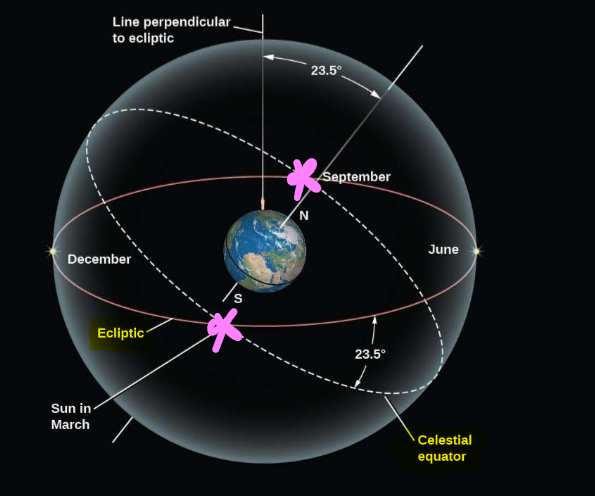
the path of the sun across the sky as it appears to move due to the rotation of the earth.
the planets and moon will appear along the ecliptic as their orbits around the sun lie nearly the same plane as the earth.
traces out the zodiac constellations
when does the ecliptic cross the celestial equator
in march and September on the equinoxes. Here the day is 12 hours long everywhere.
constellations
grouping of stars were made by the ancients in all cultures (different groupings for different cultures) to tell stories using the heavens.
the stars in a constellations are not all the same distance or all associated with each other occur when people drew a picture
not every culture has the same constellations because different cultures drew different pictures
nebula
a cloud of gas and combined with the stars it makes it glow
solar day
the amount of time it takes the sun to reappear on teh local meridian because of the earth’s tolt this time is not the same amount every day.
the coordinate system
changes the current system is defined in the 2000s you have to revise it about every 50 years
stars and galaxies are found by their coordinates and all objects in the sky have unique cords so we can find anything
apparent solar day
everyone everywhere has a different clock which also changes as the earth moves in its orbit and as the direction of the earth’s axis relative to the sun changes.
one meridian passage to another varies on time of the year
time zones were added so all cities near each other would have the same time
mean solar day
defined as exactly 24 hours
sideral time
defined as the amount of time it takes the earth to rotate exactly 360 degrees on its axis and it is approximately the time it takes for the star to reappear at the same point in the sky
not the same amount of time as a day defined by the motion of the sun
shorter than a solar day
time taken by astronomers
4 min difference which is what gives us the change in the stars positions.
length of solar vs. sidereal day
difference the two times is only 4 min
solar day takes for the earth to rotate 360 degrees. sideral day how long it takes the earth to rotate 360 degrees
seasonal changes
changes in position of the stars with time of day
over the course of many months the motion of the Earth around the sun results in different constellations appearing in the sky each night. what does the sun trace
traces out the ecliptic the earths motion or path around these stars.
The earths axis of rotation is not the same as the axis of the earths orbital motion about the sun. what is the difference
23 degrees
therefore the path of the sun through the sky varies throughout the year
what is the reason for the seasons
the tilt of the earth
When the light is high in the sky the sun shines directly down on the earth below. Therefore there is more heating during the summer. Across the sky is longer so the sun is up for more hours during the day. More heating is makes it warmer in the summer. During the winter the light from the sun comes in from an angle and spreads out over more area so the amount of heating is less. The sun is up for less hours so the heating is less
Northern hemisphere during June is summer December is winter. It is the opposite in the southern hemisphere.
in the northern hemisphere we are actually closer to the sun in the sun in the winter than the summer
how long is the moons orbital period
27.3 days which gives the moon an average speed in its orbit of 1km/s
the moons orbit is inclined slightly 5 degrees to the ecliptic
the moons rotational period is the same as its orbital period thus…
the moon always points the same face toward the earth
phases of the moon
repeat 29.5 days
new moon: when the moon lies on the same side of the earth as the sun so no sunlight reflected from its surface can be seen from the Earth. rises and sets with the sun
first quarter: high in the sky near sunset rises at noon
full moon: when the moon lies on the opposite side of the earth from the sun so the sunlight reflected from its surface can be seen from the earth hihg in the sky at midnight
third quarter: high in the sky near dawn
synodic period
the length of time between a repeat of a moon phase. For the Earth and Moon system this is slightly longer than the orbital period
what allows for solar and lunar eclipse
the plane of the moons orbit changes its orientation relative to the line connecting the Earth and Sun
only end up with them when the plane of the orbitus in line with the sun
solar eclipse
the moon is between the Earth and Sun so the Earth is in the Moon’s shadow. sun is eclipsed by the moon
lunar eclipse
the Earth is between the Moon and Sun so the Moon is in the Earth’s shadow. get the moons shadow
occur more often
saros or eclipse cycle
since the moon orbits the earth in a fixed period and the earth orbits the sun in a fixed period the alignment of the Earth moon sun is predictable and repeats
phases of the inner planets
planets Mercury and Venus
Galileo was the first to observe 400 years ago
show that these planets orbit the sun and supported the heliocentric solar system of Copernicus
outer planets
mars Jupiter Saturn these planets lie on the ecliptic
prograde
tendency for the planets to drift eastward relative to the stars as observed from the Earth
retrograde motion
since the earth moves faster in its orbit that the outer planets the earth passes the outer planets in their orbits. Whenever this occurs that planet appears to change its direction of motion relative to the stars to drift westward
slow westward drift
prograde and retrograde motion of the inner planets
the inner planets oscillate from appearing on one side of the sun to the other their motion will be split approximately equally between both prograde and retrograde motion.
Geocentric universe: Ptolemaic system
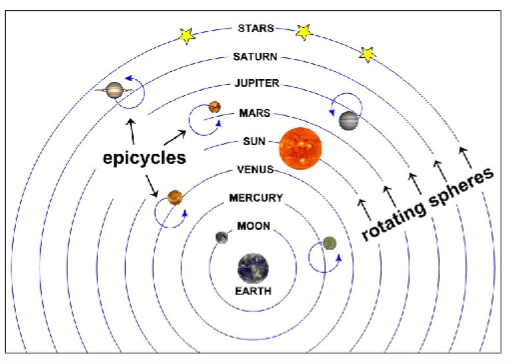
earth centered, each planet orbited the earth and the was also on at least one deferent which was a second circles attached to the first circle used to try and explain the retrograde motion of the planets.
who is identified as the originator of the heliocentric model for the solar system and who were some earlier philosophers who suggested the models
Copernicus identified it
Ancient Greek astronomers has thought the earth went around the sun. They did observations to try to prove the earth went around the sun but because of their limitations with measurements they couldn’t prove it.
The main evidence for the sun goes around the stars is the parallax
who was Nicolaus Copernicus
medieval philosopher who was the first person to present a modern heliocentric model of the “Universe” in 1543.
he said the circles were not centered on the sun they were offset to the sun.
The revolution of the Celestial Spheres
created by Copernicus the 6 books included
Heavenly motions are uniform eternal and circular or compounded of several circles (epicycles)
the center of the universe is near the sun
around the sun in order Mercury, Venus, the Earth and Moon, Mars Jupiter, Saturn, and the fixed stars
The earth has three motions: daily rotation, annual revolution and annual tilting of its axis
Retrograde motion of the planets is explained by the Earths motion which in short was also influenced by planets and other celestial bodies around earth
the distance from the earth to the sun is small compared to the distance to the stars
who was Tycho Brahe
noblemen who conducted the finest non telescopic observations of the heavens, tracking the motions of the planets to great accuracy and percision
he created a hybrid model where the Moon and Sun orbited the Earth and the other planets orbited the sun
Who was Kepler
one of Tycho’s assistants he took Tycho’s observations he as able to deduce Kepler’s Laws which confirmed the Heliocentric model
also made observations of a supernova to discredit the idea that the celestial sphere was unchang
what is Kepler’s first law
the orbit of each planet is an ellipse with the sun at one foci
ra + rp / 2a = e
what is Kepler’s second law
a line connecting each planet and the sun sweeps out equal areas in equal times - Law of equal areas
this means that planet moves at different speeds at different points in its orbit. the planet moves faster when it is closer to the sun because it has to sweep out a bigger area.
what is Kepler’s third law
the squares of the period of each planets orbit is equal to the cube of the “semi-major” axis of the planets orbit.
T² = a²
In Kepler’s 1st law how would you describe an ellipse
Astronomical Unit (AU)
The length of the semi major axis of the Earths orbit
(Period)²=(semi major axis)³
example if a planet is 5 times the distance from the Earth to the sun
(Period)^2= (5)³ = 125
squrt(125) = 11 years
(would be how to find how many AUs are so many years or vise versa)
who was Galileo
he conducted the first telescopic observations of the heavens showing the moons cratered face and discovering the phases of Venus, the moons of Jupiter and the rings of Saturn. he also showed the moon was not a perfect sphere and varied in terrain.
what did Galileo discover about the inner planets
they have phases like the moon.
observations showed mercury and Venus orbited the sun and supported the Heliocentric (sun centered) solar system model of Copernicus
Galileo’s discovery and observation of Jupiter
he found that Jupiter’s 4 largest moon’s showed that objects could orbit each other and still orbit another body thus making it possible to believe that the moon orbits the earth and the earth orbits the sun just as these moons orbit Jupiter and Jupiter orbits the sun
what id Galileo’s observations about the imperfections of the moon point out
the imperfections of the cosmos (along with Tycho and Kepler’s supernova) which directly challenged the prevailing idea that the heavens were perfect.
Newtons 1st Law of motion
every object in a state of motion remains in motion at a constant velocity, unless an external force is applied to it
unless a force is applied to an object it will continue to move in the same direction
Newtons 2nd law of motion
The net force on an object is its mass m times its acceleration a so the force F is:
F = m x a
Newtons 3rd law of motion
for every action there is an equal and opposite reaction
means that forces are symmetric if object A exerts a force on another object B, then B exerts the same magnitude of force in the opposite direction on A
Fa-b = -Fb-a
The gravitational force of the sun on the earth has a corresponding and equal force of the Earth on the sun
what is a vector
carries not just information about the magnitude (distance, speed) but also the direction (displacement, velocity)
ex. two things can have the same speed but move in different directions so their velocity will be very different
Newtons law of universal gravitation
There is an attractive force between any two objects that is proportional to the product of the masses of the two objects divided by the square of the distance between them
FA-B = -G ((MA MB)/ r²)
the force of gravity due to that body is the same as if all of it’s mass were concentrated at the center in a point. Therefore we can just calculate the force between the two objects by using the distance between their centers
centripetal force
Fcentripetal = -M (V²/r) ^r
center of mass
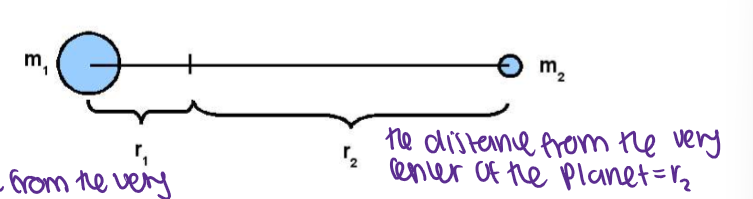
the point where the masses balance
m1r1=m2r2 and r1 +r2 = r
Linear Momentum
mass of an object times its velocity
momentum is a conserved quantity so in a closed system the total momentum of all objects in the system is a constant
p = m v
Angular Momentum
the linear momentum of a particle times its radical distance from the origin of the system
L = r x p = m r x v
also a conserved quantity this implies that absence an external force that a planet in motion around a star will stay in the same orbit
Kinetic energy
energy of motion
ex. if i drop of book it accelerates and gains this energy

gravitational potential energy
the amount of energy requires to move an object against the gravity fled of a body
ex. when i lift something up and hold it there it has gravitational potential energy
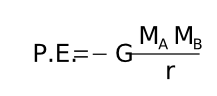
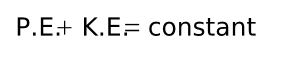
since all gradational potential energy and and kinetic energy and sound energy are the same when i drop a book the quantities are what
conserved and we can derive the velocity of an object will obtain when it falls
optical light
the type of light we see the familiar colors of the rainbow.
what wavelengths are the highest energy
bluest -380nm
what wavelengths are the lowest energy
red 700nm
list the light spectrum in order highest to lowest
Gamma rays, X rays, Ultra- violet, infrared, Microwaves, and Radio waves
light is described as both
particle and a wave
Einstein’s 1905 study of the photo electric effect showed that light must be considered as a wave and a particle at the same time
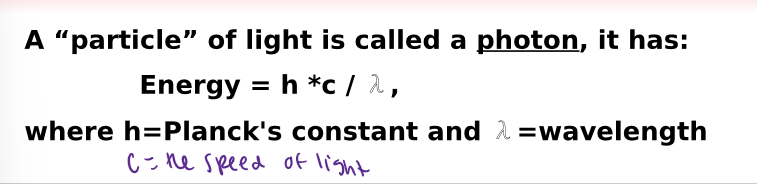
photon
a particle of light
what are the two methods to examine the spectrum of an object at optical wavelengths
the first is to disperse the light with a prism or grating into its component colors
the second is to use a series of different filters to sample multiple parts of an objects spectrum
The first is to disperse the light with a prism or grating into its component colors
When the light travels through the prism it gets bent a different amount. Some light moves faster through the glass and some moves slower through the glass. It disperses the light so we get a rainbow.
different wavelengths come out at different angles, and thus spread so we can see each wavelength (color) separately
the second is to use a series of different filters to sample multiple parts of an objects spectrum
this is similar to how our eye uses 3 different cone cells with different wavelength responses to see in color
Cone cells work by measuring light at three different filtered wavelengths. You brain looks at each amount of light coming in and assigns it as a color. You can see something as purple because it actually gives off purple light or see it as purple because it is giving off a combination of red and blue
how do we describe the light from an object
describe it as a spectrum the amount of light we receive from the object as a function of wavelength, and the brightness or the total amount of light we receive from it
why do we need both measures of spectrum and brightness
Imagine driving down the road and seeing in front of you. The color of the light tells you whether you are free to go the brightness of the light tells you, from experience, how far away the light is and thus whether you need to slow down or whether you are free to go.
how do we describe the spectra of light
continuous: emits light across all wavelengths. Emitted by dense materials (ex. plants, stars)
emission: emits light at discrete wavelengths. Emitted by low density gases (ex. neon signs, interstellar gas clouds)
absorption: a background continuous spectrum with absorption of light at discrete wavelengths looking through low density gases at background dense object (ex. atmospheres of planets and stars, interstellar gas in front of background stars)
absorption lines
occurs when the electron moves from an inner orbital to an outer orbital. electrons only have certain allowed energies for their orbitals and can only absorb photons with energies which match the difference in the energies of the orbitals. since only certain energies can be absorbed only some wavelengths of light are absorbed by each atom.

emission lines
occurs when the electron moves from an outer orbital to an inner orbital. Since electrons only have certain allowed energies for their orbitals they can only emit photons which have energies which equal the difference between two orbitals. So only certain wavelengths of light are emitted by each atom at the same wavelengths as light can be absorbed

what is a blackbody
the simplest emitting object it is opaque absorbing all light that hits it neither reflecting or transmitting any light that hits its surface.
a blackbody spectrum is an idealized description of continuous emission from a dense object.
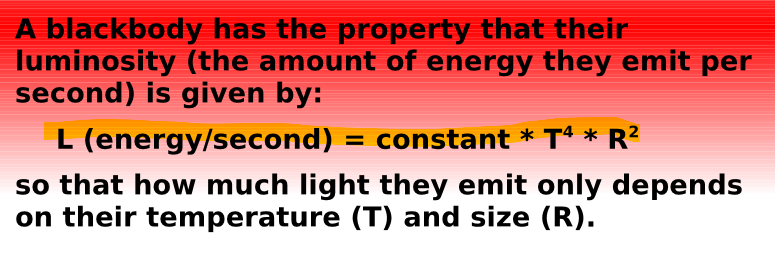
the amount of light given by any object is proportional to what?
temperature to the 4th power
therefore the hotter stars and planets give off much more light per unit surface area than cooler objects if you double the temperature you raise the energy output by a factor of 16
luminosity
the total energy output per second of an object is given by equation in pic

another important property of a blackbody
the hotter object will give off more light at all wavelengths if the objects are the same size
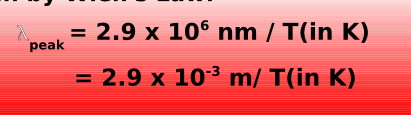
what is wiens law
for higher temperatures the wavelength of the peak radiation moves to shorter wavelengths (more energetic photons)