Neuro Test 4 - Cerebral Asymmetry & Plasticity
 Call Kai
 Learn
Learn Practice Test
 Spaced Repetition
 Match
Match Flashcards
 Knowt Play
1/52

There's no tags or description
Looks like no tags are added yet.
Name | Mastery | Learn | Test | Matching | Spaced | Call with Kai | Chat |
|---|
No analytics yet
Send a link to your students to track their progress
53 Terms
What is Cerebral Asymmetry?
means difference between 2 hemisphere
The left hemisphere (LH) is important for:
- production and comprehension of language
- controlling movement on right side of the body
The right hemisphere (RH) is important for:
- perceiving and synthesizing nonverbal information
- controlling movement on left side of body
What are 3 important points to mention about cerebral asymmetry?
- laterality is relative, not absolute (both hemisphere participate in almost every behavior)
- site is as important as side (ex: R and L frontal lobes are more similar than R frontal and R occipital lobes)
- individual variability (ex: RH is "dominant" for language in some people)
When we say dominance what do we mean?
dominance refers ONLY to language
What hemisphere is used for language and (for most people) is the dominant hemisphere?
left hemisphere
If you asked "What is your dominant hemisphere?", what would you mean?
- we mean "What hemisphere do you use for language?"
- in other words, what hemisphere is most active in relation to language
Compared to the left hemisphere, the right hemisphere is slight ____ and ____
larger and heavier
Compared to the right hemisphere, the left hemisphere has more ____ matter
gray
What is gray matter important for? Why does LH have more?
- gray matter has more cell bodies and therefore more
information processing
- LH evolved to have lots of information processors because it has to perform a VERY complex task (language)
____ is bigger in LH, and this is also known as:
Planum temporale, Wernicke's area
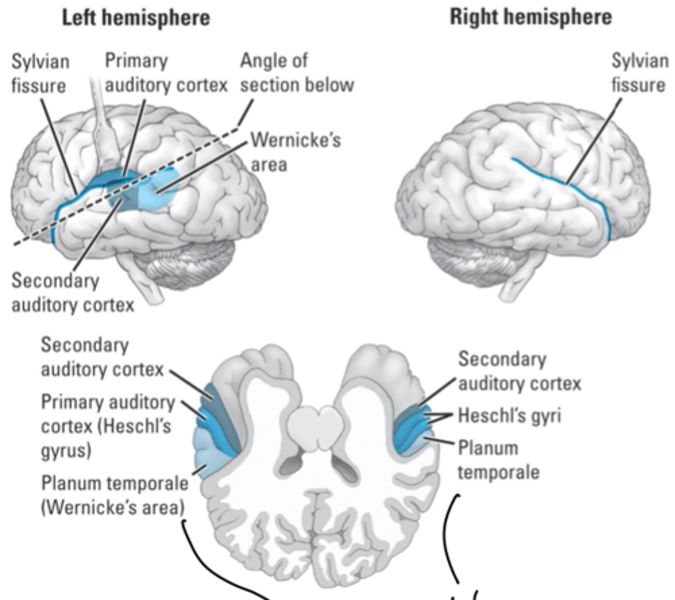
_____ is larger in RH, and this is also known as:
Heschl's gyrus, primary auditory cortex
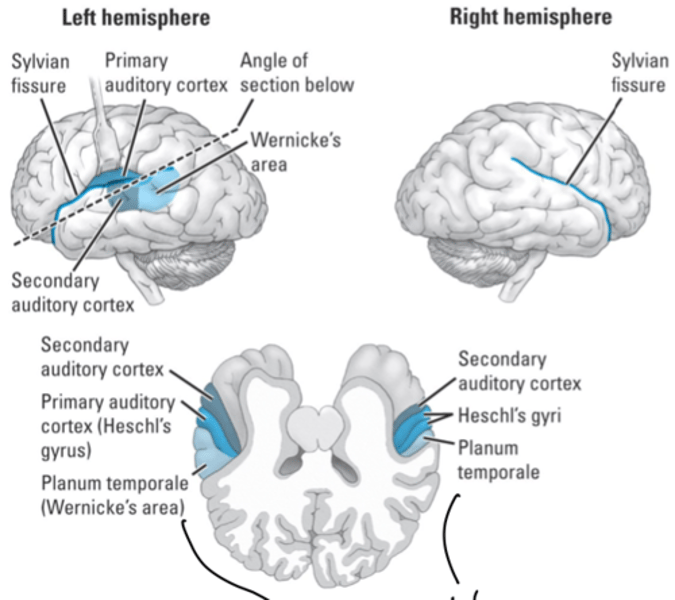
What is organized differently in RH vs. LH? What other feature is different?
- frontal operculum (Broca's area in LH)
- more visible cortex in RH, more hidden cortex in LH (more folds, grooves, things buried that you cannot see in LH)
When you hear operculum, you should think:
LH Broca's area
How is more hidden cortex helpful?
more condensed = more surface area = faster connections
Neuron's in Broca;s area (LOP) tend to have:
more dendritic branches
Distribution of neurotransmitters is:
asymmetrical (generally pathways used the same neurotransmitters, but more subtle ones use different neurotransmitters)
Explain the asymmetry of the visual system:
- right visual field from both eyes goes to left hemisphere
- left visual field from both eyes goes to right hemisphere
What is the tachistoscopic task?
- fix eyes on point, stimuli presented SO QUICK in one field that eyes cannot move to it
- present different types of stimuli
What are the tachistoscopic findings?
- RVF (LH) advantage for verbal material (ex: letters, words)
- LVF (RH) advantage for visual-spatial material (ex: 2-D point localization, dot and form enumeration, matching of slanted lines, depth perception, faces)
Describe the asymmetry in the auditory system:
- crossed system above the CN (cochlear nucleus)
- more axons in crossed projections (crossed hemisphere does more processing)
What are the findings from dichotic listening?
- R ear advantage for verbal material (ex: words, digits, backward speech)
- L ear advantage for nonverbal material (ex: music, tones, environmental sounds)
What is the dichotic listening task?
- different material (signals/sounds) are presented to 2 ears
- after the sequence, ask them to report what they heard
- more accurate recall determines advantage (more accurate recall of verbal material from R ear = R ear advantage for verbal material)
More accurate recall of verbal material from R ear means that:
information is processed by LH in stronger way
What are common deficits after left hemisphere lesions?
- language (especially production and syntax)
- verbal memory
What are common deficits after right hemisphere lesions?
- some linguistic functions (ex: prosody, pragmatics, high-level comprehension)
- visual memory (faces, location)
- visual & spatial abilities (using maps)
- some music components (ex: temporal aspects)
What is prosody?
- rhythm of speech (often change in frequency)
- communicates emotional content (stress, happy, sad)
- expresses syntactic features (content vs. content)
- can signal questions vs. statement
What are examples of high-level comprehension?
metaphors, humour, sarcasm
How does handedness impact variations in cerebral asymmetry?
- more L-handers than R- handers show no anatomical asymmetry or reversal of asymmetry (either no differences, or difference in opposite way)
ex: no differences in gray matter, or differences in gray matter in RH not LH)
- more L-handers than R-handers have RH or bilateral representation of language (Broca's in right, Wernicke in left or vice versa)
The dominant hemisphere contains:
contains language
The non-dominant hemisphere contains:
does not contain language
What are 2 key variations in cerebral asymmetry related to sex?
- extent of anatomical asymmetry may be greater in males than females (females have more symmetrical brain)
- corpus callosum may be larger in females than males (tail end is bigger, called splenium)
What is a splenium? What does a larger selenium suggest?
- name for tail end of corpus callosum
- larger one in females suggests women may use more of both hemispheres
ON AVERAGE, females are better at ____ compared to males
some verbal, STM and cognitive detail tasks
ON AVERAGE, males are better at ____ compared to males
some visual-spatial and mathematical tasks
What are 5 tasks favouring women?
1) mathematical calculation
2) recall of s tory, a paragraph or unrelated words
3) remembering displaced objects
4) precision, fine motor coordination
5) rapidly matching items in perceptual tests
What are 5 tasks favouring men?
1) test of mathematical reasoning
2) mentally finding a geometric form in a complex picture
3) mentally rotating a solid object
4) target-directed motor skills
5) visualizing where holes punched in a folded paper will fall
What is neural plasticity?
ability of the brain to change as a result of experience
What changes occur with neural plasticity?
- structural (ex: organization & size of different areas and circuits)
- chemical (ex: distribution & amount of neurotransmitters)
Neural plasticity occurs especially in:
development and after injury
What is an example of neural plasticity?
Amputation (area of cortex responsible for movement of the limb amputated gets smaller, but gets larger again with prosthetic)
What is an example of Plasticity & the Environment relating to children?
- severely neglected children may develop behavioural and cognitive abnormalities
--> nature vs. nature
--> environment plays a large role (ex: Genie)
What is an example of Plasticity & the Environment related to animals?
- enriched animal environments
- exposure early in life increases brain size and connectivity (esp. occipital cortex)
What is an example of Plasticity & the Environment relating to humans?
- systems becomes specialized for types of stimuli they are exposed to but at the cost of losing ability to process less frequently perceived stimuli types
- speech and face perception are two main examples
- ex: Monkey Facial Recognition
Who does best at the Monkey Facial Recognition task? What does this tell us?
- babies under 9 months are best at recognizing monkey faces
- adults are worst
- tells us that adults are better at perceiving human faces because they regularly see them
- indicates that specialization cut off is 9 months
How do people typically recover after brain damage?
some recovery of function typically occurs (depends on function)
Amount of recovery after brain damage is very ______
variable
The nature and mechanism of recovery after brain damage is:
poorly understood
What is restoration?
function is regained to original way
What is compensation?
learning other ways to work around the problem
What are some ways we can measure recovery?
- picture tests
- functional tests (go to grocery store and be able to ask Q's about objects)
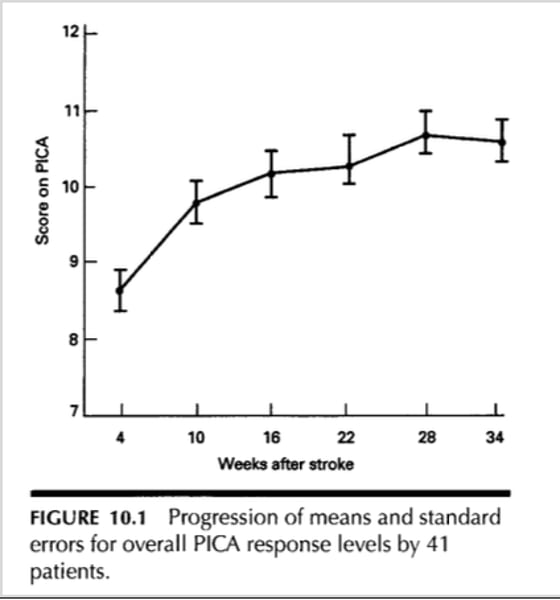
What are the general trends for return of function after brain damage?
- return of function is usually gradual with slow reemergence of skills
- rate of impairment-based recovery typically declines over time
What are the variables that may affect recover? (on average)
- lesion size --> better recovery with smaller lesions
- age --> younger people have better recover (maybe because of pruning that happens with age)
- sex --> women may have better recovery that males (maybe because they use both sides of brain)
- handedness --> L-handers recover better than R-handers
- cognitive skills/intelligence --> those with higher cognitive skills tend to recover better (can word around problems better)
- personality/motivation