cell bio exam 1
 Call Kai
 Learn
Learn Practice Test
 Spaced Repetition
 Match
Match Flashcards
 Knowt Play
1/90

There's no tags or description
Looks like no tags are added yet.
Name | Mastery | Learn | Test | Matching | Spaced | Call with Kai |
|---|
No analytics yet
Send a link to your students to track their progress
91 Terms
significance of cell bio in the 1950s
it became a discipline/class and a premiere discipline of study
1 major challenge with cell bio
their small size
what is the size of a cell
less than 100 micrometers (mm) (or .1 millimeter (mm))
whats bigger micrometer or nanometer
micrometer > nanometer 1 mm=1000 nm
what is the size of a double helix
2 nm
why aren’t cells larger if it makes it easier to study?
b/c of surface area vs. volume
some basic fundamental actions depends on diffusion. The larger the cell is the more surface area you have, but volume is much less
You want a small surface area to volume ratio due to diffusion
definition of a cell
smallest structural and functional unit of ay living organism
What happened in the mid 1600s
Robert Hooke tried to understand and laid the foundation for cell biology.
He also liked microscopes and used polished glass as a microscope.
3 basic tenants of cell biology early-mid 1800s
all organisms consist of 1 or more cells
cell is basic unit of structure
all cells arise from pre-existing (no such things as spontaneous cells)
when were all the basics of cell bio formulated
mid 1800s
true or false, cells could have many elements within cells
true
99% of cell mass is what 6 elements
carbon, hydrogen, nitrogen, oxygen, phosphorus, sulfur
whats the most prevalent element in the cell
oxygen
most abundant substance?
water
water makes up what % of mass in all living organisms
70
all protein chemistry and transciptomic chemistry takes place where?
in an aqueous medium surrounded by water
Why do we use H20 Instead of ethanol, DMSO, or Acetone
Most don’t have the same characteristics as water (water is polar and can interact with itself and other molecules, 104 degree bond angle
100 degree (212 degree F) boiling point —> acetone cant do that
high surface tension
Is Na+ hydrophilic or hydrophobic and why
hydrophilic bc it can easily interact with water (and water can arrange itself structurally easily around a sodium ion and hydrate the compound)
is methyl hydrophobic or hydrophilic
hydrophobic bc water cannot structure around methyl groups and stays away from it… theres no good lattice network
all organic molecules are what based
carbon
18% of body =
carbon
only what % of carbon is found on earth’s surface
18 % (limited in world, but concentrated in humans).
why is carbon unique
small atom = valuable
4 covalent bonds
from up to 4 other bonds w/ diff materials or itself
can make as big as you can get them
closest element to carbon
silica (3 bonds)
basic pairings/ groupings that are very reactive
CH3, OH (hydroxyl), COOH (Carboxyl), NH2 (amino)
small organic molecules
less than 1000 dolants, approx 1000 diff types, found primarily in cytoplasm
4 primary families that can build macromolecules
simple sugars (monosaccharides), fatty acids, amino acids, nucleotides
monosaccharide structure
(CH2O)n (n=3-7)
made of hydroxyl groups, aldehyde or ketone groups
can be linear of cyclic
at least 30 others like glucose
monosaccharides functions
can be oxidized to release energy (energy source) [primary function]
energy storage
can be combined to make cellulose
can make functional proteins like glycoproteins and glycolipids
Monosaccharide function #1: can be oxidized to release energy (energy source)
glucose = 686 kilocalorie per mole
can use monosaccharides to combine in linear array like links of chain to make bigger saccharides
di→ lactose
tri
poly
oligosaccharides
can be linked or branched
oligosaccharides
group of monosaccharides b/t minimum of 3 & up to 15 or 20 monosaccharides together
oligosaccharide + lipid=
glycolipid
oligosaccharide + protein =
glycoprotein
fatty acids structure
primarily carboxyl group with fatty acid chain w/ methyl group on the terminal end
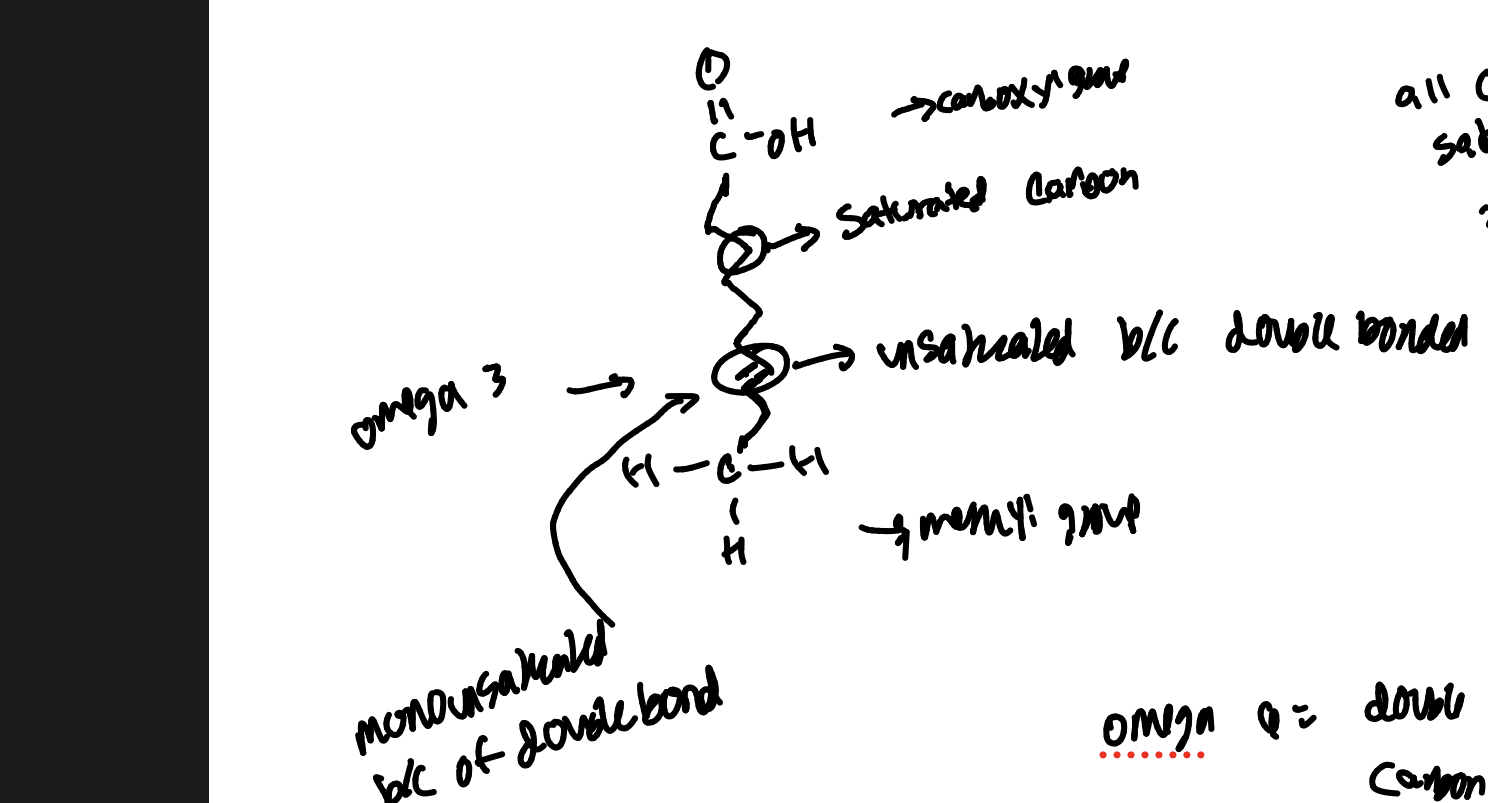
Omega 6
double bond at carbons 6 and 7
fatty acid functions
can be completely oxidized as energy source
beta oxidation cuts chains into 2 carbon units and oxidizes them and uses fat source as energu source
link fatty acids to glycerol (sugar alcohol)
amino acid function
energy (can be fully oxidized to CO2)
makes proteins by linking together each amino acid group
nucleotides are made up of
nitrogen-containing ring, 5 carbon sugars, and phosphate(s) attached to sugar
pyrimidine has 2 types
ribose and deoxyribose
(Uracil, Thymine, Cytosine)
difference between ribose and deoxyribose
ribose has OH at carbons 2 and 3 deoxyribose only has OH at carbon 3
purine and their 2 types
nucleotide and nucleoside
(A and G)
nucleoside vs. Nucleotide
nucleotide has a phosphate attached to it, nucleoside doesn’t
nucleotide function
can be oxidized completely to form energy
can add nucleotide to make nucleic acids (can be deoxyribose nucleic acids [DNA])
can make cyclic AMP
cyclic AMP
powerful signaling/ Communicating cell chemically; cell signal
2 macromolecule families
proteins and nucleotides
what do covalent bonds tie
small molecules
Ionic Bonds
b/t fully or partially charged groups
NaCl (weak attraction in water means its strong in absence of water)
Hydrogen Bonds
Shares hydrogen atoms b/t 2 electronegative bonds
ex; H2O
Van der waals
weakest
transient in appearance (very short time)
shows up in certain instances
close proximity
can occur and disappear again and again
hydrophobic
repulsion of water molecules & organize those molecules together
what makes up more in cell DNA or RNA?
RNA (about 3-5%)
DNA (about 1%)
linear arrays of nucleotides can make what?
unbranched polymers
where can RNA and DNA be found
RNA anywhere in cell or shipped out of cell
DNA found in nucleus or mitochondrial DNA in mitchondria but that’s it
chromatin
Where DNA exists
and also the Series of proteins that help wrap and protect a particular material (DNA in this case)
on DNA every helix turn is how many base pairs
10
for DNA what do you need
histones
histones
+ Closed proteins that interact together to form bases of structure to stbilize DNA
makes up chromatin
3 diff types of globular proteins
3 types of globular proteins
H2A/H2B
H3
H4(you would have 2 of each)
8 histones make what
nucleosome
H1 globular protein
non nucleosomal and wraps around DNA that’s found between nucleosomes (think of hot dog in a bun)
when DNA wraps itself around entire nucleosome, how many base pairs
about 146
why does DNA need to be wrapped around the nucleosome
to be protected from nucleases that will chew apart naked DNA
most cellular processes require what for action?
proteins
½ dry matter of cell is what?
proteins
why are proteins stable yet flexible?
must be stable for structural stability and flexible enough to be able to move and do work.
2 types of proteins
globular or fibrous
primary protein structure
held by covalent bonds, no weak bonds
secondary structure
protein becomes more fibrous or globular
beta sheets form
weak hydrogen bonds can form b/t H above and below each other
Alpha helix forms
beta sheets vs alpha helix
beta→ hydrophobic and caused by various R groups (looks like ribbon that doesn’t overlap)
Alpha→ hydrophobic (more squiggly and overlapping)
tertiary structure
peptide bonds help secure structure
hydrogen bending secures structure
R groups interact w/ each other; additional weak bonding secures tertiary structure
Can have multiple disulfide bonds
quaternary structure
2 or more peptide interacting together
monomers; heterodimer (diff) and homodimer (same)
polymers
polymers
can keep building and growing withoug needing energy source (costs energetically nothing to make0
Domain
proteins get larger by forming into domains.
subset under monomers
internal vs external proteins
internal hydrophobic external hydrophilic and bonds with other structures
ligand
any structure that will bind to protein (you still need to define what the ligand is
binding site
where ligand will bind to protein
(about 6 amino acids or less)
(most of the time there’s a specific site for ligands)
cofactor
can bind to enhance abilities to work better (nonpeptide)
explain + and - charges and hydrophobic and hydrophlic with amino acid at binding site and ligand
if amino acid at binding site is hydrophobic then ligand will have some sort of hydrophobicity as well and it’ll match up well
OR
+ amino acid charge and - ligand charge helps electrostatic interaction
enzyme
lower activation energy required for substrate to be converted to some product
how does enzyme work so efficiently?
holds substrate in appropriate orientation
binding requires energy; some of that energy reduces overall energy required to break it
think of Dr. Watts example with marker
typical enzyme can bind to substrate ligand about how many times per second
1000x
when looking at chart of substrate concentration how do you know if it’s saturated
line stops increasing
regulatory binding site
binds to regulatory ligand and can alter how substrate binds to active site for better or worse
if active site bind is better or worse after regulatory binding site what happens
better, positive moderator and graph shifts left
worse, negative moderator, shifts right
michaelis constant
km = [s] at1/2 Vmax
high affinity vs low affinity
high= quick and efficient
low= takes every now and then
high Km and low km in terms of affinity
low km = high affinity
high km= low affinity
vmax is what
fastest the enzyme will go
how to regulate enzymes
alter [s] (takes mins or seconds)
alter km (takes seconds, VERY fast)
3. alter E (VERY slow)
energy for cells comes from where
the sun
derived from electromagnetic radiation
done by oxidation meaning energy will be released
bioenergetics have the same what for generating energy
procedure
worms and humans have same procedure for generating energy (mostly)
slight deviation depending on environment